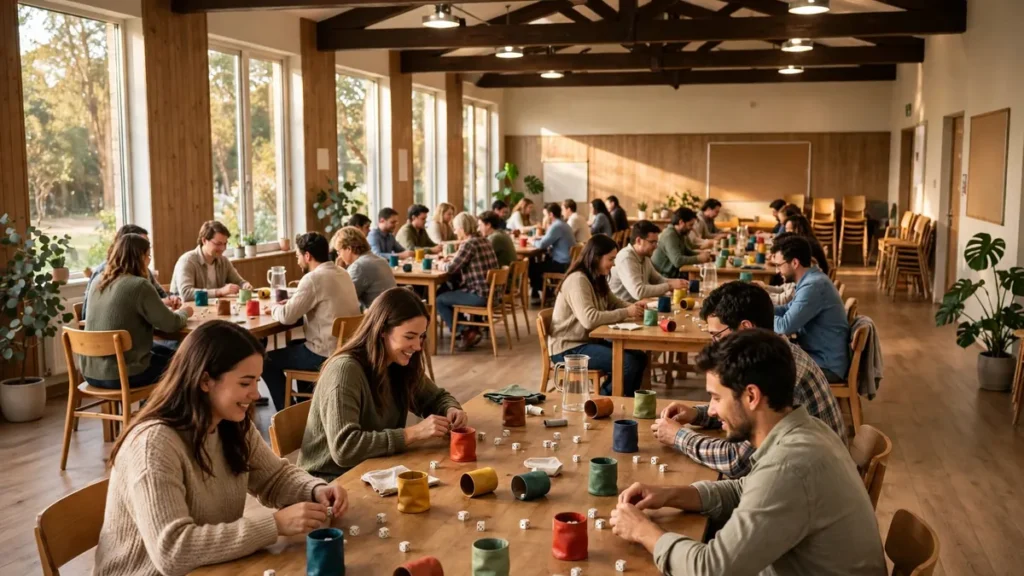
Finding the best dice games for 299 players starts with a simple truth: no single table can hold a crowd this size, so the best dice games for 299 players are not really table games at all. They are systems. A good system lets 299 people roll, score, cheer, and move at the same time, without long waits, without confusion, and without one loud table deciding the whole evening. When the format is right, a group of 299 feels like a festival rather than a queue.
The trick is to stop thinking about one game and start thinking about many small games running side by side. Split 299 players into teams and tables, give every table the same rules and the same clock, and let a shared scoreboard turn dozens of separate rolls into one shared contest.
This guide explains how to plan that kind of event, which games actually scale to 299 players, what equipment you need, and how to score fairly when 299 people are playing at once. Every game below works as a team game, uses ordinary dice and simple score sheets, and can be run by a small team of hosts.
Key takeaways
- Split 299 players into teams of five or six, so you get about 50 to 60 tables that can all play at once.
- Choose games where every table rolls at the same time, so nobody waits while another table finishes.
- Use one shared clock, one set of rules, and one scoreboard to keep dozens of tables in step.
- Keep scoring simple: points per round, team totals, and a clear winner at the end of each round.
- Plan for movement, noise, and breaks, because a crowd of 299 needs space and rest as much as it needs dice.
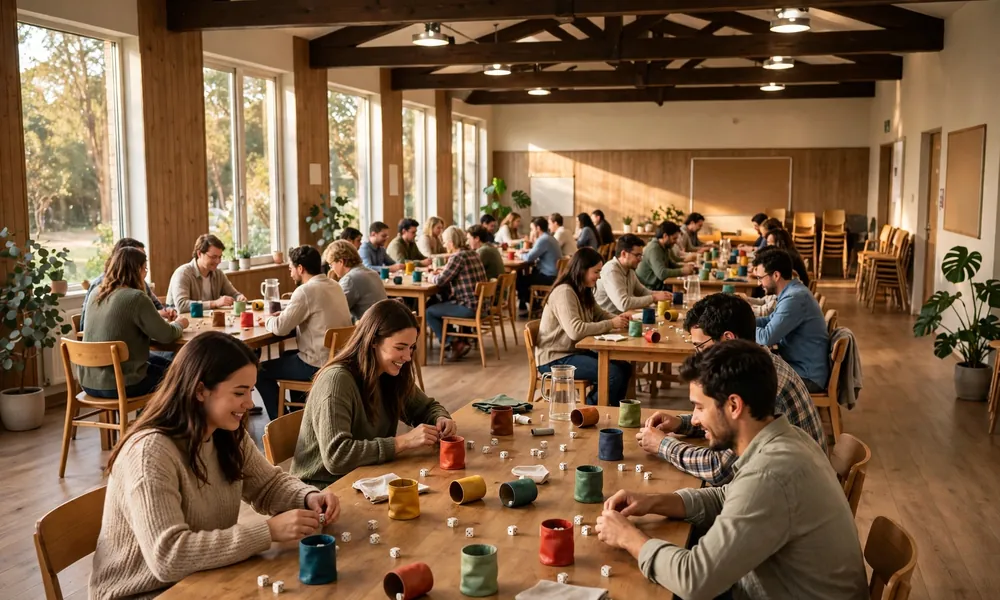
Why 299 Players Changes Dice Games Completely
Most dice games were written for two to eight people sitting close together. At that size, everyone can see the dice, hear the score, and take a turn within a minute or two. Add 299 players and the original game breaks altogether, because turns take too long, dice get lost, and half the room cannot see what is happening.
The first change is the unit of play. Instead of 299 separate players, think in teams. A team of five gives you 59 teams of five and one team of four, which is 60 tables if every team has its own table. A team of six gives you 49 teams of six and one team of five, which is 50 tables. Either arrangement works, and the choice depends on your tables, your chairs, and how much elbow room each group needs.
The second change is the clock. In a small game, play moves at the speed of the slowest player. In a large game, play moves at the speed of the clock. Set a round length, such as ten minutes, and every table plays as many turns as it can inside that time. When the clock ends, every table stops, scores are collected, and the next round begins. This keeps the event moving and stops one slow table from holding up 298 other people.
The third change is the scoreboard. With 299 players, nobody can follow every roll, so a large board or a projected table showing team names, round points, and total points keeps the whole room interested to the final round.
How to Organise 299 Players Without Chaos
Organisation matters more than the choice of game. A well-organised evening with a simple game feels better than a clever game run badly, and with 299 players there is no room to improvise the basics. Plan the room, the teams, the equipment, and the timing before anyone arrives.
Split the Room Into Teams and Tables
Teams of five are a good default for 299 players, because five people can share one set of dice, one score sheet, and one table without crowding each other. Give every team a name, a number, and a table, and print a simple team list so players can find their place quickly. Colour-coded wristbands, table numbers, or matching team cards all help, especially when players arrive at different times. If a team ends up with four players instead of five, that is fine: the games in this guide work with four, five, or six players.
Give Every Table the Same Kit
Every table needs the same equipment, so no team has an advantage and no host has to run around replacing missing pieces. A basic kit is five or six dice, one dice cup or small tray, a pencil, a score sheet, and a copy of the rules for the current game. Put the kit in a small box or bag at each table before the event starts. Dice trays matter more than they seem: a shallow tray or a felt-lined box lid keeps dice on the table and stops them rolling onto the floor.
Run the Evening on a Shared Clock
Choose a round length and announce it clearly. Ten minutes works well for most dice games, fifteen minutes suits slower scoring games, and five minutes works for fast games such as dice bingo. Use a large timer that everyone can see, a bell, or a short piece of music to mark the start and end of each round. Collect scores after every round, and keep the gaps between rounds short, because a crowd of 299 loses energy quickly when nothing is happening.
The Best Dice Games for 299 Players
The games below were chosen because they share three qualities: they work in teams, they keep every table busy at the same time, and they need only ordinary dice and a score sheet. None of them needs special boards, expensive sets, or a long rules explanation.
1. Team Bunco With Table Rotation
Bunco is a natural fit for a large crowd because it was designed for many tables playing the same game at the same time. Each table has four to six players, three dice, and a score sheet. Players roll three dice and score points for rolling the number of the current round: ones in round one, twos in round two, and so on through six rounds. A roll of three matching dice scores extra points.
For 299 players, run Bunco as a team game. Each table is one team, and the team total is the sum of every player’s points at that table. After each round, the winning team at each table moves one table forward, while the other teams stay where they are. This simple movement mixes the room and gives everyone new neighbours to meet. Keep rounds to ten minutes, play six rounds, and add up the team totals for a final winner.
2. Farkle Relay for Teams
Farkle, also known as Ten Thousand, is a push-your-luck game where players roll six dice, set aside scoring dice, and decide whether to roll again for more points or bank what they have. A roll with no scoring dice is a Farkle, and the player scores nothing for that turn.
For a large group, turn Farkle into a relay. Each team has six dice and one score sheet. One player rolls first, the team decides together whether to keep rolling or bank the points, and then the dice pass to the next player. The round lasts ten minutes, and the team total is the sum of every banked score in that time. Give each table a simple scoring card showing what each combination is worth, so nobody has to remember the full scoring table. The best dice games for 297 players use the same relay idea, and it works just as well with 299 players in the room.
3. Yahtzee-Style Scorecard League
A Yahtzee-style game gives every team a scorecard with boxes for ones, twos, threes, fours, fives, sixes, three of a kind, four of a kind, a full house, a small straight, a large straight, five of a kind, and a chance box. Each player rolls five dice up to three times, keeps the dice they like, and writes the result in one empty box. The team total is the sum of every player’s scorecard.
This format suits 299 players because it is quiet, orderly, and easy to score. Every table works through the same scorecard at its own pace, and the shared clock decides when the round ends. Print the scorecards in advance, with the scoring rules printed on the back, so hosts do not have to explain the same rules fifty times.
4. Team Liar’s Dice
Liar’s Dice is a bluffing game where each player shakes a cup of dice, looks at their own dice in secret, and makes a claim about how many dice of a certain number are showing across the whole table. The next player can raise the claim or challenge it, and the dice are then revealed. A correct challenge wins the round for the challenger, while a wrong challenge costs the challenger a die.
For 299 players, play Liar’s Dice as a team contest. Each table is one team, and each player has their own cup and five dice. Players take turns making claims and challenges for their team, and the team earns a point every time one of its players wins a challenge or survives a round. A short practice round helps new players learn the rhythm before the scored rounds begin.
5. Dice Bingo for the Whole Room
Dice bingo is the simplest large-group dice game of all, and the best choice when you want all 299 players doing exactly the same thing at exactly the same time. Every player gets a bingo-style card with numbers in a grid, and a host rolls two large dice at the front of the room. The host calls out the total, and every player marks that number on their card if they have it. The first player or team to complete a line, four corners, or a full card calls out and wins.
For a crowd of 299, run dice bingo by team. Every player has their own card, but the team score is the number of completed lines across the whole team. Print cards with different number layouts, so not every player marks the same squares on the same roll, and use large dice or a projected dice roller so everyone at the back can see the result.
6. Pig Race Relay
Pig is a simple dice game where players roll one die again and again, adding the result to a running total. Rolling a one wipes out the running total for that turn, so players must decide when to stop rolling and bank their points. It is easy to learn, quick to play, and full of groans and cheers when a one appears at the worst moment.
Turn Pig into a race for 299 players. Each team has one die and a race track drawn on a large sheet of paper, with squares numbered from zero to one hundred. One player rolls, the team decides whether to keep rolling or bank the points and move their marker forward, and then the next player takes over. The first team to reach one hundred wins the round. The best dice games for 296 players include a similar race format, and the same timing works well here.
How the Best Dice Games for 299 Players Compare
Use the table below to choose the right mix for your event. Fast games suit the start of the evening, quiet scoring games suit the middle, and loud push-your-luck games suit the end, when the room is at its liveliest.
| Game | Round length | Best for | Equipment per table | Energy level |
|---|---|---|---|---|
| Team Bunco | 10 minutes | Mixing tables and meeting people | 3 dice, score sheet, bell | Medium |
| Farkle Relay | 10 minutes | Team decisions and risk taking | 6 dice, scoring card | High |
| Yahtzee-Style League | 15 minutes | Quiet, careful scoring | 5 dice, printed scorecard | Low |
| Team Liar’s Dice | 10 minutes | Bluffing and reading players | 5 dice and a cup per player | Medium |
| Dice Bingo | 5 minutes | Whole-room play at once | Printed card and pencil per player | High |
| Pig Race Relay | 10 minutes | Simple racing and clear goals | 1 die, race track sheet | Medium |
Scoring That Works When 299 People Are Playing
Fair scoring is the difference between a fun evening and an argument. With 299 players, you cannot check every roll, so the scoring system must be simple, visible, and hard to misunderstand. Use points per round, team totals, and a running scoreboard, and let every team check its own score before it is handed in.
Give each table a score slip with the team name, the team number, the round number, and a box for the total. One player writes the total in large numbers, and another player checks it before the slip is handed in. Decide the tie-breaker before the event starts: the highest score in the final round, followed by the highest score in any single round. Reward more than the overall winner, with prizes for the best team name, the most improved team, and the highest score in a single round.
Checklist: Setting Up Dice Games for 299 Players
Work through this checklist before the event, and check each item off as you finish it. A calm setup makes a calm evening, and most large-group problems come from a missing item rather than a bad game.
- Count the tables and chairs, and confirm you have room for 50 to 60 tables with space to walk between them.
- Print team lists, score sheets, score slips, and rule cards, with spares for every table.
- Pack a kit for every table: dice, a cup or tray, pencils, a score sheet, and the rules for the first game.
- Set up a large scoreboard, a timer, and a bell or music signal that every table can see and hear.
- Brief your helpers on scoring, timing, and where spare dice and pencils are kept.
- Plan breaks, drinks, and a clear finish time, so a crowd of 299 stays comfortable to the end.
Frequently Asked Questions
Can 299 players really play dice games together?
Yes, when the game is organised by teams and tables. No single dice game is designed for 299 people around one table, but a team format lets 50 to 60 tables play the same game at the same time, with a shared clock and a shared scoreboard turning the separate tables into one event.
How many dice do you need for 299 players?
Plan for about five dice per table, plus spares. With 60 tables, that is 300 dice, and with 50 tables it is 250 dice. Buy dice in bulk packs, keep spares in a central box, and use trays or cups so dice stay on the tables.
What is the best team size for 299 players?
Teams of five work best for most events. Five players can share one set of dice and one score sheet without crowding, and 299 players divide neatly into 59 teams of five and one team of four. Teams of six also work, giving 49 teams of six and one team of five, if your tables are large enough.
How long does a dice games evening for 299 players take?
Allow two to three hours for a full evening. That gives time for arrival and team finding, three or four games of ten to fifteen minutes each, short breaks between rounds, scoring, and a prize ceremony. A short session with one or two games can fit into ninety minutes if the teams and tables are set up in advance.
Do you need special dice or boards for 299 players?
No. Ordinary dice, printed score sheets, pencils, and a tray or cup per table are enough for every game in this guide. The only special item worth buying is a set of large dice for the host, so everyone at the back of the room can see shared rolls during dice bingo and shared-roll games.
What if some players have never played a dice game before?
Start with the simplest game, such as dice bingo or Pig, and give a short demonstration round before any scored rounds. Print the rules on a card at each table, keep the scoring simple, and pair new players with confident teammates who can explain the next step. The best dice games for 295 players follow the same beginner-friendly approach, and it works just as well for a crowd of 299.
The Bottom Line
The best dice games for 299 players are team games played on a shared clock, with simple scoring and a scoreboard that everyone can follow. Split the crowd into teams of five, give every table the same kit, choose games where every table rolls at the same time, and keep the rounds short enough that nobody waits long. Bunco mixes the room, Farkle and Pig add risk and excitement, a Yahtzee-style league rewards careful scoring, and dice bingo brings the whole room together in a single moment. Plan the room, the teams, and the timing first, and the dice will take care of the rest.


