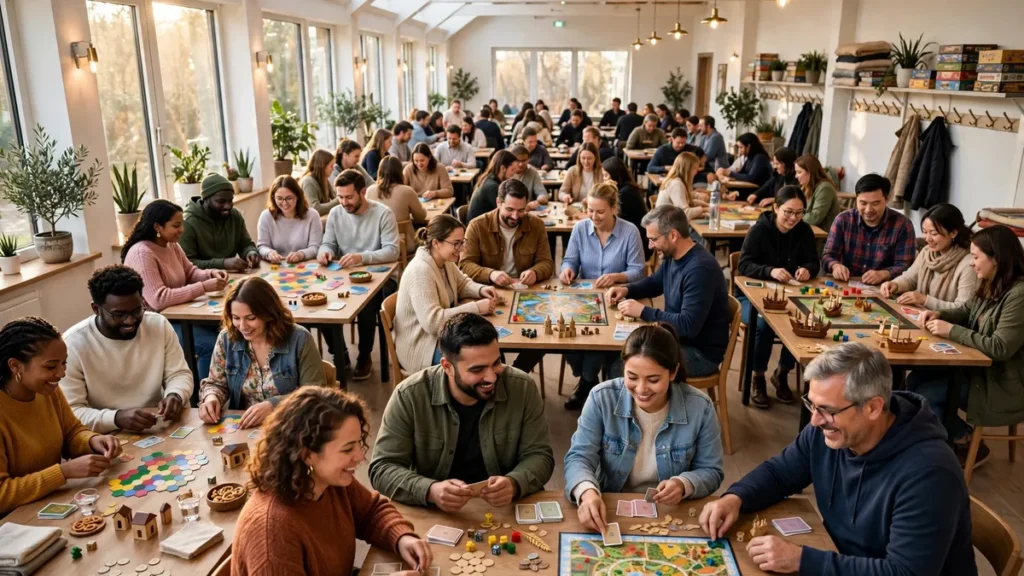
The best cooperative card games turn a quiet evening into a shared mission. Instead of trying to outplay the people across the table, everyone works together against the deck itself, and that single change transforms the whole mood of game night. There is no gloating winner and no sulking loser, just a group of friends holding their breath as the last card is flipped.
Cooperative card games have exploded in popularity over the past decade because they solve the oldest problem in tabletop gaming: not everyone enjoys direct competition. A well-designed co-op card game gives every player a real job to do, keeps the rules light enough to teach in five minutes, and still delivers the tension of a close finish. Whether you are playing with children, a partner, or a group of seasoned gamers, there is a cooperative card game built for your table.
This guide rounds up the best cooperative card games you can buy right now, from five-minute fillers to campaign experiences that unfold over months, with publisher, player count, and recommended age for every pick.
Key takeaways
- The Crew is the best cooperative card game overall, with clever trick-taking missions that scale beautifully from two to five players.
- Hanabi and The Mind prove that the simplest rules can create the tensest moments, and both fit in a pocket.
- Family groups should start with Forbidden Island or Bandido, which are easy to learn and genuinely exciting for younger players.
- Arkham Horror: The Card Game is the deepest pick here, offering a full story campaign for players who want a long-term hobby.
- Most of these games play in 20 to 45 minutes, cost less than a night out, and work best when the whole table talks through every decision.

How we chose the best cooperative card games
Every game on this list earned its place by being genuinely cooperative, not merely a competitive game with a team mode bolted on. We looked for games where players share information, plan together, and either win or lose as one group. We also weighed replay value, because a co-op game that is solved after two plays will gather dust, and we checked that each title is still in print and easy to buy from a regular game shop.
Quick comparison of the best cooperative card games
| Game | Publisher | Players | Ages | Play time | Best for |
|---|---|---|---|---|---|
| The Crew: The Quest for Planet Nine | KOSMOS | 2–5 | 10+ | 20 minutes | Best overall |
| The Mind | Pandasaurus / NSV | 2–4 | 8+ | 20 minutes | Quickest tension |
| Hanabi | R&R Games | 2–5 | 8+ | 25 minutes | Classic deduction |
| The Game | NSV | 1–5 | 8+ | 20 minutes | Brutal simplicity |
| Regicide | Badgers from Mars | 1–4 | 10+ | 20 minutes | Budget favourite |
| Forbidden Island | Gamewright | 2–4 | 8+ | 30 minutes | Best for families |
| Tranquility | Lucky Duck Games | 1–5 | 8+ | 20 minutes | Calmest game night |
| Bandido | Helvetiq | 1–4 | 6+ | 15 minutes | Youngest players |
| The Fox in the Forest Duet | Renegade Game Studios | 2 | 10+ | 30 minutes | Best for two |
| 5-Minute Dungeon | Wiggles 3D | 2–5 | 8+ | 5–30 minutes | Loudest laughs |
| The Grizzled | CMON | 2–5 | 10+ | 30 minutes | Most emotional |
| Arkham Horror: The Card Game | Fantasy Flight Games | 1–4 | 14+ | 60–120 minutes | Deepest campaign |
1. The Crew: The Quest for Planet Nine
The Crew is the best cooperative card game you can buy, and it is not particularly close. Published by KOSMOS, it takes the familiar bones of trick-taking, the same family of games as hearts and spades, and rebuilds them as a series of fifty space-exploration missions. Each mission hands the crew a secret assignment, such as winning a trick containing a particular card, and the team must complete every assignment without ever speaking about the cards in their hands.
What makes it brilliant is the communication limit. Players may share exactly one piece of information per mission using a small token, and that single clue has to carry the whole plan. The result is a game full of meaningful glances, groans, and triumphant laughter when a risky play lands. It plays in about twenty minutes, works with two to five players aged ten and up, and the mission book means the challenge keeps growing for months. If you buy one game from this list, buy this one.
2. The Mind
The Mind, from Pandasaurus and Nürnberger-Spielkarten-Verlag, is the strangest game on this list and one of the most memorable. Players hold numbered cards and must play them in ascending order without talking, signalling, or gesturing. That is the entire game. Yet somehow, in practice, groups develop an unspoken rhythm, hesitating, leaning forward, and playing a card at precisely the right moment as if by telepathy.
It supports two to four players aged eight and up, plays in about twenty minutes, and costs very little. The Mind is less a game of strategy than a game of shared feeling, and it produces stories people retell for years: the time the whole table held its breath, or the time someone played a ninety-nine on a fifty and everyone burst out laughing. Keep it in your bag for restaurants, waiting rooms, and the end of longer game nights.
3. Hanabi
Hanabi, published by R&R Games, is the grandparent of modern cooperative card games and still one of the finest. Players hold their cards facing outward, so everyone can see your hand except you, and the group must build five fireworks displays in the right order using only limited, carefully worded clues. Give a clue about a colour or a number, and hope your teammates interpret it the way you intended.
Hanabi plays with two to five players aged eight and up in about twenty-five minutes, and it won the Spiel des Jahres, Germany’s game of the year award, in 2013. Its genius is that the restriction on communication is the game itself: every clue is a small puzzle, and every misread clue is a lesson in how differently people think.
4. The Game
The Game, from NSV, is cooperative card gaming stripped to its skeleton: a deck of numbered cards, four piles, and one rule that makes everything hard. Players must collectively play all ninety-eight cards onto piles in ascending or descending order, and they may not discuss the specific numbers in their hands. It sounds trivial. It is not. The Game is famously, almost unfairly difficult, and most groups will lose their first five attempts.
That difficulty is the point. It supports one to five players aged eight and up, takes about twenty minutes, and costs very little. There is no theme and no artwork to hide behind, just pure numerical tension and the shared agony of a bad draw.
5. Regicide
Regicide, from Badgers from Mars, is the best-value cooperative card game on the market, because the standard edition is essentially a beautifully designed deck of playing cards. Players work together to defeat twelve royal enemies, the jacks, queens, and kings, by playing matching suits and combos from their hands. Suits have powers: hearts heal, diamonds draw cards, clubs double damage, and spades shield the party.
It plays with one to four players aged ten and up in about twenty minutes, and the compact box travels anywhere. Regicide feels like a role-playing game distilled into a deck of cards, with real decisions about when to spend a powerful card and when to hold it for the next enemy. It also makes a wonderful gift, since anyone who has ever held a deck of cards already understands half the rules.
6. Forbidden Island
Forbidden Island, published by Gamewright, is the best cooperative card game for families with younger players. The team explores a sinking island, collecting four treasures and escaping by helicopter before the island disappears beneath the waves. Every turn, more of the island floods, and the tension rises beautifully as safe ground shrinks.
It plays with two to four players aged eight and up in about thirty minutes, and the components are gorgeous: chunky tiles, little treasure figures, and a board that physically changes as the game progresses. Forbidden Island teaches children real cooperation, because no single player can win alone and every move is a group decision. Parents will appreciate that the game ends cleanly and sets up again in two minutes.
7. Tranquility
Tranquility, from Lucky Duck Games, is the calmest game on this list and a perfect palate cleanser after something loud. Players silently build a six-by-six grid of numbered island cards, starting and finishing with specific cards, while a shared pool of resources drains away. Talking is limited, the art is serene, and the whole experience feels more like a shared meditation than a competition.
It supports one to five players aged eight and up and takes about twenty minutes. Tranquility is the game to reach for on a quiet Sunday, with a cup of tea, when the group wants to do something together without shouting or stress. It also works brilliantly solo, which makes it one of the few games here that is worth buying even if your regular game group is sometimes just you.
8. Bandido
Bandido, from Helvetiq, is the simplest cooperative card game here and the best choice for the youngest players. A bandit is escaping through a tunnel, and the team must play cards to block every exit before he gets away. That is the whole game, and children as young as six can grasp it within a minute of watching.
It plays with one to four players in about fifteen minutes, and the tiny tin travels in a coat pocket. Bandido is a superb first cooperative game because it teaches the core idea, that the group wins or loses together, without any reading or arithmetic. Adults should not dismiss it either: on its hardest setup, the bandit is surprisingly slippery, and a quick rematch is always tempting.
9. The Fox in the Forest Duet
The Fox in the Forest Duet, from Renegade Game Studios, is the best cooperative card game made specifically for two players. Two woodland travellers must cross a forest together by winning tricks in the right pattern, moving their shared token along a winding path while avoiding the dangers that lurk in the trees. Every trick matters, and every card played changes what your partner can do next.
It plays in about thirty minutes and is recommended for ages ten and up. If you mostly play games as a couple, this is the pick that will get the most table time, and it pairs naturally with the wider world of two-player games. Once you have mastered the Duet, our guide to the best two-player board games is a natural next step for date-night game sessions.
10. 5-Minute Dungeon
5-Minute Dungeon, from Wiggles 3D, is the loudest and silliest game on this list, and sometimes that is exactly what a game night needs. Players race a five-minute sand timer through a dungeon, slapping down cards to defeat monsters and shouting for the cards they need. It is frantic, chaotic, and almost impossible to play quietly, which is precisely the appeal.
It supports two to five players aged eight and up, and a full game is over in about five minutes, though nobody ever plays just one round. 5-Minute Dungeon is the best choice here for breaking the ice at a party or for a group that finds quiet strategy games boring. Expect laughter, expect shouting, and expect someone to demand an immediate rematch the moment the timer runs out.
11. The Grizzled
The Grizzled, published by CMON, is the most emotional cooperative card game on this list. Players are a group of soldiers trying to survive the First World War together, supporting each other through hardship cards that represent fear, cold, and exhaustion. It is a game about friendship under pressure, and it handles its serious subject with remarkable grace and humanity.
It plays with two to five players aged ten and up in about thirty minutes. The Grizzled is not a light game, and it is not trying to be, but groups that play it often describe it as one of the most meaningful gaming experiences they have had. Buy it when your group is ready for something with weight, and play it when you have time to talk about it afterwards.
12. Arkham Horror: The Card Game
Arkham Horror: The Card Game, from Fantasy Flight Games, is the deepest cooperative card game ever made, and the right choice for players who want a hobby rather than a single evening. Each player builds a deck representing an investigator, and the group plays through linked story scenarios full of monsters, mysteries, and terrible choices. Decisions in one scenario echo into the next, and investigators can be injured, driven mad, or lost entirely.
It supports one to four players aged fourteen and up, and a single scenario takes one to two hours. The core set is the starting point, and expansions add new campaigns, but even the base box offers a complete and gripping story.
How to choose the right cooperative card game for your group
Start with your player count. Couples should look at The Fox in the Forest Duet or The Crew at two players, while bigger families will get more from Forbidden Island or 5-Minute Dungeon. Next, be honest about how much complexity your group enjoys: if half the table groans at long rules explanations, Bandido, The Mind, and The Game are safer than Arkham Horror.
Age is the third filter. Games marked eight and up, like Hanabi and Forbidden Island, are genuinely playable with children, while the fourteen-plus rating on Arkham Horror reflects long sessions and dark themes rather than difficult rules.
Looking after your cards
Cooperative card games get shuffled far more than most games, and a beloved deck will show wear quickly. Sleeving the cards you play most often is a small investment that keeps a favourite game looking new for years, and it makes shuffling smoother too. If you have never sleeved a game before, our guide to the best card sleeves for board games explains the sizes and brands worth buying, including options that fit the cards in the games above.
Checklist: picking your first cooperative card game
- Count your regular players first, and choose a game that shines at that number rather than merely supporting it.
- Check the age guidance honestly, especially for younger children, and favour games with short rules explanations.
- Decide whether your group wants quiet strategy, like Hanabi, or loud energy, like 5-Minute Dungeon.
- Look at play time: twenty minutes is ideal for a first purchase, while Arkham Horror suits committed groups.
- Make sure the game is in print and easy to replace if a card is lost or damaged.
- Buy one game, play it five times, and only then buy the next, because depth beats a shelf full of unplayed boxes.
Cooperative card games for solo players
If you enjoy playing alone, the solo modes here are a useful bridge into the wider world of single-player tabletop games. Our roundup of the best solo board games covers the strongest options beyond card games, from puzzle-like solo adventures to full campaign experiences designed for one player.
Frequently asked questions
What is the best cooperative card game for beginners?
Forbidden Island is the best starting point for most beginners, because the rules take five minutes to learn, the goal is clear, and the sinking island creates excitement without complexity. Bandido is even simpler and the best choice if children under eight are playing. Both games teach the core idea of cooperative play without overwhelming anyone.
What is the best cooperative card game for two players?
The Fox in the Forest Duet was designed specifically for two players and is the strongest choice for couples. The Crew also plays very well with two, and Arkham Horror offers a rich two-player campaign for groups that want something longer. Avoid games that need four or five players to feel tense, since they can feel empty with just two.
Are cooperative card games good for kids?
Yes, and they are often better for children than competitive games, because nobody is eliminated and nobody loses alone. Bandido suits ages six and up, Forbidden Island and Hanabi suit ages eight and up, and The Crew suits ages ten and up. The shared win keeps younger players engaged even when the game gets difficult.
How long does a cooperative card game take to play?
Most cooperative card games take between fifteen and thirty minutes. Bandido takes about fifteen minutes, The Crew and The Mind take about twenty, and Forbidden Island takes about thirty. Arkham Horror is the exception, with scenarios lasting one to two hours, which is why it suits dedicated game nights rather than quick sessions.
Can you play cooperative card games solo?
Many of them, yes. The Game, Regicide, Tranquility, Bandido, and Arkham Horror all have official solo modes, and The Crew includes a two-player variant that works well for a single player controlling two hands. Solo play is an excellent way to learn a game before teaching it to a group.
What is the difference between cooperative and competitive card games?
In a cooperative card game, all players win or lose together against the game itself, usually by beating a deck, a timer, or a scenario. In a competitive card game, players try to outscore or eliminate each other. Cooperative games suit mixed-skill groups and families, because experienced players help beginners instead of crushing them.
The bottom line
The best cooperative card games prove that the most memorable nights around a table are the ones where everyone wins together. Start with The Crew if you want the finest game on the shelf, Forbidden Island if children are playing, or Hanabi if your group loves a clever puzzle. Whichever you choose, shuffle the deck, gather your team, and enjoy the rare pleasure of a game where the whole table is on the same side.