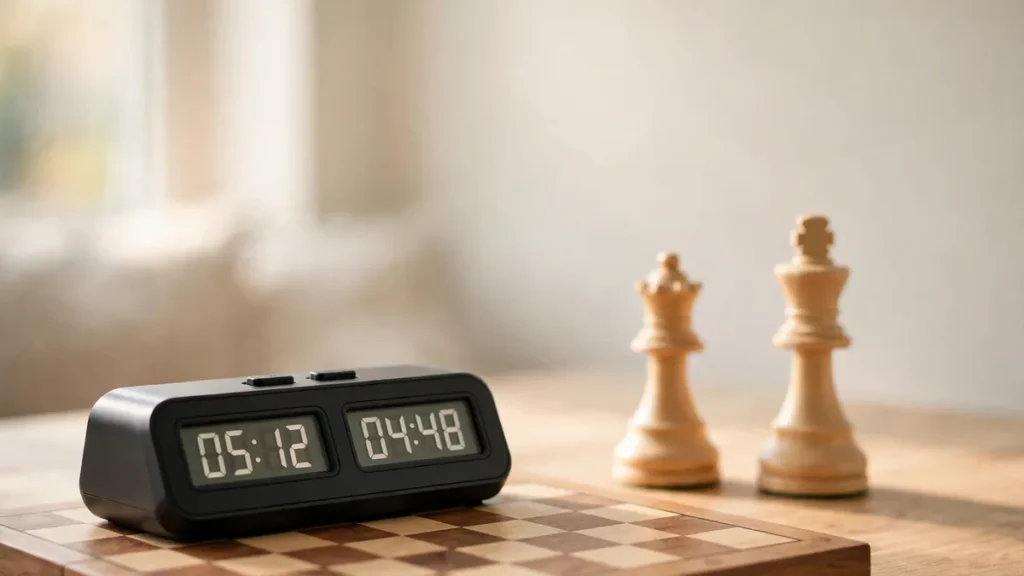
The best chess clocks turn a casual game into a real contest, because they add the one thing a board alone cannot provide: pressure. A good clock keeps both players honest about time, rewards quick thinking, and stops a single slow move from stretching an evening game into an all-night marathon. Whether you play blitz with friends, compete in a club tournament, or teach your children the game, the right clock makes every match fairer and far more exciting.
Choosing the best chess clock is not just about picking the most expensive model on the shelf. Tournament players need delay and increment settings that match official rules, while families and casual players need big buttons, a clear display, and controls simple enough for a child to learn in a minute. Some clocks connect to electronic boards, some run for years on a single set of batteries, and some are beautiful wooden objects that belong on a living room table as much as in a tournament hall.
In this guide we compare the leading digital and analog chess clocks, explain the time controls that matter, and show you exactly which model fits your style of play. Every clock below has been judged on display clarity, button feel, time control options, build quality, battery life, and value for money, so you can buy once and enjoy it for years.
Key takeaways
- The best chess clock overall is the DGT 3000, the official choice of the world chess federation, with the widest range of time controls and a clear, reliable display.
- Digital clocks beat analog clocks for almost every player, because they handle delay, increment, and bonus time automatically and accurately.
- For casual and family play, the DGT Easy Plus and the Leap PQ9907S offer the best value, with simple setup and large, easy-to-press buttons.
- Always check that your clock supports the time control your club or tournament uses, especially Fischer increment and Bronstein delay, before you buy.
- A good chess clock should last for years, so favour solid build quality, a clear display you can read from across the board, and batteries that are easy to replace.
Why a Chess Clock Changes the Game
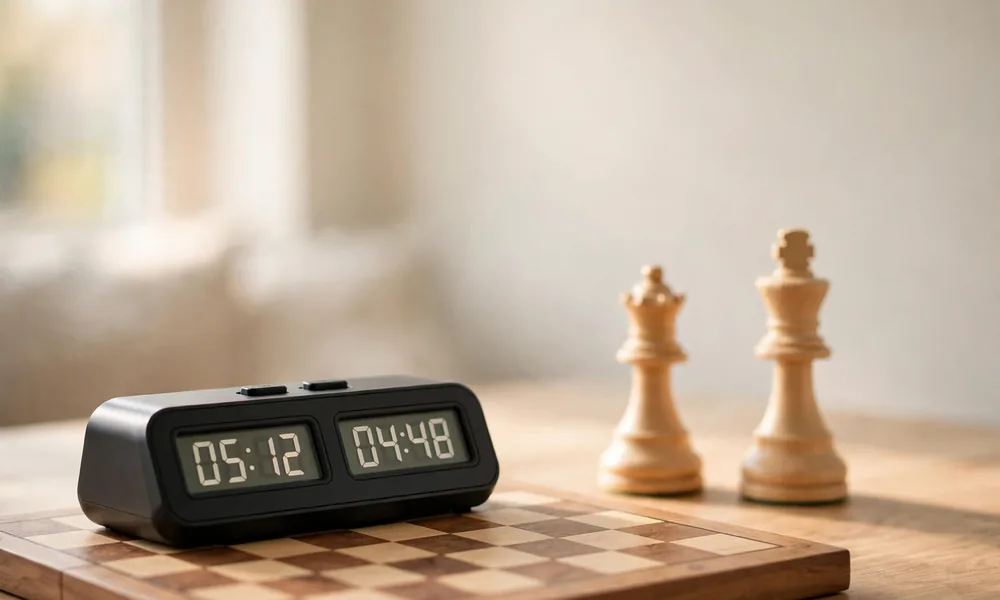
Chess without a clock is a different game from chess with one. Without time limits, a player who is losing can simply think for an hour on a single move, and a winning player can be ground down by boredom rather than beaten by skill. A clock solves that problem elegantly: each player gets a fixed share of time, and when your time runs out, you lose, no matter how good your position looks on the board.
That simple rule changes how people play. Openings get played faster, middlegames become sharper, and endgames become tests of nerve, because there is no time to calculate every variation to the end. Learning to manage the clock well can win games that look drawn or even lost.
A clock also makes chess fairer and more social. Two players of different strengths can enjoy a balanced game by giving the stronger player less time, a handicap that works far better than removing pieces. Parents can keep a game with children moving at a friendly pace, and friends can fit a proper match into a lunch break instead of letting one game swallow the whole afternoon. If you are shopping for a player who already owns a board and a set, a clock is one of the most useful best gifts for chess players you can choose, because it opens up a whole new way to play.
How a Chess Clock Works
A chess clock is really two clocks in one housing, joined by a pair of buttons or a rocking lever. Only one side runs at a time. When you finish your move, you press your button, which stops your clock and starts your opponent’s. The first player to run out of time loses the game on time, provided the opponent has enough material left to deliver checkmate. That is the whole idea, and every model on the market follows it.
Modern digital clocks add preset time controls that analog clocks cannot match. The most common are sudden death, where each player gets a fixed number of minutes for the whole game; increment, also called Fischer time, where a few seconds are added to your clock after every move you make; and delay, also called Bronstein delay, where your clock waits a few seconds before it starts counting down on each turn. Blitz games are usually played at three or five minutes per player, rapid games at ten to twenty-five minutes, and classical games at ninety minutes or more, often with a thirty-second increment.
Setting up a digital clock takes a minute once you know the menu, and most good models let you save favourite time controls as presets. Analog clocks use a falling flag on a dial instead, which is charming, but they cannot add increment or delay.
Time Controls You Should Know
Bullet chess gives each player one or two minutes for the whole game, and it is pure instinct and speed. Blitz, at three or five minutes, is the most popular online and club format, and it rewards fast, practical decisions. Rapid chess, at ten to twenty-five minutes, gives enough time for real calculation while still finishing a game in under an hour. Classical chess, at ninety minutes or more, is the slow, deep format used in major tournaments, and it is where a clock with increment really earns its price.
Increment and delay exist to stop games being decided by a frantic scramble in the last seconds. With a five-second increment, a player who moves quickly never runs out of time completely, because each move earns a few seconds back. With delay, the clock pauses briefly before counting down, giving a player a moment to make an obvious move without penalty. Tournament rules now use increment in almost every serious event, which is why a clock that supports Fischer and Bronstein modes is worth paying a little more for.
Analog vs Digital Chess Clocks: Which Is Better?
Analog chess clocks, with their twin dials, wooden cases, and mechanical flags, are beautiful objects. They need no batteries, they make a satisfying click when you press the lever, and they look wonderful on a traditional wooden board. Many older players learned the game on an analog clock and still prefer the feel of one for a slow, friendly game at home. They are also simple: wind them up, set the hands, and play.
Digital clocks win on almost every practical point. They are more accurate, they handle every modern time control, they show the exact time remaining in minutes and seconds, and they beep or flash when a player runs out of time, so there is no argument about whose flag fell first. They are lighter to carry to a club night, and most run for hundreds of hours on two AA batteries. The only real drawback is that a digital clock needs batteries and can look less traditional on a classic wooden set.
Our advice is simple: buy a digital clock if you play in clubs, tournaments, or online-style time controls at home, and buy an analog clock only if you love the traditional look and play slow, friendly games without increment. For most buyers reading this guide, a digital clock is the right choice, and every digital model in our comparison below will serve you well for years.
Best Chess Clocks Compared
| Chess Clock | Best For | Time Controls | Display | Price Range |
|---|---|---|---|---|
| DGT 3000 | Tournament play | All, including Fischer and Bronstein | Large LCD, move counter | Premium |
| DGT 2010 | Club and tournament play | All major controls | Clear LCD | Mid to premium |
| DGT North American | US tournaments | Delay and increment | Clear LCD | Mid-range |
| Chronos GX | Serious blitz players | All major controls | Bright LED display | Premium |
| Leap PQ9907S | Budget buyers | Bonus, delay, and fixed time | Large LCD | Budget |
| ZMF-II | Families and schools | Fixed time, bonus, delay | Large LCD | Budget |
| DGT Easy Plus | Beginners and casual play | Simple presets | Large LCD | Budget to mid-range |
The Best Chess Clocks Reviewed
1. DGT 3000 — Best Chess Clock Overall
The DGT 3000 is the official clock of the International Chess Federation, and it shows. It supports every time control used in serious chess, including Fischer increment, Bronstein delay, and multi-period controls with different time limits for different phases of the game. The display is large and easy to read from across the board, it shows the move count, and it can connect to DGT electronic boards for live game transmission.
The buttons have a firm, satisfying press, and the most common time controls are available as quick presets. It is the model you will meet at real events, so practising with it at home means no surprises on the day.
2. DGT 2010 — Best for Club Players
The DGT 2010 is the workhorse of club chess. It offers nearly all the time controls of the DGT 3000, including increment and delay, in a slightly simpler and cheaper package. The display is clear, the buttons are large and responsive, and the clock is officially approved for tournament use. Many clubs buy a set of DGT 2010s because they are reliable, easy to teach to new members, and tough enough to survive years of weekly use.
It lacks the move counter of the DGT 3000, but most club players will never miss it. It resets quickly between rounds and runs for a very long time on its batteries.
3. DGT North American — Best for US Tournaments
The DGT North American is built for the way chess is played in the United States, where delay is more common than increment in many events. It handles delay and increment with equal ease, has a clean and uncluttered display, and is approved by the United States Chess Federation. The buttons are wide and easy to hit in time trouble, which matters more than it sounds when you have seconds left and your hand is shaking.
This is a focused clock rather than a do-everything model, and that is its strength: there is less menu diving and less to go wrong. If you play rated events in the US, or your club uses delay-based controls, this is an excellent and slightly cheaper alternative to the DGT 3000.
4. Chronos GX — Best for Blitz Players
The Chronos GX is a legend among blitz players, and its bright touch-sensitive display is instantly recognisable in clubs across America. Instead of mechanical buttons, you tap the touch pads, which some players love for their speed and silence. It supports every time control a blitz or rapid player needs, and its display is readable in dim club rooms where a faint LCD can be hard to see.
The Chronos is expensive and the touch controls take getting used to, but its metal case is built to survive years of weekly club nights.
5. Leap PQ9907S — Best Budget Chess Clock
The Leap PQ9907S proves that a good chess clock does not have to cost a fortune. It offers bonus and delay modes, a large and clear display, and sturdy buttons at a price that makes it an easy gift or a first clock for a new player. It is the model many schools and families choose when they need several clocks without spending a small fortune.
The menus are a little less polished than a DGT, and the plastic case feels lighter, but in daily play it does the job reliably. For casual games, family matches, and learning the habit of playing with a clock, the Leap is hard to beat on value. Pair it with a decent board and you have everything a beginner needs to start playing timed chess at home.
6. ZMF-II — Best for Families and Schools
The ZMF-II is designed for the people who actually need a clock to be simple: children, beginners, and teachers running a school chess club. The buttons are large, the display is big and bright, and the most useful time controls are easy to select without reading a manual. It handles fixed time, bonus, and delay modes, which covers everything a school or family game needs.
It is light, affordable, and tough enough for children, and it sits nicely alongside other gifts for chess lovers in a birthday present.
7. DGT Easy Plus — Best for Beginners
The DGT Easy Plus does exactly what its name promises: it makes timed chess easy. It has a small number of clear presets, a large display, and one-button operation that a complete beginner can master in a minute. There is no deep menu to get lost in, and the clock does the thinking about time controls so the player can think about chess.
Tournament players will want the wider options of the DGT 3000, but for a first clock or a family, the Easy Plus is a fine buy that will last for years.
How to Choose the Best Chess Clock for You
Start with how you play. Tournament players should choose a FIDE or USCF approved clock with full Fischer and Bronstein support, because arriving at an event with a clock that cannot handle the official time control is a problem you do not need. Club players should prioritise a clear display, reliable buttons, and quick setup between rounds. Families and beginners should prioritise simplicity and price, because the best clock for a child is the one they will actually use.
Next, look at the display: large digits and good contrast you can read at a glance, even in dim light. Press the buttons too; they should be large enough to hit without looking and firm enough not to trigger by accident. Finally, check the batteries. Most digital clocks use AA batteries and run for hundreds of hours.
Think about size and travel too. A clock you carry to a club every week should be light and fit in your chess bag beside the board, and a clock you enjoy looking at is one you will use more.
If you are buying for a young player, remember that a clock is only part of their chess education. A good book matters just as much, and the right chess books for beginners will teach them the ideas behind the moves while the clock teaches them to make those moves on time. Together, a clock and a book make a complete starter kit for a new player.
Chess Clock Buying Checklist
Use this checklist before you buy, and you will end up with a clock that suits your games for years.
- Time controls: Confirm it supports Fischer increment and Bronstein delay, plus the sudden-death and rapid controls you play most.
- Display clarity: Choose large, high-contrast digits you can read at a glance from across the board, even in dim light.
- Button feel: Pick wide, firm buttons that are easy to hit quickly and hard to press by accident.
- Tournament approval: If you play rated events, check for FIDE or US Chess Federation approval before you buy.
- Battery life: Look for AA batteries, hundreds of hours of play, and a clear low-battery warning.
- Size and travel: Make sure it fits your board and your bag, and that it is light enough to carry to club night every week.
Frequently Asked Questions
What is the best chess clock for beginners?
The DGT Easy Plus and the ZMF-II are the best chess clocks for beginners, because both are simple to set up, have large displays and buttons, and cover the time controls a new player needs. Start with one of these, and upgrade to a DGT 3000 later if you begin playing tournaments.
Do I need a chess clock to play at home?
You do not need one, but a clock makes home games fairer, faster, and more exciting. It stops games dragging on, teaches time management, and lets players of different strengths enjoy a balanced match by giving the stronger player less time. Most players who try a clock never go back.
What is the difference between increment and delay?
Increment, or Fischer time, adds a few seconds to your clock after every move you make, so quick play is rewarded. Delay, or Bronstein delay, pauses your clock for a few seconds before it starts counting down on each turn, giving you a moment to make an obvious move. Both stop games being decided by a frantic scramble in the final seconds.
Are analog chess clocks still used in tournaments?
Analog clocks are rarely used in modern tournaments, because they cannot handle increment or delay, and reading the exact time left is difficult. They are still loved for friendly and traditional games at home, but almost every rated event today requires a digital clock.
How long do chess clock batteries last?
Most digital chess clocks run for hundreds of hours on two AA batteries, which means months or even years of regular club play. Always carry spare batteries to an event, and replace them as soon as the low-battery warning appears rather than risking a mid-game failure.
Can I use a chess clock for other board games?
Yes, a chess clock works well for any two-player game where each side takes turns, including Scrabble, Go, and many strategy board games. Some players also use one side of the clock as a simple timer for puzzles and practice drills.
The Bottom Line
The best chess clock is the one that matches the way you play. Tournament players should buy the DGT 3000, club players will be happiest with the DGT 2010 or the DGT North American, and families and beginners will get the most joy from the Leap PQ9907S, the ZMF-II, or the DGT Easy Plus. Whatever you choose, make sure it supports increment and delay and has a display you can read under pressure. Buy the right clock once, and enjoy faster, fairer, and far more exciting games.