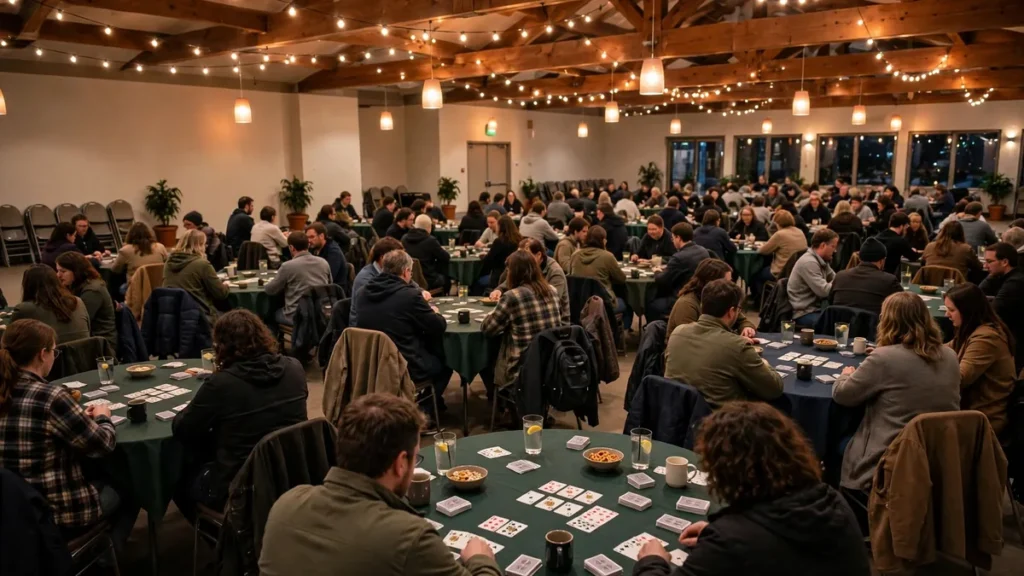
The best card games for 75 players are not found in a single box, because no card game is printed for 75 people around one table. The largest card games seat eight, ten, or at most twenty players, and most classics are happiest with four to six.
A group of 75 players is a hall full of people, not a table full of friends. It is a company offsite, a school fundraiser, a wedding weekend, a community social, or a large family reunion.
This guide names the card games that scale well, explains how many decks and tables each one needs for 75 players, and sets out three proven formats — team play, multi-table tournaments, and whole-room host-led games — so every person plays at the same time. You will also find a comparison table, a two-hour running order, a setup checklist, and answers to the questions every large-group host asks first.
Key takeaways
- No single card game seats 75 players, so plan for teams, multiple tables, or a whole-room format instead of one table.
- Uno, Dutch Blitz, Pit, Taco Cat Goat Cheese Pizza, Exploding Kittens, Apples to Apples, Codenames, and tournament Rummy are the strongest choices for 75 players.
- Buy several copies of the same game rather than many different games, because identical tables are easier to teach, score, and rotate.
- Use a simple points system and a visible leaderboard so players at every table know where their team stands.
- Keep rounds short, rotate tables between rounds, and finish with one whole-room final that brings all 75 players together.

Why 75 Players Changes Everything
A card night for six people needs a deck, a table, and a few snacks. A card night for 75 needs a plan, and the plan matters more than the game.
Seventy-five people need roughly thirteen to nineteen tables, depending on whether each table seats four, five, or six players. Teaching also changes: the games that succeed here are the ones a table captain can explain in two minutes, using the cards themselves.
The Three Formats That Actually Work for 75 Players
Every successful large-group card night uses one of three formats, and the best nights use all three in sequence. Team play divides the room into squads that compete across several tables. Multi-table tournaments run the same game at every table at the same time, then bring winners together. Whole-room games put one host in charge and let all 75 people play at once.
Team Play
Team play turns 75 strangers into fifteen teams of five, each with a name, a colour, and a home table. Teams play a short card game, record their score on a team sheet, and rotate to a new table to meet a new team. Apples to Apples works beautifully in teams, because each team discusses its answer together, and Codenames scales by running several copies at several tables at once.
Multiple Tables and Tournaments
A multi-table tournament is the format for groups who want real competition, and it is the natural home for Rummy, Hearts, Spades, and Uno. Every table plays the same game, for the same length of time, under the same rules, and the winners move to a new table for the next round. This format needs identical equipment at every table, counted and labelled, plus a simple scoring system, such as points for finishing first, second, third, and fourth. The approach used in the best card games for 74 players follows the same logic.
Whole-Room Host-Led Games
Whole-room games are the secret weapon of a 75-player night, because they are the only format in which all 75 people do the same thing at the same moment. A confident host, a microphone, and a game with simple public actions can hold a hall in a way no table game can. Pit is a classic example: players trade cards by shouting, swap sets, and ring a bell when they collect a full set.
Best Card Games for 75 Players
The games below were chosen because they still work when they are multiplied. Each one can be bought in several identical copies, taught in two minutes, played in a short round, and scored simply enough that fifteen tables can report results without confusion.
Uno With Multiple Decks
Uno is the most reliable large-group card game, because almost everyone knows the rules. Run fifteen tables of five players, each with its own deck, in fifteen-minute rounds. Award five points to the first player out, three to the second, and one to everyone who finishes, then rotate the top scorer to a new table. A round can end cleanly at a bell: count the cards left in each hand, and the player with the fewest wins the table.
Dutch Blitz
Dutch Blitz is a fast, frantic game in which every player plays at the same time, racing to build piles in the centre of the table. There are no turns, so nobody waits, and a round lasts about five minutes, which makes it ideal for rotation. Each copy seats four players, so a room of 75 needs about nineteen copies, or a mix of Dutch Blitz tables and a second fast game. Speed and pattern-spotting decide the winner, and a new player can learn it in one demonstration round.
Pit
Pit is a trading game in which players swap cards by shouting the number they want, trying to collect a complete set of nine matching cards, then ringing a bell. It has no turns, no scoring sheets, and no waiting, which makes it one of the few card games that can involve dozens of people in a single game. For 75 players, use several decks, divide the room into trading groups of eight to ten with a bell each, then bring each group winner forward for a loud final.
Taco Cat Goat Cheese Pizza
Taco Cat Goat Cheese Pizza is a silly, speedy game in which players flip cards and say the next word in the sequence, slapping the pile whenever a card matches the word spoken. It seats up to eight players, plays in about fifteen minutes, and needs no strategy, which makes it perfect for people who do not usually play card games. For 75 players, run ten tables of seven or eight players, each with its own copy. The fun is in the slap, not the score, and a table of strangers will be laughing within two minutes.
Exploding Kittens
Exploding Kittens is a funny, simple game in which players draw cards, avoid the exploding kitten, and use action cards to skip, attack, or defuse. The base game seats five players and the party pack seats ten, so a room of 75 needs about eight party packs or fifteen base games. The cards are funny to read aloud, the rules take two minutes to explain, and a round ends quickly when the kittens appear.
Apples to Apples
Apples to Apples is a party game in which a judge plays a green word card, and every other player plays a red card they think best matches it, with the funniest match winning the round. It seats up to ten players and needs no skill beyond a sense of humour, which makes it ideal for teams. For 75 players, divide the room into teams of five, give each team a copy, and let the team discuss its answer together before playing a card, so shy players contribute without performing alone.
Codenames
Codenames is a team game in which a spymaster gives a one-word clue linking several secret words, and their team tries to guess the right cards without hitting the assassin. It scales to 75 players by running several copies at several tables at once, with ten copies covering teams of seven or eight. Place Codenames tables in a quieter corner, because the game needs conversation and concentration, and provide a printed rules sheet, because the spymaster and operative roles are easy to confuse on a first play.
Tournament Rummy, Hearts, and Spades
Classic games with a standard deck deserve a place here, because they cost almost nothing to scale and almost everyone has played at least one of them. A room of 75 needs only about nineteen packs, one per table, plus spares. Rummy works best as a tournament game, with each table playing a timed round and the best scorer moving on. Hearts and Spades work best as team games, with partners opposite each other and team scores added together.
Comparison Table
The table below gives a host a quick way to choose.
| Game | Players per table | Copies for 75 players | Best format | Round length | Energy |
|---|---|---|---|---|---|
| Uno | 5 | 15 decks | Tournament | 15 minutes | Medium |
| Dutch Blitz | 4 | 19 copies | Tournament | 5 minutes | Very high |
| Pit | 8 to 10 | 8 sets | Whole room | 10 minutes | Very high |
| Taco Cat Goat Cheese Pizza | 7 to 8 | 10 copies | Multi-table | 15 minutes | High |
| Exploding Kittens | 5 to 10 | 8 to 15 copies | Tournament | 15 minutes | Medium |
| Apples to Apples | 5 to 10 | 8 to 15 copies | Team play | 20 minutes | Medium |
| Codenames | 5 to 8 | 10 to 15 copies | Team play | 20 minutes | Low to medium |
| Rummy, Hearts, Spades | 4 | 19 packs | Tournament | 20 minutes | Low to medium |
How to Run a 75-Player Card Night in Two Hours
A two-hour running order keeps the night moving without rushing it. Start with fifteen minutes of welcome and seating: greet people at the door, hand each person a team colour or table number, and let teams introduce themselves. Follow with a ten-minute whole-room warm-up, such as Pit, then a twenty-minute first round of Uno or Dutch Blitz, with scores collected at the bell. Take a ten-minute break, play a twenty-minute second round of Apples to Apples or Codenames, take a second short break, play a fifteen-minute third round of Taco Cat Goat Cheese Pizza, and finish with a fifteen-minute whole-room final and a short prize-giving.
Score simply: five points for first place at a table, three for second, two for third, and one for everyone else, added to a team total if the night is team-based.
Seating, Supplies, and Scoring
Solve seating the day before, not on the night. Visit the hall, count tables and chairs, and plan fifteen tables of five or nineteen tables of four, with a host table near the door and a leaderboard everyone can see. Leave a clear walkway around every table, and put quiet games such as Codenames at one end and noisy games such as Pit at the other. Supplies are simple but easy to forget: counted and labelled games, spare decks, score sheets, pens, a bell or whistle, a microphone, a whiteboard, team wristbands, and small prizes. The guide to the best party games for 74 players makes the same point about keeping food and play separate.
Common Mistakes to Avoid
The most common mistake is choosing a game that is too complicated. A game with a thick rulebook or a long setup may be excellent for four experienced players, but it will collapse when fifteen tables try to learn it at once. The second mistake is buying one copy of many different games instead of many copies of a few games. A hall with fifteen different games needs fifteen different explanations and score sheets, while a hall with three games repeated across five tables is far easier to teach, score, and rotate, and players can compare results fairly.
The third mistake is forgetting the players who are not competitive. In a group of 75, some want to win, some want to laugh, and some want a quiet game with a friend. Provide for all three: a tournament for the competitors, a party game for the laughers, and a side table with relaxed Rummy for anyone who wants to step out for a round. The best board games for 69 players takes the same approach to mixed groups.
75-Player Card Night Checklist
Use this checklist in the week before the night, and tick each item off as it is done.
- Book a hall with at least fifteen tables and 75 chairs, clear walkways, good light, and a host table near the door.
- Buy or borrow enough identical copies of three chosen games, count every deck, and label each box with its table number.
- Print score sheets, rules sheets, a rotation plan, a two-hour running order, and a large leaderboard sheet.
- Appoint fifteen table captains, give each one a rules sheet and a score sheet, and brief them before the guests arrive.
- Prepare a bell or whistle, a microphone or speaker, pens, team colours or wristbands, water, snacks, and small prizes.
- Test the whole setup with one table the day before, playing one full round, scoring it, and rotating to a new table.
Frequently Asked Questions
Can one card game really seat 75 players?
No. No published card game seats 75 people around one table, because the cards would be unreadable, turns would take too long, and most players would be spectators. Run the same game at many tables at once, divide the room into teams, or play a whole-room game with a host.
How many decks do I need for 75 players?
Use one deck or copy per table, with two spares. For Uno, that means fifteen decks for fifteen tables of five, plus two spares. For Rummy, it means nineteen packs for nineteen tables of four. For a party game that seats ten, such as the party pack of Exploding Kittens, it means about eight copies.
What is the best card game for a mixed group of 75?
Uno is the safest single choice, because almost everyone knows it, it plays quickly, and it works as a tournament. Apples to Apples is the warmest choice for laughter and conversation, and Codenames is the best choice for a group that enjoys thinking together.
How do I keep score fairly across fifteen tables?
Use one simple points system for the whole night: five points for first place at a table, three for second, two for third, and one for everyone else, printed on every score sheet. Collect the sheets after each round, add the points to a visible leaderboard, and keep the sheets in order so any dispute can be checked.
How long should a 75-player card night last?
Two hours is a good length for a first night, including a welcome, a warm-up, two or three rounds, breaks, and a final. Three hours works for a confident host with an experienced group, but only if the extra hour adds another round and a longer break, rather than stretching the same rounds until people grow tired.
What if some players have never played card games before?
Choose games that can be taught in two minutes, seat new players with a friendly table captain, and start with the simplest game of the night. Uno, Taco Cat Goat Cheese Pizza, and Pit all work for complete beginners, because the rules are visible in the cards and a new player can learn by watching one round.
Bottom Line
The best card games for 75 players are the ones that respect the size of the room. Uno, Dutch Blitz, Pit, Taco Cat Goat Cheese Pizza, Exploding Kittens, Apples to Apples, Codenames, and tournament Rummy, Hearts, and Spades all work at this scale, not because they seat 75 people at one table, but because they multiply cleanly across many tables, divide neatly into teams, or bring a whole hall together under one host. Buy several identical copies, keep the rules simple, score every table the same way, rotate between rounds, and finish with a final everyone can watch. Do that, and 75 players will feel like the reason the night was worth hosting.