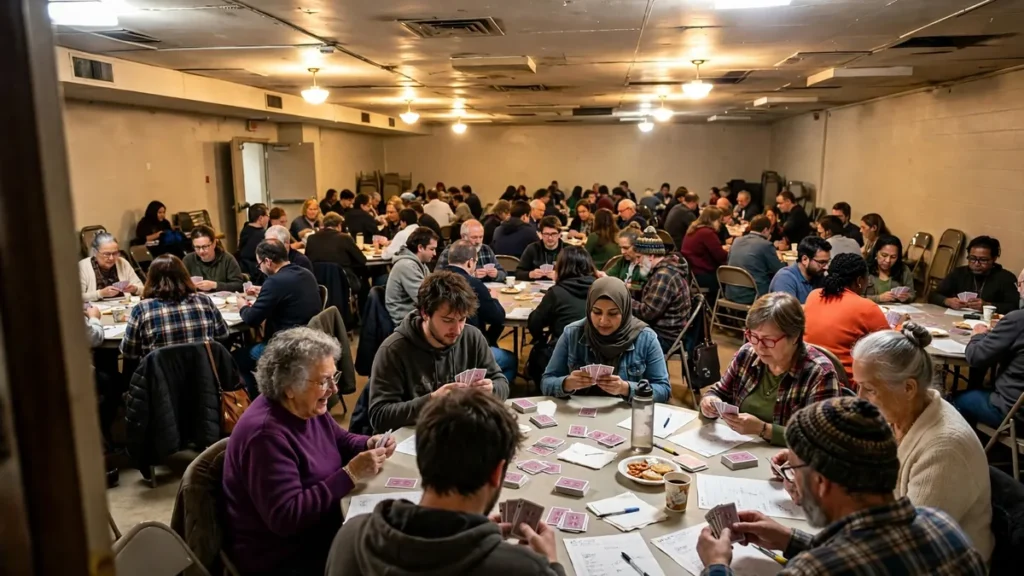
568 players will not fit around 1 table, and no 1 game needs to hold them all. A night for 568 players is a night of many small tables playing at the same time, with every table on the same heat length and every total written down on a tally sheet.
This guide gives you 9 games that fit a crowd of 568. 5 of them are layouts for 1 player, played side by side in timed heats, and 4 are team games for 4 or 6 players. Every game here uses ordinary packs, plain tally sheets, and points only, so nothing needs special equipment and every total is counted in points.
Plan the hall first and the games will follow. Count your tables, count your packs, name a captain for every table, and keep the heats short enough that nobody waits long for the next deal.
Key takeaways
- 568 players work best in parallel heats, not at 1 large table.
- Layouts for 1 player let many people play at the same time with 1 pack each.
- Bolivia and Pennies from Heaven suit teams that enjoy long melding hands.
- Tien Len is the fastest game here, so it suits the opening heat.
- Plain tally sheets and a table captain at every table keep the count honest.

How 568 Players Fit Into 1 Day
Start with the hall, not the games. Count how many tables you have, then work out how many players each table holds. Layouts for 1 player take 1 player each, so 10 tables hold 10 players at a time. Team games hold more: Tien Len and Bolivia take 4 each, Pennies from Heaven takes 6, and Three Thirteen takes 4.
Timing matters more than anything else. Give every table the same heat length and announce each change of heat from the front of the hall. Short heats suit the layouts for 1 player: Elevens, Cruel, Shamrocks, and Saratoga all finish in 10 to 20 minutes. Team games need more time, so give Bolivia and Pennies from Heaven 60 to 90 minutes, and give Tien Len and Three Thirteen 20 to 60 minutes.
If your hall leans loud and social, the card games for 566 players lean on party-style picks such as Hot Seat and Babette, which suit a hall where tables talk across to each other. Our 568 night is calmer by design: the layouts for 1 player keep the hall calm, and the team games give each table its own small contest.
The 9 Games at a Glance
Use this table to plan your hall. It shows how many players each game takes at 1 table, how many packs each table needs, and how long 1 heat lasts.
| Game | Players per table | Packs per table | Time per heat |
|---|---|---|---|
| Elevens | 1 | 1 | 10 minutes |
| Tien Len | 4 | 1 | 20 minutes |
| Bolivia | 4 | 3 | 60 minutes |
| Pennies from Heaven | 6 | 4 | 90 minutes |
| Cruel | 1 | 1 | 15 minutes |
| Blockade | 1 | 2 | 30 minutes |
| Three Thirteen | 4 | 2 | 60 minutes |
| Shamrocks | 1 | 1 | 15 minutes |
| Saratoga | 1 | 1 | 20 minutes |
The 9 Games
Each game below gives you the layout, the moves, and the way it scales to 568 players.
1. Elevens
Elevens is a layout for 1 player that turns adding up into a full game. Deal 9 cards face up in 3 rows of 3, and keep the rest of the pack face down as the stock. Any 2 cards on show that total 11 leave the table together: the lowest rank with a 10, a 2 with a 9, a 3 with an 8, a 4 with a 7, and a 5 with a 6. Every space left behind is filled from the stock, so the layout stays 9 cards wide until the stock is empty. The 3 face ranks cannot make 11 with anything, so they leave as a group of 3: 1 of each face rank, whatever the suit.
For 568 players, Elevens is the easiest heat to organise. Every player needs 1 pack and a flat place for 9 cards. Give each heat 10 minutes and count 1 point for every card that leaves the table. The game ends in a finish when all 52 cards have left the table, and it ends without a finish when the layout holds no total of 11 and no complete group of 3.
2. Tien Len
Tien Len is a fast shedding game from Vietnam for 4 players at 1 table. Deal 13 cards to each player from 1 pack, and the player with the lowest card of the pack opens the first hand. On your turn, play a higher combination of the same shape: a lone card, a group of 2 matching ranks, a group of 3 matching ranks, or a sequence of 3 or more cards in rank order. The player who empties a hand first takes the round, and the points follow the order in which hands are emptied. The 2 is the highest rank in the game, so a lone 2 beats any lone card, and only a group of 4 matching ranks beats a lone 2.
For 568 players, Tien Len is the fastest heat in this guide, so use it to open the night. A table of 4 needs 1 pack, and a heat lasts about 20 minutes, so 10 tables move 40 players through 1 heat. The card games for 564 players use quick picks such as Cambio and Bandido, which suit tables where new faces arrive all night, and Tien Len brings that same quick turnover to a 568 night.
3. Bolivia
Bolivia is a melding game for 4 players in 2 teams of 2, played with 3 packs shuffled together plus 6 jokers, 162 cards in all. Deal 15 cards to each player, draw 2 cards from the stock on your turn, and end your turn by discarding 1 card. Melds are groups of 3 or more cards of the same rank, or sequences of 3 or more cards of the same suit in rank order. The 2s and jokers are wild and can stand in for any card you need.
7-card melds earn the bonuses. A group of 7 matching ranks earns a bonus, a sequence of 7 cards of 1 suit in rank order earns a larger bonus, and a meld of 7 wild cards earns the largest bonus of all. A team may empty a hand only after it holds at least 1 7-card sequence and 1 more large meld. Red and black 3s never join a meld, and a black 3 left in a hand costs its holder points. For 568 players, a table of 4 needs 3 packs and a full hand lasts about 60 minutes, so keep each table’s 3 packs together between heats.
4. Pennies from Heaven
Pennies from Heaven is a melding game for 6 players in 2 teams of 3, played with 4 packs shuffled together plus 8 jokers, 216 cards in all. Deal 13 cards to each player as the playing hand, then deal 11 more cards face down to each player as a reserve hand. Draw 2 cards from the stock on your turn, meld if you can, and end your turn by discarding 1 card. A meld starts with 3 or more cards of the same rank and grows to 7 cards, and 4 kinds of 7-card meld earn different bonuses: a natural meld, a mixed meld, a meld of 7 wild cards, and a meld of 7 cards of rank 7.
For 568 players, Pennies from Heaven is the largest team game in this guide. A table of 6 needs 4 packs, and a full hand lasts about 90 minutes, so give it the longest heat of the night. A team may empty its hands only after it holds 1 of each kind. The 2s and jokers are wild, the 3s never join a meld, and a player picks up the reserve hand only after completing a 7-card meld.
5. Cruel
Cruel is a layout for 1 player that earns its name honestly. Lay the 4 lowest-rank cards of the pack in a row as the home piles, then deal the other 48 cards face up into 12 piles of 4. Move 1 top card at a time: onto the next higher card of the same suit in another pile, or up to its home pile in rank order. Only the top card of each pile can move. When no move is left, gather the piles in order from left to right and deal them out again in 4s, without shuffling.
For 568 players, Cruel is a fine heat for players who enjoy a hard puzzle. Every player needs 1 pack, a heat lasts about 15 minutes, and the scoring is plain: 1 point for every card that reaches a home pile. Play until all 52 cards are on the home piles, or until a redeal changes nothing and the layout is spent.

6. Blockade
Blockade is a layout for 1 player that uses 2 packs, 104 cards in all. Deal 1 card face up to each of 12 piles, and keep the rest as the stock. Build downward in suit on the piles, move whole sequences together when they are in suit order, and build the 8 home piles upward in suit from the lowest rank. When a pile empties, the stock fills it, so the layout keeps shifting until the stock is spent. When no move is left, deal 1 card from the stock onto each pile, even on piles that already hold long sequences. Each new deal can open a move that was closed a moment before.
For 568 players, Blockade is the 2-pack answer to Cruel, and it suits players who want a longer challenge on their own. Every player needs 2 packs, a heat lasts about 30 minutes, and the scoring is plain: 1 point for every card that reaches a home pile, with a small bonus for a full finish. When the stock is spent, any card may fill an empty pile. Keep the packs of each table together and count them before the next heat.
7. Three Thirteen
Three Thirteen is a melding game for 2 or more players that changes every round. It is played in 11 rounds: in round 1 each player is dealt 3 cards, in round 2 each player is dealt 4, and so on until round 11, when each player is dealt 13. The wild rank matches the number of cards dealt, so 3s are wild in round 1, 4s are wild in round 2, and the highest rank is wild in round 11. Draw 1 card on your turn and end your turn by discarding 1 card. The aim is to arrange your hand into groups: 3 or more cards of the same rank, or 3 or more cards of 1 suit in rank order. Wild cards fill any opening in a group.
For 568 players, Three Thirteen is the game that grows with the night. A table of 4 needs 2 packs and a full game lasts about 60 minutes across 11 short rounds. Groups stay in your hand until the round ends, when each player lays their groups down and counts the cards left over. The lowest total after 11 rounds takes the game.
8. Shamrocks
Shamrocks is a layout for 1 player with 17 piles of 3 cards and 1 lone card, 18 piles in all. Every card is face up, so the whole layout is on show from the first move. Build the 4 home piles upward in suit from the lowest rank, and move the top card of any pile onto a card 1 rank higher or 1 rank lower, whatever the suit. No pile may hold more than 3 cards, and an empty pile stays empty. When the highest rank of a suit lands on a lower card of the same suit, tuck it underneath that card. There is no redeal in Shamrocks, so every move counts in 2 ways: for the card it frees, and for the pile it leaves behind.
For 568 players, Shamrocks is a fine heat for players who enjoy an open puzzle. Every player needs 1 pack, a heat lasts about 15 minutes, and the scoring is plain: 1 point for every card that reaches a home pile. There is no redeal in Shamrocks, so every move counts in 2 ways: for the card it frees, and for the pile it leaves behind.
9. Saratoga
Saratoga is a layout for 1 player where every card is on show from the start. Deal 7 columns of 1 to 7 cards, all face up, and keep the other 24 cards as the stock. Build downward on the columns in alternating colours, red on black and black on red, and build the 4 home piles upward in suit from the lowest rank. Only the highest rank, or a sequence headed by the highest rank, may fill an empty column. Turn the stock 3 cards at a time onto the discard pile, and only the top card of that pile can be played. When the stock is spent, turn the discard pile over and pass through it again, as often as you like.
For 568 players, Saratoga is the friendliest layout in this guide for new players. Every player needs 1 pack, a heat lasts about 20 minutes, and the open layout means nobody plays blind. Put Saratoga tables near the entrance, where new arrivals can sit down, learn the moves in 1 heat, and join the night without a long lesson.
Night Checklist
Work through this list before the first deal. The card games for 560 players mix South Asian melding games such as Seep and Mendikot with solitaire layouts such as Agnes and Narcissus.
- Count the packs by game, then allow 10 spare packs for the hall.
- Print a tally sheet and a pen for every table, and keep spares at a central table.
- Name a table captain for every table before the first deal.
- Keep 1 visible timer at the front of the hall and announce each change of heat.
- Keep 1 spare pack at every table for a damaged pack.
- Collect every tally sheet at the end of each heat and read out the top totals before the next heat begins.
Frequently Asked Questions
Can 568 people really play at the same time?
Yes, in parallel heats across many tables. No 1 table holds 568 people, and no 1 game needs to. Each table plays its own heat at the same time as every other table, and the tally sheets bring all the totals together at the end of each heat. A hall with 142 tables of 4 holds the whole crowd at the same time.
How many packs do we need?
Count from the table above: multiply the packs per table by the number of tables you use for that game, then allow 10 spare packs. Layouts for 1 player need 1 pack each, except Blockade, which needs 2. Tien Len needs 1 pack per table of 4, Three Thirteen needs 2, Bolivia needs 3, and Pennies from Heaven needs 4 per table of 6.
What if a table finishes early?
Let the early finishers help. A table that finishes a heat early can send its captain to help a nearby table, or its players can start a fresh heat of a short game such as Elevens or Shamrocks. Never let a table sit idle while the hall waits: a fresh heat keeps the night moving.
Do we need a helper at every table?
No. A table captain at each table is enough, with 1 helper for every 8 to 10 tables. The captain teaches the layout, watches the tally sheet, and calls the announcer if a rule is in doubt. Helpers carry spare packs, collect tally sheets, and look after a table when its captain needs a rest.
How do we keep count across so many tables?
Use 1 tally sheet per table per heat, with the game name, the table number, and every player’s total written in plain figures. Table captains collect the sheets at the end of each heat and hand them to a central table, where 2 or 3 helpers bring the totals into 1 list. Read the top totals aloud before the next heat.
What makes a card game work for a crowd this size?
3 things: short heats, plain rules, and parallel play. Short heats keep every table moving together. Plain rules mean a table captain can teach the game in a minute, and new players can join without a long lesson. Parallel play means no table waits for another table to finish.
The Bottom Line
A night for 568 players is a night of small tables, not 1 large table. 9 games, plain tally sheets, a table captain at every table, and heats that start and end together are all it takes. Pick the games that suit your hall, count the packs the night before, and let the points decide the placings.


