
Finding the best card games for 41 players is a different challenge from picking a game for a quiet evening with four friends. With 41 people in the room, a single deck of cards will not go far, one table will not hold everyone, and any game that leaves half the group waiting for a turn will lose the room within minutes. The games that work at this scale are the ones built for big groups: fast rounds, simple rules, plenty of decks, and formats that keep everyone playing at the same time.
The good news is that 41 players is a wonderful number for a card game night. It is large enough to split into five or six tables, run a proper tournament, and fill a hall with energy, yet small enough that one host can still manage the whole evening with a clear plan. The best card games for 41 players use multiple decks, team play, and rotation so that nobody sits out for long and the night builds toward a satisfying finish.
This guide covers the games that genuinely work with 41 players, how many decks and tables each one needs, and how to organise the evening so the games run smoothly from the first shuffle to the final round. Every game here has been chosen because it scales well, explains quickly, and keeps a large group laughing rather than waiting.
Key takeaways
- Plan for at least ten standard decks of cards, plus two or three extra decks for spares and replacements.
- Split 41 players into five or six tables of seven or eight, and rotate players between rounds so everyone meets new opponents.
- Choose games with simultaneous play or very short turns, so nobody waits more than a minute for their next move.
- Run a simple points tournament across the evening, with the top scorers meeting at a final table.
- Keep rules to one page per game and appoint a table captain at every table to settle questions quickly.
Why 41 Players Changes the Game
Most card games are designed for two to eight players, so a group of 41 breaks the usual assumptions. A single deck has only 52 cards, which means 41 players would receive one card each and still leave almost nothing to play with. The first adjustment, therefore, is quantity: big-group card games need several decks shuffled together, or several games running in parallel across multiple tables.
The second adjustment is time. In a game where each player takes a turn in sequence, 41 turns can take ten minutes or more before the first player acts again. That kind of waiting kills the mood at a party. The best card games for 41 players either let everyone act at the same time, as in speed and matching games, or keep individual turns very short, as in shedding games where a player simply plays a card or draws one.
How to Set Up Card Games for 41 Players
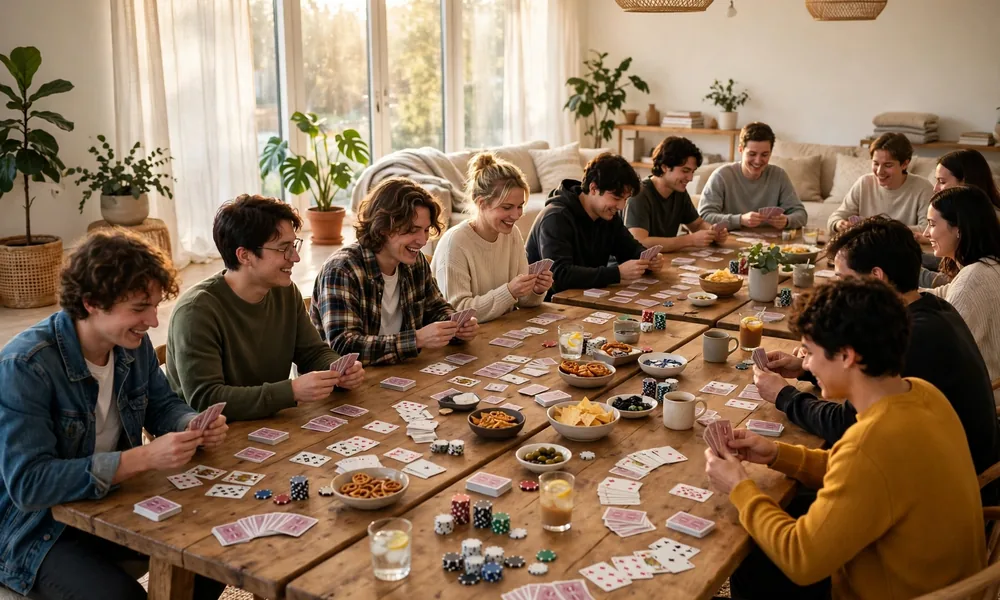
Set up five or six tables, each seating seven or eight players, following the same multi-table layout as the best card games for 39 players. Round tables work well for conversation, while long tables suit team games and tournaments. Leave a clear space in the middle of each table for the draw pile and the discard pile, and keep drinks at the edge of the table or on a side table so that a spilled glass does not end the game.
Decks, Tables and Rotation
A practical layout for 41 players is six tables: five tables of seven and one table of six. After each round, move the top two scorers at each table up one table and the bottom two scorers down one table. This rotation, borrowed from bridge clubs, keeps the competition balanced and means every player meets a fresh set of opponents in every round. After four or five rounds, the players with the highest total scores advance to a final table.
Keeping the Pace Fast
The Best Card Games for 41 Players
The games below are ordered from the easiest to explain to the ones that reward a little more strategy. All of them work with 41 players when split across tables, and all of them can be played with ordinary decks or with inexpensive commercial card sets. Start the evening with a fast, noisy game to warm the room up, then move on to the deeper games once everyone is comfortable.
1. Uno With Multiple Decks
Uno is one of the easiest games to scale up, because its rules are already familiar to most people. For 41 players, use four or five Uno decks shuffled together across your tables, with one deck per table of seven or eight. The colour matching and action cards work exactly as usual, and the familiar rules mean you can start playing within two minutes of sitting down.
Uno works especially well as the opening game of the night. It needs no explanation for most guests, it produces plenty of laughter, and it gives the host time to sort out seating and scorekeeping while everyone is already having fun. Keep a spare deck handy, because Uno cards tend to wander off during excited play.
2. President
President, also known as Scum or Asshole, is a shedding game that scales beautifully to large groups. The aim is simple: get rid of all your cards before anyone else. Players take turns playing single cards or sets of equal cards that beat the previous play, and anyone who cannot beat the last play must pass. The first player out becomes the President, the last player out becomes the Scum, and the titles carry small privileges in the next round.
With seven or eight players per table, use two decks shuffled together so the draw pile stays deep and the game keeps moving. The social titles give the game its charm: the President gets the best seat and the first deal, while the Scum hands over their two best cards at the start of the next round. This light role-playing makes the game memorable and gives quieter players a reason to join in the banter.
3. Spoons
Spoons is a fast, physical matching game that brings instant energy to a large room. Each table needs a set of spoons, one fewer than the number of players, placed in the middle of the table. Players pass cards around the table, trying to collect four of a kind, and the moment one player has four matching cards they quietly grab a spoon. Every other player must then grab a spoon too, and the player left without one is out or loses a point.
For 41 players, run Spoons at all six tables at the same time. The passing is simultaneous, so nobody waits for a turn, and the scramble for spoons produces the loudest laughter of the evening. Use plastic spoons rather than metal ones to avoid bruised knuckles and scratched tables, and keep a few spare spoons nearby.
4. Cheat
Cheat, also called Bullshit, is a bluffing game that thrives on large groups. Players take turns discarding cards face down while announcing what they are, and the announcement does not have to be true. Any player who doubts the claim can call out the bluffer, and the cards are revealed. If the bluffer was lying, they pick up the whole pile; if they were telling the truth, the challenger picks it up instead.
The game works best with seven or eight players and two decks shuffled together, because a bigger pile raises the stakes of every bluff. With 41 players across six tables, the room fills with accusations, laughter and dramatic reveals, and the social side of the game matters as much as the cards themselves. The first player to shed all their cards wins the round.
5. Rummy Tournament
Rummy is a classic melding game that suits a tournament format perfectly. Each player tries to form sets of three or four cards of the same rank, or runs of three or more cards in sequence in the same suit. Players draw and discard in turn, and the round ends when one player lays down all their cards. Unmatched cards left in other players hands count against them, so every discard matters.
For tables of seven or eight, use two decks shuffled together and deal ten cards to each player. The larger draw pile keeps the game moving and gives players a fair chance of completing their melds. Award tournament points based on finishing position at each table, with the winner taking the most points and the remaining places scored in order. The format is close to the best card games for 38 players, which use the same melding style at slightly smaller tables.
6. Canasta in Partnerships
Canasta is a partnership game that was made for large groups. Players work in pairs to build melds of seven cards, called canastas, and score points for the melds they complete. The game traditionally uses two decks plus jokers, which is exactly the right quantity for a table of seven or eight when players are split into partnerships with a shared score.
For 41 players, seat four partnerships at some tables and run a rotating partner system so that nobody is stuck with the same partner all night. Each round, partners sit opposite each other and combine their scores, and after each round the partnerships change. This keeps the game social and stops one strong pair from dominating the evening.
7. Crazy Eights Mega Deck
Crazy Eights is a simple shedding game that every generation seems to know. Players match the top card of the discard pile by rank or suit, and eights are wild and can be played on anything. The first player to shed all their cards wins the hand. The rules take thirty seconds to explain, which makes it ideal for groups that include children, grandparents, and guests who rarely play cards.
For 41 players, shuffle two decks together at each table and deal seven cards to each player. The extra cards keep the draw pile deep and stop the game from stalling when several players in a row cannot match the discard pile. Because the rules are so simple, Crazy Eights is also the best game on this list for the final round of the evening, when energy is high and attention spans are shorter.
8. Slapjack Tournament
Slapjack is a reaction game that turns a quiet room into a noisy one within seconds. Players take turns flipping cards onto a central pile, and when a jack appears everyone slaps the pile. The fastest hand wins the pile, and the player who collects all the cards wins the game. There is no strategy to learn, only reflexes and nerve.
With 41 players, Slapjack works best as a knockout tournament. Start with six tables, run quick games at each, and send the winners forward to a semi-final table and then a grand final. The knockout format builds excitement as the evening goes on, and the final table draws a crowd of spectators who cheer every slap.
9. Phase 10 Party Format
Phase 10 is a rummy-style game with a clever twist: each player must complete a specific phase, such as two sets of three or a run of seven, before moving on to the next one. Everyone works through the same ten phases in order, but at their own pace, so a player who falls behind can still catch up with a strong hand. This structure makes the game fair and forgiving for mixed-ability groups.
For 41 players, buy five or six Phase 10 sets, one per table, and play a shortened version using only the first five phases if time is limited. A full ten-phase game can take over an hour, which is too long for a multi-game evening, but five phases fit neatly into forty-five minutes and still feel complete. Score each table winner and carry the results into the evening tournament.
10. Dutch Blitz and Nerts Race
Dutch Blitz and its close cousin Nerts are speed games in which every player plays at the same time. Each player has their own small deck and races to build shared piles in the centre of the table, playing cards in ascending order by suit and colour. There are no turns at all, which makes these games the fastest on this list and the best answer to the problem of waiting.
For 41 players, you will need one Dutch Blitz set per four players, so buy ten or eleven sets to cover the whole group. Seat players in groups of four at each table, with several small games running side by side, and award points to the winners of each mini-game. The simultaneous play means a full game takes only five minutes, so you can run many rounds in a short time.
Comparison Table: Card Games for 41 Players at a Glance
| Game | Decks Needed | Time per Round | Best For | Difficulty |
|---|---|---|---|---|
| Uno (multi-deck) | 4 to 5 Uno decks | 15 minutes | Opening game, all ages | Easy |
| President | 12 standard decks | 15 minutes | Social play, quick rounds | Easy |
| Spoons | 6 standard decks | 15 minutes | Energy and laughter | Easy |
| Cheat | 12 standard decks | 20 minutes | Bluffing and banter | Easy |
| Rummy | 12 standard decks | 20 minutes | Tournament play | Medium |
| Canasta | 12 standard decks plus jokers | 30 minutes | Teamwork and strategy | Medium |
| Crazy Eights | 12 standard decks | 10 minutes | All ages, late night | Easy |
| Slapjack | 6 standard decks | 10 minutes | Knockout tournament | Easy |
| Phase 10 | 6 Phase 10 sets | 45 minutes | Main event, structured play | Medium |
| Dutch Blitz | 10 to 11 sets | 5 minutes | Speed and competition | Easy |
Checklist for a 41-Player Card Game Night
- Buy at least twelve standard decks of cards, plus any commercial sets your chosen games need, and keep two spare decks at the host table.
- Set up six tables for seven or eight players each, with space in the middle of every table for draw and discard piles.
- Print a one-page rules sheet for each game and place one at every table before guests arrive.
- Appoint a table captain at each table and give them the score sheet for their table.
- Put up a visible scoreboard and update it after every round so the whole room can follow the tournament.
- Plan the running order in advance: a fast warm-up game, two medium games, an energy game, and a short closer, with breaks for food and drinks between rounds.
Frequently Asked Questions
How many decks of cards do you need for 41 players?
You need at least ten standard decks, and twelve is a safer number. Most games on this list use two decks per table of seven or eight players, so six tables need twelve decks. Buy decks with different coloured backs so each table keeps its own cards separate, and keep two spare decks for replacements.
What is the best card game for a very large group?
President is the best all-round choice for a very large group, because it is easy to learn, plays quickly, and works perfectly with two decks per table. Uno with multiple decks is the best choice if the group includes children or guests who rarely play cards, since almost everyone already knows the rules. For a full evening, combine several games rather than relying on one.
How do you organise 41 players into card game tables?
Split the group into six tables of six to eight players. After each round, move the top two scorers at each table up one table and the bottom two down one table. This rotation keeps the competition balanced, mixes the groups, and lets the highest scorers meet at a final table at the end of the evening.
Can children play card games with 41 players?
Yes, children can join in happily. Uno, Crazy Eights, Spoons and Slapjack are all suitable for children aged seven and up, and they work well at mixed-age tables where adults can help younger players with the rules. For a family event, start with these simpler games and add the thinkier games later once the children have had their fun.
How long does a card game night for 41 players last?
Plan for two and a half to three hours, including breaks. A good running order is four or five games of fifteen to twenty minutes each, with a ten-minute break for food and drinks in the middle. Shorter rounds keep the energy up, and a clear finish time helps guests plan their evening.
Do you need special cards for large group games?
Most games on this list need only standard playing cards, which keeps the cost low. Uno, Phase 10 and Dutch Blitz need their own commercial sets, which are inexpensive and widely available. Whatever you buy, choose sturdy cards that can survive enthusiastic play, and keep spares on hand.
The Bottom Line
The best card games for 41 players are the ones that keep everyone playing at the same time, explain in under two minutes, and scale with extra decks rather than extra complexity. Uno, President, Spoons, Cheat and Crazy Eights will warm the room up and keep it laughing, while Rummy, Canasta and Phase 10 give the evening its competitive heart. Add a visible scoreboard, six well-planned tables, and a rotation system, and 41 players stops being a logistical problem and becomes the best kind of crowd: big enough for a real tournament, and lively enough to make the night unforgettable. If you are planning a smaller gathering as well, the best party games for 39 players use the same multi-table approach and are an easy next read for your planning.


