
Finding the best board games for 49 players is a different challenge from choosing a game for a family of four. Almost no board game is designed for 49 people to sit around one table and take turns, so the best approach is to think in teams, tables, and rounds rather than in a single box. With the right format, 49 players can enjoy a lively, well-organised game night where everyone plays, nobody waits too long, and the evening still feels like one shared event.
The best board games for 49 players are therefore the games that scale well, split cleanly into teams, or work brilliantly as a tournament across several tables. Party games with team play, word games with a single clue-giver, and strategy games run in parallel heats all fit this brief. The games in this guide were chosen because they keep large groups engaged, use simple rules that can be explained in minutes, and create moments that the whole room can share.
This guide explains how to organise 49 players, compares the strongest options side by side, and gives you a practical plan for the night. Whether you are planning a school event, a work social, a club night, a birthday party, or a community gathering, you will find a format that works for your space, your time, and your players. If you have run a slightly smaller night before, the ideas in our guide to the best board games for 48 players will feel familiar, and most of the same principles apply here with one extra player to place.
Key takeaways
- No single board game seats 49 players at one table, so plan for teams, multiple tables, or a tournament format.
- Team party games such as Codenames, Wavelength, and Two Rooms and a Boom scale best for very large groups.
- Split 49 players into seven groups of seven, or into two large teams, to keep every round fast and fair.
- Choose games with rules that can be explained in under five minutes and rounds that last 15 to 30 minutes.
- Run heats in parallel and bring everyone together for a final round to keep the whole night feeling like one event.
Why 49 Players Changes Everything
A group of 49 is large enough to fill a hall, but small enough to organise well if you plan ahead. The main problem is not finding a fun game. It is finding a format that gives everyone a meaningful role. In a normal game, each player takes a turn, makes decisions, and watches the board change. With 49 turns, that cycle becomes far too slow, and most players would spend the evening waiting.
Team play solves this problem. When 49 players are split into teams, each team discusses, debates, and decides together. Every player can contribute ideas, even if only one person moves a piece or gives a clue. Games built around discussion, guessing, and deduction work especially well in this format because talking is the game, not waiting for a turn.
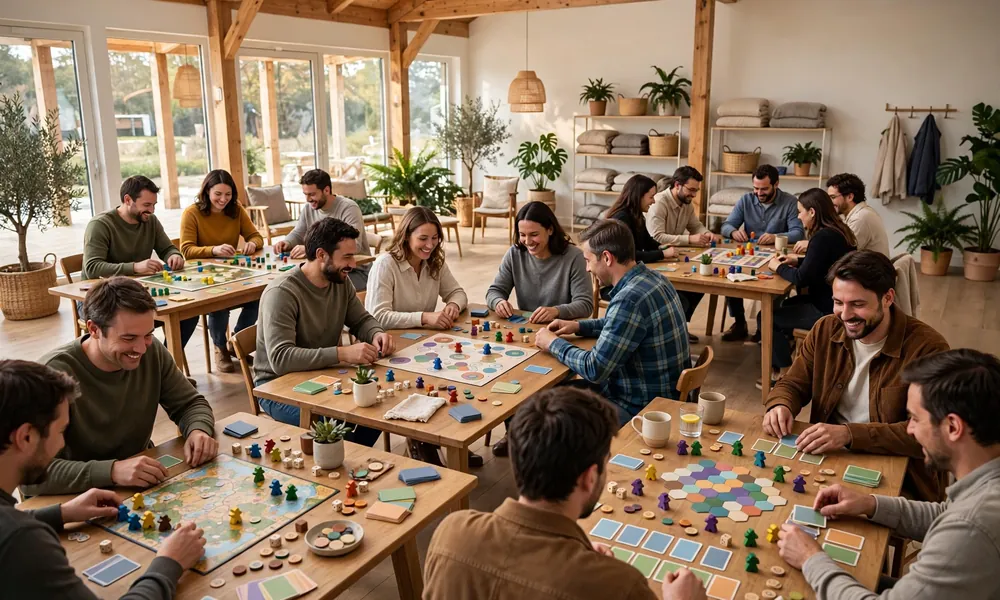
Parallel tables solve the problem in a different way. Seven tables of seven players each can run the same game at the same time, with winners advancing to a final table. This format suits strategy games and card games that work best with four to seven players. It also gives the evening a clear structure, with heats, semi-finals, and a final that everyone can watch.
How to Run Board Games for 49 Players
The simplest format for 49 players is two large teams. One team sits on each side of the room, or the teams mix across several tables, and the teams take turns. This works best for word games, guessing games, and quiz-style games where one clue or question can engage a whole team at once. The host manages the pace, keeps the score visible, and makes sure both teams get equal turns.
Whatever format you choose, appoint one host and one helper for every two or three tables. The host explains the rules, keeps time, and answers questions. The helpers watch for confusion, hand out pieces, and keep scores. With 49 players, you cannot rely on everyone hearing one set of instructions at the same time, so short written rule cards on each table help a great deal.
Best Board Games for 49 Players at a Glance
The table below compares the strongest choices for a group of 49. It shows how each game scales, how long a round takes, and what kind of group it suits best. Use it to pick a starting game, then read the detailed reviews below for the games that interest you most.
| Game | Best format for 49 | Round length | Best for |
|---|---|---|---|
| Codenames | Two large teams | 15 to 20 minutes | Word lovers and mixed groups |
| Wavelength | Two large teams | 20 to 30 minutes | Discussion and debate |
| Two Rooms and a Boom | Whole group, two rooms | 15 minutes | High energy and social deduction |
| Ticket to Ride | Seven tables, tournament | 30 to 45 minutes | Families and casual players |
| Catan | Seven tables, tournament | 45 to 60 minutes | Strategy fans |
| Azul | Seven tables, tournament | 30 to 40 minutes | Quiet, thoughtful play |
| Dixit | Seven tables, tournament | 30 minutes | Creative and visual players |
| Telestrations | Seven tables, parallel play | 20 to 30 minutes | Drawing and laughter |
| Wits and Wagers | Two large teams | 20 to 30 minutes | Trivia without expert knowledge |
| Just One | Two large teams | 20 minutes | Quick, cooperative fun |
The Best Board Games for 49 Players in Detail
1. Codenames
Codenames is one of the best board games for 49 players because it is built for two teams and scales easily. One player from each team gives one-word clues that link several words on a grid, and the rest of the team discusses which words to guess. With 49 players, you can split the room into two teams of 24 and 25, with one clue-giver per team and everyone else debating each guess.
The rules take about three minutes to explain, and a round takes 15 to 20 minutes. That makes Codenames ideal as a first game or as a warm-up before a tournament. It also works well for mixed groups, because it rewards clever thinking and teamwork rather than speed or specialist knowledge. Players who are quiet in other games often shine here, because a single good idea can win the round.
2. Wavelength
Wavelength is a team discussion game in which players try to place a target on a scale between two opposite ideas, such as hot and cold or boring and exciting. One player gives a clue, the team debates where the target lies, and the team scores points for accuracy. It is simple, funny, and endlessly replayable.
For 49 players, Wavelength works best as a two-team game, with the teams taking turns to guess. Each round takes a few minutes, and a full game takes 20 to 30 minutes. The game creates lively debate because there is rarely one obviously right answer, and players love arguing about whether a clue means a little hot or very hot.
3. Two Rooms and a Boom
Two Rooms and a Boom is a social deduction game designed for large groups, and it is one of the few games that genuinely works with 49 players at once. Players are split between two rooms, each with a hidden role, and they must find out who is on their team before time runs out. The game is fast, loud, and full of bluffing, negotiation, and surprise.
A round takes about 15 minutes, including the time needed to swap players between rooms. That short length makes it easy to play several rounds in an evening, with roles changing each time. The game needs two separate spaces, or one large room divided by a screen or a curtain, and a host who can keep time strictly.
4. Ticket to Ride
Ticket to Ride is a family-friendly strategy game in which players collect coloured train cards and claim railway routes across a map. It is easy to learn, visually clear, and satisfying to play. A standard game supports two to five players, so for 49 players you should run it as a tournament across several tables.
Set up seven tables with seven players each, or use the standard five-player limit and run ten tables with a mix of four and five players. Each table plays one game, and the winner from each table advances to a final. A game takes 30 to 45 minutes, so plan for two rounds plus a final if time allows.
5. Catan
Catan is a classic strategy game in which players build settlements, cities, and roads on an island, trading resources with each other to gain points. It supports three to four players in the standard game, and five to six with an extension, so for 49 players you need a tournament format with many tables.
A Catan game takes 45 to 60 minutes, which makes it one of the longer games in this guide. That length suits an evening where Catan is the main event, with a first round, a semi-final, and a final. It is less suited to a night where you want to play many short games, because a single round takes up a large part of the evening.
6. Azul
Azul is a beautiful tile-laying game in which players draft coloured tiles and place them on a board to score points. It supports two to four players, so for 49 players you should run it across many tables in parallel. A game takes 30 to 40 minutes, and the rules can be explained in about five minutes.
Azul is quieter and more thoughtful than the party games in this guide. It suits players who enjoy puzzles, patterns, and calm competition. It is also a good choice for mixed-age groups, because the tiles are colourful, the board is easy to read, and the game does not depend on fast reactions or specialist knowledge.
7. Dixit
Dixit is a creative storytelling game in which players use beautifully illustrated cards to give clues that are clear enough for some players to guess, but vague enough that not everyone guesses correctly. It supports three to six players, so for 49 players you need several tables running at the same time.
A game of Dixit takes about 30 minutes, and it works best with players who enjoy imagination, art, and lateral thinking. It is a gentle, friendly game with little direct conflict, which makes it a good choice for family events and community gatherings. The cards themselves are a talking point, and players often enjoy discussing the artwork as much as playing the game.
8. Telestrations
Telestrations is a drawing and guessing game that combines the fun of a telephone game with simple sketches. Each player draws a word, passes the sketch to the next player, who guesses the word, and the chain continues until the book returns to its owner. The results are often hilarious, and no drawing skill is needed.
The standard game supports four to eight players, so seven tables of seven players each works perfectly for 49 players. A round takes 20 to 30 minutes, and the game is easy to explain in two minutes. Telestrations is one of the best choices for breaking the ice, because it creates laughter from the first round.
9. Wits and Wagers
Wits and Wagers is a trivia game with a twist: players do not need to know the answer, they only need to guess closest to it. Each question has a numerical answer, players write down a guess, and then they bet on which guess they think is closest. This makes the game fair for everyone, including players who know little trivia.
For 49 players, Wits and Wagers works best as a two-team game, with teams discussing each question and placing a joint bet. A game takes 20 to 30 minutes, and seven questions make a good round. The game is lively, inclusive, and easy to follow, because every question creates a new discussion.
If your group also enjoys quiz-style play, the ideas in our guide to party games for 48 players include several other formats that work well alongside a trivia round. Wits and Wagers is a strong choice for a mixed group because it rewards judgement and teamwork rather than memorised facts.
10. Just One
Just One is a cooperative word game in which players write one-word clues to help a guesser identify a mystery word. If two players write the same clue, those clues are cancelled, so players must think of original, helpful hints. It is simple, fast, and very social.
The standard game supports three to seven players, so for 49 players you can run seven tables of seven, or split the room into two large teams with a shared mystery word. A game takes about 20 minutes, and the rules take less than two minutes to explain. Just One is an ideal first game because it gets everyone talking straight away.
How to Choose the Right Game for Your 49 Players
Card games can also work well in a large-group format, and the ideas in our guide to the best card games for 48 players show how to run card games across many tables without losing the sense of a shared event. The same principles apply here: keep the rules simple, keep the rounds short, and bring everyone together for a final round.
Planning Checklist for 49 Players
Use this checklist when you plan your night. It covers the practical details that make the difference between a smooth evening and a chaotic one.
- Choose your format first: two large teams, seven tables of seven, or a tournament with heats and a final.
- Pick two or three games that fit your players, your space, and your time, and have a spare game ready in case one does not work.
- Count your copies: make sure you have enough sets, boards, cards, and pieces for every table.
- Set up the room before players arrive, with labelled tables, chairs, score sheets, and pens.
- Appoint a host and helpers, and give each table a short written summary of the rules.
- Plan the timing: allow 15 to 30 minutes per round, with short breaks and a clear finish time.
Frequently Asked Questions
Can one board game really support 49 players?
Almost no standard board game supports 49 players at a single table. The best board games for 49 players are those that split into teams, run across several tables, or work as a tournament. Games such as Codenames, Wavelength, and Two Rooms and a Boom are designed for large groups, while strategy games such as Ticket to Ride and Catan work well in a tournament format.
What is the best format for 49 players?
The best format depends on your group and your space. Two large teams work best for word and party games, seven tables of seven work best for strategy and card games, and a tournament with heats and a final adds excitement to a longer evening. Many organisers use a mix: a team game to start, parallel tables in the middle, and a final that brings everyone together.
How long should a game night for 49 players last?
Two to three hours is a good length for a game night with 49 players. Allow 15 to 30 minutes per round, with short breaks between rounds. Three or four rounds is plenty. A longer night can work if you have a clear schedule and a mix of games, but a shorter, well-paced night is usually more enjoyable than a long night that drags.
Do I need many copies of the same game?
Yes, if you are running parallel tables. Each table needs its own copy of the game, including the board, cards, and pieces. For seven tables, you need seven copies. Borrow copies from friends or club members, or choose games that only need one set for the whole room, such as Codenames or Wavelength, which can be run as two-team games.
What if some players have never played board games before?
Start with a very simple game and explain the rules in under five minutes. Choose games that reward discussion and teamwork rather than specialist knowledge, such as Just One, Codenames, or Telestrations. Put experienced players at each table to help beginners, and keep the atmosphere friendly so that new players feel welcome.
How do I keep 49 players engaged for the whole night?
Keep rounds short, rotate players between tables, and bring everyone together for a final round. Use a visible scoreboard, announce results between rounds, and vary the types of games. Short breaks, snacks, and a clear schedule also help. The key is pace: players stay engaged when they are playing, discussing, or watching a final, not when they are waiting.
The Bottom Line
The best board games for 49 players are not the games with the biggest player counts on the box. They are the games that let 49 people play together, talk together, and share an evening, whether that means two large teams debating a clue in Codenames, seven tables competing in a Ticket to Ride tournament, or a whole room bluffing its way through Two Rooms and a Boom. Choose a format that fits your space, pick games your players will enjoy, keep the rounds short, and bring everyone together for a final. Do that, and 49 players will feel like one great game night, not 49 people waiting for a turn.


