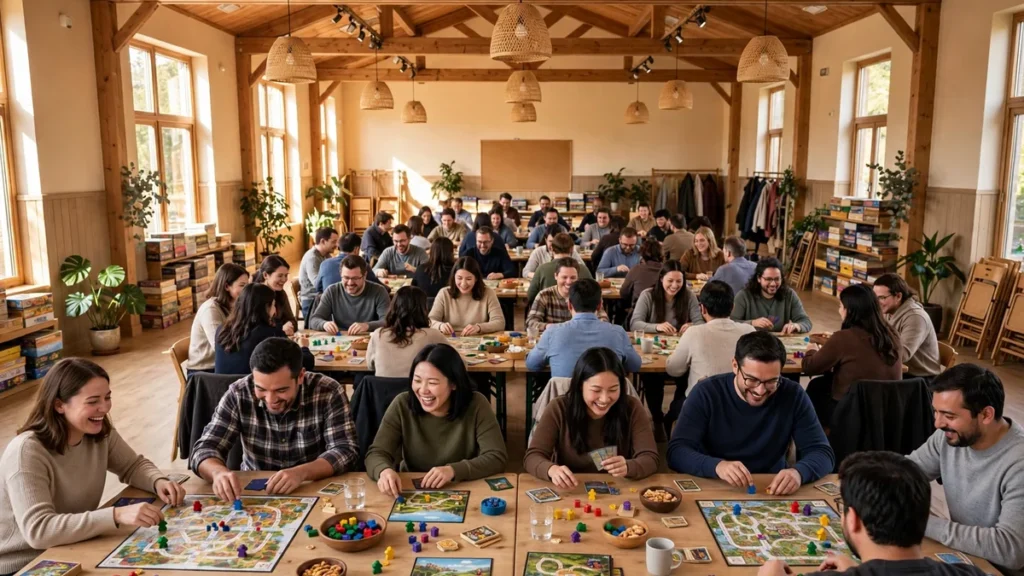
Planning board games for 137 players sounds impossible at first, and in one sense it is: no single board game on the shelf seats 137 people around one table. The biggest party games top out at 12, 20, or 30 players, and even those numbers stretch the definition of a single game. But board games for 137 players are absolutely possible once you stop thinking about one table and start thinking about one room. With the right mix of team play, multiple tables, and tournament formats, 137 people can all play together in the same event, on the same night, with the same shared result.
The trick is to pick games that scale sideways rather than upwards. A game that works brilliantly for 8 players can work for 137 if you run it across 17 tables at once, split the room into teams with a captain at each table, or run it as a relay where every table’s score feeds one leaderboard. The games in this guide were chosen because they survive that kind of scaling: simple rules that a host can explain once to the whole room, short rounds that keep every table in sync, and scoring that works when dozens of teams are competing at the same time.
This guide covers the three formats that work for a group of 137, the best games for the job, and a hosting plan you can run with a few copies of each game, a whiteboard for scores, and one confident host. Whether this is a school event, a company party, or a large family gathering, the plan below gets all 137 players into the game.
Key takeaways
- No single board game seats 137 players, so plan for team play, multiple tables, or a tournament instead of one giant table.
- Pick games with rules a host can explain to the whole room in under two minutes.
- Buy or borrow multiple copies of the same game so every table plays the same round at the same time.
- Use one shared leaderboard so all 137 players feel part of a single competition.
- Keep rounds short and rotate roles so nobody sits out for long.

| Game | Best format for 137 | Copies needed | Why it works at this size |
|---|---|---|---|
| Codenames | Team play, multiple tables | 6 to 8 | Two-team word play that scales cleanly with a shared timer |
| Two Rooms and a Boom | Whole-room, parallel games | 5 to 6 | Built for very large groups with hidden roles |
| Wavelength | Tournament, multiple tables | 6 to 8 | One clue, whole-room guessing, easy shared scoring |
| Telestrations | Multiple tables, relay | 10 to 12 | Drawing and guessing needs no talking across tables |
| Wits & Wagers | Whole-room, team play | 4 to 6 | Trivia-style betting works with any number of teams |
| Just One | Tournament, multiple tables | 8 to 10 | Cooperative guessing, one word per player, no elimination |
| One Night Ultimate Werewolf | Parallel games, tournament | 8 to 10 | Ten-minute rounds let every table finish together |
Why No Single Board Game Seats 137 Players
Board games are designed around a table, and a table has a physical limit. Players need to reach the board, read the cards, and hear each other. Once a game passes about 12 players, turns get slow, downtime grows, and the people at the far end of the table stop paying attention. At 20 players most games break down entirely, and at 137 players a single game is not a game at all, it is a crowd watching a few people play. Any guide that claims otherwise is selling a fantasy, so this guide starts with the honest answer and builds a real plan from it.
That does not mean 137 people cannot share one game night. It means the game has to be organised the way a sports tournament is organised: many small games feeding into one result. A football league does not put 137 players on one pitch, and a board game night for 137 players should not put 137 people around one board. Instead, you run the same game at many tables, or split the room into teams, and you keep everyone connected through shared rounds, a single host, and one leaderboard that the whole room can see.
The number 137 also has a practical side: seventeen tables of eight use 136 seats, leaving one host free, and ten teams of thirteen or fourteen work well for team games with a captain each. Work with the number rather than against it, and the size of the group becomes a feature of the night instead of a problem.
The Three Formats That Actually Work for 137 Players
Every successful large-group game night uses at least one of three formats, and most use all three across the evening. Choose your format first, then choose games that fit it.
Multiple Tables, Same Game, Same Round
This is the simplest format and the one this guide recommends for most of the evening. Every table plays the same game, and the host calls the start and end of each round for the whole room. With 17 tables of eight players, you need 17 copies of the game in theory, but in practice most party games can be shared across two neighbouring tables, or played with one copy per table using a shared timer. The key is synchronisation: when every table starts and finishes together, the room feels like one event rather than seventeen separate ones.
Multiple tables work best with games that have short, fixed rounds and no player elimination. Telestrations, Just One, and Wavelength all fit because a round takes five to ten minutes and nobody is knocked out early. The host walks the room, keeps the energy up, and collects scores at the end of each round. The main cost is copies of the game, so borrow from friends or ask players to bring their own copies of the same title.
Team Play With Captains
Team play is the format to use when you want the whole room in a single game at the same time. Split the 137 players into teams of ten to fourteen, give each team a captain, and let the captain make the team’s moves while the rest of the team discusses, shouts suggestions, and votes. Codenames is the classic example: the spymaster gives a clue, and the whole team debates which words it points to. Wits & Wagers works the same way, with each team agreeing on one answer and one bet.
Team play needs far fewer copies of a game, often just one set plus a way for every team to see the board, such as a projector or a large printed board. It also needs a strong host, because a team game with 137 people can turn noisy. Set one clear rule before you start: only the captain speaks to the host, and teams discuss among themselves. That single rule keeps the room manageable and the game moving.
Tournament and Relay Formats
A tournament format turns the evening into a competition with a winner, which suits groups that enjoy a little rivalry. Each table plays a short game, the winners move up, and the final tables play a championship round while the rest of the room watches, cheers, and plays a side game. A relay format is similar but cooperative: each table completes one stage, such as one round of Telestrations, and passes its result to the next table. Both formats give the night a shape and a finish line.
Tournaments work best as the final hour of the evening rather than the whole night, because early elimination leaves people with nothing to do. Keep everyone involved by running a consolation bracket, or by making the final a whole-room game where every team can still score points. The best large-group nights end with everyone playing, not with 130 people watching seven.
The Best Games for 137 Players, Format by Format
Each game below is judged on the same four questions: can a host explain it in two minutes, does a round finish in ten minutes or less, does it work when many tables play at once, and does it keep all 137 players involved rather than a few stars. Every game here passes all four. The copy counts are realistic for a group this size, so plan to borrow, rent, or ask players to bring copies.
Codenames
Codenames is the strongest single choice for board games for 137 players because it is a team word game in which the whole team plays on every turn. One spymaster gives a one-word clue, the team debates, and the captain points at the words. With 137 players, split the room into ten teams of thirteen or fourteen, give each team a captain and a spymaster, and run several copies at once with a shared five-minute timer per round. The same word grid can even be projected for the whole room, so every team works from the same board and the scores compare directly.
What makes Codenames special at this size is that talking is the game. Nobody waits for a turn, because the discussion never stops, and quieter players can contribute a single word that changes the round. If your group already enjoys word play, our guide to the best word games for adults has more titles that work the same way in teams.
Two Rooms and a Boom
Two Rooms and a Boom is one of the few games actually designed for very large groups, with a standard game supporting up to 30 players per room pair. For 137 players, run five parallel games in five pairs of rooms or marked zones, each with its own moderator, and bring everyone together between rounds to compare results. Each game takes about fifteen minutes, players have hidden roles and secret goals, and the whole room is talking, trading information, and trying to work out who to trust.
The game needs a confident host in each zone and a clear briefing before the first round, because hidden-role games fall apart if half the room does not understand their card. Run one short practice round with open roles first, then play for real. It is loud, chaotic, and memorable, which is exactly what a group of 137 needs after an hour of quieter table games. For groups that like this kind of puzzle, escape-room board games offer the same hidden-clue thrill at a single table.
Wavelength
Wavelength is a guessing game built around one idea: the clue giver picks a point on a hidden scale, gives a clue, and the team guesses where the point sits. It plays in about twenty minutes, supports up to 12 players per copy, and translates beautifully to a whole room because the clue and the scale can be shown to everyone at once. Run six to eight copies across the tables, use the same target cards at every table, and award points on a shared leaderboard.
The reason Wavelength works for 137 players is that the debate is the fun: teams argue about what a clue means, and every player has an opinion worth hearing. The rules take ninety seconds to explain, and it suits mixed groups where some players have never played a modern board game.
Telestrations
Telestrations is the drawing-and-guessing game where each player sketches a word, passes the sketch on, and the next player guesses what it shows. A single copy supports 12 players, so ten to twelve copies cover 137 players across the tables, and the game needs no talking between tables at all. That makes it the easiest game in this guide to run at scale: hand out the books, start the timer, and let the room get on with it.
Telestrations also solves the mixed-ability problem: bad drawings are the funniest part, and nobody is eliminated, so everyone plays every round. At the end of each round, each table votes for its funniest chain, and the host reads the winners aloud. That shared reveal turns separate tables into one event, so do not skip it.
Wits & Wagers
Wits & Wagers is a trivia betting game in which teams answer a numerical question, place their chips on the answer they trust most, and score for being right or for backing the right guess. It is the closest thing in this guide to a whole-room quiz, and it scales to 137 players with almost no extra equipment: one host, one set of questions, and one answer sheet per team. If you want a dedicated quiz night for a crowd this size, our list of trivia games built for 100 players shows how the same format works for very large groups.
The betting mechanic is what makes Wits & Wagers better than an ordinary quiz for 137 players: a team that does not know the answer can still win chips by betting on another team’s sensible guess, so nobody is ever out of the game. Use numerical questions, such as how many days or how tall, so every team can make a reasonable guess.
Just One
Just One is a cooperative guessing game in which all but one player write a one-word clue, duplicate clues are removed, and the guesser has to work out the mystery word from what is left. It plays up to seven per copy, so eight to ten copies cover the room, and because it is cooperative, there are no winners and losers at each table, only a shared score. That makes it the gentlest game in this guide and a good choice for groups with mixed ages or nervous first-time players.
The duplicate-clue rule creates a moment of drama at every table at the same time, when the host calls for clues to be revealed. Keep the mystery words easy for the first two rounds, then use harder words once the room understands the strategy.
One Night Ultimate Werewolf
One Night Ultimate Werewolf is a ten-minute hidden-role game in which each player gets one role, one night phase, and one day of discussion before the room votes. A copy supports up to ten players, so eight to ten copies run in parallel across the tables, and because each game lasts only ten minutes, every table finishes at roughly the same time. The host then collects the results, reshuffles the roles, and starts the next round with the whole room in sync.
The short rounds are the point: nobody sits out, and a bad round is forgotten in ten minutes. Use the free companion app to run the night phase, and keep the role mix simple for the first two rounds. It is the best closing game in this guide: fast, loud, and easy to repeat until the night ends.
Your 137-Player Game Night Checklist
- Count the room first: confirm 137 players, then plan 17 tables of eight with one host free.
- Pick one format for each hour: multiple tables, team play, then a tournament finish.
- Borrow or buy enough copies: six to twelve copies per title, depending on the game.
- Print a one-page rules summary for every table so the host only explains each game once.
- Set up a visible leaderboard on a whiteboard or projector before anyone arrives.
- Keep rounds to ten minutes, announce the time, and collect scores at the end of each round.
Frequently Asked Questions
Can one board game really seat 137 players?
No. No single board game seats 137 players around one table, and any claim that one does should not be trusted. The games in this guide work for 137 players through team play, multiple tables, and tournament formats, where many small games feed into one shared result.
How many copies of a game do I need for 137 players?
It depends on the game, but plan for six to twelve copies of each title. Games that support 12 players per copy need about twelve copies, while team games that use one board per team need far fewer. Borrowing copies from players is the easiest way to reach the number without buying everything.
What is the best game for 137 players?
Codenames is the best all-round choice because the whole team plays on every turn and it scales cleanly with captains and a shared timer. Two Rooms and a Boom is the best choice if you want a single whole-room experience, and Telestrations is the easiest to run across many tables.
How long does a 137-player game night take?
Plan for two to three hours: thirty minutes for arrival and the first explanation, ninety minutes of play, and thirty minutes for the final round and results.
Do I need a microphone and a projector?
A microphone is essential for 137 players, because a host without one cannot be heard across a large hall. A projector is very useful for the leaderboard and shared boards, but a large whiteboard works just as well.
What if some players have never played a board game?
Choose the games in this guide and you will be fine, because every one of them can be explained in under two minutes. Start with Just One or Telestrations, which are cooperative and need no experience, and save the hidden-role games for later in the evening once everyone is comfortable.
The Bottom Line
Board games for 137 players are not about finding one magical game with 137 seats. They are about choosing games that scale sideways, running them across many tables or in teams, and keeping all 137 players connected through shared rounds and one leaderboard. Start with Codenames or Wits & Wagers for team play, add Telestrations and Just One for easy multi-table rounds, and finish with a fast tournament round of One Night Ultimate Werewolf. With the right format, enough copies, and a confident host, 137 players is not too many for a board game night. It is exactly the right number for a great one.