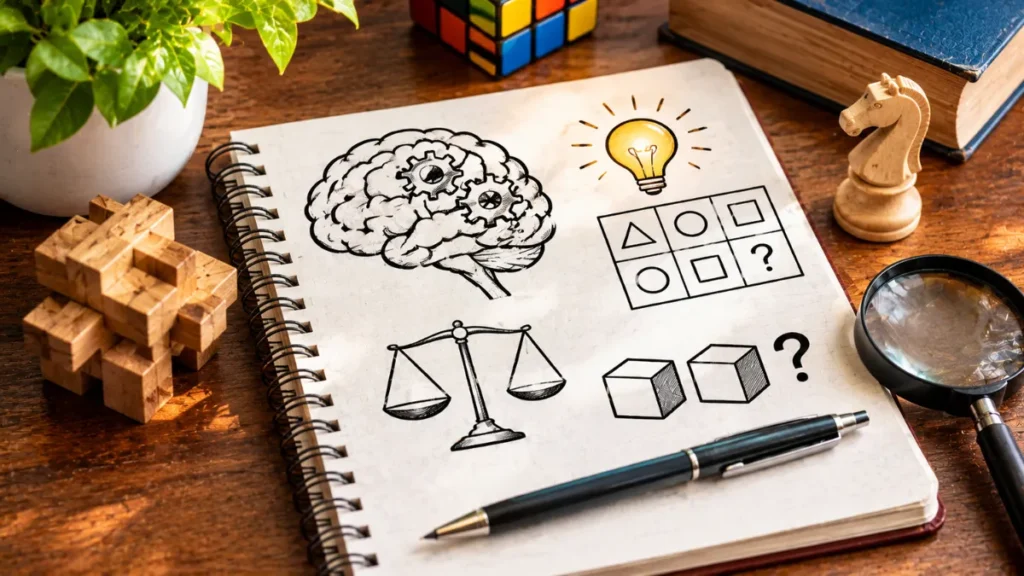
Do you enjoy solving tricky problems and discovering clever solutions? Logic puzzles are an excellent way to challenge your mind, improve critical thinking, and develop problem-solving skills. They encourage you to analyze information, recognize patterns, and use reasoning instead of simply guessing.
Whether you’re looking for entertaining logic questions, difficult logic puzzles, or fun brain teasers to share with friends, there’s something for everyone in this collection.
In this guide, you’ll find 25 logic puzzles with answers, ranging from simple number challenges to more difficult reasoning problems. Each puzzle includes an explanation so you can understand how the solution works.
What Are Logic Puzzles?
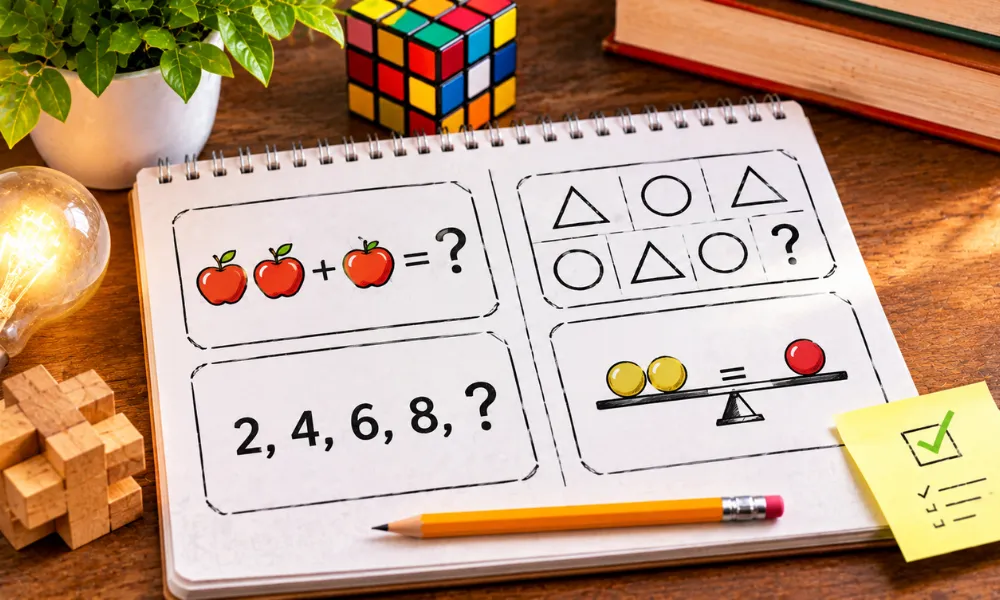
Logic puzzles are problems that require you to use reasoning, deduction, and analytical thinking to find the correct answer. Instead of relying on luck, you examine the available clues and eliminate possibilities until you reach a logical conclusion.
These puzzles come in different forms, including:
- Number puzzles: Identify patterns and calculate missing numbers.
- Deduction puzzles: Use clues to determine what happened or who is responsible.
- Sequence puzzles: Find the next number or item in a pattern.
- Lateral thinking puzzles: Approach a problem from an unexpected perspective.
- Visual logic puzzles: Use shapes, symbols, or diagrams to identify solutions.
Logic puzzles are popular among students, adults, teachers, and anyone who enjoys a good mental challenge.
Easy Logic Puzzles with Answers
Start with these simple logic questions to warm up your brain. They are suitable for beginners and anyone who wants to practice basic reasoning.
1. Find the Missing Number
Look at this number sequence:
2, 6, 12, 20, 30, ?
What number comes next?
Answer: 42
Explanation: The differences between the numbers are 4, 6, 8, and 10. Each difference increases by 2, so the next difference is 12. Therefore, 30 + 12 = 42.
2. The Family Puzzle
A family has two parents and three children. Each child has one sister. How many people are in the family?
Answer: 6 people.
Explanation: The family consists of two parents, three children, and one sister shared by all three children. This means there are four children in total, making six family members.
3. The Three Boxes
You have three boxes labeled Apples, Oranges, and Mixed. Every label is incorrect. You can take only one fruit from one box. How can you correctly label all three boxes?
Answer: Pick one fruit from the box labeled Mixed.
Explanation: Since every label is wrong, the box marked Mixed cannot contain a mixture. If you pick an apple, that box must contain only apples. The box labeled Oranges cannot contain oranges, and it cannot contain apples because those are already identified, so it must contain mixed fruit. The remaining box contains oranges. The same reasoning works if you pick an orange.
4. The Overtaking Question
You are running a race and overtake the person in second place. What position are you in now?
Answer: Second place.
Explanation: When you pass the runner in second place, you take their position. You are not first because the runner who was leading is still ahead.
5. The Machine Puzzle
If five machines take five minutes to make five products, how long will 100 machines take to make 100 products, assuming every machine works at the same rate?
Answer: 5 minutes.
Explanation: Each machine makes one product in five minutes. Therefore, 100 machines can make 100 products simultaneously in five minutes.
Tricky Logic Questions with Answers
These puzzles require more attention to detail. Read each question carefully before checking the answer.
6. The Light Switch Puzzle
You are standing outside a closed room. There are three switches outside, but only one controls the light bulb inside. You can operate the switches however you like, but you may enter the room only once. How can you identify the correct switch?
Answer: Use the bulb’s heat.
Explanation:
- Turn on the first switch and leave it on for several minutes.
- Turn it off and turn on the second switch.
- Enter the room.
If the bulb is glowing, the second switch controls it. If it is off but warm, the first switch controls it. If it is off and cool, the third switch controls it.
7. The Two Doors Puzzle
You are standing before two doors. One leads to safety, and the other leads to danger. Two guards stand nearby. One always tells the truth, while the other always lies. You don’t know which guard is which. You can ask only one guard one question. What should you ask?
Answer: Ask either guard, “Which door would the other guard say leads to safety?” Then choose the opposite door.
Explanation: The truthful guard honestly reports the liar’s incorrect answer. The lying guard lies about the truthful guard’s correct answer. Both point you toward the dangerous door, so you should choose the opposite one.
8. The Three Switches and Three Bulbs
You have three switches and three bulbs in another room. Each switch controls one bulb. You can enter the room only once. How can you match every switch to its bulb?
Answer: Use the same heat-and-light method as the single-bulb puzzle.
Explanation: Turn on the first switch for several minutes, then turn it off. Turn on the second switch and enter the room. The glowing bulb belongs to the second switch, the warm but unlit bulb belongs to the first, and the cool, unlit bulb belongs to the third.
9. The Coin Puzzle
You have two coins that add up to 30 cents. One of them is not a nickel. What are the two coins?
Answer: A quarter and a nickel.
Explanation: One coin is not a nickel, but the other one is. A quarter and a nickel add up to 30 cents.
10. The Clock Puzzle
A clock takes five seconds to strike six times. How long will it take to strike twelve times, assuming the time between strikes stays the same?
Answer: 11 seconds.
Explanation: Six strikes create five intervals between them. If five intervals take five seconds, each interval takes one second. Twelve strikes create eleven intervals, so they take eleven seconds.
Difficult Logic Puzzles with Answers

Ready for a bigger challenge? These difficult logic puzzles require careful reasoning, planning, and the ability to connect several clues. If you’re looking for more ways to challenge your thinking with friends, explore these 30 fun party games for entertaining activities that combine creativity, teamwork, and problem-solving.
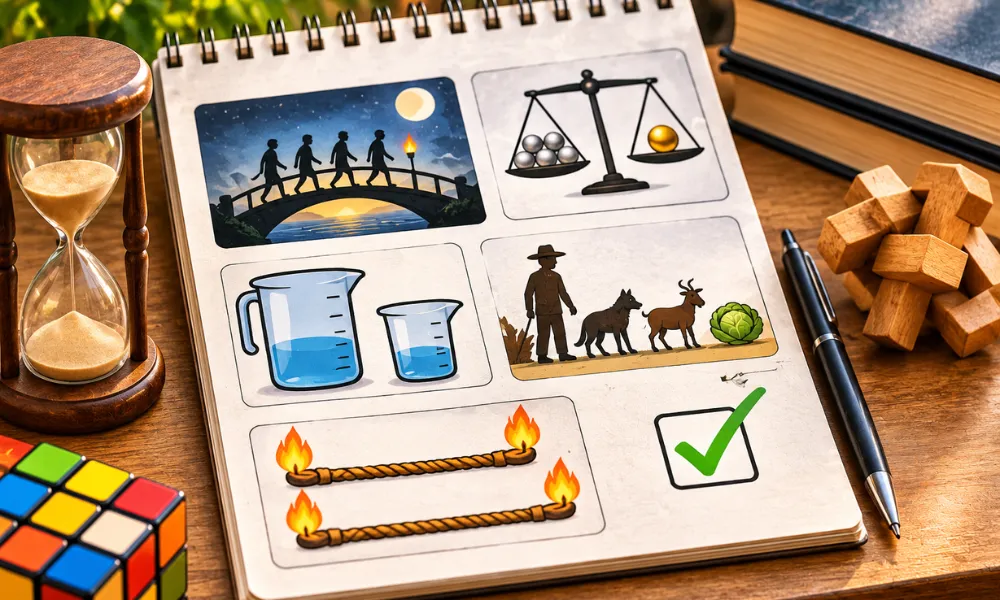
11. The Bridge Crossing Puzzle
Four people need to cross a bridge at night. They have one flashlight, and no one can cross without it. The bridge can hold only two people at a time.
Each person takes a different amount of time to cross:
- Person A: 1 minute
- Person B: 2 minutes
- Person C: 7 minutes
- Person D: 10 minutes
When two people cross together, they move at the slower person’s speed. What is the shortest time needed for everyone to cross?
Answer: 17 minutes.
Explanation:
- A and B cross together: 2 minutes.
- A returns with the flashlight: 1 minute.
- C and D cross together: 10 minutes.
- B returns with the flashlight: 2 minutes.
- A and B cross together again: 2 minutes.
Total time: 2 + 1 + 10 + 2 + 2 = 17 minutes.
12. The Eight Balls Puzzle
You have eight identical-looking balls, but one is heavier than the others. You have a balance scale and can use it only twice. How can you find the heavier ball?
Answer: Divide the balls into groups of three, three, and two.
Explanation:
- Weigh three balls against another three.
- If both sides balance, the heavier ball is among the remaining two. Weigh those two against each other to find it.
- If one side is heavier, the heavier ball is among the three on that side. Weigh two of those balls against each other.
- If one is heavier, you have found it. If they balance, the third ball is the heavier one.
You can identify the heavier ball in just two weighings.
13. The Water Jug Puzzle
You have a five-liter jug and a three-liter jug. Neither jug has measurement markings. How can you measure exactly four liters of water?
Answer: Use the two jugs in a sequence.
Explanation:
- Fill the five-liter jug completely.
- Pour water into the three-liter jug until it is full. Two liters remain in the five-liter jug.
- Empty the three-liter jug.
- Pour the remaining two liters into the three-liter jug.
- Fill the five-liter jug again.
- Pour water from the five-liter jug into the three-liter jug until it is full. Since the smaller jug already contains two liters, it needs only one more liter.
Exactly four liters remain in the five-liter jug.
14. The Farmer’s Crossing Puzzle
A farmer needs to cross a river with a wolf, a goat, and a cabbage. His boat can carry only the farmer and one item at a time.
He cannot leave the wolf alone with the goat, and he cannot leave the goat alone with the cabbage. How can he transport everything safely?
Answer: Follow this sequence.
Explanation:
- Take the goat across first.
- Return alone.
- Take the wolf across.
- Bring the goat back.
- Take the cabbage across.
- Return alone.
- Take the goat across again.
Now the wolf, goat, and cabbage are all safely on the other side.
15. The Two Ropes Puzzle
You have two ropes. Each rope takes exactly 60 minutes to burn completely, but they burn unevenly. You have a lighter and need to measure exactly 45 minutes. How can you do it?
Answer: Light the first rope at both ends and the second rope at one end.
Explanation:
- Light both ends of the first rope and one end of the second rope at the same time.
- The first rope burns completely in 30 minutes.
- At that moment, light the other end of the second rope.
- The remaining portion of the second rope now burns from both ends and takes 15 minutes.
Total time: 30 + 15 = 45 minutes.
Logical Reasoning Puzzles for Adults

These logical reasoning puzzles test your ability to identify patterns, evaluate information, and make decisions using the available clues. For another fun mental challenge, try 80s trivia questions to test your knowledge, recall historical facts, and sharpen your thinking skills.
16. The Lily Pad Puzzle
A pond is covered with lily pads. Every day, the number of lily pads doubles. If the pond is completely covered on the 48th day, on which day was it half-covered?
Answer: The 47th day.
Explanation: The lily pads double every day. Therefore, the pond must have been half-covered one day before it became completely covered.
17. The Brothers and Sisters Puzzle
A girl has as many brothers as sisters. However, each of her brothers has twice as many sisters as brothers. How many boys and girls are in the family?
Answer: 3 boys and 4 girls.
Explanation: Each girl has three brothers and three sisters other than herself. Each boy has four sisters and two brothers. Therefore, the family has three boys and four girls.
18. The Three People Puzzle
Two fathers and two sons go to a restaurant. Each person orders one meal, but the waiter receives only three orders. How is this possible?
Answer: There are only three people.
Explanation: The group consists of a grandfather, his son, and his grandson. The grandfather and father are two fathers, while the father and grandson are two sons.
19. The Number Pattern
Find the missing number:
1, 4, 9, 16, 25, ?
Answer: 36.
Explanation: These numbers are perfect squares:
- 1 × 1 = 1
- 2 × 2 = 4
- 3 × 3 = 9
- 4 × 4 = 16
- 5 × 5 = 25
- 6 × 6 = 36
20. The Three Hats Puzzle
Three people stand in a line, one behind another. The person at the back can see the two people in front. The middle person can see only the person in front, and the person at the front cannot see anyone.
They are given hats chosen from three black hats and two white hats. Each person can see the hats ahead but not their own.
The person at the back says they cannot determine their hat color. The middle person also says they cannot determine theirs. The person at the front then correctly identifies their own hat color.
What color is the front person’s hat?
Answer: Black.
Explanation: If the back person had seen two white hats, they would know their own hat had to be black because only two white hats exist. Since they cannot determine their color, the two hats ahead are not both white.
The middle person knows this. If they saw a white hat on the person in front, they would know their own hat must be black. But they also cannot determine their color. Therefore, the front person’s hat must be black.
More Brain-Teasing Logic Questions
Here are five additional puzzles to give your brain another workout.
21. The Missing Dollar Puzzle
Three friends pay $30 for a hotel room. Later, the hotel manager realizes the room should have cost $25 and gives $5 to the bellboy to return.
The bellboy keeps $2 and gives each friend $1 back. Each friend has now paid $9, making a total of $27. The bellboy has $2. That makes $29. Where is the missing dollar?
Answer: There is no missing dollar.
Explanation: The friends paid $27 in total. That amount already includes the $2 kept by the bellboy. The hotel received $25, and the bellboy kept $2. Adding these gives $27. The remaining $3 was returned to the friends.
22. The Race Puzzle
Four runners finish a race. Adam finishes before Ben. Ben finishes before Chris. David finishes after Chris. Who finishes first?
Answer: Adam.
Explanation: The order is Adam, Ben, Chris, and David. Adam finishes before everyone else.
23. The Age Puzzle
A father is four times as old as his son. In 20 years, he will be twice as old as his son. How old are they now?
Answer: The father is 40 years old, and the son is 10.
Explanation: The father is currently four times the son’s age. In 20 years, the father will be 60 and the son will be 30. Since 60 is twice 30, the answer is correct.
24. The Number Riddle
I am an even number. If you divide me by 2, you get 6. What number am I?
Answer: 12.
Explanation: Since 12 divided by 2 equals 6, the missing number is 12.
25. The Truth and Lie Puzzle
A person says, “Everything I say is a lie.” Is this statement true or false?
Answer: It creates a logical paradox.
Explanation: If the statement is true, then the person is lying, which makes it false. If it is false, then the person does not always lie, so the statement cannot be treated as a straightforward truth or lie. This is a version of the classic liar paradox.
Benefits of Solving Logic Puzzles
Solving logic puzzles is an enjoyable way to practice different thinking skills. Regularly working through reasoning challenges can help you become more comfortable analyzing information and finding solutions. You can also try rebus puzzles with answers to explore visual wordplay and develop creative problem-solving skills.
Here are some potential benefits:
- Improves critical thinking: You learn to examine clues and evaluate possible answers.
- Develops problem-solving skills: Puzzles encourage you to break complicated problems into smaller steps.
- Strengthens pattern recognition: Number sequences and deduction games help you identify relationships.
- Encourages patience: Difficult puzzles teach you to slow down and consider different possibilities.
- Supports concentration: Working through a problem requires attention to details.
- Promotes creative thinking: Some puzzles have unexpected solutions that require a different perspective.
Tips for Solving Difficult Logic Puzzles
Finding the correct answer is easier when you approach a puzzle systematically. Use these tips when working through challenging questions:
- Read every clue carefully: Small details can change the entire solution.
- Identify what you know: Separate the given facts from assumptions.
- Eliminate impossible answers: Remove options that contradict the clues.
- Look for patterns: Number sequences and repeated relationships often reveal useful information.
- Work step by step: Break complex problems into smaller parts.
- Check your solution: Make sure your answer satisfies every condition in the puzzle.
- Avoid guessing too quickly: Give yourself time to consider different possibilities.
Frequently Asked Questions
What are logic puzzles with answers?
Logic puzzles with answers are reasoning-based questions that challenge you to solve problems using clues, patterns, and deduction. They include number sequences, word problems, and complex reasoning challenges.
What are some good logic questions for beginners?
Beginners can start with simple number patterns, family relationship puzzles, and basic deduction questions. For example, finding the next number in a sequence such as 2, 6, 12, 20, and 30 is a good way to practice pattern recognition.
What are difficult logic puzzles?
Difficult logic puzzles require multiple steps of reasoning and careful analysis. Examples include the bridge-crossing puzzle, water-jug challenge, and truth-and-lie problems.
Are logical reasoning puzzles good for adults?
Yes. Adults can enjoy logical reasoning puzzles as entertaining mental challenges. They provide opportunities to practice deduction, analytical thinking, and problem-solving.
How can I improve my logical reasoning skills?
Practice different types of puzzles regularly, pay attention to details, identify patterns, and explain your reasoning step by step. Reviewing incorrect answers can also help you understand where your thinking went wrong.
Can children solve logic puzzles?
Yes. Children can solve age-appropriate logic puzzles that involve simple numbers, shapes, patterns, and everyday situations. These activities can make learning more interactive and enjoyable.
Final Thoughts
Logic puzzles are a fun way to challenge your mind and explore different approaches to problem-solving. From easy number sequences to difficult logic puzzles involving multiple clues, each challenge gives you an opportunity to practice reasoning and analytical thinking.
Try solving these 25 logic puzzles with answers on your own, share them with friends, or use them during classroom activities and family game nights. Remember to focus on the clues, think carefully, and enjoy the process of finding each solution!