A half-finished jigsaw puzzle is a strange thing to own. It is too precious to sweep into a drawer, too fragile to lean against a wall, and too wide for the table everyone else wants for dinner. Most puzzles are lost while they are being put away, not while they are being built — a piece slips off the edge, a lid comes loose, a damp corner warps the cardboard. If you are just starting out, our jigsaw puzzles for beginners guide will help you pick a puzzle worth the effort.
Key takeaways
- A puzzle in progress needs a flat, covered surface — a board, a mat, or a table nobody else needs that week.
- Loose pieces survive in shallow trays or sealed bags, grouped by colour or edge.
- A finished puzzle can be glued and framed, photographed and taken apart, or stored flat between sheets of card.
- Unopened boxes last longest upright on a dry shelf, away from sun and damp.
- One missing piece usually traces back to one careless move — a photo before you move anything is the cheapest insurance.
First, work out which kind of storage you need
Puzzles need different care at different moments. A sealed box wants a shelf, a half-built puzzle wants a flat surface nobody will disturb, loose pieces want small containers with lids, and a finished puzzle wants a wall or a flat, dry place.
Ask three questions first: how long will it sit untouched, will it need to move, and who shares the space — a cat, a toddler, a table that doubles as a desk? Two quiet evenings need little more than a cover. A house move needs a rigid board, a photograph of the layout, and every loose piece bagged and labelled.
Storing a puzzle you are still working on
An unfinished puzzle is at its most vulnerable: its built sections are held together by friction alone, and one bump can scatter an hour of work. Keep it flat, keep it covered, move it as little as possible.
Leave it flat and cover it
If the table can stay yours until the puzzle is done, this is the easiest option. Lay a clean sheet, a large piece of baking paper, or a lightweight board over the top between sessions. The cover stops dust settling on the pieces, keeps curious hands and paws off, and reminds everyone in the house that the table is occupied. Use something light — a stiff sheet of card or a thin plywood offcut — rather than a heavy blanket, which can catch edges as you pull it away. Before you cover it, take a photograph from directly above: if anything shifts, the photo shows where everything was.
Roll it up in a mat
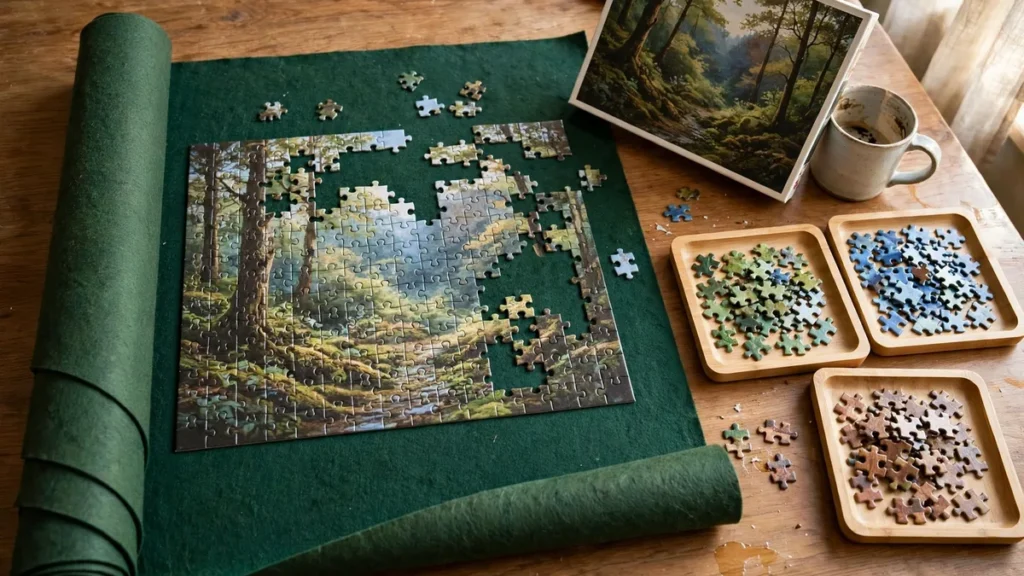
When the dining table has to be cleared for dinner, a roll-up mat earns its keep. You build on a felt surface, then roll the whole thing around a tube and tuck it under a bed or behind a sofa. Our best puzzle roll-up mats guide looks at the mats themselves; the technique matters just as much. Move every loose piece into trays before you roll, because unconnected pieces are the ones that slide. Roll slowly and evenly around the tube, never fold the mat, and strap it closed so it cannot unroll in storage. When you unroll it, let it lie flat for a few minutes first — pieces will not sit straight on a curling edge.
Mats suit puzzles up to about a thousand pieces and homes where cupboard space matters more than keeping every loose piece in exactly the same spot. They are a poor choice for large, loosely connected sections, because rolling softens the joins. Slide a sheet of card under each big finished area and carry those separately instead.
Move it on a board or in a case
For a puzzle that must travel — to a puzzle club, a holiday cottage, or simply from the kitchen to a spare room — a rigid board is the safest carrier. Slide a board slightly larger than the finished puzzle underneath, keep everything level, and carry it with two hands, one at each end. A second board on top, held with a couple of elastic straps, turns it into a sandwich you can carry upright for a short distance. Never carry a board at a steep angle: pieces slide downhill, and the ones at the bottom edge bunch and bend.
Zippered cases and portfolio folders do the same job with more protection, holding board, trays, and box lid together in one parcel — exactly what you want for a car boot or a train seat. Whatever carrier you use, photograph the layout first and keep loose pieces in lidded trays.
Keeping loose pieces safe and sorted
Loose pieces are the pieces that go missing: small, rolling, sleeve-sticking, carpet-hiding. A sorting system need not be fancy, but it needs lids.
Shallow trays are the working standard. Sort by whatever you search by: edges in one tray, sky in another, a distinctive colour or pattern in a third. Stackable trays with lids are worth the small cost: they can be carried and stacked without spilling. If you are choosing between trays and boxes, our best puzzle storage boxes guide compares the options that puzzlers actually keep using. For a puzzle you are building right now, trays beat boxes: you can see what is in them at a glance.
For pieces that will sit untouched for weeks, sealed zip bags are hard to beat. Bag one group at a time, squeeze the air out, and write on the bag with a marker — the puzzle name, the group, and the piece count if you counted them. Labelled bags you can trust; unlabelled ones become mysteries, usually the wrong puzzle. Keep the box lid visible while you work: it is your reference picture and the label that tells future you what belongs in each bag. If the box is falling apart, slip the lid into a clear plastic sleeve.
Count the pieces when a puzzle comes out of storage: a two-minute count against the number on the box tells you at once whether one has gone astray.
Storing a finished puzzle
Finishing leaves you with a pleasant problem: a picture a metre wide and one piece thick. Display it, take it apart and keep it, or pass it on — each needs different storage.
Displaying it starts with glue: brush puzzle glue or a thin layer of craft glue across the front, let it dry, then flip the puzzle on a board and glue the back. A glued puzzle can still bend if you pick it up by one corner, so support it with both hands or a board until it is framed. A frame with a proper backing board protects it from dust and sunlight — but keep it out of direct sun, which fades puzzle cardboard faster than most people expect.
If you would rather build the puzzle again one day, take it apart carefully instead of breaking it up in handfuls. Slide a sheet of card under the finished puzzle, carry it flat to a table, and separate it into large sections, then into pieces. Bag the pieces by area — top, middle, bottom — rather than mixing them together. Three labelled bags rebuild in an evening; one mixed pile means sorting from scratch. Glued but unframed puzzles should be stored flat, never leaning: a month against a wall will bow one and crack the glue. Slip it between two sheets of stiff card, label the outside, and slide it under a bed or on top of a wardrobe.
Storing unopened boxes
Sealed puzzles are easy to store well and easy to ruin: keep them dry, cool, out of the sun, and never under something heavy — the same rules as books.
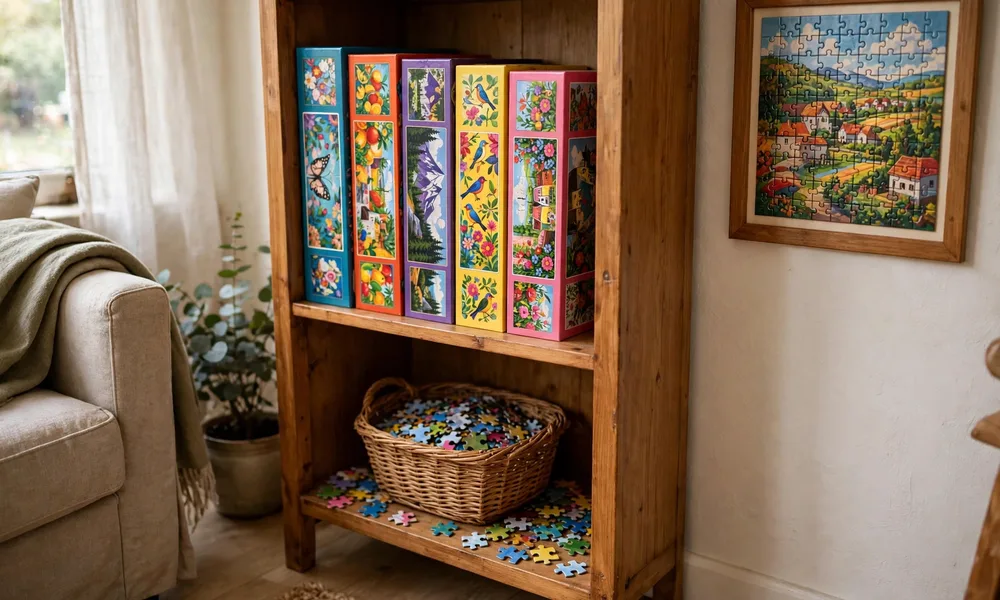
Stand boxes upright like books, spines out, so you can read the picture and piece count without pulling a stack apart. Stacking boxes flat is fine for two or three, but a tall stack crushes the bottom box, bows its lid, and can split the corners — and a split corner is where pieces escape. If you must stack, keep the heaviest boxes at the bottom and the stack no higher than your forearm.
Keep the shelf away from radiators, damp exterior walls, and windows that catch the afternoon sun. Damp swells cardboard and lifts the printed surface; heat dries the glue and makes pieces brittle. A dry interior wall in a lived-in room is ideal. Lofts and garages are the worst choice unless insulated — the swings between seasons do more damage than a steady cool room.
Protecting puzzles from pets, children, dust and damp
Most puzzle damage is undramatic: a cat on a half-built sky, a toddler pocketing a piece, a glass tipped across a corner, a slow damp patch. Each has a simple defence.
Cats are the classic hazard. They love the warmth of a table, the texture of felt, and the game of batting a loose piece onto the floor. A cover helps, but a determined cat will sit on a cover too. A board with a lid, a case that zips shut, or a room with a closing door will do what a sheet cannot. If a cat walks across your puzzle, check the floor and its favourite sleeping spots first — cats carry pieces further than dogs do.
Small children need a different approach. Give them their own small puzzle and their own tray, and keep the grown-up puzzle on a table they cannot easily reach. A puzzle stored at a child’s eye level will be explored, and that is fair enough — the pieces are colourful and tempting. The answer is height and a lid, not scolding. Dust settles on an uncovered puzzle within days, dulling the picture and working under the pieces — a cover, lid, or closed case keeps it off. Damp is more serious: if a puzzle smells musty, move it to a dry room, let it air, and check the box for soft spots before building.
When space is tight
Small homes force vertical choices: a mat under a bed, a covered board flat behind a door, sealed boxes on top of a wardrobe. What does not work is squeezing a half-built puzzle where it does not fit — a board bent around a radiator or a mat folded in half damages both.
With no spare table at all, build on a lap tray or portable board that lives on a chest of drawers between sessions, loose pieces in a lidded tray beside it. Keep the whole kit together — board, trays, box lid — so setting up takes a minute, not a hunt through three cupboards. For a holiday or puzzle night, pick a smaller puzzle than usual, pack loose pieces in sealed bags inside a rigid box, and carry the board flat — never wedged upright between suitcases.
Mistakes that lose pieces
Almost every lost piece comes from the same short list: tipping a puzzle into a bag to clear a table, carrying a board one-handed, storing loose pieces in an open bowl, dropping a box from a high shelf, leaving a puzzle uncovered in a house with a cat. None is a disaster alone, but each puts a piece somewhere you did not expect.
The fix is routine: photograph before you move anything, bag before you carry anything, cover before you walk away, count when a puzzle comes back out. Minutes of habit are the difference between a collection you enjoy and a shelf of puzzles each missing one piece.
Frequently asked questions
Can I store a jigsaw puzzle in a roll-up mat for months?
You can, but a mat is made for pauses between sessions, not seasons. For months untouched, move it to a rigid board with a cover, or take it apart and bag the pieces flat. A puzzle left rolled for a long time can develop a curl that leaves the finished picture wavy.
How do I store a puzzle if I have no spare table?
Build on a portable board you can slide under a bed or lean flat against a wall, loose pieces in lidded trays stacked on top. Board plus trays is a complete puzzle station that fits beside a wardrobe and sets up in under a minute.
Should puzzle boxes be stored upright or flat?
Upright, like books: you can see what you own and nothing gets crushed. Flat stacking suits a few boxes, but keep the stack short with the heaviest at the bottom so lids do not bow.
What is the best way to keep a finished puzzle?
Glue it front and back, frame it with a backing board, and hang it away from direct sun. To rebuild it later instead, take it apart in sections, bag the pieces by area, and store the bags flat and dry with the box lid.
Flat, covered, bagged, labelled, and dry — get those five things right and every piece will be there when you come back to it.