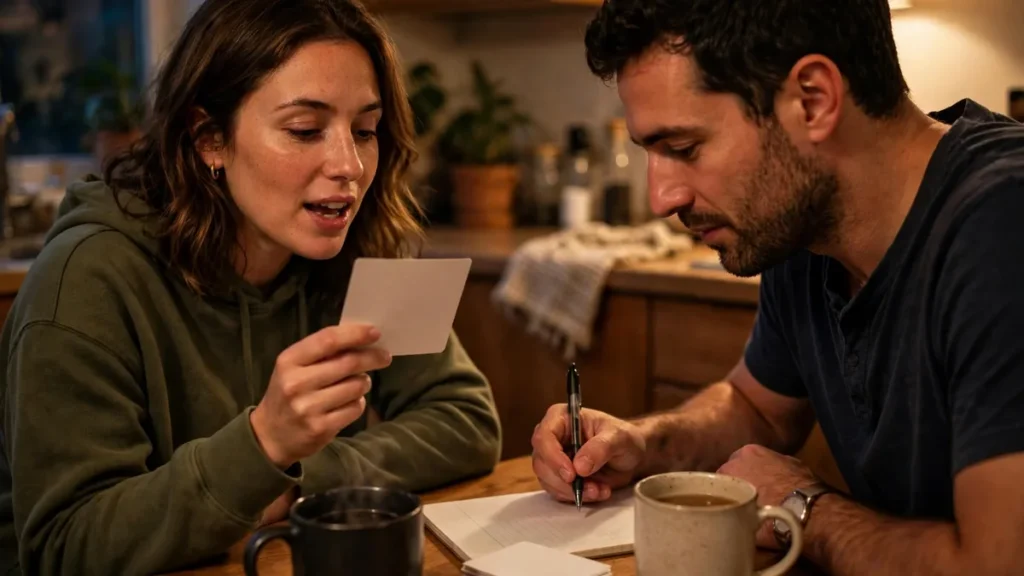
Think of the last evening you still talk about. Chances are it holds two kinds of laughter. There is the quick one, the sudden burst when somebody drops a single sharp line and the whole table cracks up at once. And there is the slow one, the laughter that builds while somebody tells you what happened to them last summer, and by the end you are laughing at a person you have never met, in a place you have never been, because for three minutes you were there with them. Both felt wonderful. Only one of them can win this argument, so let us have it properly: are jokes better than stories?
I am not asking which one is funnier in a single second. A joke will win that contest almost every time. I am asking which one does more for us across a whole evening, a whole friendship, a whole life. A joke is a spark. A story is a fire somebody has to tend. Sparks are brighter. Fires keep you warm.
The short version: jokes are faster, cheaper, and easier to share with strangers. Stories are slower, riskier, and far harder to forget. A joke gives you the laugh; a story gives you the person behind the laugh. If you want the biggest laugh in the next ten seconds, tell a joke. If you want an evening people still mention years later, tell a story. My verdict is at the end, and it surprised me.
First, What Each One Really Is
A joke is a small machine with one job. It sets up an expectation, then knocks it sideways in a single step. The whole thing can be over in one sentence, and the listener does not need to know anything about the teller. You can hear a joke from a stranger on a train, laugh, and never learn their name. That is part of its charm. It asks almost nothing of you except attention for a few seconds, and it pays you back at once. Jokes come in many families, and we have already argued over two of them in our comparison of puns and jokes.
A story is a different creature altogether. It needs a person, a place, and something that went wrong or right. It needs time, because the listener has to build the scene in their head before the funny part can land. You cannot rush it. A story told in a hurry is just a list of things that happened, and lists are not funny. The teller has to choose what to leave in and what to leave out, hold back the best detail until the right moment, and trust the room to stay with them.
Speed: The Joke Wins the First Minute
There is no contest here, and the story side should admit it early. A joke can land before the kettle has boiled. You walk into a room, somebody says one line, and the mood of the whole place lifts. That quick lift is real, and it is one reason a well-timed joke can shrink a bad day instead of just decorating a good one. Nobody had to sit down. Nobody had to agree to listen. The joke does its work and gets out of the way, and the conversation carries on as if nothing happened, except that everyone is in a slightly better mood.
A story cannot do that. A story has to ask for the room. It has to begin, and beginnings are awkward. Somebody has to say, in effect, stop what you are doing and listen to me for a while. If the room is busy, or tired, or full of strangers, that request can feel like an imposition.
But speed has a price, and the price is depth. A joke that lands in five seconds is also over in five seconds. The room laughs, and then the room moves on, and by the next morning nobody can quite recall what was so funny. Speed is wonderful for lifting a mood. It is useless for building one that lasts.

The Setup: One Twist Against a Whole World
A joke hides a single surprise. The teller builds a small expectation, then swaps it for something else at the last moment, and the listener’s brain enjoys the jolt of being wrong in a safe way. Everything in a joke serves that one swap. Any detail that does not help the twist is dead weight, and a good joke-teller cuts it without mercy. That discipline is why a great joke can feel so clean. There is nothing extra in it.
A story hides its surprises differently. It does not have one twist; it has a dozen small ones, and most of them are not even jokes. The surprise might be that the stern neighbour turned out to be kind, or that the plan fell apart in exactly the way everybody warned it would, or that the teller was the fool all along.
Memory: Why Stories Stay and Jokes Slip Away
Here is a test you can run on yourself. Try to remember a joke somebody told you last month. Not the gist of it, the whole thing, word for word, in the right order, with the twist landing where it should. Most of us cannot do it. We remember that it was funny, and we remember roughly what it was about, and the middle has gone soft like an old photograph left in the sun. Jokes are hard to carry because they are all twist and no scenery. Take away the exact wording and there is nothing left to hold on to.
Now try to remember a story somebody told you last year. You will probably manage it. You will remember the place, the people, the thing that went wrong, and the line somebody said at the end that made everyone laugh. The shape of it will be there, because stories give your memory places to grip: a kitchen, a car, a holiday, a face. The funny part is tied to a scene, and scenes are far stickier than sentences.
Retelling: The Joke Dies, the Story Grows
Nothing kills a joke faster than hearing it twice. The second time, you know the twist is coming, so your brain is waiting for it instead of being surprised by it, and the laugh comes out smaller and more polite. By the third time, you are laughing at the teller’s enthusiasm rather than at the joke itself. This is not a flaw in any particular joke. It is how the form works. Surprise can only happen once.
Stories behave the opposite way. A good story often gets better the second time you hear it, because you already know the shape of it and you can enjoy the details you missed the first time. The teller relaxes, adds a line they forgot, and the room joins in with the parts they remember. One line from the middle of it is enough to make everyone at the table laugh, because they are not laughing at the line. They are laughing at everything the line stands for.
There is a limit, of course. A story retold too often can turn into a party trick. But that takes years, while a joke reaches that point by the second telling. Even the shortest funny lines can live on when they are attached to a person and a moment, which is why we love a good pun so much: the wordplay sticks because the moment around it sticks.
The Room: Who Gets to Speak, and Who Gets Left Out
A joke is democratic in a way a story is not. Anyone can tell one, to anyone, at almost any moment. You do not need the room to know you, and you do not need them to trust you. A stranger can make you laugh in a queue, and that small shared laugh can make the queue feel shorter. Jokes are the humour of people who have only just met, and they do a genuine job there: they tell everyone in the room that it is safe to relax a little.
Stories are less generous with strangers. A story needs the room to care about the teller, and strangers have no reason to care yet. Tell a long story to people who have just met you and you will feel the room drift. They simply have nothing invested in your holiday, your neighbour, or your old school friend. Stories are the humour of people who already belong to each other, and they repay that belonging. They are less useful at the edges of a group and far more powerful at its centre.
There is also the question of failure. When a joke falls flat, the damage is small and quick. There is a short silence, somebody changes the subject, and the moment passes. When a story falls flat, the damage is slow and public. The teller keeps going, the room keeps waiting, and everyone can feel the minutes passing. That risk is real, and it keeps a lot of good stories untold.
When Each One Wins
Put them in real situations and the picture gets clearer. A joke wins on a bad morning, when somebody needs lifting and there is no time for a tale. It wins in a text message, where a story would arrive as a wall of words nobody reads. It wins at work, where a quick line can break the tension before a meeting starts. It wins whenever the moment is short and the audience is uncommitted.
A story wins after dinner, when the plates are cleared and nobody is in a hurry. It wins on a long drive, where the miles give the teller room to breathe. It wins at a wedding, where the point is not to be funny for ten seconds but to make a room full of people feel like they know the couple. It wins whenever people have already chosen to be together and the evening is the point, not the clock.
Our Verdict
Here is where I land, after arguing both sides as fairly as I can. If the question is which one makes people laugh harder in a single moment, the joke wins, and I will not pretend otherwise. Nothing a story does can match the crack of a perfect one-liner landing in a room that was not expecting it. The joke is the purest form of surprise we have, and surprise is a wonderful thing.
But the question I asked at the start was not about a single moment. It was about which one does more for us across a whole evening, a whole friendship, a whole life. And on that question, the story wins. A joke can make a stranger laugh. Only a story can make a stranger into a friend, because a story is the only kind of joke that tells you who the teller is.
That is my verdict: stories are better than jokes, not because jokes are weak, but because stories do everything a joke does and then keep going. A joke gives you a laugh. A story gives you a laugh and a person, a place, and a memory you can carry home with you. Tell the joke when you have ten seconds. Tell the story when you have the room. And if you only have time for one of them tonight, tell the story. It will still be funny tomorrow.
Frequently Asked Questions
Can a story also be a joke?
Yes, and the best ones often are. A funny story usually ends with a twist or a line that works exactly like a punchline, except that it lands harder because the listener has spent three minutes getting to know the people involved. The difference is not the ending. It is everything that comes before it.
Why do I forget jokes but remember stories?
Because memory holds on to scenes far better than it holds on to sentences. A joke is mostly wording, and wording fades fast. A story gives you a place, a person, and a sequence of events, and each of those is a hook your memory can catch on.
Can you turn a story into a joke?
You can, and it usually makes the joke better. Take the funniest moment of the story, cut everything around it, and keep only the detail the listener needs to understand the twist. What you lose is the warmth and the world around it. What you gain is speed. It is a fair trade when the moment is short, and a bad one when the evening is long.