We have all been there. You walk into a room only to completely forget why you went there in the first place. Or maybe you find yourself reading the exact same paragraph four times because your focus keeps drifting away. In a fast-paced world filled with constant digital notifications, maintaining sharp focus and a strong recall can feel like an uphill battle.
The good news is that your brain is highly adaptable. Just like a physical muscle, your mind requires regular exercise to stay in peak condition. Incorporating targeted brain games for memory into your daily routine is one of the most effective, science-backed ways to enhance your cognitive longevity, protect your mental processing speed, and sharpen your daily focus.
By engaging in structured memory improvement games, challenging concentration puzzles, and regular mind training activities, you actively build new neural pathways. At riddlepuzzle.com, we study how playful mental challenges can transform your daily mental performance.
The Science of Brain Training: How It Works
To understand why mental exercises are so valuable, we must look at a concept called neuroplasticity. For many years, scientists believed that the human brain stopped developing after childhood. Modern neurological data shows this is completely false. Your brain has the lifelong ability to reorganize itself by forming new neural connections in response to learning and mental stimulation.
When you challenge yourself with an unfamiliar puzzle, your brain releases a neurotransmitter called acetylcholine. This specific chemical is responsible for attention, learning, and memory formation. If you keep your brain in a passive state by watching mindless videos, these neural pathways can weaken over time.
However, when you force your mind to calculate variables, remember hidden sequences, or decode complex linguistic riddles, you are giving your brain a high-intensity workout. This consistent stimulation keeps your prefrontal cortex active, which is the exact area of your brain responsible for short-term memory, decision-making, and deep concentration.
4 Essential Categories of Cognitive Exercises
Not all mental games target the same areas of the brain. To get the most comprehensive benefits, you should mix different types of challenges throughout your week. Here is a breakdown of the four main categories of mental workouts and how they help your mind.
1. Working Memory Puzzles
Working memory is your brain’s temporary scratchpad. It allows you to hold onto small pieces of information for a short time while you complete a task. Dual N-Back games, sequential card matching, and backward number counting are fantastic tools to expand this temporary storage capacity.
2. Selective Attention Challenges
Selective attention is the ability to focus on a single input while completely ignoring distracting background noise. Puzzles that require intense visual scanning, like finding hidden objects or solving detailed spot-the-difference images, train your eyes and mind to filter out irrelevant information.
3. Spatial Reasoning Puzzles
Spatial reasoning involves mentally manipulating 3D objects, visualizing geometric patterns, and understanding layouts. Solving Rubik’s cubes, playing tile-matching block games, or navigating complex physical mazes strengthens the parietal lobe, which helps with navigation and structural organization.
4. Semantic Processing Games
Semantic games focus entirely on language mechanics, vocabulary retrieval, and contextual wordplay. Crosswords, word ladders, and lateral thinking riddles force your brain to search its long-term storage banks for specific definitions and word relationships, keeping your linguistic recall fast and fluid.
The Best Brain Games for Memory and Focus
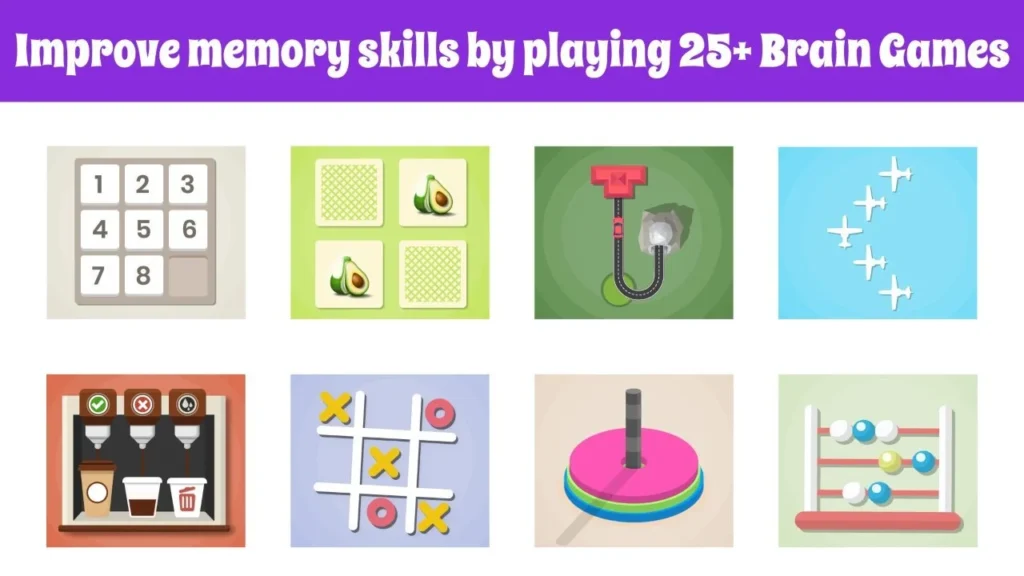
To help you build a well-rounded mental workout routine, we have compiled a list of the top games that offer the highest cognitive returns. These activities are accessible, highly effective, and easy to fit into a busy schedule.
Dual N-Back Puzzles
Dual N-Back is one of the very few mind training activities that has been shown in peer-reviewed studies to potentially increase fluid intelligence. In this game, you watch a square appear on a grid while simultaneously listening to a letter spoken aloud. You must indicate if the current square position or spoken letter matches the one shown “N” steps back in the sequence. It is incredibly challenging but highly rewarding for your short-term focus.
Logic Grid Puzzles
These are deductive reasoning games where you are given a short backstory, a few specific clues, and a grid matrix. You must use pure logic to deduce the relationships between different people, places, and objects. They require intense working memory because you must cross-reference multiple clues at the same time without losing track of your previous conclusions.
Classic Sudoku
Sudoku is a numbers-based puzzle that has absolutely nothing to do with math. Instead, it relies entirely on working memory and forward planning. To fill in the missing numbers from one to nine, you must hold multiple possibilities in your head simultaneously, scanning rows and columns to eliminate impossible options.
Speed Chess
While standard chess is excellent for long-term strategic planning, playing chess with a strict countdown timer forces your brain to process visual information at an accelerated rate. This rapid decision-making requirement sharpens your immediate concentration and helps you maintain focus under high-pressure conditions.
Designing Your Ultimate Weekly Mind Training Routine
To see real, measurable improvements in your memory and focus, consistency is far more important than intensity. Playing a memory game for four hours straight once a month will not provide lasting cognitive benefits. Instead, you should aim for fifteen to twenty minutes of daily, focused practice.
To maximize your results, try to cycle through different cognitive styles throughout the week. This keeps your brain from getting too comfortable with one single type of puzzle. The moment a specific game becomes easy for you, its cognitive benefit drops significantly, meaning it is time to increase the difficulty or switch to a new format.
| Day of the Week | Targeted Brain Skill | Recommended Game or Activity | Expected Cognitive Benefit |
| Monday | Working Memory | Dual N-Back or Card Matching | Enhances immediate information retention |
| Tuesday | Selective Attention | Visual Spot-the-Difference | Improves focus and filters out distractions |
| Wednesday | Deductive Logic | Logic Grid Puzzles | Strengthens problem-solving skills |
| Thursday | Spatial Reasoning | 3D Block Rotations or Mazes | Boosts mental visualization and orientation |
| Friday | Semantic Processing | Crosswords or Lateral Riddles | Quickens vocabulary and memory retrieval |
| Saturday | Processing Speed | Speed Chess or Fast Trivia | sharpens quick thinking under time limits |
| Sunday | Cognitive Relaxation | Jigsaw Puzzles or Free Drawing | Lowers stress while maintaining basic focus |
5 Practical Habits to Maximize Your Brain Training
Simply playing a game is not always enough to guarantee cognitive growth. To get the absolute most value out of your memory improvement games, you should integrate these five lifestyle habits into your routine.
-
Eliminate Multitasking: When you are playing concentration puzzles, turn off your television, put your smartphone on silent, and close extra browser tabs. Multitasking trains your brain to have a short attention span, which completely defeats the purpose of your mental workout.
-
Embrace the Struggle: If a puzzle feels frustratingly difficult, that is a sign your brain is working hard and growing. Resist the urge to look at the answer key immediately. The actual mental effort you expand while trying to solve a tough problem is where the real cognitive development happens.
-
Prioritize Restful Sleep: Your brain solidifies memories and clears out metabolic waste while you sleep. If you are chronically sleep-deprived, your brain cannot build new neural pathways efficiently, no matter how many mental games you play during the day.
-
Track Your Progress: Keep a simple journal or log of your high scores, completion times, or puzzle difficulty levels. Seeing tangible proof of your improvement over a few weeks provides an excellent motivational boost to help you stick with the habit long-term.
-
Vary Your Challenge Levels: As soon as you can complete a daily crossword or Sudoku puzzle without making a single mistake, your brain transitions into an automated cruise control mode. Always push yourself to try harder variations or introduce strict time limits to keep the challenge real.
Conclusion:
Investing time into your cognitive health is one of the most rewarding choices you can make. By dedicating just fifteen minutes a day to structured brain games for memory, you can actively train your mind to ignore distractions, retain information more effectively, and process complex ideas with greater ease. Your brain is a dynamic instrument that responds directly to how you use it every day.
If you are ready to put your memory, focus, and lateral thinking skills to the test right now, head over to our main platform at riddlepuzzle We offer an extensive, carefully curated library of logical riddles, word puzzles, and interactive brain teasers designed to give your mind a thorough, entertaining workout. Pick a challenge, turn off your distractions, and start building a sharper, more focused mind today.
Frequently Asked Questions (FAQ)
Can brain games for memory actually prevent age-related cognitive decline?
Based on available research data, regular mental stimulation cannot completely cure or prevent neurodegenerative conditions. However, consistently engaging in mentally challenging activities helps build a stronger cognitive reserve. This structural reserve can help your brain stay resilient, functional, and sharp for a significantly longer period as you age.
How long does it take to see noticeable improvements in focus?
Most people notice a lift in their daily focus and mental clarity after roughly three to four weeks of consistent, fifteen-minute daily training sessions. The key to seeing these quick results is choosing puzzles that challenge your current limits rather than playing games that feel comfortable or easy.
Are digital brain training apps better than traditional paper puzzles?+
Neither format is inherently superior. Digital applications are fantastic for tracking your progress, adjusting difficulty levels automatically, and delivering fast-paced visual games like Dual N-Back. However, traditional paper puzzles, such as printed crosswords, logic grids, and reading riddles, provide a wonderfully tactile, screen-free experience that helps lower digital eye strain.
What is the single best puzzle style for building deep concentration?
Logic grid puzzles and chess are widely considered the gold standards for deep focus. Both activities require you to maintain a steady stream of attention, track multiple moving pieces of data, and plan out several steps in advance, which completely prevents your mind from drifting.
Can children benefit from playing memory improvement games?
Yes, absolutely. Children are in a phase of rapid neurological development, making their minds incredibly responsive to structural play. Introducing age-appropriate riddles, memory card matching, and pattern games helps them build strong spatial awareness, enhances reading comprehension, and establishes early critical thinking habits.