
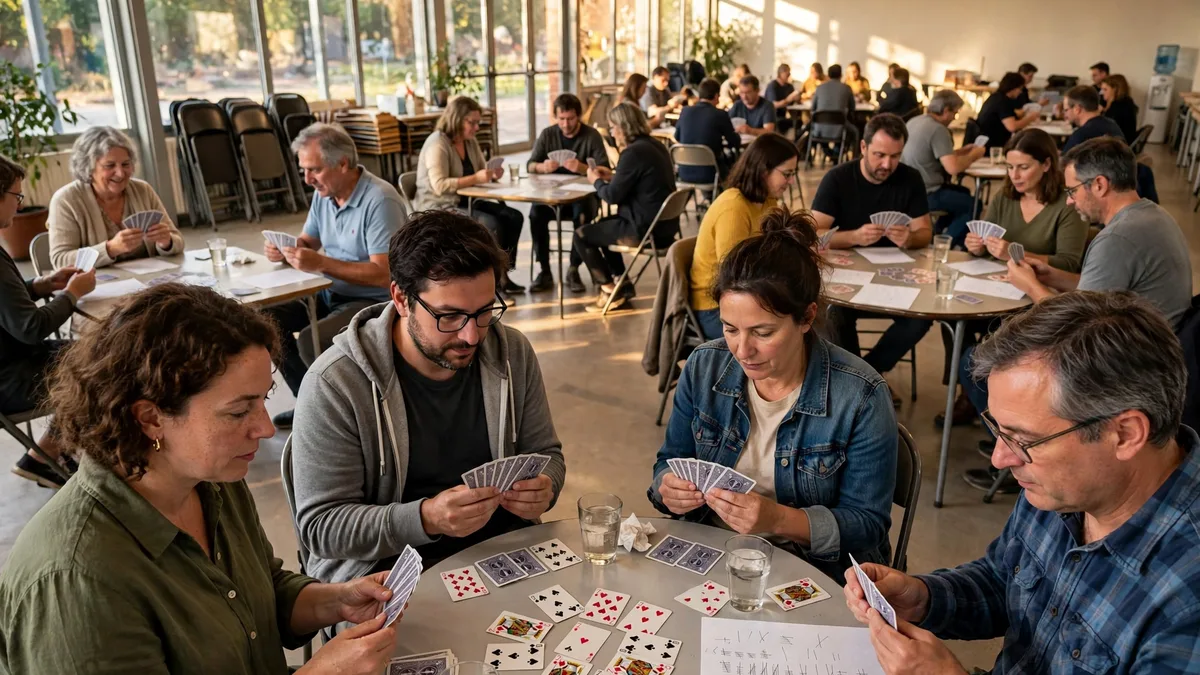
A hall with 572 people and a pack of cards at every seat sounds impossible until you stop thinking of it as one game. Nobody plays against 571 other people. Everyone plays the same layout at the same time, in small groups, and the hall stays together because every zone follows the same schedule. Nine zones, nine games, and a short rotation turn a crowd that size into an ordinary evening of cards.
The nine games below were picked for a crowd, not for a night at home. Last Card is the lively one, a shedding game where everyone at a table of four aims to empty their hand before anyone else at the table. The other eight are patience layouts, one person to a layout, so nobody waits for a turn and nobody leaves early. That mix matters: the patience zones give the evening its calm backbone, and Last Card gives it its noise and laughter.
Everything in this guide is built to be hosted by a small team. One helper looks after each zone, two floaters step in where needed, and one tally sheet at the front of the hall holds the whole evening together. Packs, seats, timings, and the rotation are all written out below, so you can hand this guide to your helpers and the evening will take care of itself.
Key takeaways
- 572 people play at once in 9 zones of about 64, with one game per zone and a short rotation between zones.
- Last Card is the only shared-table game; the other eight are patience layouts, one person to a layout.
- You need 656 packs, plus 20 extra — 1 pack per seat, 2 packs per seat for the two-pack games.
- One helper per zone, plus 2 floaters, is enough when every zone uses the same layout and the same timings.
- Keep count with one master tally sheet: zone totals after every rotation, not per-card scores.
The table below gives the shape of each game at a glance. Packs are counted per seat, and the patience games use one seat per layout, so the pack count for a zone is simply the number of seats in that zone, doubled for the two-pack games.
| Game | Packs per seat | Players per table | Why it works for 572 |
|---|---|---|---|
| Last Card | 1 | 2 to 6 | Short shedding rounds end in minutes, so tables stay together. |
| Emperor | 2 | 1 | Ten columns of 3; every seat works the same layout at the same time. |
| Lady of the Manor | 1 | 1 | A wide row of short columns; easy to learn from one example layout. |
| Picture Gallery | 1 | 1 | A long gallery row that is easy to read from across the hall. |
| Fourteen Out | 1 | 1 | Duos adding to 14 leave the layout; a clear goal for timed zones. |
| Doublets | 2 | 1 | Matching duos leave together; calm, steady work for mixed ages. |
| Lanes | 1 | 1 | Four long lanes in the same shape at every seat. |
| Leoni’s Own | 1 | 1 | 13 small piles of 4; only the top card of each pile is live. |
| Buffalo Bill | 1 | 1 | Ten short columns built down in matching suit; a sturdy layout for long sessions. |
How 572 players fit into one day
Split the hall into 9 zones and put about 64 people in each zone. Give each zone one of the nine games and one helper. Everyone in a zone plays the same game at the same time, so a helper only has to watch one layout, one short rules sheet, and one tally sheet.
Rotate every 25 minutes. When the time is up, each group moves to the next zone and starts the next game from a fresh layout. A full rotation takes about 4 hours with a short breather in the middle, which suits an afternoon or an evening session.
Seating is the part most hosts get wrong. Put the patience zones along the edges of the hall, where the daylight is steadiest and nobody has to squeeze past a table to reach a seat. Put Last Card in the middle, where its lively talk will not drown out the calmer zones.
The same zone plan works at other sizes too. Our card games for 570 players use nine zones in the same way, with the same helper count and the same rotation.
The 9 games
Each game below lists the packs per seat, the players per table, and the move that defines it. Learn the layout from the description, agree the shared rules before the opening deal, and keep an extra pack on every zone table for the moment a pack goes missing.
1. Last Card
Last Card is a shedding game for 2 to 6 people at a table. Each person is dealt 7 cards, one card is turned face up to start the discard pile, and the aim is to empty your hand before anyone else at your table. Play a card that matches the rank or the suit of the top card, or pick up one card from the pack and let the turn pass to the next person.
Two cards carry extra force, so agree them before play starts. A 2 makes the next person pick up 2 cards, and an 8 makes the next person miss a turn. When you hold only 1 card, say so clearly — the table needs to hear it, and it keeps the ending honest. A round lasts about 10 minutes, which is why Last Card suits the rotation: a table can finish, gather the pack, and be ready for the next group without holding up the hall.
2. Emperor
Emperor is a two-pack patience layout, and it is the grandest layout in this collection. Ten columns of 3 cards are dealt face up, and the aim is to move every card onto 8 home piles, one for each suit, climbing from A upward in matching suit. Build the columns downward in matching suit, and move a whole ordered group together when the cards line up.
A cleared column may take any card, which is the move that rescues a stuck layout. Deal the leftover pack one card at a time when nothing on the table will move, and keep the home piles in plain sight so a helper can see at a glance how far each layout has got. Emperor suits a long, calm zone: the layout is generous, the decisions are unhurried, and a whole zone can work in companionable calm.
3. Lady of the Manor
Lady of the Manor is a one-pack patience layout with a wide row of short columns. Build the columns downward in alternating colours, and start the 4 home piles with the low cards as they appear, climbing upward in matching suit. Only the top card of each column is live, so every decision is visible and every move is easy to explain to the person beside you.
An empty column is filled by a K, which gives a stuck layout a clear way back. The layout rewards patience over haste, and it is a kind choice for a mixed-age zone: nobody is rushed, nobody is left behind, and a helper can talk a newcomer through the opening moves in under a minute.
4. Picture Gallery
Picture Gallery is a one-pack patience layout built around a long gallery row of face-up cards. The gallery is the centre of the layout: read it from left to right, build downward in alternating colours, and lift cards onto the home piles as the low cards appear. The layout looks splendid on a table, which is half the point — a zone full of galleries is easy to read from across the hall.
Keep the gallery row straight and leave a clear opening between the gallery and the home piles, so a helper walking past can see the state of every layout in a few seconds. Picture Gallery suits a zone near the entrance, where newcomers can watch a layout for a minute and understand the aim before they sit down.
5. Fourteen Out
Fourteen Out is a one-pack patience layout with a simple, satisfying goal: clear the whole pack by removing duos that add to 14. Lay out 2 rows of 7 face-up cards. A K and an A leave together, a Q leaves with a 2, a J leaves with a 3, and so on down to two 7s. Every duo that leaves is replaced from the pack, so the layout stays full until the pack runs out.
Count the values aloud while you learn: J counts 11, Q counts 12, K counts 13, and A counts 1. The arithmetic is the whole challenge, and it is gentle enough for every age. Fourteen Out suits a timed zone because the goal is so clear: at the end of the rotation, the helper counts how many duos each layout removed, and the highest total leads the zone.
If your hall is four seats smaller, our card games for 568 players follow the same rotation plan, with the same nine-zone shape and the same helper count.
6. Doublets
Doublets is a two-pack patience layout, and its name gives away its move: matching duos of the same rank leave the layout together. Deal a wide layout of face-up cards, lift off every matching duo you can see, and refill the empty places from the pack. The aim is to clear both packs, duo by duo, before the rotation ends.
Doublets suits a calm zone because the work is steady and the decisions are small. There is no long planning to do, only a careful look across the layout after every refill. Helpers like this zone: a glance tells them who is stuck, and a soft hint about a missed duo is usually enough to get a layout moving again.
7. Lanes
Lanes is a one-pack patience layout dealt into 4 long horizontal lanes. Each lane builds downward in matching suit, and the low cards start the home piles as they appear. Move a whole ordered group from one lane to another when it opens a lane up, and keep the lanes straight so the shape of each lane is easy to read.
Lanes suits a wide zone because the layout is so easy to copy: four lanes, the same shape at every seat, and no fiddly extra piles. A helper can lay out an example lane on an extra table at the front of the zone, and every newcomer can copy it without a word of explanation.
8. Leoni’s Own
Leoni’s Own is a one-pack patience layout dealt into 13 small piles of 4 cards. Only the top card of each pile is live, and the aim is to move every card onto the home piles, climbing upward in matching suit from the low cards. Build the piles downward in alternating colours, and move a whole ordered group together when the cards line up.
13 piles sounds like a lot to watch, but the layout is friendlier than it looks: most piles sit untouched while you work on 2 or 3 live ones, and a pile that empties is a small triumph in itself. Leoni’s Own suits a zone for experienced players, where the extra piles feel like a treat rather than a chore.
9. Buffalo Bill
Buffalo Bill is a one-pack patience layout with 10 short columns, and it is the sturdiest layout in this collection. Build the columns downward in matching suit, start the home piles with the low cards, and climb upward in matching suit until every card has found its home pile. A cleared column may take any card, so a careful player can always find a way forward.
Buffalo Bill suits the final zone of the rotation because it rewards a steady hand and a long view. Players who reach this zone late in the day will find a layout that forgives a slow start, and helpers will find a zone that largely looks after itself.
Checklist for the day
Work through this list the week before the event, and again on the morning itself. Every item below has caught out a host at least once.
- Count the packs: 1 pack per seat, 2 packs per seat for Emperor and Doublets, plus 20 extra packs for damaged or missing ones.
- Print one tally sheet per zone and one master sheet for the front of the hall, with the zone names written in before the doors open.
- Brief the 9 zone helpers together, with an example layout for each game on the table in front of them.
- Lay out the zones the night before, with chairs, tally sheets, and an extra pack at every seat.
- Agree the Last Card extras (2s and 8s) in writing, and pin the sheet where every Last Card table can see it.
- Carry a stopwatch for each zone helper, and agree the rotation signal in advance — a raised hand from the host, held until every zone has seen it.
Frequently asked questions
Can 572 people really play at the same time?
Yes. Nobody plays against the whole hall. Everyone plays in a zone of about 64 people, at a table of 4 for Last Card or at a single layout for the eight patience games. The hall feels busy and lively, but each person only ever deals with the cards in front of them and the helper in their zone.
How many packs do we need?
656 packs, plus 20 extra. Count 1 pack per seat for the one-pack games, 2 packs per seat for Emperor and Doublets, and 16 packs for the Last Card zone, where 16 tables of 4 share a pack each. Buy in bulk and keep the extra packs sealed until they are needed.
What if a table finishes early?
Give them a fresh layout at once. A patience player who clears a layout gets a new deal from an extra pack, and a Last Card table that finishes gets a new round with the same extras. Nobody sits idle, and nobody has to wait for the rotation to catch up.
Do we need a helper at every table?
No. One helper per zone is enough, plus 2 floaters who step in where a zone is stretched. The helpers only need to know one game each, which is why the zone plan works: a helper who knows Emperor inside out is more useful than a helper who half-knows nine games.
How do we keep count across so many tables?
Keep it simple. After every rotation, each zone helper writes 2 numbers on the master sheet: how many layouts were cleared in their zone, and how many Last Card rounds were completed. Add the 9 zone totals together, and you have the hall total. Do not try to track per-card scores across 572 people — the evening will drown in paperwork.
What makes a card game work for a crowd this size?
Three things: a short round, a clear goal, and the same layout at every seat. Last Card rounds last about 10 minutes, the patience goals are all visible on the table, and every zone uses one layout, so a helper can explain it once and the whole zone can start together. If a game needs a long explanation, a special pack, or a referee at every table, it does not belong in a hall this size.
Bottom line
572 people, 9 zones, 9 games, and 1 tally sheet: that is the whole plan. Keep the layouts the same at every seat, keep the rotations short, and let the helpers own their zones. Do that, and a crowd that sounds unmanageable will spend the afternoon lost in the cards, which is exactly where you want them.
For a hall six seats smaller, our card games for 566 players keep the same nine-zone shape. Start with the zone plan, trust the helpers, and let the cards do the work.


