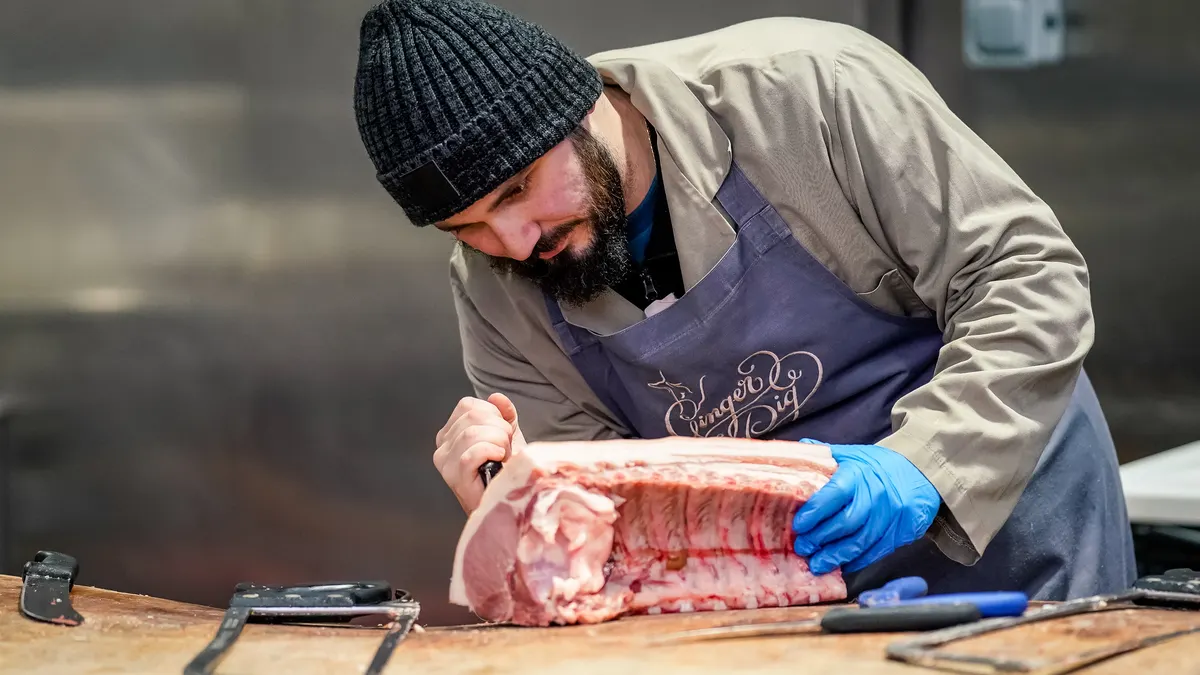
553 people in one building sounds impossible until you picture the right building. Think of an old village butcher’s shop at the end of a busy day: the wooden worktop is clear, the white coats are put away, the counter is wiped down, and the whole place smells faintly of fresh paper and clean wood. That is the spirit of these dice games for 553 players. They are plain dice games that a huge crowd can play together without fancy kit and without anyone waiting around with nothing to do.
The way to do it is to stop thinking of 553 people as one crowd and start thinking of them as 79 tables of seven. Seven is a friendly number for dice games. Everyone at a table can see the dice and gets a roll. Each table works through the same nine games in the same order, with the same plain kit, and the caller keeps every table moving together. When one table ends a game early, the players help the table beside them instead of sitting idle.
All nine games below use the butcher’s shop as their setting, and each one borrows a little job from the trade: weighing a cut, wiping the counter, wrapping paper, and so on. Nothing here needs real meat, a sharp tool, or any skill with food. The dice do the work, the paper strips and tally sheets do the recording, and the theme gives every game a clear picture.
Key takeaways
- Split 553 players into 79 tables of seven, so every person can see the dice.
- Give every table the same kit: three dice, paper strips, a tally sheet, and a pencil.
- Play the nine games in order, with the caller keeping all tables on the same game at the same time.
- Keep the scoring plain: one tally sheet per table, with points added up after each game.
- Let tables that end early help the table beside them, so nobody is left waiting.
How 553 Players Share One Day
The arithmetic is kind here. Five hundred and fifty-three divides neatly into 79 tables of seven, with no leftover players. When every table has the same number of players, every game takes about the same amount of time at every table. Put the tables in straight rows with a clear walkway down the middle, so the caller and the helpers can move freely. Leave the end of each row clear for the tally sheets to be collected.
Count the Tables to Begin With
Before anyone arrives, count out 79 tables and mark each one with a number on a paper strip. The numbers run from 1 to 79, and each table keeps its number for the whole day. When the caller says “table 40, are you ready”, there is no confusion about which group is being asked. Seven places at each table is the right amount. A table with only six places leaves one player with nowhere to sit, and a table with eight places tempts people to squeeze in and unbalance the numbers.
Give Every Table the Same Kit
Each table needs three dice, a bundle of paper strips, a tally sheet, and two pencils. Three dice per table means 237 dice in all, so ask for 250 and keep the extras in a little box near the caller. The paper strips should be cut to the same length, about the length of a hand, and the tally sheet should have nine rows, one for each game, and a column to record the points.
Do not put out anything else at the start. Anything more only causes confusion when 553 people are trying to listen at once. The dice, the strips, the tally sheet, and the pencils are enough for all nine games. If your group has played a food-themed evening before, the chef-themed set in our dice games for 500 players shows how a trade setting carries a whole night of dice play.
Name a Scorekeeper at Every Table
Each table chooses one scorekeeper before the opening game. The scorekeeper holds the tally sheet, records the points after each game, and says the table’s tally back to the caller when asked. The job moves to a different player after every third game, so three people share it across the day. The scorekeeper also looks after the dice. If a die rolls off the table, it counts as a missed roll, and the player rolls again. If two players disagree about a number, the scorekeeper’s reading is final.
The Nine Games at a Glance
Here is the whole day in one view. Each game takes about ten to fifteen minutes, so the nine together fill around two hours, with a short rest in the middle after game five.
| Game | What you need | Time |
|---|---|---|
| 1. Dice Sausage Link | Two dice, paper strips, tally sheet | 15 minutes |
| 2. Dice Cleaver Wipe | Two dice, a cloth, tally sheet | 10 minutes |
| 3. Dice Meat Scale | Three dice, tally sheet | 15 minutes |
| 4. Dice Bone Saw | Two dice, paper strips, tally sheet | 10 minutes |
| 5. Dice Steak Cut | Three dice, tally sheet | 15 minutes |
| 6. Dice Meat Chill | Two dice, tally sheet | 10 minutes |
| 7. Dice Paper Wrap | Two dice, paper strips, tally sheet | 15 minutes |
| 8. Dice Sausage Twist | Three dice, tally sheet | 10 minutes |
| 9. Dice Butcher Counter | Three dice, tally sheet | 15 minutes |
The Nine Butcher’s Shop Games
Each game below is written so the caller can say the instructions aloud once and every table can begin. Work through the games in order, and let the caller announce the start and the end of each one.
1. Dice Sausage Link
Every table starts with a bundle of paper strips and two dice. One player rolls both dice, and the number shown tells the table how many strips to join. A roll of six means six strips are tucked through each other, one after another, until they form a lengthy paper shape like a row of sausages. The table keeps rolling in order, and each roll adds to the same growing shape.
The aim is to build the shape with the most strips in one unbroken run before the caller ends the game. If a strip tears, the table must start a new shape, so gentle hands matter as much as lucky rolls. The scorekeeper counts the strips in the table’s best shape at the end and records the number as the table’s points. It is a good opening game, and it teaches the two habits that carry the whole day: listen for the caller, and look after the paper.
2. Dice Cleaver Wipe
The counter must be wiped down before the day’s work begins, and this game turns that job into a timed task against the dice. Each table has a cloth and two dice. One player rolls, and the number shown is the number of times the cloth must travel across the table and back again in an even motion. A roll of three means three crossings, and a roll of eleven means eleven.
The rule is that the cloth must stay even on the table for the whole crossing. If the cloth wrinkles or rises off the surface, that crossing does not count, and the player must do it again. The scorekeeper looks at the cloth and counts only the clean crossings. Each player has a chance with the cloth, and the table’s points are the clean crossings made by all seven players together.
3. Dice Meat Scale
Every butcher weighs each cut, and this game asks each table to weigh with dice instead of a balance. Three dice are rolled together, and the three numbers are added up. That sum is the weight of the cut, in imaginary pounds, and the scorekeeper records it. The weighing habit here mirrors the fish-market set in our dice games for 535 players, where every table works from the same plain kit.
After five rounds of rolling, the table looks at its five weights and chooses the heaviest one as its entry for the game. But there is one rule to remember: any roll that shows three of the same number is spoiled, and that round records nothing. A table that rolls three sixes has the heaviest possible weight, but it counts for nothing. The table with the heaviest single valid weight takes the most points, and the other tables take points in order from heaviest to lightest.
4. Dice Bone Saw
The bone saw is the butcher’s most patient tool, and this game is about patience too. Each table has two dice and a bundle of paper strips. A player rolls both dice, and if the two numbers are different, the player cuts a strip in two with a careful tear along its length. If the two numbers match, the player must wait, and the dice move on.
The table keeps cutting strips until the caller ends the game, and the aim is to have the most strips of roughly the same length at the end. Strips that are torn unevenly do not count, so the scorekeeper checks each strip against a strip kept aside as the pattern. A player who rolls matching numbers three times in a row will be groaning by the third roll, while the others at the table laugh.
5. Dice Steak Cut
Three dice are rolled together, and the numbers are taken as a cut: the largest number is the thickness, the middle number is the width, and the smallest number is the length. The scorekeeper multiplies the three numbers together, and the result is the size of the cut. A roll of six, five, and four gives a size of 120.
Each player rolls once, and the table keeps only its largest cut. But the caller adds one extra rule: after every player has rolled, the caller names a number from one to six, and any table whose largest cut used that number must discard it and keep its next largest instead. A table that rolled a beautiful six, six, and five can lose it at once if the caller names six.

6. Dice Meat Chill
After the excitement of the steak cut, the meat must rest in a chilled place, and this game brings the whole building to a gentle speed. Two dice are rolled, and the numbers are added up. If the sum is seven, the table scores nothing and the dice move on. Any other sum is recorded as points, and the table keeps a tally that grows as the game goes on.
A sum of seven comes up often enough that every table will hit it several times, and each time the whole table sighs together. Players start to cheer for low rolls and large rolls alike, unless they are seven. It is a restful game by design, sitting in the middle of the day like a chilled place after a busy start.
7. Dice Paper Wrap
Wrapping is the ending job before a cut leaves the shop, and this game asks each table to wrap paper strips around a bundle of dice. Two dice are rolled, and the numbers tell the table how many strips to use. A roll of four means four strips are wrapped around the bundle, one at a time, each tucked neatly under the one before it. A roll of twelve means twelve strips, which needs two players working together.
The wrapped bundle must stay together when the scorekeeper takes it up by one strip. If it falls apart, the table must unwrap it and start again. The points come from the number of strips in the largest bundle that stays together at the end of the game. A bundle of twenty strips that stays together is worth far more than a bundle of thirty that falls apart, so care is worth more than ambition here.
8. Dice Sausage Twist
The sausages are linked, and now they must be twisted into shape. Three dice are rolled together, and the three numbers are taken as three twists: a little twist, a medium twist, and a large twist. The player mimes each twist in the air above the table, turning an imaginary sausage link with both hands. The others at the table look on and must agree that all three twists were shown clearly.
This is the silliest game of the nine, and deliberately so. By this stage in the day, 553 people have been concentrating for a good while, and a game that asks grown people to mime twisting sausages in the air is exactly the release they need. The scoring is simple: each agreed roll earns points equal to the sum of the three dice, and each disputed roll earns nothing.
9. Dice Butcher Counter
The ending game brings the whole day back to the counter where it began. Three dice are rolled together, and the numbers are added up. That sum is the number of customers served at the counter in that round. Each player rolls once, and the table adds up all seven sums to get its tally for the game. The table with the largest tally leads the day.
There is one extra rule for the ending game. If any player rolls three of the same number, the whole table must rise, applaud the player, and then sit down again before the next roll. In a building of 553 people it creates a wave of applause that rolls down the rows and back again. The scorekeeper adds the ending game’s tally to the tally sheet and works out the table’s final tally across all nine games.
Your Evening Checklist
Run through this list before the opening game, and again during the short rest after game five.
- Count the tables and make sure that each one has seven places and a number strip.
- Put three dice, paper strips, a tally sheet, and two pencils on every table.
- Name a scorekeeper at each table and show them where to record the points.
- Walk the walkway and make sure the caller can be heard from the farthest table.
- During the rest, collect the tally sheets from the opening five games and make sure the adding is right.
- Keep extra dice, strips, and pencils in a little box near the caller for the whole day.
Frequently Asked Questions
Can 553 players really play dice games at the same time?
Yes, if the players are split into tables of seven and every table plays the same game at the same time. The food-themed set in our dice games for 467 players runs the same way, with plain dice, paper strips, and a tally sheet at every table.
How many dice do we need for 553 players?
Three dice per table across 79 tables comes to 237 dice, so ask for 250 and keep the extras near the caller. A few dice will always roll off a table and disappear during the day, and having extras close by means no table has to wait. Plain dice are best, with clear numbers.
What if a table has only six players?
A table of six can still play every game, because none of the nine games needs exactly seven people. The table simply takes fewer rolls, and its tally will be a little lower than a full table. If you can, move a late arrival to the short table early in the day, before the next game begins, so the numbers even out.
How much time does the whole day take?
The nine games take about two hours, with a short rest in the middle after game five. Allow another thirty minutes at the start for everyone to find their tables and for collecting the tally sheets and announcing the results at the end. About 150 minutes in all is a comfortable length.
Do players need to know the butcher’s trade already?
No. The theme is only a setting, and every game is explained in a few sentences before it begins. The words used are ordinary ones: sausage, cleaver, bone, steak, paper, and counter. Nobody needs to have worked in a shop to enjoy weighing, wiping, wrapping, and twisting with dice.
Is any real meat used in the games?
No. All nine games use dice, paper strips, a cloth, tally sheets, and pencils. The meat in the games is imaginary, and the paper sausage shapes, the wrapped bundles, and the counted cuts are all made from paper. That keeps the day clean and simple for every player.
The Bottom Line
Dice games for 553 players work when the crowd is split into little tables, the kit is identical, and the caller keeps everyone on the same game. The butcher’s shop gives the day a clear picture: a wooden worktop, a white coat, a counter, and nine little jobs. Play the nine games in order, keep the tally plain, and let the tables help each other when one ends early.
The best part of the day is usually the ending applause in the ninth game, when 553 people who started the day as strangers are clapping together. That is what good huge-group dice games do: they change a crowd into a company, one roll at a time.