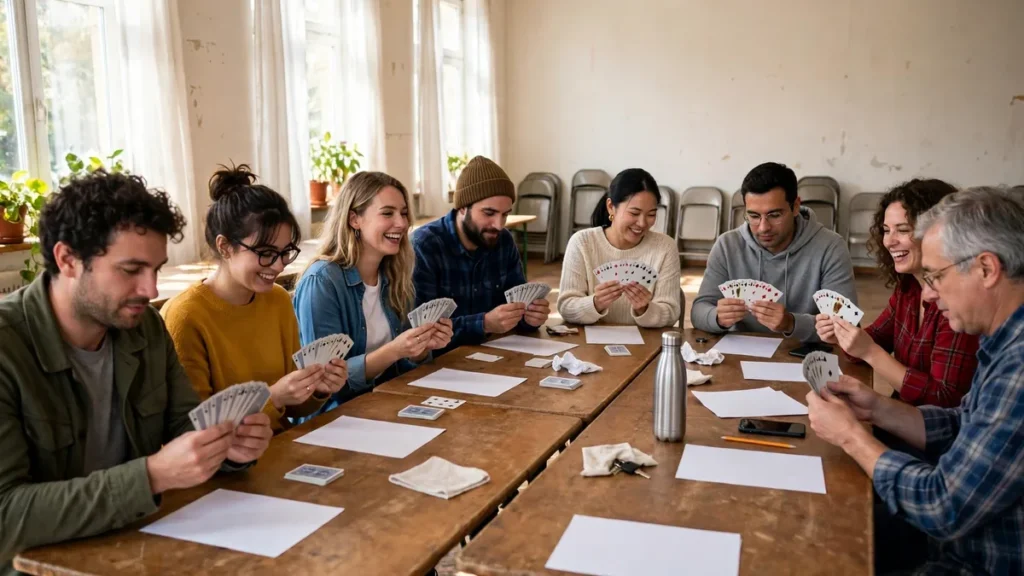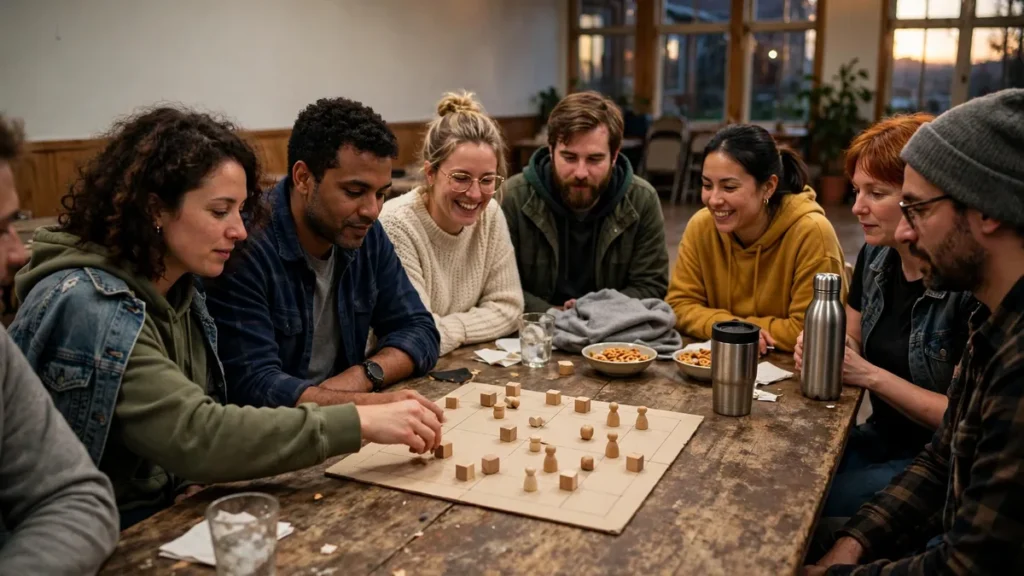
Five hundred and forty-six players is not a table. It is a hall, a reunion, a whole conference floor with every chair taken. When a crowd that size wants a card game, the usual advice breaks down, because a single deck cannot stretch across a room. The games below solve that problem in a different way: they teach in minutes, they run on more than one table at the same time, and they keep every player busy.
The nine games in this list share three habits. Each one explains its rules in under two minutes, so a host can teach a fresh table and walk away. Each one plays fast enough that a group can finish a full game, compare tallies, and start again without anyone drifting off. And each one is points-only, with no real cash anywhere near the table, so a huge group can play for pride alone.
Every game below is a fresh choice for this series, with its player count and playing time. Use the comparison table to choose fast, then read the full notes. If your crowd is two seats smaller, our guide to card games for 544 players has nine more choices built the same way.
Key takeaways
- Split a huge crowd into many small tables and run the same game on all of them at once.
- Choose games that teach in under two minutes so no table waits long to start.
- Keep every game points-only, with a clear tally and no real cash involved.
- Use short games and rotate tables between rounds so players meet new faces.
- Appoint one host per table and one roaming host to answer rules questions.
Why these nine games fit a crowd this size
A game fits a huge group when it survives being taught ten times in a row. The host at table one explains it, the host at table two explains it again, and by table ten the explanation still holds together. That is why every game below has a short list of rules and a clear goal.
A game also fits a huge group when it ends cleanly. Short games let a hall compare tallies, hand out a small prize to the best player at each table, and mix the tables for a fresh round. Each game below finishes in about half an hour or less, except for one longer trading game that earns its time with constant talk and laughter.
Compare the nine games at a glance
| Game | Players | Time | Why it fits a crowd |
|---|---|---|---|
| Kuhhandel | 3 to 5 | Under an hour | Open auctions and loud horse trading fill a room with talk. |
| Pusoy | 2 to 4 | About 30 minutes | Quiet arranging suits a calm corner table. |
| Tong-its | 3 | About 30 minutes | Fast draw and discard with melds keeps trios moving. |
| Courtisans | 2 to 5 | About 20 minutes | Three cards a turn means nobody waits long. |
| 9 Lives | 3 to 4 | About 15 minutes | A prediction twist keeps every trick tense. |
| Maskmen | 2 to 6 | About 20 minutes | A shifting wrestler order rewards sharp memory. |
| Tricks and the Phantom | 2 to 4 | About 20 minutes | Deduction in eleven cards fits a quick break. |
| Flotsam Fight | 2 to 6 | 10 to 30 minutes | Lifeboat arithmetic is easy to learn and hard to master. |
| Vulture Culture | 2 to 5 | About 20 minutes | Simultaneous reveals keep every round fair and fast. |
The nine games
Here are the nine games, from the loudest to the quietest, with enough detail to teach each one at your own table.
1. Kuhhandel
Kuhhandel, published in English as You’re Bluffing, is a trading and auction game from Rüdiger Koltze. Three to five players sit down with a deck of 95 cards: 40 animal cards in ten kinds of four, and 55 play-money cards. The goal is to complete groups of four matching animals, because a completed group scores the value of its animal. A chicken group scores 10 points and a horse group scores 1,000.
On a turn, a player either auctions the uppermost animal card or offers a horse trade to another player who holds the same kind of animal. Auctions are open and loud, and the auctioneer may match the highest bid and take the animal, or hand it over and take the money. A horse trade is quieter: the challenger lays a hidden offer of play-money cards face down, and the other player must accept it or make a counter-offer. Completing two groups doubles both, and three triples all three. One animal triggers a fresh handout of play-money cards to everyone. Points decide the champion.
2. Pusoy
Pusoy, also known as Chinese Poker, is an arrangement game for two to four players with a standard 52-card deck. Each player receives 13 cards and must arrange them into three hands: a five-card back hand, a five-card middle hand, and a three-card front hand. The back hand must be at least as strong as the middle hand, and the middle hand must be at least as strong as the front hand. Break that order and the arrangement is fouled, counting as beaten in all three rows.
Once everyone has arranged their cards, all three rows are compared with every opponent’s matching row: back against back, middle against middle, front against front. Each row taken earns a point, and taking all three earns a bonus. Special hands earn royalty points. The same 13 cards can be arranged a dozen ways, and only one of them is the best. Pusoy suits a calm corner table, and a full game runs about half an hour. It is strictly points-only.
3. Tong-its
Tong-its is a three-player draw-and-discard game from the Philippines, and it is one of the fastest games in this list. One player receives 13 cards and the other two receive 12 each, with the rest forming a central pile. On a turn, a player draws from the pile or the discard pile, then discards one card. The goal is to form melds, of at least three matching ranks or three cards in sequence from one suit, and to empty the hand or finish with the fewest unmatched points.
Melds can be laid down, and a card may be added to an opponent’s exposed meld, a move called sapaw. A four of a kind is a special meld, and a suited run of four or more is called escalera. A player who uses every card in melds takes the game at once. If the pile runs out, the fewest unmatched points comes out ahead. A player who never lays down a meld cannot challenge a draw, so there is pressure to show a meld early.
4. Courtisans
Courtisans is a 2024 release from Catch Up Games, designed by Romaric Galonnier and Anthony Perone, for two to five players and about 20 minutes. The deck holds 90 courtier cards across six families: Stag, Toad, Butterfly, Carp, Nightingale and Hare. Each turn, a player must play all three cards in hand: one at the royal table, one in their own domain, and one in a rival’s domain. Each card helps one player and may hinder another.
Four roles add texture to the court. An Assassin removes a courtier from the same area, a Guard cannot be removed by an Assassin, a Noble counts as two courtiers when the area is scored, and a Spy is played face down so nobody knows which family it belongs to. Hidden mission cards add a further layer, each one worth three points when its condition is met. The deck is trimmed to suit the player count. A turn never drags: three cards, three placements, and the next player is already thinking.
5. 9 Lives
9 Lives is a trick-taking game from Allplay, designed by Taiki Shinzawa, for three to four players and about 15 minutes. The deck holds 36 cards, numbered one through nine in four colour suits, with the colour visible on each card back, so everyone can see what the other players hold. The purple suit outranks every other suit. Each player is handed nine cards, then everyone predicts how many tricks they will take by placing a feline token on a small rug.
One number predicted correctly earns four points; two numbers earns two. Miss, and a point is taken away for every space of difference. The twist is that the player who takes a trick must take one of the other cards from that trick into their own hand. Play ends when one player runs out of cards, and the game ends after four rounds or at nine points. If your crowd enjoys a quick game with a sharp edge, our guide to card games for 542 players offers nine more in the same spirit.
6. Maskmen
Maskmen is a shedding game from Oink Games, designed by Jun Sasaki, for two to six players and about 20 minutes. Six wrestlers stand in for the suits, with no numbers on the cards. At the start, nobody knows which wrestler is strongest. Each player is handed a hand of cards, and the host of the round plays one card of a wrestler of their choice.
The next player must either play more cards of a new wrestler to prove that wrestler stronger, or sit out the round. A new wrestler is proven stronger by playing one more card than the player before, so the counts climb from one to three, and no player may ever play more than three cards at once. Once every player except one has sat out, the round ends and the wrestler order is fixed. The player who empties their hand first takes a gold belt worth two points, the fewest cards left takes a silver belt worth one point, and the most cards left takes a black belt worth minus one point. Four seasons decide the champion.
7. Tricks and the Phantom
Tricks and the Phantom is a deduction game from Oink Games, designed by Takashi Saito, for two to four players and about 20 minutes. Eleven cards hold the whole game: roles two through ten, plus two Phantom cards numbered one. Each player is handed two cards, then lays one face down with a colour token on it. A Phantom card may carry any colour token.
Once every card is down, each player places a magnifying glass on the card they believe holds the criminal. The Barkeeper, numbered two, cancels the Politician, numbered ten, and becomes the criminal instead. Points are given for playing the criminal, for guessing the criminal, and to a Phantom player for every player who guessed the Phantom, while a player who guessed the Phantom gives up a point. After two rounds, ten or more points brings the game to a close. Despite its name, this is a quick deduction puzzle that rewards reading the other players.
8. Flotsam Fight
Flotsam Fight is a shedding game from Oink Games for two to six players and ten to thirty minutes. A boat full of treasure is sinking, and everyone is loading what they can onto the lifeboats. Each player is handed ten cards from a deck of 64 treasure cards. On a turn, a player either adds a card to a lifeboat or sits out until the round resets. A card may join a lifeboat only when the lifeboat’s number divides the card’s number, and the numbers on each lifeboat must always rise.
Only as many lifeboats may be used as there are players, so a four-player game uses four lifeboats and no more. When every player except one has sat out, the lifeboats are cleared, except that a player who sat out holding only one card must draw two new cards first. The round ends when one player empties their hand; that player takes two points, the next-best finisher takes one point, and the lowest-ranked hand takes a minus-one point. Three rounds decide the champion.
9. Vulture Culture
Vulture Culture is a simultaneous-reveal game for two to five players and about 20 minutes, built on a classic design by Alex Randolph. Each player holds fifteen cards numbered one through fifteen, and fifteen point cards form a face-down pile. Point cards show meerkats worth one to ten and vultures worth minus one to minus five. Each round, one point card is turned over and every player chooses a card, then all choices are revealed at once.
Ties are ignored: two players choosing the same highest card means neither takes it. The highest unmatched card takes a meerkat; the lowest unmatched card is stuck with a vulture. If every choice ties, the point card stays and is claimed with the next one. Played cards are laid aside face up, so a sharp player can track which numbers are spent. After fifteen rounds, the most points takes the game. Every round takes seconds, nobody waits for a turn, and the whole table gasps at the same moment.
How to run card games for a huge group
Start by choosing the game that matches your tables. Three-player games suit trios, while six-player games suit fuller tables. Hand out one copy per table, appoint one host per table, and ask the roaming host to walk the room. The roaming host is the most useful role in the room, because a stuck table waits in silence rather than asking for help.
Keep rounds short and mix the tables between rounds. When a game ends, ask each table to send two players one table to the left and two to the right, then start again. Everyone meets new faces, and the hall stays loud. Our roundup of card games for large groups covers the same approach in more detail.
Keep the tally visible. A large sheet on the wall with each table’s points gives the whole hall something to watch. Offer a small prize for the best combined tally, and a fun prize for the loudest cheering. The prize is never money; a ribbon or the honour of choosing the next game is enough.
Checklist
- Count heads first, then choose games to match your tables.
- Hand out one copy per table, with the rules sheet beside it.
- Appoint one host per table and one roaming host for the whole room.
- Teach each game in under two minutes.
- Mix the tables between rounds so players meet new faces.
- Keep a visible wall tally and hand out a fun prize at the end.
Frequently asked questions
Can these games really handle 546 players?
No single table seats five hundred and forty-six players, . The idea is to run the same game on many tables at once, with a shared tally on the wall and mixed tables between rounds. That way a hall of any size plays together.
Which game is fastest to teach?
Vulture Culture is the fastest, because a whole round is just a hidden choice and a simultaneous reveal. 9 Lives is close behind: predict a number, then take tricks. Both can be explained in under a minute.
Which game needs no special deck?
Pusoy and Tong-its need only a standard 52-card deck, which makes them the easiest to prepare at scale. A hall can stock a dozen ordinary decks for very little money, and every table can start at once.
Which game is best for mixed ages?
Flotsam Fight is the friendliest choice for a mixed-age hall, because its arithmetic is printed on the cards. Courtisans is another good choice: three cards a turn, clear placements, and no long rules to remember. Both welcome younger players without slowing the table down.
Do any of these games involve real money?
No. Every game in this list is points-only. Kuhhandel uses play-money cards as tokens, and the rest use points, belts or tallies. Nothing in this list asks anyone to risk real cash, and the prizes here are ribbons and bragging rights.
What if our group turns out smaller than expected?
Every game in this list also works with a small group, because the player counts here run from two to six. If only a few friends show up, choose Courtisans, Maskmen or Flotsam Fight for two players, . They scale down as easily as they scale up.
The Bottom Line
A crowd of five hundred and forty-six players does not need a bigger deck. It needs a better plan: many tables, one game per table, short rounds, mixed tables and a visible tally. The nine games above give you that plan, and every one of them is points-only and quick to teach.
Choose one game, teach it in two minutes, and let the hall do the rest. When the tables mix after the first round, you will hear a huge group having fun, and that is the whole point.