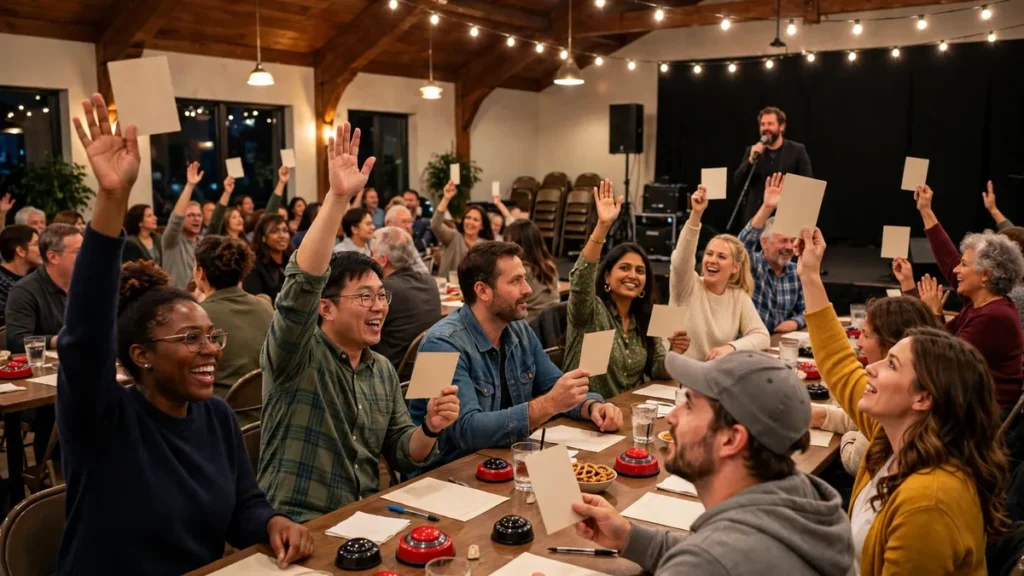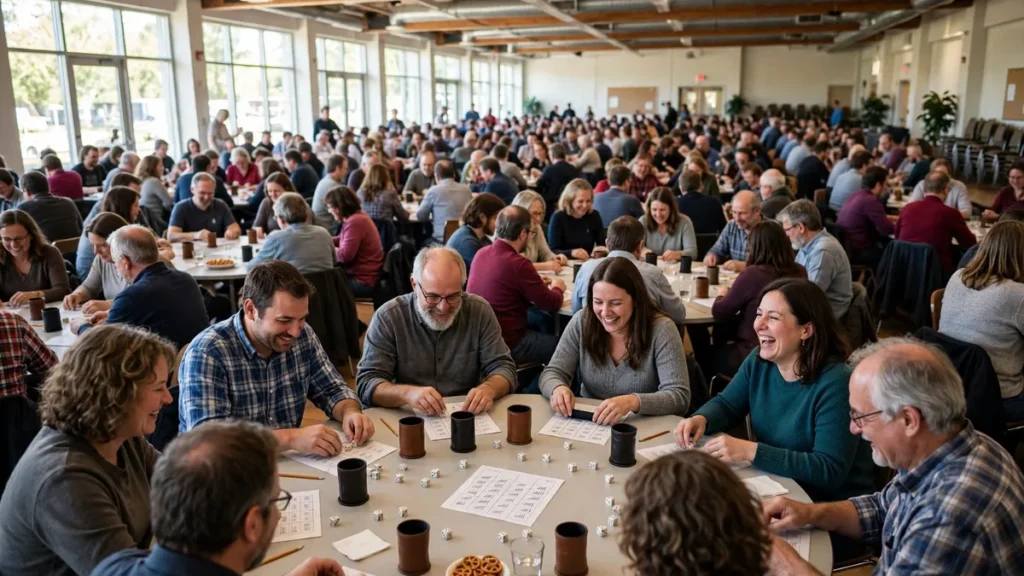
Finding the best dice games for 332 players sounds impossible at first. Most dice games are built for two to eight people around a single table, so a crowd of 332 feels far too large for a handful of dice. The good news is that dice games scale better than almost any other kind of table game. Dice are cheap, the rules are simple, and a single round takes only a few minutes, so 332 players can all play at the same time when the event is organised around many tables running in parallel.
The best dice games for 332 players work through a tournament format rather than one giant game. You set up dozens of small tables, give every table the same game and the same number of rounds, and let players rotate between tables as scores are collected. Winners move up, newcomers join in, and a central scoreboard keeps track of the leaders. That structure keeps waiting time low, keeps every player involved, and turns a huge crowd into a lively festival of play.
This guide covers the ten dice games that actually work at this scale, the exact numbers of tables, dice, cups and score sheets you will need, a rotation system that keeps 332 people moving smoothly, and a ready-to-use plan for your event. These dice games for 332 players will keep every single person rolling from the first throw to the final score. The same parallel-table approach also works for slightly smaller crowds, and you can see how it is adapted in our guide to dice games for 331 players.
Key takeaways
- Dice games for 332 players work through parallel tables and short tournament rounds, not one giant game.
- You need roughly 56 tables of six players, at least 280 dice, 112 dice cups and 332 score sheets.
- Simple, fast games such as Farkle, Bunco, Yahtzee and Liar’s Dice are the best choices for very large groups.
- A rotation system where winners move up and new players join keeps every table competitive and social.
- Plan for one organiser per eight tables, clear signage, a central scoreboard and a strict round timer.

Why Dice Games Work for 332 Players
Dice games have three qualities that make them ideal for very large groups. First, they are cheap: a set of dice costs very little, and even 300 dice plus cups and score sheets cost far less than buying board games for 56 tables. Second, the rules are simple, and most dice games can be explained in under two minutes, so new players can join a table and start playing straight away. Third, the rounds are short, so nobody sits idle for long and the whole event keeps moving.
Dice games are also easy to learn by watching, which matters at a 332-player event where you cannot give every person a personal tutorial. Dice are also fair: they are random, so no player has a built-in advantage, and a child can beat an adult on any given roll. That sense of fair play keeps a large crowd happy and makes dice games a good choice for mixed-age events.
The Numbers: Tables, Dice, Cups and Score Sheets
Before you buy anything, work out the numbers. With 332 players and six players per table, you need 56 tables: 55 tables of six gives 330 players, plus one table of two, or you can run 54 tables of six and one table of eight to reach exactly 332. Most organisers prefer 56 tables of six with four spare seats, because six is the ideal table size for dice games. Tables of six keep every player close enough to see the dice, and turns come around fast.
Each table needs its own dice, cups and score sheets. A standard game uses five or six dice per table, but allow two sets per table so a lost die never stops play. Dice cups matter more than most organisers expect: rolling dice in a cup and tipping them onto the table keeps dice on the table, stops them rolling onto the floor, and makes the game quieter in a large hall. Score sheets and pencils are just as important, because without written scores a 332-player tournament quickly becomes guesswork.
| Item | Per table | For 56 tables | Notes |
|---|---|---|---|
| Tables | 1 | 56 | Six players per table |
| Chairs | 6 | 336 | Include four spares |
| Dice | 5 | 280 | Two spare sets per table |
| Dice cups | 2 | 112 | One per two players |
| Score sheets | 6 | 336 | One per player, plus spares |
| Pencils | 6 | 336 | Short pencils are fine |
| Timers | 1 | 56 | Or one central bell |
Buy your dice in bulk and check them before the day, replacing any die with uneven edges or faint spots. Keep a box of spare dice and pencils at the organiser table, because both vanish at large events.
The 10 Best Dice Games for 332 Players
The ten games below were chosen because they meet four tests: they play in under fifteen minutes, they need no more than six dice, a beginner can learn them in two minutes, and they stay fun when repeated across several rounds. Every game works at a table of six, and every game produces a clear score that can be added to a central leaderboard.
1. Farkle
Farkle is the best all-round dice game for a huge crowd. Each player rolls six dice, sets aside scoring dice, and chooses whether to roll the remaining dice again for more points or bank the points already earned. Rolling with no scoring dice is a Farkle, and the player loses all the points from that turn. A game to 10,000 points takes about twenty minutes at a table of six, and a shorter game to 5,000 points takes about ten minutes, which fits a tournament round perfectly.
2. Yahtzee
Yahtzee is the most familiar dice game on this list, and familiarity is a real advantage at a large event. Almost every adult has played it, so you will spend almost no time explaining rules. Each player rolls five dice up to three times per turn, trying to fill thirteen scoring boxes that include three of a kind, a full house, a small straight, a large straight and the famous Yahtzee of five matching dice. Every player has their own score sheet, so nobody is eliminated early and nobody waits for others to finish.
3. Bunco
Bunco is the classic large-group dice game, and it was practically designed for events like this. Players sit in pairs at each table and roll three dice, trying to roll the number that matches the current round. Rolling three of the target number is a Bunco and scores 21 points, while each die showing the target number scores one point. After each round, the winning pair moves up to the next table and the losing pair moves down, so every player meets new opponents throughout the night.
4. Liar’s Dice
Liar’s Dice is the best bluffing game for a large crowd. Each player gets five dice and a cup, rolls them in secret, and then players take turns bidding on how many dice of a certain number are showing across all the cups at the table. A player can raise the bid or challenge the previous bid, and when a challenge happens, all the cups are lifted and the dice are counted. The loser of a challenge loses a die, and the last player with dice left wins the table.
5. Ten Thousand
Ten Thousand, also known as Zilch, is a close cousin of Farkle and a strong choice for a tournament. Players roll six dice, score for ones, fives, three of a kind and straights, and decide after each roll whether to bank their points or roll again. The twist is the Zilch: if a roll produces no scoring dice, the player loses all the points from that turn. A game to 10,000 points takes about twenty minutes, and a shorter game to 5,000 points fits a ten-minute round.
6. Left Center Right
Left Center Right is the simplest game on this list, and simplicity is a strength when you have 332 players. Each player starts with three chips, rolls three dice marked with L, C, R and dots, and passes chips left, centre, right or keeps them according to the dice. The last player still holding chips wins the table. A full game takes about ten minutes, and the rules can be explained in under a minute, which makes it perfect for a warm-up round or for tables with young children. The game is pure luck, so a child has exactly the same chance as an adult.
7. Ship Captain Crew
Ship Captain Crew is a fast, noisy game that gets a whole table shouting. Each player rolls five dice, trying to roll a six for the ship, a five for the captain and a four for the crew, in that order. Once the ship, captain and crew are secured, the remaining two dice are added together as the player’s score, and the highest score at the table wins the round. The catch is that the dice must come in order: a five does not count as the captain until a six has already appeared. It needs only five dice per table and no score sheet at all.
8. Dice Bingo
Dice Bingo mixes the luck of dice with the familiar format of bingo. Each player gets a bingo-style card with numbers on it, and a caller rolls two dice and announces the total. Players mark off the matching number on their card, and the first player to complete a row, a column or a full card shouts bingo and wins the round. The whole room can play at once from a single caller. One person at the front rolls the dice, announces the total through a microphone, and hundreds of players mark their cards at the same time.
9. Three or More
Three or More, also known as Threes, is a neat little game that rewards patience. Each player rolls five dice and tries to roll three or more of a kind. Threes score nothing, while other matching sets score their face value, so a player who rolls three fours scores twelve points and a player who rolls three sixes scores eighteen. The lowest total score wins, which turns the usual logic of dice games upside down: you want low numbers, not high ones. A game takes about ten minutes, it needs only five dice per table, and the low-score-wins rule keeps players thinking.
10. Pig
Pig is the simplest risk game in this guide and a fine way to close the night. Each player rolls a single die and adds the result to their turn total, choosing after each roll whether to roll again or bank the points. Rolling a one ends the turn and wipes out all the points from that turn. The first player to reach 100 points wins the table. A game takes about fifteen minutes and needs only one die per table. A similar approach to short, simple games also shapes our guide to dice games for 330 players, where the same quick rounds keep a huge crowd moving.
How to Run a 332-Player Dice Tournament
A 332-player dice tournament needs a clear structure, and the simplest structure is a series of short rounds with a central scoreboard. Plan for six rounds of fifteen minutes each, with five-minute breaks between rounds for players to move tables and hand in score sheets. That gives about two hours of playing time, which is long enough to feel like a real event and short enough that nobody gets tired or bored. Announce the schedule at the start, print it on the back of every score sheet, and stick to it: a tournament that runs late loses players fast.
Use a simple rotation system. After each round, the top two scorers at each table move up one table number and the bottom two move down one table number, while the middle two stay where they are. Collect score sheets at the end of each round, add the scores to a central leaderboard, and display the top twenty players on a large screen or a notice board so the whole room can follow the race. Plan for one organiser per eight tables, plus one announcer and one scoreboard manager.
Setup Checklist for Your 332-Player Event
Use this checklist in the week before your event, and check every item off before the doors open. A missing box of score sheets or a shortage of chairs is easy to fix a week early and hard to fix with 332 players already in the hall.
- Book a hall with space for 56 tables, 336 chairs and clear walkways between every table.
- Buy or borrow 280 dice, 112 dice cups, 336 score sheets and 336 pencils, plus spares of each.
- Print the rules for each game on a card for every table, and print the full schedule on every score sheet.
- Recruit seven table organisers, one announcer and one scoreboard manager, and brief them all before the day.
- Set up a central scoreboard, a microphone, a bell for round changes and a lost-property box for stray dice.
- Test the layout with a small group first, timing one full round to check that fifteen minutes is enough.
Common Mistakes to Avoid
The most common mistake is choosing games that are too slow or too complex. A game that takes forty minutes or needs a ten-minute explanation will stall a 332-player event, because every table stalls at the same time. Stick to the games in this guide and keep every round under twenty minutes.
The second mistake is underestimating the logistics. Dice, cups, score sheets and pencils all run out faster than you expect, and a shortage of any one item can stop a table from playing. Buy spares of everything and keep them at the organiser table. The third mistake is poor sound: in a hall of 332 people, a normal speaking voice will not reach the back tables, so use a microphone and a bell, test them before the event, and keep announcements short. Finally, remember the players who finish early: give them a practice table or a quick game of Ship Captain Crew while they wait, because bored players leave early. For more ideas on keeping a very large group engaged, see our guide to dice games for 329 players, which uses the same rotation and early-finisher plan.
Frequently Asked Questions
How many tables do you need for 332 dice players?
You need about 56 tables with six players at each table. That gives 336 seats, which covers 332 players with four spare seats for organisers or late arrivals. Six per table is better because every player can see the dice.
How many dice do you need for 332 players?
You need at least 280 dice, which is five dice per table across 56 tables, plus spare sets. In practice, buy 350 to 400 dice so you have replacements for dice that are lost, damaged or rolled under a table.
What is the best dice game for a very large group?
Bunco is the best dice game for a very large group, because the movement system is built into the game and players rotate tables automatically. Farkle is the best all-round choice if you want a single game that is fast, exciting and easy to score, while Yahtzee is the best choice if your players are mostly beginners who already know the rules.
How long does a 332-player dice tournament take?
A six-round tournament with fifteen-minute rounds and five-minute breaks takes about two hours of playing time, plus thirty minutes for arrival, welcome and prize-giving. Plan for two and a half to three hours from doors opening to the final announcement.
Can children play dice games at a 332-player event?
Yes, children can play most of the games in this guide. Left Center Right, Pig and Dice Bingo are all suitable for children aged six and over, and Bunco works well for children aged eight and over. Seat children with an adult at their table.
Do you need special dice for a large dice games event?
No, standard dice are fine for every game in this guide except Left Center Right, which needs dice marked with L, C and R. You can buy those dice in bulk or mark ordinary dice with stickers. Use large, clear dice with bold spots.
The Bottom Line
The best dice games for 332 players are the simple, fast and social ones: Farkle, Yahtzee, Bunco, Liar’s Dice and Ten Thousand at the top of the list, with Left Center Right, Ship Captain Crew, Dice Bingo, Three or More and Pig filling out the programme. Set up 56 tables of six, buy plenty of dice, cups and score sheets, run short rounds with a clear rotation system, and keep the whole room moving on a strict timer. Do that, and 332 players will not feel like a crowd to manage. They will feel like a room full of people having the same good time, together, one roll at a time.