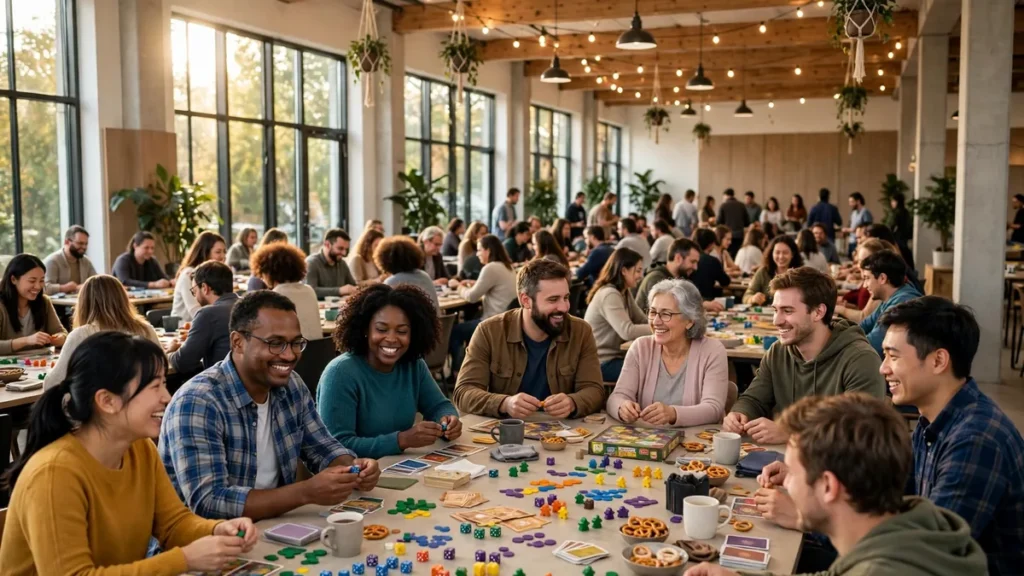
Finding the best board games for 322 players is a different kind of challenge from picking a game for a family night. No single board game seats 322 people around one table, and any guide that pretends otherwise is selling a fantasy. The real question is how to give 322 people a genuine board game experience at the same event, and the answer is a mix of parallel tables, team formats, giant party games, and a schedule that keeps everyone playing instead of waiting. When the format is right, a crowd this size becomes an advantage: more energy, louder reactions, and a room full of people discovering games they would never have tried at home.
A 322-player board game event works best when it is treated like a small festival rather than one oversized game night. That means dividing the crowd into groups of four to twelve, running several games at the same time, and using a few large-group games to open and close the day so the whole room shares a moment together. The games themselves matter less than the structure around them, yet the game list still has to be right. Fast rules, short rounds, and games that survive noise and movement are essential, while long strategy games with heavy setup and quiet concentration will fall flat in a hall full of 322 players.
This guide covers the games that actually work at this scale, the formats that keep a huge group moving, and the practical details of tables, timing, and supplies. Every recommendation below has been chosen for a crowd of this size, with honest notes on player counts, setup time, and where each game fits in the day. Whether you are planning a company event, a school gathering, a community festival, or a convention floor, the plan here scales to 322 players without leaving anyone standing around.
Key takeaways
- No single board game seats 322 people, so the best board games for 322 players are played across parallel tables, team brackets, and large-group rounds.
- Party games with simple rules and short rounds, such as Codenames, Wavelength, and Telestrations, work best when the room is loud and the groups are large.
- Split 322 players into groups of four to twelve, and run three to four game rounds with breaks between them so nobody waits too long.
- One or two giant group games at the start and end of the event bring the whole crowd together and set the tone for the day.
- Bring extra copies of the most popular games, simple score sheets, and a clear timetable, because supplies and timing decide whether a big event feels smooth or chaotic.

Why 322 Players Changes Everything
Most board games are designed for two to six players, and a few stretch to eight or twelve. That is the first fact to accept when planning for 322 people. The event is not one game, it is dozens of games happening at once, and the organiser is really running a small tournament. Once that shift in thinking happens, the planning becomes much easier, because the problem changes from finding one impossible game to choosing a strong set of games and a format that fits them.
The Three Formats That Work
The first format is parallel tables, and it carries most of the day. Divide 322 players into groups of roughly six to eight, set up a game at each table, and let every table play at the same time. With groups of eight, that means about forty tables, and with groups of six, about fifty-four. Each table needs a copy of its game, a host who knows the rules, and a score sheet. This format is simple, it uses the widest range of games, and it lets people play at their own pace without waiting for the whole room.
The second format is team play, where each table is a team and the tables compete against each other. This works well for quiz-style games, word games, and drawing games, because a whole table can shout out answers together. Team play adds a competitive edge that parallel free play lacks, and it gives the event a leaderboard that people can follow through the day. A team format also solves the problem of shy players, because nobody has to perform alone in front of a crowd.
The third format is the giant group game, used sparingly to open and close the event. These are games where the whole room, or a large part of it, plays together with one host and a microphone. Social deduction games, big trivia rounds, and audience voting games fit here. One or two of these sessions is enough. More than that, and the novelty wears off, while the practical problems of sound, sightlines, and crowd control start to dominate.
The Best Board Games for 322 Players
The games below are grouped by the role they play at a large event. Some are the main attraction at each table, some are quick fillers between rounds, and some are the big shared moments that the whole room remembers. All of them share the same strengths: rules that can be taught fast, turns that move quickly, and play that stays fun when the room is noisy. For a slightly smaller crowd, the best board games for 320 players use the same approach, and many of the same titles appear there, because the format matters more than the exact headcount.
Codenames
Codenames is the single most useful game for a 322-player event. Two teams compete to find their secret words on a grid of twenty-five word cards, guided by one-word clues from their spymaster. The standard game plays two to eight or more, and with extra copies the event can run Codenames at a dozen tables at once. Rounds last about fifteen minutes, the rules take two minutes to explain, and the game creates the kind of loud debate that fills a hall with energy.
The game scales well because it is easy to watch. People standing near a table can follow the grid, argue about clues, and join the next round without a lesson. For very large tables, split players into two teams of six or eight, with one spymaster per team and the rest discussing each clue together. That keeps everyone involved, and it avoids the common problem of quiet players going unheard. Bring at least six copies for an event this size, because Codenames tables fill up first.
Wavelength
Wavelength is a guessing game where one player gives a clue on a scale between two opposite ideas, such as hot and cold, and the team guesses where the hidden target sits on that scale. It plays two to twelve players, it takes about twenty to forty minutes, and it produces constant conversation. The game is ideal for mixed groups, because there are no right answers to memorise and no special knowledge needed, only opinions and judgement.
At a large event, Wavelength works best at tables of eight to twelve, where the debate about each clue becomes the entertainment. The physical dial and the colourful board are visible from a distance, which helps when the room is crowded. A host can also run a giant version for a bigger audience by projecting the scale and letting the room vote, which makes it one of the few games that can bridge the gap between a table game and a whole-room event.
Telestrations
Telestrations is a drawing and guessing game in which players sketch a word, pass the sketch on, and watch the meaning change as it travels around the table. It plays four to eight players in the standard box, and the party pack stretches that to twelve. Each round takes about fifteen minutes, and the results are usually funny enough to get the whole table laughing. The game needs no reading skill beyond the word cards, which makes it friendly for mixed ages and mixed language groups.
The practical advantage of Telestrations is that it needs almost no explanation. One demonstration round teaches the whole table, and the dry-erase books keep the game moving without piles of paper. For an event of 322 players, bring several copies and plenty of spare markers, because markers dry out and disappear faster than any other component. Telestrations also makes a good closing game at tables, since it ends with everyone sharing the funniest sketches.
Two Rooms and a Boom
Two Rooms and a Boom is a social deduction game for six to thirty players, split between two rooms, with hidden roles and a three-round timer. One team tries to get its bomber into the same room as the president, while the other team tries to keep them apart. Players move between rooms between rounds, negotiate, bluff, and trade information, and the game ends in a single dramatic reveal.
Ultimate Werewolf
Ultimate Werewolf is the classic large-group social deduction game, with villagers trying to find the werewolves hidden among them. It plays five to seventy-five players, and it is one of the only games that can involve dozens of people in a single session. A moderator guides the day and night phases, players debate and vote, and the tension builds with every elimination.
| Game | Players per copy | Time per round | Best moment at the event |
|---|---|---|---|
| Codenames | 2 to 8 or more | About 15 minutes | Opening rounds and team play |
| Wavelength | 2 to 12 | 20 to 40 minutes | Large-table debate |
| Telestrations | 4 to 12 | About 15 minutes | Quick fun between rounds |
| Two Rooms and a Boom | 6 to 30 | About 15 minutes | Midday feature session |
| Ultimate Werewolf | 5 to 75 | 30 to 60 minutes | Evening large-group session |
How to Run a 322-Player Board Game Event
Setting Up the Room
Start with the tables. Groups of six to eight players work best for most games, so plan for about forty to fifty tables. Leave wide gaps between tables so hosts can move around and players can stand, stretch, and watch other games. Put the loud party games in the centre of the hall and the quieter games, such as Dixit and Just One, near the edges or in a side area. That simple split improves the experience for both groups.
Each table needs a game, a score sheet, pens, and a small sign showing the game name and the table number. Numbering the tables matters more than it sounds, because it lets the host direct people quickly and lets players find their next table without wandering. Keep spare copies of the most popular games at a central table, so a host can swap a game in seconds when a table finishes early or a group wants a change.
Planning the Timetable
A timetable with three or four rounds works well for a full day. Each round lasts forty-five to sixty minutes, with a fifteen-minute break between rounds for moving, eating, and choosing the next game. The first round should start with easy, fast games so that late arrivals can join without missing much. The middle rounds can hold the longer and more involved games, and the final round should be light, so the day ends on a high note rather than with tired players struggling through a long game.
Publish the timetable before the event, and post it on the walls and at every table. Players should always know what time the next round starts and where to go. A simple schedule, such as registration at ten, round one at half past ten, lunch at one, and the closing game at four, is enough. The exact times matter less than the fact that the schedule is visible, consistent, and kept to time by the hosts.
Mixing in Trivia and Party Games
Board games carry the day, but a 322-player event benefits from variety. Trivia rounds and party games give players a change of pace, and they are easier to run for very large groups than most board games. A trivia round can involve every table at once, with each table acting as a team and writing answers on a shared sheet. The trivia games for 321 players follow the same team format, and the structure translates directly to a crowd of 322 with one extra seat at a table.
Party games also help with the parts of the day that board games handle poorly, such as the opening minutes and the closing session. A quick party game at the start gets the room laughing before anyone has learned a rule, and a short party game at the end sends people home happy. The party games for 320 players are a useful companion list, because the same fast, loud, simple games that work for 320 players work just as well for 322. Mixing these formats into the board game schedule keeps the energy up and gives every kind of player something to enjoy.
Checklist for a 322-Player Board Game Day
- Book a hall with space for forty to fifty tables, wide walkways, and a quiet corner for calmer games.
- Choose ten to twelve games from this guide, and bring multiple copies of Codenames, Telestrations, and Wavelength, since those tables fill first.
- Recruit one host per table, give each host a single game to learn, and add four or five floaters with spare supplies.
- Print a timetable with three or four rounds, table numbers, and the rotation system, and post it at every table.
- Pack spare pens, score sheets, dice, markers, and a first-aid kit for the games, then count every piece before and after the event.
- Plan a loud opening game, a proper lunch break away from the tables, and a light closing game so the day ends well.
Frequently Asked Questions
Can one board game really be played by 322 people at once?
No, and any honest guide should say so. The largest board games seat about thirty players, and most seat six or fewer. A 322-player event works by running many games at the same time, with groups of four to twelve at each table, plus a few large-group sessions. The experience is still a board game event, because everyone is playing board games together, but no single box covers the whole crowd.
How many tables do I need for 322 players?
Plan for forty to fifty tables, depending on group size. Groups of eight need about forty tables, while groups of six need about fifty-four. Round the number up rather than down, because a spare table is useful for late arrivals, a game that needs extra space, or a group that wants to split. Wide gaps between tables matter as much as the count, since cramped tables slow the games down.
What is the best game to start a 322-player event?
Codenames is the safest opening game, because it is fast, loud, and easy to explain. Just One is a good alternative if the crowd is shy or new to board games, since it is cooperative and low pressure. Either way, start with a game that takes fifteen to twenty minutes, so the first round ends quickly and players get an early win before moving on to longer games.
How long should a 322-player board game event last?
A full day of five to six hours works well, with three or four rounds of forty-five to sixty minutes and breaks between them. A shorter event of three hours can work with two rounds and a closing game, but it feels rushed. Avoid running more than four long rounds, because players get tired and the quality of play drops. A clear end time also helps people plan travel and childcare.
Do I need a professional host for an event this size?
You do not need a professional, but you do need one confident person with a microphone to run announcements, keep time, and lead the large-group sessions. The table hosts can be volunteers who know one game each. The central host is the person who keeps the whole room moving, so choose someone comfortable speaking to a crowd and making quick decisions when the schedule slips.
What should I do if a game is too slow for a table?
Swap it out. Keep spare copies of fast games at the central table, and give floaters the authority to replace a slow game without asking permission. A table that is bored after twenty minutes will not improve by playing for another forty. A quick switch to Telestrations, Green Team Wins, or Just One usually rescues the round, and the players will remember the rescue more than the slow start.
The Bottom Line
The best board games for 322 players are not found in a single box, but in a well-planned day where dozens of tables play at once and the whole room comes together for a few shared moments. Choose fast, simple, social games such as Codenames, Wavelength, Telestrations, and Monikers for the tables, add Two Rooms and a Boom and Ultimate Werewolf for the large-group sessions, and build the day around a clear timetable, numbered tables, and hosts who know their game. Do that, and 322 players will not feel like a crowd to manage, but like a festival that everyone wants to return to.


