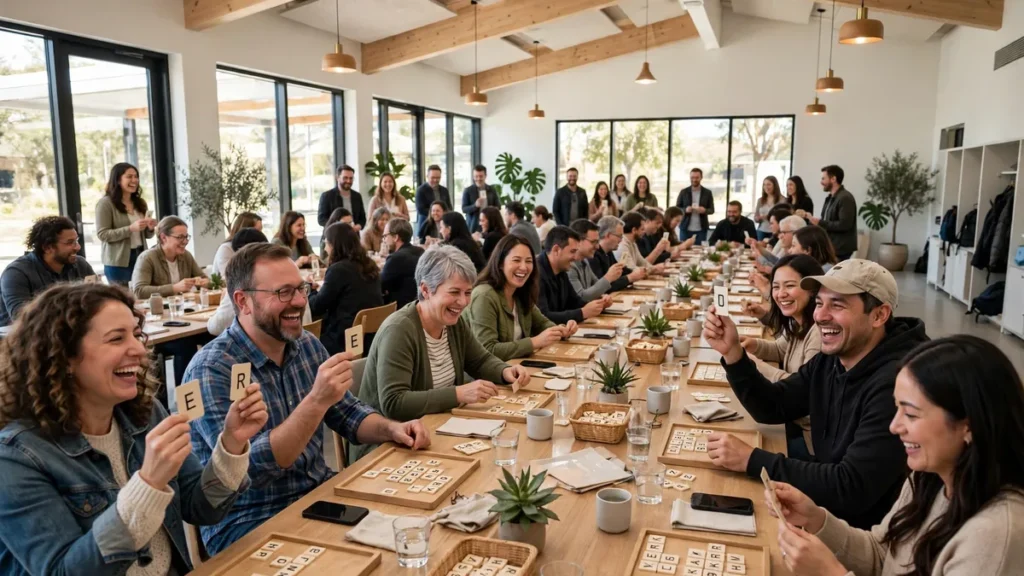
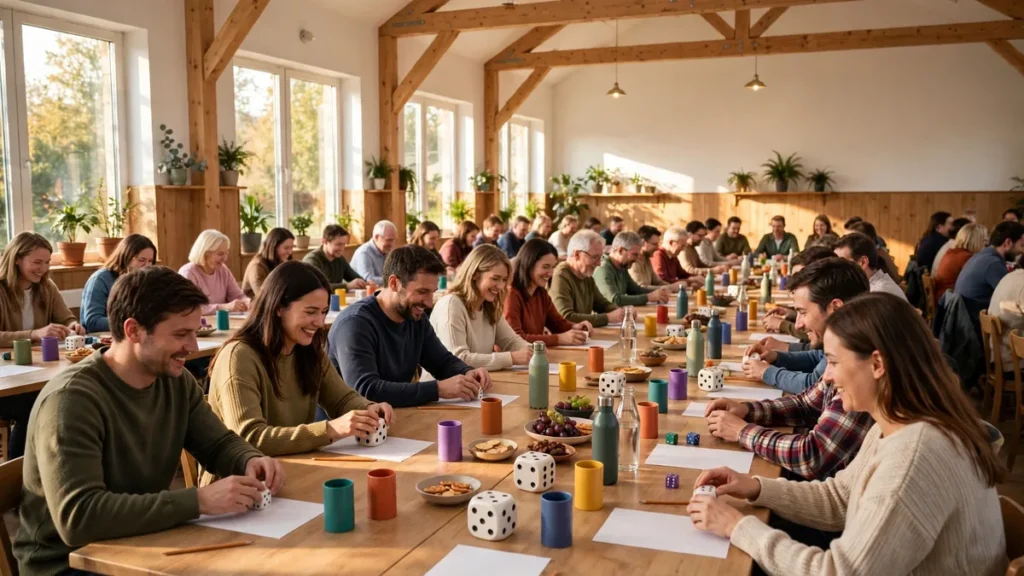
The best dice games for 313 players turn a headcount that looks impossible on paper into a loud, cheerful hall full of people who are all playing at once. Three hundred and thirteen is not a game night. It is a school assembly, a wedding reception, a company celebration, or a community festival that happens to have dice on the tables. Most dice games were written for four to eight friends around one table, so the usual advice simply does not stretch this far. You cannot hand one set of dice to three hundred people and expect everyone to have fun.
The number itself is part of the puzzle. Three hundred and thirteen is a prime number, which means it does not split neatly into equal groups. Fifty-two tables solve the problem beautifully: fifty-one tables seat six players each and one table seats seven, which adds up to exactly 313. Every table plays the same game at the same time, every table reports its scores to one central leaderboard, and the whole room shares one schedule and one big finish. Nobody waits long, nobody watches from the sidelines, and the size of the crowd becomes the entertainment instead of the problem.
This guide gives you ten games that genuinely work at this scale, with exact table counts, dice needs, and timing for 313 players. Every game below runs with ordinary six-sided dice, printed score sheets, dice cups, and a handful of volunteers. Pick three or four for an evening, or run all ten across a full day of play, and your 313 players will leave talking about the rolls they made rather than the time they spent waiting.
Key Takeaways
- Seat 313 players at 52 tables: 51 tables of six and one table of seven.
- Use the same game at every table, with heats, team captains, and one shared leaderboard.
- Plan on five dice and one dice cup per table, plus a printed score sheet for every player.
- Keep each round to 15 to 25 minutes so nobody sits idle for long.
- Appoint one captain per table and one scorekeeper per ten tables to keep results moving.

Best Dice Games for 313 Players at a Glance
| Game | Players per Table | Dice per Table | Round Time | Best For |
|---|---|---|---|---|
| Bunco Hall Relay | 6 to 7 | 3 | 20 minutes | Big noisy openers |
| Farkle Team Sprint | 6 to 7 | 6 | 25 minutes | Risk takers |
| Yahtzee Score Chase | 6 to 7 | 5 | 25 minutes | Steady strategists |
| Liar’s Dice Showdown | 6 to 7 | 5 each | 20 minutes | Bluffers and actors |
| Dice Bingo Bonanza | 6 to 7 | 2 shared | 15 minutes | All ages together |
| Sevens Station Race | 6 to 7 | 2 | 15 minutes | Fast warm-ups |
| Tenzi Table Dash | 6 to 7 | 10 each | 15 minutes | High-energy rounds |
| Roll-and-Write Relay | 6 to 7 | 2 shared | 20 minutes | Quiet thinkers |
| Pig Dice Relay | 6 to 7 | 1 | 15 minutes | Quick decisions |
| High Roller Knockout | 6 to 7 | 2 | 20 minutes | Dramatic finales |
The 10 Best Dice Games for 313 Players
Every game below is written for the 52-table layout, so the numbers already add up to 313. Run them in any order, and keep the same table captains all evening so players settle in and the rounds start faster each time. If your crowd is close to this size, the best dice games for 311 players use the same hall system with only two fewer seats to fill.
1. Bunco Hall Relay
Bunco is the natural opener for a crowd of 313 because it is loud, simple, and built around moving. Each table plays the same target number in each round, rolling three dice and counting how many match the round number. When the head table rings its bell, every table stops, winners move up one table, and new opponents sit down. The constant movement means players meet dozens of new people across the evening, which is exactly what a gathering this size needs.
At 313 players, run six rounds of about three minutes each, with the bell rung from the stage so the whole hall hears it at once. You need 156 dice in total, three per table, plus one bell or whistle for the head table. Keep a travelling prize at the head table, such as a small trophy or a funny hat, so the movement has a visible goal.
2. Farkle Team Sprint
Farkle rewards bold players and punishes greedy ones, which makes it perfect for a room full of competitive tables. Each player rolls six dice, sets aside scoring combinations, and decides whether to bank the points or roll again for more. Rolling with no scoring dice is a Farkle, and the turn scores nothing. The tension at each table builds quickly because everyone can see the score sheet and knows exactly who is ahead.
At 313 players, play to 5,000 points per table, which takes most tables about 25 minutes. You need 312 dice, six per table, and one score sheet per player. Table captains should announce the top score at each table halfway through the round, because a public leaderboard update pushes cautious players to take one more risky roll.
3. Yahtzee Score Chase
Yahtzee is the calm, thoughtful counterweight to the louder games on this list. Each player rolls five dice up to three times per turn, aiming to fill thirteen scoring boxes that range from simple totals to a five-of-a-kind Yahtzee. Because everyone plays the same boxes in the same order, tables stay roughly in step, and the final totals are easy to compare across the whole hall.
At 313 players, print 313 identical score sheets and give each table five dice and one dice cup. A full game takes about 25 minutes if players keep a brisk pace, so set a visible countdown on the stage and warn tables when five minutes remain. The top scorer at each table advances to a champions table for a short tie-breaker round, which gives the finale a clear winner.
4. Liar’s Dice Showdown
Liar’s Dice turns each table into a small theatre of bluffing. Every player starts with five dice hidden under a cup, peeks at their own roll, and then bids on how many dice of a certain value are showing across the whole table. The next player must raise the bid or call the bluff, and the dice are revealed. It is easy to learn in two minutes and almost impossible to master, which keeps experienced players and first-timers evenly matched.
At 313 players, you need 1,565 dice and 313 cups, which sounds like a lot until you remember that dice are cheap in bulk and cups can be plain paper ones. Play elimination style: when a player loses their last die, they join the cheering crowd behind their table. The last player standing at each table earns a place in the hall final, played on the stage with a microphone.
5. Dice Bingo Bonanza
Dice Bingo is the most welcoming game on this list, because it needs no strategy and no prior experience. Each player gets a bingo card printed with numbers, and the caller rolls two dice on the stage and announces the total. Players mark matching numbers, and the first to complete a line, four corners, or a full card shouts bingo. The whole hall plays at exactly the same pace, which makes it ideal for mixed groups of children, parents, and grandparents.
At 313 players, print 313 different bingo cards from a free card generator and check them before the event so no two cards are identical. The caller needs only two large dice and a microphone, and each game takes about 15 minutes. Run three games back to back with different winning patterns, and hand out small prizes after each one so the energy stays high.
6. Sevens Station Race
Sevens is a fast dice race that works beautifully as a warm-up while latecomers are still finding their tables. Each player rolls two dice in turn and adds the total to a running score, aiming to reach exactly 77 without going over. Overshooting sends the player back to 50, which produces groans and cheers in equal measure. There is nothing to set up and nothing to explain beyond one sentence, so tables can start within a minute of sitting down.
At 313 players, give each table two dice and one shared score sheet, and let the first player at each table to reach 77 raise a hand for a volunteer to record the win. A round takes about 15 minutes, and you can run it twice with a fresh target, such as 100, for the second race. It is also the best backup game on this list if another activity runs short.
7. Tenzi Table Dash
Tenzi is pure speed. Each player gets ten dice and rolls them all at once, setting aside the dice that show their chosen number and re-rolling the rest until all ten match. The first player at a table to finish shouts Tenzi, and the noise level at a table of seven people rolling seventy dice at once is something to hear. It is the loudest game on this list and the one players ask to repeat most often.
At 313 players, you need 3,130 dice, ten per player, so order them in bulk well ahead of the event and count them into small bags of ten before the day begins. Use a different colour for each table so stray dice find their way home. Play best of three rounds, which takes about 15 minutes, and give the fastest player at each table a coloured wristband for the hall final.
8. Roll-and-Write Relay
Roll-and-write games give quiet players a game they can win. The captain at each table rolls two shared dice and calls the result, and every player at the table writes the number into their own grid, trying to complete rows, columns, and patterns before the grid fills up. Nobody waits for a turn, nobody is eliminated early, and the whole table finishes together, which makes it a kind relief after the louder games.
At 313 players, print 313 identical grids and give each table two dice and a pencil per player. A round takes about 20 minutes, and the scoring is simple enough for table captains to check in under a minute. If your group includes many younger players, choose a grid with larger boxes and fewer rules, and let captains read the scoring example aloud before the first roll.
9. Pig Dice Relay
Pig is the simplest risk game ever invented, and that simplicity is its strength at this scale. One player rolls a single die, adds the result to a running turn total, and chooses to bank the points or roll again. Rolling a one wipes out the turn total and passes the die to the next player. The whole table leans in on every roll, because one bad roll can erase a lead built over five minutes of careful play.
At 313 players, play to 100 points per table, which takes about 15 minutes with brisk turns. You need only 52 dice, one per table, which makes Pig the cheapest game on this list to supply. To keep the pace up, set a house rule that a player must decide within five seconds of each roll, and let the table captain hold the score sheet where everyone can see it.
10. High Roller Knockout
High Roller Knockout is the finale this crowd deserves. Each player rolls two dice, and the lowest roller at each table is knocked out. Survivors roll again, and the table narrows from seven players to one over five or six quick rounds. The eliminations are fast and dramatic, and the crowd around each table grows as neighbours finish their own games and come to watch.
At 313 players, the knockout produces 52 table champions in about 20 minutes. Bring those champions to the stage, seat them at eight tables of six or seven, and repeat the knockout until one player remains. You need only two dice per table, and the stage final needs a microphone so the hall can hear each roll. Save this game for last, because nothing else on this list ends an evening with the same roar.
How to Run 313 Players Without Chaos
The games matter less than the system around them. Set up the hall the night before if you can, with 52 numbered tables, a chair count that matches each table, and a printed table map at the door so nobody wanders. Place the dice, cups, score sheets, and pencils in a labelled bag on each table before players arrive, and keep spares at a supply table near the stage. A room that is ready before the first guest arrives feels organised, and organised rooms play better.
Volunteers are the second half of the system. You need one captain per table, one scorekeeper for every ten tables, one caller with a microphone on the stage, and two runners to carry score sheets between tables and the leaderboard. Brief every volunteer for ten minutes before the doors open, give each one a printed schedule, and give captains a single rule: if a table is stuck, make a quick decision and keep playing. A small mistake that keeps the game moving beats a perfect ruling that stops the room for five minutes. Groups a little smaller than this one can borrow the same layout from the best dice games for 310 players, which uses fifty tables and the same captain system.
Your 313-Player Checklist
- Count chairs twice: 51 tables of six and one table of seven, 313 seats in total.
- Pack one labelled bag per table with dice, cups, score sheets, and pencils.
- Print 313 score sheets and bingo cards, plus twenty spares of each.
- Brief 52 table captains and six scorekeepers ten minutes before doors open.
- Test the microphone, the bell, and the visible countdown before guests arrive.
- Set up one central leaderboard where every table can see its standing.
Frequently Asked Questions
How many tables do 313 players need?
Fifty-two tables is the cleanest layout: fifty-one tables seat six players each and one table seats seven, which adds up to exactly 313. If your venue has long banquet tables instead of round ones, seat six or seven per section and mark each section with a table number so captains know where they belong.
How many dice do you need for 313 players?
It depends on the game. Most games on this list need two to six dice per table, which is roughly 100 to 315 dice for the whole hall. Tenzi is the exception, needing ten dice per player, or 3,130 in total. Buy dice in bulk bags of one hundred and count them into labelled table bags before the event.
Can children play dice games with 313 people?
Yes, especially Dice Bingo, Sevens, and Pig, which need no reading beyond numbers and no strategy beyond simple choices. Seat children with a parent or an older sibling at the same table, and choose the gentler games for the first hour while everyone settles in. The best dice games for 309 players include the same family-friendly picks for a slightly smaller hall.
How long does a 313-player dice evening take?
Plan for about two and a half hours: a ten-minute welcome, three or four games of 15 to 25 minutes each with short breaks, and a fifteen-minute finale. A full day event can run all ten games with a lunch break in the middle, but most hosts find that four well-run games leave players happier than ten rushed ones.
What if some players arrive late?
Keep two spare seats at the seven-player table and a small stack of blank score sheets at the door. Late players join the seven-player table first, or fill any empty chair at a table whose captain can catch them up in under a minute. Never hold the start for latecomers; begin on time and let them join the second round.
Do you need special dice for a group this large?
No. Ordinary six-sided dice work for every game on this list, and standard dice are cheap enough to buy in bulk. Use a single bright colour per table so stray dice are easy to return, and keep a spare bag of one hundred dice at the supply table for losses. Large foam dice are fun for the stage final but too slow for table play.
The Bottom Line
The best dice games for 313 players work because they stop treating the crowd as one giant table and start treating it as 52 small ones. Give every table the same game, the same dice, and the same schedule, put a captain at each table and a leaderboard where everyone can see it, and 313 strangers become 52 teams sharing one evening. Choose three or four games from this list, set the hall up the night before, and your only real problem will be finding a trophy big enough for the final winner.