
Finding the Best Dice Games for 261 Players sounds like an impossible brief, but it is really a logistics puzzle with a fun answer. Two hundred and sixty-one people cannot share one table, so the best formats split the crowd into tables, teams and heats, then reunite them for shared scoring and a single winner. The games themselves stay simple on purpose, because when hundreds of people play at once, the rules have to be learned in under a minute and the excitement has to come from the rolling, the shouting and the scoreboard, not from a complicated rulebook.
A 261-player dice night works best when it is treated like a tournament rather than a single game. Players sit in groups of four to six at numbered tables, each table runs the same short game at the same time, and table winners advance while everyone else keeps playing in a consolation bracket. A host with a microphone, a big visible scoreboard and a strict timer keeps the whole room moving together.
This guide covers the formats that scale to 261 players, the equipment you need, and the mistakes that turn a big dice night into a long queue. Every game below uses cheap, ordinary dice, works for mixed ages and abilities, and can be explained in a single sentence, which is exactly what a room of 261 people needs.
Key takeaways
- Split 261 players into tables of four to six and run the same short game at every table at the same time.
- Use a tournament structure with table winners advancing, so the whole room stays involved.
- Pick games with rules that can be explained in one minute and rounds that last ten minutes or less.
- One host, one microphone and one visible scoreboard matter more than fancy equipment.
- Giant foam dice, dice trays and printed score sheets keep hundreds of rolls fast, fair and easy to follow.
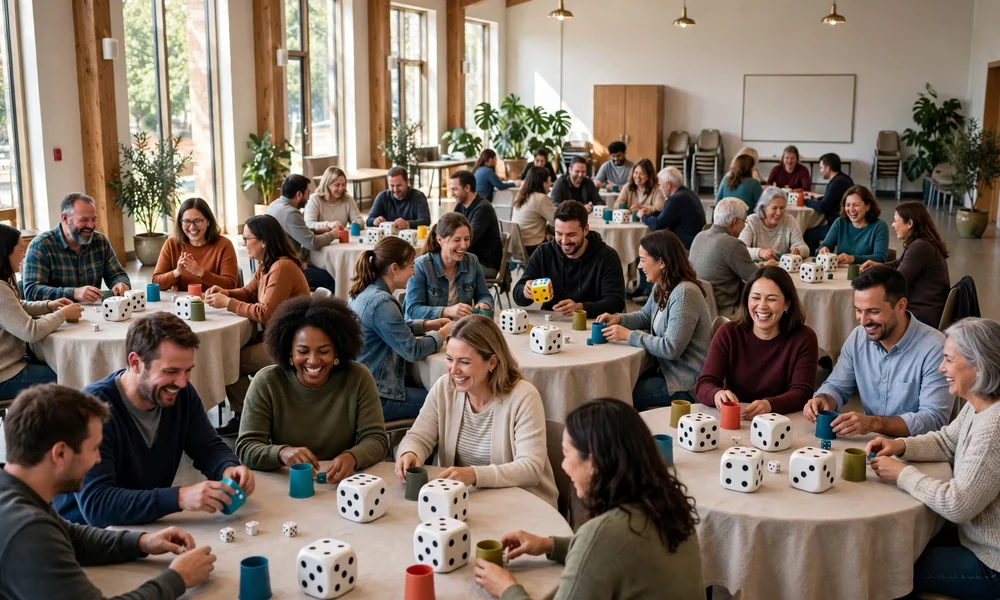
Why 261 Players Changes How Dice Games Work
A dice game that is perfect for six people can fall apart completely with 261. The first problem is waiting time: if every player needs a turn before the game moves on, a single round can take half an hour. The second problem is visibility: nobody at table forty can see table one, so the drama has to be local. The third problem is scoring: with hundreds of score sheets in play, the system must be simple enough for a volunteer to total in minutes.
The fix is to stop thinking of 261 players as one giant game and start thinking of them as fifty or so small games running in parallel. At four players per table you need 66 tables, and at six per table you need 44. Each table becomes its own arena, and the tournament structure connects them into one event. Short rounds are the other half of the secret: games that finish in five to ten minutes let you run four or five rounds in an hour, so nobody is knocked out early with nothing to do.
How to Organise Dice Games for 261 Players
Organisation decides whether the night feels like a party or a queue. Number every table clearly, put a printed rules card and a score sheet on each one, and place the dice, cups and trays in the middle first. Seat players in mixed groups, because mixed tables make better conversation and fairer competition. If you are running a similar event at a slightly smaller scale, the format in our guide to dice games for 259 players shows how the same table system works with just a couple of tables fewer.
Split Into Tables and Teams
Divide the room into tables of four to six players and give every table a number and a colour. For team events, group four tables into a team zone so that table scores add up to a team total, which gives quieter players a group to cheer for. Rotate seats between rounds, and move table winners up a table number while losers move down, which sorts the strongest players towards the top tables by the final.
One Scoreboard for Everyone
Appoint one scorekeeper per eight tables and give them a simple job: collect the table score sheet at the end of each round, check the winner’s name, and hand it to the central table. A large whiteboard, a projected spreadsheet or a flip chart at the front becomes the shared scoreboard. Announce the top ten scores after every round, because public recognition turns a quiet room into a cheering one.
Keep Rounds Short and Loud
Set a visible timer for every round and stick to it. Ten minutes is the sweet spot for most dice games at this scale, and a loud air horn or a bell marks the end far better than a voice that only the front rows can hear. The host should walk the room during play and build up the tension before the final round. Music between rounds keeps the energy up, and announcing the next game’s rules before the dice are touched stops the most common delay of all: a table that has not understood the game.
Best Dice Games for 261 Players
The games below all share three qualities: they need nothing more than dice, a score sheet and a pencil, they can be learned in a minute, and they produce a clear winner in under ten minutes. They are ordered from the easiest to run at massive scale to the ones needing more preparation.
| Game | Players per table | Round length | Dice needed per table | Best for |
|---|---|---|---|---|
| Bunco-style tournament | 4 | 10 minutes | 3 | Big social events |
| Yahtzee tournament | 4 to 6 | 10 minutes | 5 | Strategy fans |
| Farkle relay | 4 to 6 | 8 minutes | 6 | Risk takers |
| Liar’s Dice team battle | 5 to 6 | 10 minutes | 5 each | Bluffing and laughs |
| Dice Bingo | Any number | 10 minutes | 2 each | Mixed ages |
| Tenzi race | 4 to 6 | 5 minutes | 10 each | High energy finals |
| Pig relay | 4 | 8 minutes | 1 | Quick warm-ups |
| Left Centre Right mega game | 6 to 8 | 10 minutes | 3 | Whole-room play |
| Zombie Dice horde | 4 to 6 | 8 minutes | 13 | Themed parties |
| Roll-and-write rally | 4 to 6 | 10 minutes | 2 | Quiet focus rounds |
Bunco-Style Multi-Table Tournament
Bunco is the classic large-group dice game for a reason. Four players sit at a table with three dice, and each round targets a number from one to six. Players roll, count matching dice, and pass the dice on when they stop scoring, while a travelling pair moves between tables after each round. It is loud, social and almost entirely luck-based, which suits 261 players of very different skill levels. Use a bell to end each round across all tables at the same moment, and give small prizes for the most buncos, the most wins and the most losses.
Yahtzee Tournament
Yahtzee scales beautifully to a tournament because every table plays the same thirteen categories at the same pace. Each player gets three rolls per turn to build hands such as three of a kind, a full house or a Yahtzee of five matching dice, and the score sheet does the hard work of keeping everyone honest. Print the score sheets in advance, run all tables on the same timer, and collect the sheets after the final category to find the highest total. The game rewards thinking ahead, so it suits competitive players.
Farkle Relay
Farkle is a push-your-luck game in which players roll six dice, bank scoring combinations, and decide whether to risk the points they have already won for another roll. A roll with no scoring dice is a Farkle, and the turn’s points vanish, which produces the gasps and groans that make a big room fun. Run it as a relay: each table plays a fixed number of turns, then adds its total to a team score, so one unlucky Farkle does not ruin anyone’s night. The game needs no equipment beyond dice and a simple scoring card.
Liar’s Dice Team Battle
Liar’s Dice gives every player five dice and a cup, and the whole table bids on how many of a particular number are showing across all the hidden dice. Players bluff, challenge each other and lose dice when they are caught out, until one player is left standing. At 261-player scale, run it as a team battle, with each table’s winner earning points for their team zone, and start everyone with four dice instead of five to keep rounds short. The hidden information and the bluffing make it the funniest game on the list.
Dice Bingo
Dice Bingo is the simplest game here to run for a huge room, because every player needs only two dice and a printed bingo card showing the numbers two to twelve. One person at the front rolls the giant dice, calls the total, and every player who has that number marks it off, with the first to complete a line or a full card shouting bingo. It needs almost no explaining, suits children and grandparents side by side, and works as a warm-up while late arrivals find their tables. The format also appears in our guide to dice games for 258 players, where it fills the same opening slot.
Tenzi Race
Tenzi is pure speed. Each player gets ten dice and rolls them all at once, over and over, until all ten show the same number, and the first player at the table to finish shouts Tenzi. A table round lasts two or three minutes, so you can run a whole knockout bracket in a quarter of an hour, with table winners racing in front of the room for the final. It is the best closing game on the list, because the final is fast and visual, especially if the finalists roll giant foam dice on a stage.
Pig Relay
Pig is a one-die game with a single rule: roll and add to your total, but roll a one and you lose everything from that turn. Players decide when to stop and bank their points, and the first to reach one hundred wins the table. It takes five minutes to teach and eight to play, making it the perfect warm-up while the room fills, and the relay version passes a running team total from table to table so the whole team shares the risk. Pig is also great for tables with children, because the maths is simple and the decision to roll again is exciting at any age.
Left Centre Right Mega Game
Left Centre Right, often shortened to LCR, gives every player three tokens and three special dice marked with L, C, R and dots. On your turn you roll and pass tokens left, right or into the centre pot, and the last player holding tokens wins everything in the pot. With 261 players, run it at tables of six to eight, then bring the table winners together for a grand final with one giant pot. The game is almost pure luck, it takes seconds to learn, and tokens moving around dozens of tables at once is one of the most entertaining parts of a big dice night.
Zombie Dice Horde
Zombie Dice is a push-your-luck game with thirteen special dice showing brains, shotguns and footsteps. Players roll three dice, keep the brains they eat, and stop before three shotgun blasts end their turn empty-handed. It is quick, silly and highly visual, which makes it a strong choice for themed nights and younger crowds, and the horde version lets whole tables play as one team, adding their brains together against the other tables. The special dice cost more than plain ones, so buy a few sets and rotate them between tables.
Roll-and-Write Rally
Roll-and-write games give every player the same dice results and a personal sheet to fill in, which makes them perfect for a huge room because there is no waiting for turns at all. The host rolls two dice at the front, calls the numbers, and all 261 players write at the same time, racing to complete rows, columns and patterns on their sheets. Print the sheets in bulk, use a projector so the back of the room can see the dice, and run three short rallies with different sheets. It is the calmest game on the list, so schedule it between the loud ones as a breather.
Your 261-Player Dice Night Checklist
Use this checklist in the week before the event, and tick each item off as it is packed.
- Dice in bulk: at least 300 standard dice plus 20 giant foam dice for the stage, counted and bagged per table.
- Tables and chairs: 44 to 66 numbered tables seating four to six, plus a central score table near the host.
- Printed materials: a rules card and score sheet for every table, plus spares, pens and a visible timer.
- Sound and display: a microphone, a speaker loud enough for the hall, and a whiteboard or projector for the scoreboard.
- Volunteers: one host, one scorekeeper per eight tables, and two floaters to solve problems.
- Prizes: a main prize for the overall winner, small prizes for table winners, and fun awards for the most buncos and unluckiest player.
Tips to Keep 261 Players Engaged
Energy is the hardest thing to maintain across a whole evening with 261 people, so plan for it deliberately. Open with Dice Bingo or Pig while the room settles, because both games forgive late arrivals and confused first-timers. Put the loudest, silliest games in the middle of the evening when the room is warm, and save Tenzi or a Left Centre Right grand final for the end, when everyone wants a spectacle. Announce the leaderboard after every round and hand out small spot prizes for the fastest Tenzi win or the most dramatic Farkle, because recognition keeps people playing hard even when they are out of the running for the main prize.
Mix the formats so that no two rounds feel the same. Alternate a quiet strategy game like Yahtzee with a noisy luck game like Bunco, and follow a tense bluffing round of Liar’s Dice with a calm roll-and-write rally. Build in ten minutes for drinks halfway through, and use it to update the scoreboard and interview the leaders. If you are planning the wider party around the dice tournament, the ideas in our guide to party games for 258 players pair well with these dice formats.
Frequently Asked Questions
How many dice do you need for 261 players?
Plan for around 300 standard dice, which covers tables of four to six players with spares for dice that roll under tables or go missing. For Tenzi, add ten dice per player, or share Tenzi sets between tables in heats. Giant foam dice are optional but worth buying for the stage final, where the whole room needs to see the roll.
How long does a 261-player dice night take?
Most events run for two to three hours, including arrival, five or six rounds of ten minutes each, breaks and a final. Shorter games such as Tenzi and Pig keep the pace up, while Yahtzee and Bunco rounds take a little longer. Publish a running order in advance so nobody leaves before the final by mistake.
What is the best dice game for a very large group?
Bunco is the best all-rounder for a very large group because it was designed for multi-table play, needs only three dice per table, and mixes luck with movement between tables. Dice Bingo is the best choice if the group includes children or beginners, because the whole room plays together from a single roll at the front.
Can children play in a 261-player dice tournament?
Yes, and dice games are one of the easiest tournament formats for mixed ages. Dice Bingo, Pig and Tenzi need only simple counting, and children can be paired with an adult at tables of six so that they always have help with the score sheet. Keep the event alcohol-free if children are playing, and schedule family-friendly games early.
How do you stop cheating with 261 players?
Use dice trays or cups so that every roll is contained and visible, rotate seats between rounds so the same players do not stay together, and have volunteers walk the room during play. Most cheating at fun events is accidental, such as miscounting a score, so a clear rules card on every table and a calm volunteer to settle disputes matters more than strict policing.
What prizes work best for a dice tournament?
Small, fun prizes work better than one expensive prize that only one person can win. Offer a main prize such as a board game bundle or a gift voucher, then add table-winner prizes, fun awards for the unluckiest player, and a raffle prize drawn from all the score sheets.
The Bottom Line
The Best Dice Games for 261 Players are the ones that split a huge crowd into small, fast, noisy tables and then tie those tables together with a simple tournament, a loud host and a scoreboard everyone can see. Bunco leads the list for big social nights, Yahtzee suits the strategists, Tenzi makes the best final, and Dice Bingo warms the room up, but the format matters more than any single game. Get the tables, the dice, the timer and the scoreboard right, keep the rounds short, and 261 players will spend the evening rolling and laughing.


