
The Best Trivia Games for 261 Players turn an ordinary quiz night into a full-scale event, and the difference between a smooth tournament and a chaotic evening comes down to format. With 261 players in the room, you cannot simply hand out answer sheets and hope for the best. You need teams, brackets, a clear scoring system, and a host who can keep hundreds of people moving at the same pace.
A group of 261 players can fill a hall, a school gym, or a company conference floor, yet every team can still feel part of one competition. The best formats split players into teams of three to six, run several rounds with different question styles, and mix written answers, buzzers, and audience-response tools so no team waits long for its turn.
This guide covers the trivia games and formats that actually work for 261 players, from team tournaments and buzzer rounds to quiz-bowl brackets and app-based audience trivia. Each format is judged on speed, fairness, equipment, and how much fun it stays for teams at the back as well as the front.
Key takeaways
- Split 261 players into teams of three to six, giving you roughly 45 to 85 teams that are easy to score and seat.
- Written-answer rounds are the fastest format for a huge group, while buzzer rounds work best as a short final for the top teams.
- A quiz-bowl style bracket keeps elimination fair, but it needs several rooms or hosts running at the same time.
- Audience-response apps let every player answer at once and give instant scores, keeping a large room engaged between rounds.
- Mix question styles across rounds, keep every round under twenty minutes, and announce the leaderboard after each round.
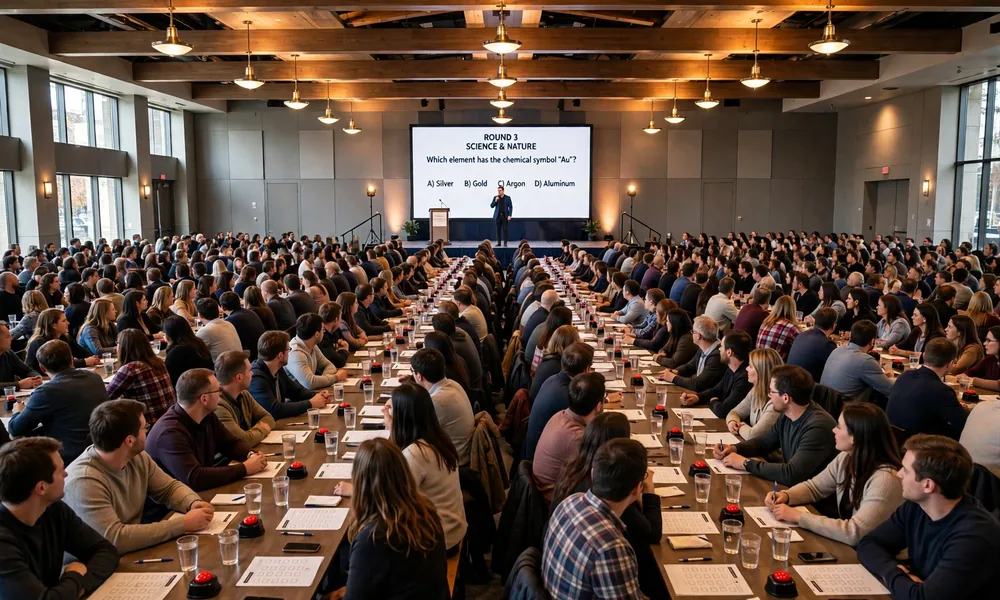
Why 261 Players Changes Trivia Completely
Trivia for ten people and trivia for 261 people are different games, even when the questions are the same. With ten players, one host can read a question and collect the answers in a minute. With 261 players, that loop breaks down, and a single slow round can drain the energy from the whole room.
The first problem is seating. Teams of six need about 44 tables, while teams of three need about 87, which is far harder to fit into one hall. Teams of four or five give 52 to 65 teams, large enough to feel like a tournament and small enough for a host and two or three scorers to manage.
The second problem is fairness. In a huge hall, teams at the back may hear a question a second later, and a team near a noisy bar may miss a word entirely. Good hosts solve this by showing each question on a large screen as well as reading it aloud, and by repeating it once before the timer starts.
The third problem is pace. If each round takes thirty minutes, a five-round night lasts two and a half hours before scoring, and most players will stop caring by round four. Keep rounds short, score quickly, and show the leaderboard often, because players who can see their team climbing stay engaged even when they are not winning.
The Best Trivia Games for 261 Players
The formats below are ranked for a group of exactly this size. Each one scales well, uses equipment most venues already have, and keeps all 261 players involved rather than turning most of them into spectators.
Team Trivia Tournament
The team trivia tournament is the most reliable format for 261 players, and it should be the backbone of your night. Players form teams of four or five, sit at numbered tables, and answer the same written questions in each round. The host reads each question twice, teams write their answers, and runners collect the sheets while the host reads the answers aloud.
What makes this format work at scale is that nothing depends on buzzing speed or on hearing first. Every team gets the same time, the same questions, and the same chance to score. Scoring is simple: one point per correct answer, with a bonus for a perfect round, and scorers can mark 60 sheets in about ten minutes.
The best team tournaments use five or six rounds of ten questions, each built around a different theme such as history, science, sport, music, food, or general knowledge. A picture round and a music round break up the written questions and give different kinds of players a chance to shine. Keep the difficulty mixed in every round so that no team scores zero or a perfect round too easily. If you want ideas for scaling the same format down slightly, the guide to trivia games for 259 players shows how the same team structure works with a nearly identical group size.
Buzzer Format Final
A buzzer format is thrilling, but it does not work as the main game for 261 players, because only one team can answer at a time and the other 260 would spend most of the night watching. Use buzzers as a short final for the top four or six teams, after the written rounds have decided who qualifies.
In the final, the qualifying teams sit on stage with a buzzer each, and the host asks rapid-fire questions. The first team to buzz gets ten seconds to answer, a correct answer earns points, and a wrong answer lets the next team try. Ten to fifteen questions are enough to decide a winner, while the rest of the room watches on the big screen and plays along on answer sheets for fun.
Buzzers need little equipment: four to six wireless buzzers, a clear sound system, and a visible scoreboard. Keep the questions shorter and easier than the written rounds, because buzzer questions reward fast recall rather than deep thinking, and the final gives the night a natural climax.
Quiz-Bowl Style Bracket
A quiz-bowl style bracket brings real competitive structure to a large trivia night. Teams face each other head to head in short matches, winners advance, and the bracket narrows from dozens of teams to a single champion. For 261 players, it works best with 48 or 64 teams, meaning teams of four or five with a few byes to fill the gaps.
Each match lasts about fifteen minutes and covers ten questions, with a toss-up either team can answer followed by a bonus for the team that wins it. Matches can run in parallel in several rooms or corners of one hall, each with its own host and buzzer set, so four matches at a time can clear a 64-team bracket in about two hours.
The bracket suits competitive groups such as school teams, company departments, or sports clubs, because every match feels like a contest rather than a test. It needs more hosts than a written tournament, so it works best as the second half of the night, after a written round has seeded the teams. A similar large-group approach is described in the guide to trivia games for 258 players, which uses the same team sizes and bracket logic.
Audience-Response Trivia
Audience-response trivia uses phones or clickers so all 261 players can answer at the same time. The host shows a question on the screen, players tap their answer, and the results appear instantly as a chart. The fastest correct answers earn the most points, which keeps the energy high even in a very large room.
This format is the easiest to score, because the software does the work, with no sheets to collect and no marking between rounds. It is also the most inclusive, because shy players can still take part. The main risk is technical: weak Wi-Fi can fail with 261 devices connected at once, so test the venue network in advance and keep a written backup round ready.
Audience-response trivia works well as an opening round or a warm-up between written rounds, and as the whole game for a casual corporate event where the goal is fun rather than serious competition. Mix multiple-choice, picture, and true-or-false questions to keep the pace fast, and show the top ten teams after every five questions.
Large-Group Trivia Night
A classic large-group trivia night combines the best parts of the formats above into one evening. The night opens with a written round, moves into a picture round and a music round, and finishes with a buzzer final for the top teams, giving every player something to enjoy while the host controls the pace.
The key to a good large-group night is the running order. Start with an easy general knowledge round so every team scores points and settles in, follow it with a themed round and a picture round, and put a music round in the middle to lift the energy. A final written round decides which teams reach the buzzer final, and a small prize for the best team name keeps the mood light.
For the question bank, variety matters more than difficulty. Use history, geography, science, sport, music, film, food, and current events, with a mix of easy, medium, and hard questions in every round. The history trivia questions and answers collection is a useful source of well-tested questions for a history round.
Relay and Rotation Trivia
Relay and rotation trivia adds movement to a night that would otherwise keep 261 players sitting still for two hours. In a relay round, one member of each team walks to the front, reads a question on a card, and walks back to confer before the next member goes. In a rotation round, teams move between stations, each with a different kind of question, such as a puzzle table or a picture wall.
Rotation trivia works best when the venue has more than one room or a hall with clear zones. Six stations at ten minutes each gives a full hour of play. It suits family events and school nights, because it feels like a fairground rather than an exam, but it needs a volunteer at each station.
Keep relay and rotation rounds short and simple, with questions answerable in a minute or two and scoring visible at each station. Use them as one round inside a larger night rather than the whole event, because they are harder to run for 261 players than a seated written round.
Comparison Table: Which Format Fits Your Event
Choosing a format is easier when you compare the practical demands side by side. The table below covers the six formats in this guide and what matters most with 261 players: how many people play at once, how long a full game takes, how much equipment you need, and how hard it is to score fairly.
| Format | Players at once | Time needed | Equipment | Scoring effort | Best for |
|---|---|---|---|---|---|
| Team trivia tournament | All 261 | 2 hours | Answer sheets, pens, screen | Moderate | Most events |
| Buzzer format final | 4 to 6 teams | 20 minutes | Buzzers, sound system | Low | Exciting finish |
| Quiz-bowl style bracket | 8 teams per round | 2 hours | Buzzers, several hosts | Moderate | Competitive groups |
| Audience-response trivia | All 261 | 1 hour | Phones, Wi-Fi, screen | Very low | Corporate events |
| Large-group trivia night | All 261 | 2 to 3 hours | Sheets, buzzers, screen | Moderate | Full evening events |
| Relay and rotation trivia | All 261 | 1 hour | Stations, volunteers | High | Family and school nights |
How to Run a 261-Player Trivia Night
Form the Teams
Decide the team size before you send out invitations, and print it on every invitation. Teams of four or five work best for 261 players: smaller teams mean more tables and sheets to mark, while larger teams leave some players sitting quietly. Let players form their own teams in advance, and keep a sign-up table on the night for single players.
Number every table and give every team a number. The number goes on the answer sheet, on the table, and on the leaderboard, so scorers never have to guess which team a sheet belongs to. If two teams pick the same name, add the table number to the name to avoid confusion.
Plan the Rounds
Five rounds of ten questions is the standard shape for a 261-player night, and it fits neatly into two hours with breaks. Each round should take about fifteen minutes, including reading the questions, collecting the sheets, and announcing the answers, with a ten-minute break in the middle.
Write the questions in advance and test them on two or three people who will not be playing. Rewrite or drop any question both testers find confusing, and check every answer twice, because a wrong answer key in front of 261 players is far worse than the same mistake in front of ten. Keep a spare round of ten questions ready in case a round runs short or a technical problem eats into your time.
Score Fairly and Quickly
Scoring is where large trivia nights usually slow down, so plan it carefully. Recruit at least four scorers, give each one a stack of answer sheets and a marking key with the exact accepted answers, and decide in advance whether close spellings count, telling the teams before the first round.
Swap answer sheets between teams for marking if you are short of scorers, and have one scorer check any disputed answers. Post the running leaderboard after every round, showing the top ten teams and the teams just below them, because teams a few points from the top ten will try harder in the next round.
Keep the Room Engaged
A host makes or breaks a large trivia night. The host should speak clearly, keep a steady pace, and read every question twice, with jokes between rounds but no long stories between questions. A co-host can watch the timer, collect sheets, and handle disputes while the main host reads the questions.
Use the screen for more than the questions. Show the round theme, the leaderboard, and the countdown timer between questions, and play short music clips during breaks. If the room has a bar or a food table, place it at the back so movement does not distract the teams near the front.
Checklist for a 261-Player Trivia Night
Use this checklist in the week before your event to catch the details that are easy to forget while you are busy writing questions.
- Confirm the venue holds 261 players seated at tables, with space for a stage, a screen, and a scoring table.
- Set the team size at four or five players, number the tables, and prepare a sign-up sheet for single players.
- Write five rounds of ten questions, test them, check every answer twice, and prepare one spare round.
- Print enough answer sheets and pens for every team, plus spare sheets for mistakes and late arrivals.
- Test the sound system, the screen, and the Wi-Fi from the back of the room before the players arrive.
- Recruit at least four scorers, brief them on the marking rules, and prepare a simple leaderboard to update after each round.
Frequently Asked Questions
How many teams should 261 players form?
Teams of four or five work best, giving you about 52 to 65 teams. Teams of four are easier to seat and score, while teams of five let more friends play together. Avoid teams of more than six.
How long does a trivia night for 261 players take?
Plan for two to two and a half hours of play, plus a break in the middle. Five rounds of ten questions take about fifteen minutes each, including scoring, and a buzzer final adds about twenty minutes. Announce the finish time on the invitation.
What equipment do I need for 261 players?
At minimum you need a sound system that reaches the back of the room, a large screen, printed answer sheets, pens, and a scoring table. Add buzzers for a final, and test the Wi-Fi for an audience-response round. Bring spare pens and sheets.
How do I stop cheating in a large trivia group?
Ask players to put phones away during written rounds, with a clear penalty such as losing the points for that round, and space the tables far enough apart that teams cannot easily see each other’s sheets. For audience-response rounds, cheating is less of a problem because speed matters as much as accuracy.
Can I run trivia for 261 players without a big budget?
Yes. A written team tournament needs little more than printed sheets, pens, and a borrowed sound system, with simple prizes such as a trophy for the winners. The most important investment is time spent writing good questions and testing them before the night.
What makes a good question for a huge group?
A good question has one clear answer, uses plain language, and is fair to players of different ages and backgrounds. Mix easy questions most teams can answer with harder ones that separate the leaders, and avoid questions that depend on very recent news or have two acceptable answers unless you accept both.
The Bottom Line
The Best Trivia Games for 261 Players all share the same qualities: they keep every player involved, they score fairly, and they run on time. Start with a written team tournament as the backbone of your night, add a buzzer final for the top teams, and use an audience-response round for instant scoring. Form teams of four or five, write five rounds of ten well-tested questions, recruit enough scorers, and show the leaderboard after every round, and 261 players will leave asking when the next trivia night is.


