
Best trivia games for 269 players turn an ordinary gathering into a full-scale event, and the best trivia games for 269 players are the ones that keep every single person involved from the first question to the final score. A group of 269 is far too large for a single table, a single buzzer, or a single sheet of paper, yet it is exactly the right size for a well-run team trivia night. With the right format, the room divides into teams, the questions move at a steady pace, and the competition stays close enough that nobody drifts away to check a phone.
Large-group trivia works because it rewards knowledge that is spread across a crowd. One player knows classic films, another knows geography, a third knows sport, and a fourth knows music from the 1990s. A team of eight or ten people can cover far more ground than any individual, which is why trivia scales so well. The challenge is not finding enough questions. The challenge is organisation: clear teams, a scoring system everyone can follow, questions that are fair at every difficulty level, and a host who keeps the energy high without letting the night drag.
This guide compares the formats, games, and tools that work best when 269 people play together. It covers classic board games adapted for teams, buzzer-style game-show formats, phone-based trivia platforms, pub quiz structures, and do-it-yourself rounds you can build in an afternoon. It also explains how to split 269 players into teams, how many rounds to run, how to score fairly, and how to choose a format that suits your venue, your budget, and your audience.
Key takeaways
- Split 269 players into teams of six to ten, which gives you roughly 27 to 45 teams and keeps every player involved in every round.
- Phone-based and buzzer-based trivia scale best for very large groups, because scoring is instant and nobody waits for paper to be collected.
- Mix easy, medium, and hard questions in every round so new players score early and experienced players stay challenged.
- Run five to seven rounds of ten questions, with a picture round and a music round, for a night that lasts about two hours.
- Appoint a host, a scorekeeper, and a question reader, and test every slide, speaker, and buzzer before the first team arrives.
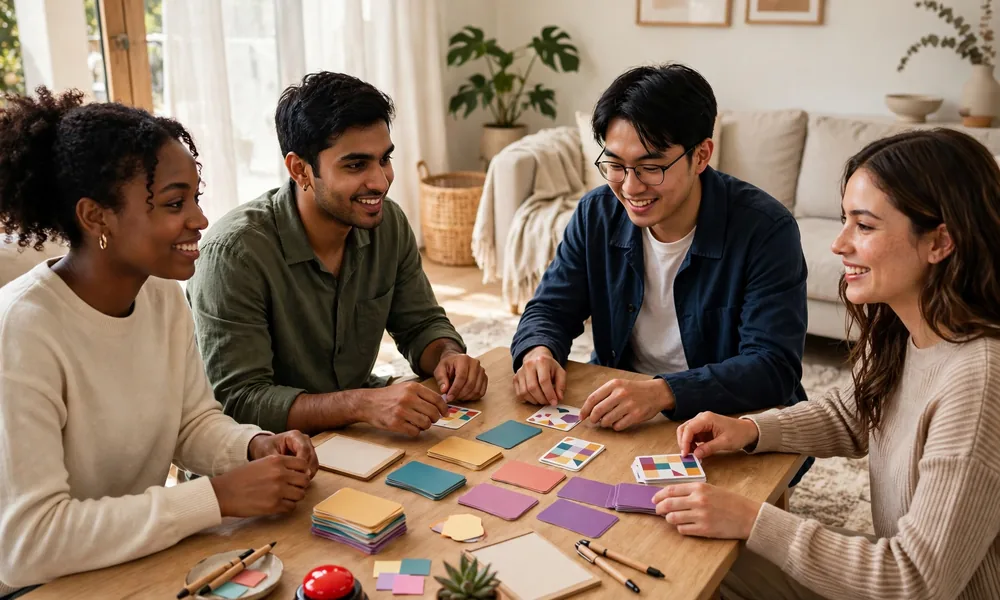
Best Trivia Games for 269 Players at a Glance
The table below compares the strongest options for a group of this size. Board games work well when each team has its own copy, while app-based and buzzer games work best when the whole room plays together through one central system. Look first at the player count, the setup time, and whether the game needs a host, because those three factors decide whether a format survives contact with 269 players.
| Game or format | Best for | Players per set | Setup time | Host needed |
|---|---|---|---|---|
| Trivial Pursuit team edition | Classic general knowledge | 2 to 6 per board | 15 minutes | Yes |
| Quiz buzzer game show | High-energy finals | 4 teams on stage | 30 minutes | Yes |
| Phone-based trivia app | Whole-room play | Unlimited | 20 minutes | Yes |
| Pub quiz format | Mixed-age crowds | Unlimited in teams | 20 minutes | Yes |
| Music and picture rounds | Variety and fun | Unlimited in teams | 30 minutes | Yes |
| Jeopardy-style board | Competitive teams | 3 teams per board | 25 minutes | Yes |
| Trivia card decks | Warm-ups and breaks | 2 to 8 per deck | 5 minutes | No |
| Online quiz platform | Hybrid and remote teams | Unlimited | 20 minutes | Yes |
No single game covers 269 players on its own. The strongest nights combine two or three formats: a phone-based system for the main rounds, a buzzer final for the top teams, and card decks on the tables for warm-ups while everyone settles in. That combination keeps the pace brisk, gives every team a fair chance, and creates a clear climax at the end of the night.
Classic Board Trivia, Adapted for Teams
Classic board trivia games remain the foundation of most large trivia nights, and they adapt well once you stop thinking of them as games for a single table. Trivial Pursuit, for example, was designed for small groups, but its question cards are perfect for team play. Give each team a set of cards, or read the questions aloud from one master set while teams write their answers on score sheets. The board itself becomes optional, and the questions become the game.
The strength of classic board trivia is the quality and range of its questions. A good set covers history, geography, arts and literature, science and nature, sports and leisure, and entertainment, which means every team has a category where it feels strong. The weakness is pace. Reading questions one at a time to a room of 269 people takes discipline, so set a strict time limit of thirty seconds per question and move on whether every team has answered or not. A visible timer on a screen keeps the rhythm honest.
Buy or borrow several copies of the same game so that question writers can pull from a large pool without repeating cards. If you are running a themed night, such as films, music, or the 1980s, choose an edition that matches the theme rather than forcing general questions into a theme they do not fit. Teams notice when a themed round is really just a general round with a different label, and the night feels sharper when the questions genuinely match the promise. For a closer look at how similar large-group lists are built, the guide to the best trivia games for 267 players shows how the same team format scales up and down with only small changes to team size and round length.
Buzzer and Game-Show Formats
Buzzer games create the most excitement in a large room, and they are the best choice for a final round. Four top teams stand on stage, a host reads a question, and the first team to buzz in gets the chance to answer. The audience watches every buzz, the tension builds with each question, and the final score feels earned in front of everyone. A simple set of wireless buzzers, or even a phone-based buzzer app, is enough to run this format well.
The main risk with buzzers is that they favour speed over knowledge, so design the final to balance both. Mix quick-fire questions, where the fastest team wins, with longer questions that reward careful thinking. Give teams a short conference time before they answer, and take points away for a wrong answer on a buzz-in so that teams cannot simply buzz first and guess. A penalty of one point keeps the game honest without punishing bold play too harshly.
Buzzer formats also need a confident host. The host controls the pace, settles disputes, reads questions clearly, and keeps the audience involved between rounds. Choose someone who enjoys speaking to a crowd and who can stay calm when two teams buzz at the same moment. A second person should watch the buzzer lights and confirm which team buzzed first, because the host cannot do that job and read questions at the same time. Rehearse the final with two volunteer teams before the night begins, even if it takes only ten minutes, because a smooth final is what people remember.
Phone-Based and App Trivia
Phone-based trivia is the most practical format for 269 players, because it removes the two biggest problems of large-group play: collecting paper and counting scores. Each player, or each team captain, answers on a phone. Answers arrive instantly, scores update on a screen, and the leaderboard changes in real time. The room stays focused because everyone can see where their team stands after every round.
Choose a platform that supports at least 300 simultaneous players, and test it on the venue Wi-Fi before the event. Ask the venue whether the network can handle 269 phones at once, and have a mobile hotspot as a backup if the answer is uncertain. Run a practice question at the start of the night so that every team can check that its answers are registering. If a team reports a problem, fix it during the practice round, not during a scored round.
Phone-based games also let you mix question types that paper cannot handle. Picture rounds, music clips, and short video questions all work well on a screen, and they break up the rhythm of text questions. Keep each clip under fifteen seconds, keep the volume high enough for the back of the room, and always show the question on a large screen as well as on the phones, because some players will look up while others look down. The best trivia games for 266 players guide uses the same phone-first approach and is a useful comparison when you are deciding between app platforms and paper score sheets.
One caution applies to phone-based play: it can feel less social than paper play if teams stare at screens instead of talking. Prevent this by giving teams thirty seconds of discussion time before answers lock in, and by building in rounds that require conversation, such as a picture round where the team must agree on a single answer. The best phone trivia nights feel like team conversations with a phone in the middle, not like 269 people taking a test in silence.
Pub Quiz Structure for a Very Large Room
The pub quiz is the most forgiving structure for a group of 269, because it was designed for noisy rooms, mixed abilities, and teams of friends. A standard pub quiz runs for about two hours, with five or six rounds of ten questions, a picture round, and a music round. Teams write answers on paper or submit them by phone, the host reads the answers at the end of each round, and the scores build steadily toward a winner.
Build each round around a clear theme so that teams know what to expect. A history round, a geography round, a sport round, a music round, a film and television round, and a general knowledge round give every team a fair spread. Add a picture round in the middle, where teams identify famous places, films, or faces from images on a screen, and a music round near the end, where teams name the song and the artist from a short clip. These two rounds change the pace, reward different kinds of knowledge, and give teams that struggle with text questions a real chance to catch up.
Question difficulty matters more than question quantity. In every round of ten, aim for three easy questions that most teams will answer, four medium questions that about half the teams will answer, and three hard questions that only the strongest teams will answer. This spread keeps the scores close, prevents one team from running away with the night, and makes sure that every team hears its own correct answers read out at least a few times. Avoid questions that depend on a single obscure fact, and avoid questions with more than one defensible answer, because disputes slow the night down and frustrate the room.
How to Run Trivia for 269 Players
Running trivia for 269 players is a logistics task as much as a quiz, and the plan below covers the decisions that matter most. Start by fixing the team size. Teams of six to ten work best, which means 27 to 45 teams for 269 players. Smaller teams give every player more questions to answer, while larger teams are easier to manage but leave quieter players with less to do. Ask people to form teams in advance where possible, and have a joining table for individuals and small groups on the night.
Next, fix the schedule. A two-hour night with six rounds of ten questions, plus a picture round and a music round, is a proven shape. Allow five minutes between rounds for marking, scoring, and a short break, and keep the host talking during those gaps so the energy does not drop. Start on time, even if a few teams are still arriving, because a late start pushes the finish past the point where people begin to leave. Announce the schedule at the start so that teams know when the final round begins.
Finally, plan the venue. A room for 269 players needs clear sightlines to a screen, speakers that reach the back rows, and tables arranged so that teams can talk without shouting across the room. Visit the venue in advance, test the sound from the farthest table, and check that the lighting lets teams read their answer sheets. If you need inspiration for structuring the rounds themselves, the pub quiz questions and answers collection is a strong starting point for building balanced rounds that work in a large room.
Checklist: How to Choose a Trivia Game for 269 Players
- Confirm the format supports at least 300 players at once, with a tested backup if the Wi-Fi or the platform fails.
- Choose teams of six to ten players, and prepare a plan for individuals and small groups who arrive without a team.
- Mix easy, medium, and hard questions in every round, and include one picture round and one music round.
- Book a host, a scorekeeper, and two helpers, and give each of them a printed copy of the questions and the schedule.
- Test the microphone, speakers, projector, buzzers, and phones from the farthest table before the first team arrives.
- Set a two-hour schedule with six rounds, mark answers quickly, and show a leaderboard after every second round.
Frequently Asked Questions
How many teams should 269 players form?
Teams of six to ten players work best, which gives you roughly 27 to 45 teams. Six-player teams give every member more chances to answer, while ten-player teams are easier to organise and seat. Avoid teams larger than ten, because quieter players stop contributing and the team becomes a small audience rather than a team. If you have more than 45 teams, add a second scorekeeper so that marking and scoring keep pace with the rounds.
How long does a trivia night for 269 players take?
Plan for about two hours of play, plus thirty minutes for arrival, seating, and a practice question. Six rounds of ten questions take roughly ninety minutes when you allow time for reading, answering, and marking. A picture round and a music round add about fifteen minutes each. A buzzer final for the top four teams adds a further fifteen minutes. Start on time and keep the breaks short, because a night that runs past two and a half hours loses players to tiredness.
What is the best trivia format for a group this large?
Phone-based trivia is the most practical format for 269 players, because scoring is instant and the leaderboard updates in real time. A pub quiz structure on paper is the best low-cost alternative, and it works well when you have enough helpers to collect and mark sheets quickly. Buzzer games are best saved for a final between the top teams, where the drama of a live buzz-in adds excitement without slowing down the main rounds.
How do you stop one team from winning too easily?
Use a balanced mix of easy, medium, and hard questions in every round, and include picture and music rounds that reward different kinds of knowledge. A handicap round, where teams answer questions from a category they did not choose, can also close the gap. Most importantly, keep the scores close by design: if the strongest team leads by a wide margin after round two, the rest of the room stops trying, and the night loses its energy.
Do you need special equipment for 269 players?
You need a microphone and speakers that reach the back of the room, a large screen or projector for questions and the leaderboard, and a reliable way for teams to submit answers, either on paper or by phone. Buzzers are optional and are best used only for the final. Test every piece of equipment from the farthest table before the event, and keep spare batteries, printed answer sheets, and a backup speaker within reach.
Can children play in a 269-player trivia night?
Yes, children can play well in a large trivia night when the questions include rounds they can win. Add a round on animals, cartoons, food, or sport, and keep the language simple in the early rounds. Mixed-age teams work best, because adults and children cover different categories between them. Keep the night to two hours, schedule it earlier in the evening, and offer a small prize for the best family team as well as for the overall winner.
The Bottom Line
The best trivia games for 269 players are the ones that turn a very large crowd into a room full of small, focused teams, each with a fair chance to win. Choose a phone-based system or a well-run pub quiz for the main rounds, add a picture round and a music round for variety, and finish with a buzzer round for the top teams. Mix easy, medium, and hard questions, keep the pace brisk, test every piece of equipment, and staff the night with a host, a scorekeeper, and helpers who know the schedule. Do that, and 269 players will feel like one room playing together rather than a crowd waiting for the night to end.


