
Finding the Best Puzzle Games for 260 Players is a very different challenge from picking a game for a family night or a small classroom. At this scale, a single tabletop puzzle cannot carry the room, and a game that works beautifully for twenty people can collapse into confusion when two hundred and sixty players all need a role, a task, and a way to contribute. The best puzzle games for a group this large are built around teams, parallel stations, and shared goals, so that every player is solving something at the same time instead of watching a handful of confident solvers do all the work.
Large-group puzzle play works when the event is designed like a tournament rather than a single game. Players are split into teams of four to ten, each team tackles the same set of puzzles or a different station in a relay, and scores are tracked on a visible leaderboard. Formats such as team puzzle hunts, giant jigsaw relays, escape-room style challenges, and logic puzzle tournaments all scale well because they divide the work naturally. A puzzle hunt can hand every team the same packet of riddles and word puzzles, a jigsaw relay can run ten tables at once, and a logic tournament can seat hundreds of players at individual answer sheets while still feeling like one shared event.
This guide covers the puzzle formats that genuinely work for 260 players, how each one runs in practice, what equipment and space you need, and how to keep the event fair, fast, and fun. Every format here has been chosen because it handles huge numbers without long waits, without expensive specialist equipment, and without leaving quieter players on the sidelines. Whether you are planning a school event, a corporate team day, a community festival, or a record-breaking puzzle gathering, the games below will help you turn 260 players into one memorable shared experience.
Key takeaways
- Split 260 players into teams of four to ten so that everyone solves at the same time and no one waits on the sidelines.
- Team puzzle hunts and logic puzzle tournaments scale best because every team gets the same puzzles and works in parallel.
- Giant jigsaw relays and escape-room style stations work well when you have enough tables, space, and duplicate puzzle sets.
- Use a visible leaderboard and fixed time limits to keep the event moving and to keep scoring fair across all teams.
- Plan one puzzle station per team, plus spare sets and clear printed instructions, so the event runs smoothly from start to finish.
Why 260 Players Changes Puzzle Games
Most puzzle games are designed for two to six players, and that assumption shapes everything from the size of the pieces to the number of clues. When the player count jumps to 260, the problems are practical rather than creative. A single puzzle cannot be seen or touched by that many people at once, answers cannot be checked one by one by a single host, and any format that asks players to take turns will leave most of the room idle for most of the event. The games that succeed at this scale solve those problems by design, not by accident.
The first rule of large-group puzzle play is parallelism. Every team should be working on something at every moment. In a team puzzle hunt, all teams receive the same packet at the same time and race to solve it. In a jigsaw relay, ten or more tables run side by side, each with its own puzzle and its own team. In a logic tournament, every player gets an answer sheet and works through the same set of problems while a host calls time. Parallel play keeps energy high, because nobody is waiting for a turn that may never come.
The second rule is clarity. Instructions must be printed, short, and identical for every team. At a small gathering, a host can explain a rule verbally and answer questions as they arise. With 260 players, that approach breaks down, because half the room will not hear the explanation and the other half will remember a different version of it. Printed instruction cards at every station, a short demonstration before the event starts, and a single set of written rules prevent most disputes before they happen. Space matters too: plan for roughly one table per team, with room around each table for players to stand, lean in, and pass pieces to each other.
The Best Puzzle Games for 260 Players
The formats below are ranked by how well they handle a crowd of this size, how little specialist equipment they need, and how much genuine puzzle solving each player gets to do. The strongest choice for most organisers is a team puzzle hunt, because it needs little more than printed puzzle packets and a scoring table, but the other formats on this list each solve a different problem, from keeping hands busy to creating a dramatic finish.
1. Team Puzzle Hunt
A team puzzle hunt is the most reliable format for 260 players. Teams of five to ten receive an identical packet of puzzles, usually ten to fifteen problems covering word puzzles, logic grids, riddles, codes, and picture puzzles. Teams work through the packet at their own pace within a fixed time limit, often sixty to ninety minutes, and score one point per correct answer, with bonus points for the fastest finishers. Because every team works in parallel, no one waits, and because the puzzles vary in type, every team member can contribute in the area where they are strongest.
2. Giant Jigsaw Relay
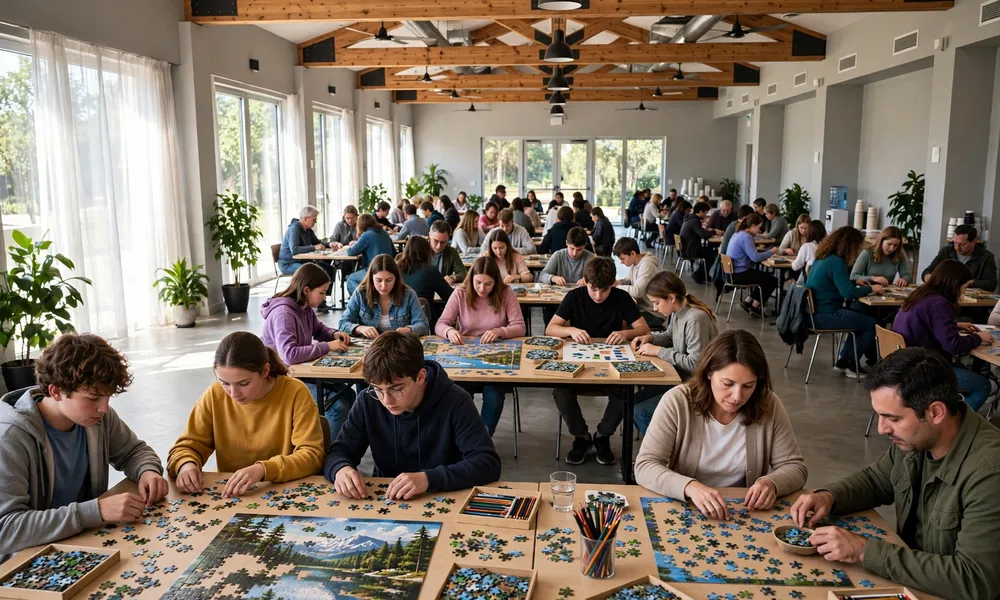
A giant jigsaw relay turns a quiet solo activity into a fast team race. Each team gets a large jigsaw puzzle, typically between five hundred and one thousand pieces, and races to complete it before the other teams. For 260 players, the relay format works best with teams of eight to ten, giving you roughly twenty-six to thirty-two tables, each running its own puzzle. The first team to finish wins the round, and the remaining teams are ranked by how much of their puzzle is complete when the time limit expires.
The main challenge is cost and logistics. Thirty large puzzles is a significant purchase, but the puzzles can be reused for future events, borrowed from a puzzle club, or bought second-hand. Choose puzzles with distinct images and similar piece counts so that no team gets an easier or harder picture by luck. Bright, detailed images with clear colour blocks are easier to assemble under time pressure than soft landscapes or abstract art, and they make the finished puzzles look impressive when they are displayed at the end.
3. Escape-Room Style Team Puzzles
Escape-room style puzzles bring the excitement of a locked-room game to a large group by running many identical stations at once. Each team works at a table set up as a mini escape room, and must solve a chain of puzzles, find hidden codes, open combination locks, and complete a final task within a time limit. For 260 players, the practical approach is a tabletop version where each team gets a box of puzzles, locks, and clues at its own table, so that all teams play the same game at the same time.
A tabletop kit can be assembled from combination padlocks, small locked boxes, printed clue cards, invisible ink pens, and simple cipher wheels, and the same kit can be duplicated for every team. Each team works through the same sequence of puzzles, and the team that escapes fastest, or solves the most puzzles within the limit, wins the round. Because the kits are identical, the results are directly comparable, which keeps the competition fair.
4. Large-Group Logic Puzzle Tournament
A logic puzzle tournament is the purest form of large-group puzzle play, and it scales to 260 players with almost no equipment at all. Every player receives the same set of logic puzzles, such as Sudoku grids, logic grid puzzles, nonograms, and number sequences, and works individually or in pairs for a fixed time. Scores are tallied from the answer sheets, and the top scorers advance to a final round on stage. The format is quiet, focused, and genuinely competitive, which makes it a strong choice for school competitions and puzzle club championships.
5. Cryptic Crossword Race
A cryptic crossword race is a classic puzzle format that adapts well to a large group. Teams receive the same crossword, or the same set of quick crosswords, and race to complete as many clues as possible within the time limit. Cryptic crosswords suit experienced solvers, while quick crosswords and general knowledge crosswords suit mixed groups. For 260 players, the race format works best with teams of five to eight, each team working on a single large printed crossword that everyone at the table can see and discuss.
The main advantage of a crossword race is simplicity. One printed sheet per team, one time limit, and one clear scoring rule: one point per correct answer. You can run several rounds with different crosswords, awarding points per round and adding them to a running total. Short rounds of fifteen to twenty minutes keep the pace brisk, and the variety of crosswords across rounds means that a team that struggles with cryptic clues may do better with a general knowledge round. Large-print crosswords are worth the extra paper, because small print slows teams down and frustrates players sitting further from the sheet.
6. Puzzle Relay Race
A puzzle relay race adds movement and energy to puzzle solving. Teams line up at one end of a hall, and one player at a time runs to a puzzle station, solves a single puzzle, and runs back to tag the next player. The puzzles are short and self-contained, such as a five-piece tangram, a single riddle, a short word ladder, or a small logic problem. The first team to complete all of its puzzles wins. For 260 players, the relay works best with teams of ten, giving you twenty-six teams and twenty-six lanes or stations.
Relay races are loud, physical, and highly watchable, which makes them a strong choice for festivals, school sports days, and team-building events. The puzzles must be quick, with most taking under a minute to solve, because a single slow puzzle can stall a whole team and frustrate the players waiting in line. Prepare the puzzles in advance on laminated cards, keep one set per station, and station a volunteer at each lane to check answers and hand out the next puzzle. Volunteers are essential at this scale, because the host cannot watch twenty-six lanes at once.
For more ideas in this series, the guide to Best Puzzle Games for 259 Players covers similar large-group formats for a slightly smaller crowd, while the Best Puzzle Games for 258 Players guide offers another set of team puzzle ideas that scale well to huge groups.
Best Puzzle Games for 260 Players Compared
The table below compares the six formats on the factors that matter most to an organiser: how many players each one handles comfortably, what equipment it needs, how much preparation it takes, and how much active solving each player gets. Use it to pick the format that fits your venue, your budget, and your audience.
| Format | Players | Equipment needed | Preparation | Solving time per player |
|---|---|---|---|---|
| Team puzzle hunt | 260 | Printed packets, answer sheets | Medium | High |
| Giant jigsaw relay | 260 | 26 to 32 large puzzles, tables | High | High |
| Escape-room style | 260 | Locks, boxes, clue cards | High | High |
| Logic tournament | 260 | Printed booklets, pencils | Low | High |
| Cryptic crossword race | 260 | Printed crosswords | Low | Medium |
| Puzzle relay race | 260 | Laminated puzzle cards, lanes | Medium | Medium |
How to Run a 260-Player Puzzle Event
Running a puzzle event for 260 players is a logistics exercise as much as a creative one. The puzzles matter, but the event succeeds or fails on preparation, timing, and communication. The checklist below covers the steps that matter most, and following it will prevent the most common problems, from missing materials to confused teams and disputed scores.
- Choose the format first, then the venue, so that the space fits the game rather than forcing the game into a room that is too small or too crowded.
- Decide team sizes and prepare a team list in advance, with one packet, puzzle set, or answer sheet per team, plus five spare sets for late arrivals and damaged materials.
- Print clear written instructions for every team, including the rules, the time limit, the scoring system, and how to ask for a hint.
- Recruit enough volunteers, aiming for at least one volunteer per five teams, to handle marking, timing, hints, and crowd flow.
- Set up a visible leaderboard and update it between rounds, so that every team can see where it stands.
- Run a short practice round before the main event, so that teams understand the format and the host can fix any problems before the real competition begins.
Frequently Asked Questions
What is the best puzzle game for 260 players?
The best choice for most organisers is a team puzzle hunt, because it needs only printed packets and answer sheets, it keeps every team solving in parallel, and it scales to any number of players without extra equipment. A logic puzzle tournament is the best low-cost alternative, while a giant jigsaw relay is the best choice when you want a visual, hands-on event.
How many teams should 260 players be split into?
Teams of five to ten work best, which gives you between twenty-six and fifty-two teams. Smaller teams mean more teams to manage, while larger teams risk leaving quieter players without a task. Teams of eight are a good middle ground for most formats, giving you around thirty-two teams, which is manageable for a small team of volunteers and large enough for every team to have a mix of skills.
How long should a puzzle event for 260 players last?
A full event usually lasts between two and three hours, including briefing, two or three rounds of puzzles, breaks for marking, and a final reveal or awards ceremony. A single round of puzzles takes forty-five to ninety minutes, depending on the format. Shorter events of ninety minutes work well for a single format, while a full-day event can combine several formats.
What equipment do I need for a 260-player puzzle event?
The essential equipment is printed puzzle packets or booklets, answer sheets, pencils, a timer, and a leaderboard. Depending on the format, you may also need tables, jigsaw puzzles, combination locks, clue cards, or a projector. The most important preparation is printing: prepare one set per team, plus five spare sets, and check every set before the event starts.
Can puzzle games for 260 players work outdoors?
Yes, and outdoor venues suit several formats very well. Puzzle relay races work well on a field or a sports ground, and scavenger-style hunts are designed for outdoor spaces. Outdoor events need a backup plan for bad weather, such as a hall or a covered area, and puzzle materials should be printed on card or laminated so that they survive wind and light rain.
How do I keep scoring fair for 260 players?
Fair scoring starts with identical materials for every team, clear written rules, and a simple scoring system that everyone understands. Use one point per correct answer, mark all answer sheets against the same answer key, and have two markers check any disputed answers. Update the leaderboard visibly between rounds, and decide tie-breakers in advance.
For a related large-group format, the guide to Best Board Games for 258 Players shows how board game formats handle a crowd of a similar size, and many of the same team and scoring ideas apply to puzzle events as well.
The Bottom Line
The Best Puzzle Games for 260 Players are the ones that give every player something to solve, keep every team working in parallel, and turn a huge crowd into a single shared competition. A team puzzle hunt is the most reliable choice for most organisers, a logic tournament is the simplest to run, and a giant jigsaw relay or an escape-room style game offers the most memorable experience. Whichever format you choose, the principles are the same: split the crowd into teams, print clear instructions, use a visible leaderboard, and keep the puzzles varied enough that every player finds something they can solve. Plan the logistics carefully, test your materials in advance, and the event will take care of itself. Two hundred and sixty players, one set of puzzles, and a room full of people thinking together is a combination that is hard to beat.


