
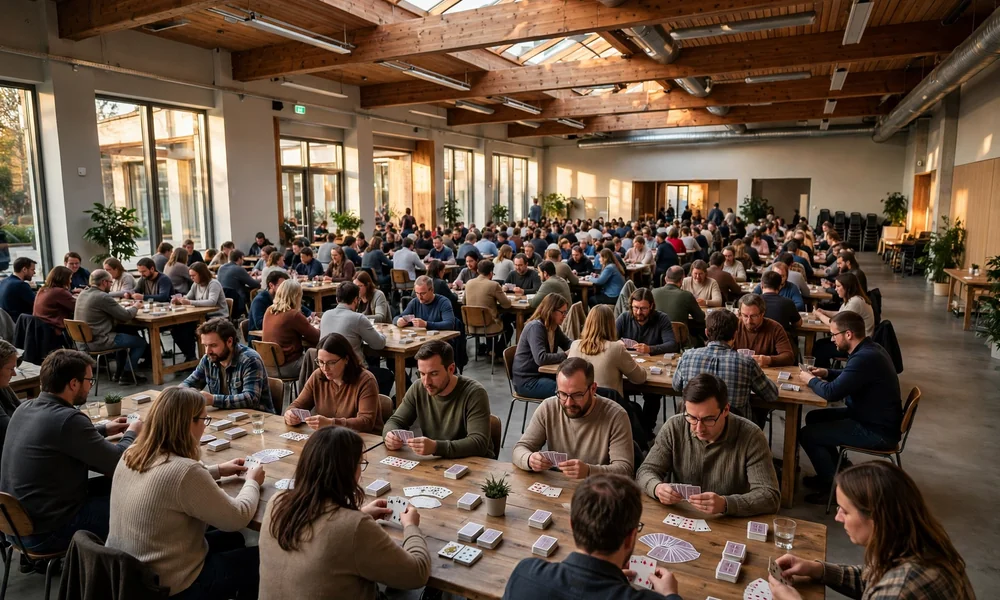
Finding the best card games for 260 players starts with one honest fact: no single deck of cards can hold 260 people at once. A crowd this size needs a format, not just a game. The best card games for 260 players are the ones that split a huge room into small tables, run every table on the same rules and the same clock, and bring everyone back together for a shared finish. When the structure is right, 260 players feel like one big event instead of 40 separate card games happening in the same building.
A group of 260 is large enough to fill a school hall, a conference floor, a community centre or a festival marquee, yet it is still small enough to organise well with a little planning. The trick is to divide the crowd into tables of four to eight players, give every table the same game or the same rotation of games, and use a central scoreboard so every table can see how it is doing. Team captains, colour-coded table numbers and a clear round timer do more for the evening than any single rule change ever will.
This guide covers twelve formats that work at genuine large-group scale, from classic trick-taking tournaments to fast party card games and relay formats built for hundreds of players. Each entry explains how many decks you need, how the tables are organised, and which kind of player will enjoy it most. Use the comparison table to shortlist two or three formats, then follow the organiser checklist to run your event without last-minute surprises.
Key takeaways
- Split 260 players into tables of four to eight and run every table on the same rules and round timer.
- Multi-deck games and tournament formats scale best, because every table plays at the same time.
- Plan roughly one standard deck per table, plus spares, and colour-code decks so cards never mix between tables.
- Team captains and a visible central scoreboard keep a huge room organised and competitive.
- Mix one serious tournament game with one fast party game so every kind of player has a format to enjoy.
How Card Games Work at 260-Player Scale
At 260 players, a card game is really a scheduling problem. One table of eight players needs one deck, one set of rules and one dealer. Forty tables need forty decks, forty dealers and one person in charge of time. The games that work best are the ones where every table finishes a round at roughly the same moment, so nobody sits waiting while another table is still arguing over the last trick. Short rounds of ten to fifteen minutes are ideal, because they let you rotate players, change partners and keep the energy high.
Scoring needs to be simple enough for a volunteer to record in seconds. Points per round, tricks won, or games won are all easy to tally on a card that travels with each team. Avoid games that need long negotiations or complicated scoring sheets, because forty tables will produce forty different interpretations of the same rule. Print one rules sheet per table, keep it to a single page, and appoint one referee per zone of ten tables to settle disputes quickly and consistently.
Space matters as much as the game itself. Plan for roughly one square metre per player plus table space, and leave clear aisles so captains can move between tables to collect scores. A hall with good lighting and a public address system or a loud bell is worth more than a clever game choice. If you are comparing formats for a crowd this size, the best card games for 258 players use the same table-and-timer structure, and the lessons there apply directly to a group of 260.
The 12 Best Card Games for 260 Players
1. Tournament Bridge
Bridge is the classic large-scale card game, and duplicate bridge was designed for exactly this problem. Every table plays the same pre-dealt hands, so results can be compared fairly across the whole room. With 260 players you run 65 tables of four, using one deck per table and a set of pre-sorted boards. Rounds last about fifteen minutes, and players rotate to a new table after each round. Bridge suits experienced players who enjoy deep strategy, and it gives a serious competitive backbone to any large card event. You will need a director who understands duplicate scoring, but the format itself is proven at events far larger than 260 players.
2. Euchre Tournament
Euchre is a fast trick-taking game for four players that works beautifully as a tournament. Each round takes ten minutes, the rules are simple enough to teach in five minutes, and the trump system creates exciting comebacks. For 260 players, set up 65 tables and rotate partners after every round so everyone meets new opponents. Score five points per game won and record results on a simple tally card. Euchre is ideal for mixed groups where some players know card games well and others are learning, because a beginner can contribute to a partnership within a single round.
3. Hearts Tournament
Hearts is a four-player game where the aim is to avoid taking penalty cards, and it scales cleanly to a tournament of any size. Every table plays the same number of hands per round, and the lowest score wins the table. With 260 players you need 65 decks, one per table, and a scoring sheet that even a first-time volunteer can fill in. Hearts rewards careful play and memory, and the famous move of shooting the moon gives every round a moment of drama. It is a strong choice for an evening event where you want steady, thoughtful play rather than noise.
4. Spades Tournament
Spades is a partnership trick-taking game that thrives on teamwork and bidding. Two pairs sit at each table, bid on how many tricks they will win, and score points for meeting the bid. A round of three hands takes about fifteen minutes, which fits a rotation schedule well. For 260 players, run 65 tables and rotate partnerships so that every player teams up with different people through the night. Spades suits confident players who like a mix of strategy and table talk, and the bidding adds a layer of excitement that keeps spectators interested too.
5. Multi-Deck Rummy Relay
Rummy is one of the easiest card games to scale, because adding decks is all it takes. In a relay format, each table of six players uses two decks shuffled together, and the winner of each table advances to a winners table while other players stay in a friendly bracket. With 260 players you need about 44 tables and 88 decks, so buy decks in bulk and keep them in matching sets. Rummy rounds last around fifteen minutes, the rules are familiar to most adults, and the relay structure means everyone keeps playing even after losing a round.
6. Uno Party Tournament
Uno is built for large groups, and the multi-deck party version is one of the most reliable crowd-pleasers for 260 players. Each table of six to eight players uses one Uno deck, and tables play short games of about ten minutes. Winners move up a table, losers move down, and after five rounds the top table plays a grand final in front of the room. The colour matching and action cards are easy to learn, the game is loud and social, and it works for families, school groups and office parties alike. Keep spare decks handy, because action cards wear out fast in a tournament.
7. President Card Game
President, also known as Scum, is a shedding game where players race to get rid of their cards, and it handles big groups better than almost any other card game. Tables of six to eight players use one deck each, and the winner of each hand becomes President while the last player becomes Scum for the next hand. The titles, the card trading between rounds and the race to climb the table order create a running story across the evening. For 260 players, run about 40 tables and let winners move up after every three hands. President is fast, funny and fiercely competitive, and it needs no special equipment beyond standard decks.
8. Spoons Tournament
Spoons is a high-energy game of speed and observation. Players pass cards around the table trying to collect four of a kind, then grab a spoon from the centre. With one fewer spoon than players, someone always misses out, and the scramble is the whole point. For 260 players, set up tables of eight with one deck and seven spoons each, and run the tables as a tournament with winners advancing. Spoons is noisy, physical and hilarious, so it works best as the second game of the evening after a quieter tournament round. Use plastic spoons and a clear floor space, because the grab for the last spoon gets enthusiastic.
9. Cheat Relay
Cheat, also called I Doubt It, is a bluffing game that turns a whole hall into a room full of liars and detectives. Each table of six to eight players uses one deck, and players take turns playing cards face down while claiming a rank. Anyone can call out a bluff, and the loser picks up the pile. In a relay format, the first player to shed all their cards at each table advances to the next round. Cheat needs no scoring sheets, no referees and no special decks, which makes it one of the simplest games to run for 260 players. It suits groups who enjoy talking, laughing and bluffing more than silent strategy.
10. War Bracket Tournament
War is the simplest card game of all, and that simplicity is exactly why it works for a crowd of 260. Two players flip cards, the higher card wins, and ties trigger a war. In a bracket format, each table runs a mini-tournament of eight players, and the table winners meet in a final bracket on a stage. A full bracket for 260 players takes about an hour, needs one deck per table, and requires no teaching at all. War is the perfect opening game for a mixed crowd, because children, grandparents and complete beginners can all play it within seconds of sitting down.
11. Slap Jack Relay
Slap Jack is a speed game where players flip cards onto a central pile and slap the pile when a jack appears. The fastest hand wins the pile, and the player who collects all the cards wins the table. For 260 players, run tables of six with one deck each, and advance table winners to a final slap-off. The game is loud, fast and physical, and it works brilliantly as a relay because each table round lasts only five minutes. Slap Jack is best for younger crowds and high-energy events, and it pairs well with a quieter game like Hearts in the same evening.
12. Exploding Kittens Party Edition
Exploding Kittens is a modern party card game built around avoiding the exploding kitten card, and the party edition supports larger groups with extra decks. For 260 players, run tables of six with one party deck per table, and play short rounds of about fifteen minutes. The artwork, the silly action cards and the constant threat of exploding keep every table laughing, and the rules take two minutes to explain. This is the best choice when your crowd includes people who have never played a traditional card game, because it feels like a party game first and a card game second. If you want more ideas in the same spirit, the best card games for 256 players include several party formats that scale the same way.
Comparison Table
| Game | Players per table | Decks for 260 players | Best for |
|---|---|---|---|
| Tournament Bridge | 4 | 65 | Serious strategists |
| Euchre Tournament | 4 | 65 | Mixed ability groups |
| Hearts Tournament | 4 | 65 | Thoughtful evening play |
| Spades Tournament | 4 | 65 | Partnership competition |
| Multi-Deck Rummy Relay | 6 | 88 | Familiar family play |
| Uno Party Tournament | 6 to 8 | 40 | Families and parties |
| President Card Game | 6 to 8 | 40 | Fast social play |
| Spoons Tournament | 8 | 33 | High-energy fun |
| Cheat Relay | 6 to 8 | 40 | Bluffing and laughter |
| War Bracket Tournament | 8 | 33 | Complete beginners |
| Slap Jack Relay | 6 | 44 | Younger crowds |
| Exploding Kittens Party Edition | 6 | 44 | Modern party groups |
Organiser Checklist for 260 Players
- Book a hall with clear aisles, good lighting and a bell or speaker system so every table hears the round timer.
- Buy decks in bulk, one per table plus at least ten spares, and colour-code each table set so cards never mix.
- Print a one-page rules sheet for every table and a tally card for every team before the doors open.
- Appoint one referee per ten tables and one captain per table to collect scores and settle small disputes.
- Run a five-minute practice round so every player understands the rotation before scoring starts.
- Set up a visible central scoreboard and announce the leading tables after every round to keep the room buzzing.
Frequently Asked Questions
Can 260 people really play card games at the same time?
Yes, when the crowd is split into tables of four to eight players and every table plays the same game on the same round timer. No single table holds 260 people, but forty tables running at once give everyone a game. A central scoreboard and a shared final bring the room back together at the end.
How many decks do I need for 260 players?
Plan for one deck per table, which means 33 to 65 decks depending on table size, plus at least ten spares. Four-player games like Bridge need the most decks, while eight-player games like Spoons need the fewest. Colour-coding each table set stops cards from wandering between tables during rotations.
What is the easiest card game for a mixed group of 260?
War is the easiest, because it needs no teaching and no strategy, while Uno is the easiest game that still feels like a real contest. Both work for children, beginners and experienced players in the same room. Start the evening with War as a warm-up, then move to a tournament game once everyone is settled.
How long does a 260-player card game event take?
Allow three to four hours for a full evening, including arrival, a practice round, five or six scored rounds and a grand final. Each round takes ten to fifteen minutes, and rotations take about two minutes between rounds. Shorter events work well with three rounds and a final, which fits into about two hours.
Do I need referees for a card game night this large?
Yes, but not many. One referee per ten tables is enough, because most disputes are small and table captains can settle them. The referees mainly watch the clock, collect tally cards and handle the rare serious disagreement. A short referee briefing before the event prevents most problems.
What if some players have never played card games before?
Seat beginners at tables playing Uno, War or President, and pair each beginner table with a friendly captain who can explain the rules in two minutes. Avoid Bridge or Spades for first-time players, and run a five-minute practice round so nobody starts the scored rounds feeling lost. For more large-group ideas, the best party games for 258 players include formats that suit complete beginners too.
The Bottom Line
The best card games for 260 players are not the cleverest games or the most fashionable ones. They are the games that split a huge crowd into small tables, run every table on the same clock, and give everyone a fair shot at the final. Bridge and Euchre reward serious players, Uno and President keep a party laughing, and War welcomes complete beginners. Pick one serious tournament game and one fast party game, print the rules, buy the decks, and let the tables do the rest. With the right structure, 260 players do not feel like a crowd at all. They feel like one great card night.


