
The Best Board Games for 260 Players are not the games you pull off a shelf for a quiet evening at home. When 260 people gather in one hall, one school gym, or one conference centre, a single box with four player tokens will never be enough. You need games that scale, formats that split a crowd into teams, and a plan that keeps every single person playing instead of watching from the sidelines.
That is exactly what this guide delivers. We have picked real board games that work at massive scale, explained the team, tournament, giant-board, and relay formats that make them work for 260 players, and laid out a practical plan for running the whole event without chaos. Every game below can be adapted for a crowd of this size, and every format has been chosen because it keeps the energy high and the waiting time low.
Whether you are organising a school activity day, a company social, a youth camp, a church gathering, or a community games festival, the ideas here will help you turn 260 players into one memorable event. You do not need 260 copies of a game or a hall full of expensive equipment. You need the right games, the right structure, and a host who keeps the rounds moving.
Key takeaways
- Split 260 players into teams of four to ten so everyone plays at the same time instead of waiting for a turn.
- Choose games with simple rules, short rounds, and simultaneous play so a huge group stays engaged.
- Use tournament brackets, giant boards, and relay formats to turn classic board games into crowd events.
- Appoint team captains, scorekeepers, and a central host to keep 260 players organised and on schedule.
- Plan for two to three hours, with warm-up rounds, a main tournament, and a final showdown everyone can watch.
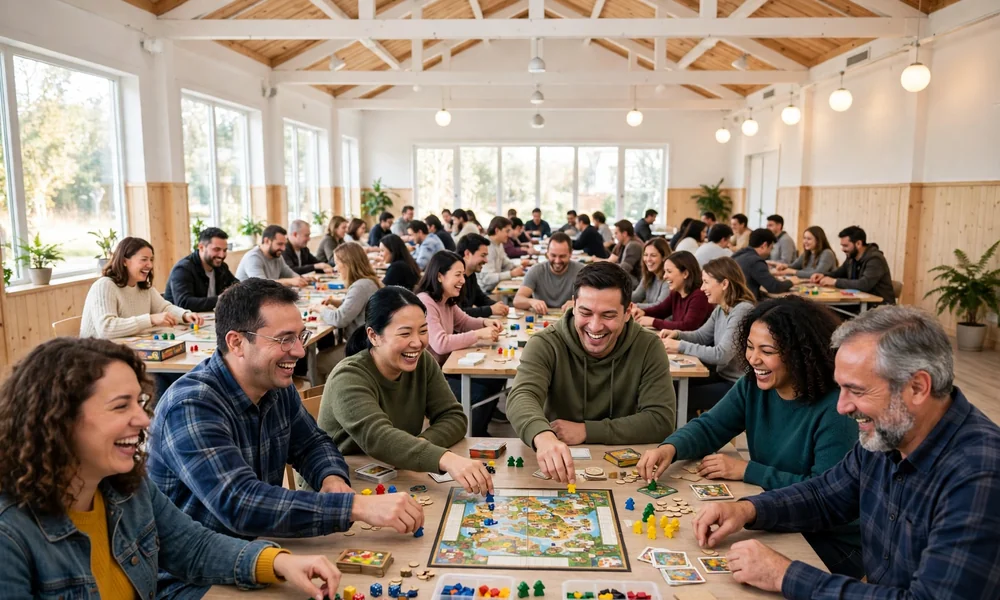
Why 260 Players Needs a Different Kind of Board Game
A board game designed for four players assumes everyone sits close together, takes turns in order, and can see every piece on the board. Multiply that group by sixty-five and every one of those assumptions breaks. Turns take forever, most players cannot see the board, and half the room loses interest before the first round ends. The best board games for 260 players solve these problems by design, not by accident.
The first thing to look for is simultaneous play. In a good large-group game, every team acts at the same time. Nobody waits while one player thinks for five minutes. Trivia games, word games, drawing games, and guessing games all work well here because each team can write down an answer, hold up a card, or shout out a guess at the same moment. The result is a room full of energy rather than a room full of people checking their phones.
The second thing to look for is simple rules. With 260 players, you cannot spend twenty minutes explaining a rulebook. The best choices can be taught in under two minutes, ideally with a single demonstration round. If a game needs a long setup or a complicated scoring system, save it for a smaller night and pick something clearer for the big event.
Scale also changes what a board looks like. A standard board is too small for a crowd, so organisers use giant boards projected on a screen, floor boards made from tape and cards, or a central board that team captains move pieces on while their teams call out decisions. The board becomes a showpiece that the whole room can follow, and that shared focus is what turns 260 separate players into one audience.
The Best Formats for 260 Players
No single game format fits every event, so the smartest organisers mix two or three formats across the evening. Each format below works for 260 players, and each one solves a different problem, from keeping rounds fast to giving everyone a moment in the spotlight.
Team Tournament Format
Divide the room into teams of five, giving you 52 teams, and run a tournament where every team plays the same game at the same time. After each round, the top teams advance and the rest move into a fun consolation bracket, so nobody is eliminated early and sent home. This format works beautifully with trivia, word, and guessing games, and it is the easiest way to keep 260 players involved from start to finish. A similar approach powers the board games built for 258 players, where team play keeps a near-identical crowd size engaged.
Giant Board Format
Take a classic board game and scale it up. A giant snakes and ladders board taped to the floor, a huge chess or checkers set, or a projected game board on a stage all let the whole room follow the action. Team captains move the pieces while their teams decide the moves together, which means every player contributes to the decision even though only one person touches the piece. Giant boards are especially good for the final round, when you want the whole hall watching one game.
Relay Format
In a relay format, each team sends one player at a time to the board to make a move, answer a question, or complete a challenge, then tags the next teammate. Relays are fast, noisy, and very watchable, and they work well with puzzle games, memory games, and dexterity games. Because only a few players are at the board at any moment, the format also solves the problem of crowding around a small table.
Station Rotation Format
Set up ten to thirteen game stations around the hall, each with a different board game, and rotate teams through them on a timer. Every fifteen minutes a bell rings and teams move to the next station, collecting points as they go. Station rotation is the best choice when you want variety, because players get to try many games instead of just one, and it spreads the crowd evenly so no single table is overwhelmed.
Best Board Games for 260 Players Compared
Use this table to pick the right game for your event. Each game is scored for how well it scales, how quickly it can be taught, and how much energy it brings to a large room.
| Game | Best format | Players per round | Teach time | Energy level |
|---|---|---|---|---|
| Team Trivia | Tournament | All 260 | 2 minutes | High |
| Pictionary | Tournament | All 260 | 2 minutes | Very high |
| Giant Snakes and Ladders | Giant board | All 260 | 1 minute | High |
| Codenames | Tournament | All 260 | 3 minutes | High |
| Charades | Relay | All 260 | 1 minute | Very high |
| Bingo | Simultaneous | All 260 | 1 minute | Medium |
| Scattergories | Tournament | All 260 | 2 minutes | High |
| Giant Chess | Giant board | All 260 | 3 minutes | Medium |
Best Board Games for 260 Players: Our Top Picks
These eight games are our top picks for a 260-player event. Each one is a real, well-known board or party game that adapts cleanly to team play, and each one has been chosen because it keeps a huge group laughing, thinking, and competing together. The board games for 256 players follow the same team-first logic, so if your group size changes slightly, the same picks still work.
1. Team Trivia
Team trivia is the safest and most flexible choice for 260 players. Every team gets an answer sheet, the host reads each question aloud, and all 52 teams answer at once. Mix general knowledge, music, pictures, and local questions so every team has a strength. Ten rounds of ten questions fill about an hour, and the scoring is simple enough for a small team of volunteers to handle.
2. Pictionary
Pictionary scales brilliantly because drawing is fun to watch. Each team appoints a drawer who sketches the word on a whiteboard or a large pad while teammates guess. With a projector or a camera pointed at the drawing board, the whole hall can watch the best drawings and laugh along. Keep rounds to sixty seconds so the pace stays quick and the energy never drops.
3. Giant Snakes and Ladders
Giant snakes and ladders turns a childhood classic into a crowd spectacle. Mark out a ten-by-ten grid on the floor, use teams as the counters, and roll an oversized foam die. Every team moves together, cheers when they climb a ladder, and groans when they slide down a snake. It is the simplest game on this list to explain, which makes it a perfect opener for a mixed-age crowd.
4. Codenames
Codenames is a word association game where a spymaster gives one-word clues that link several secret words on a grid. For 260 players, project the grid on a screen and let each team discuss its guess before submitting it. The game rewards clever thinking and teamwork, and the moment a team guesses the assassin word by mistake is always a highlight of the evening.
5. Charades
Charades needs no board at all, which makes it one of the easiest games to run for a huge group. Teams take turns sending an actor to the front to mime a film, a book, or a well-known phrase while their teammates guess. Use a relay format so every team gets regular turns, and keep each round to ninety seconds. The physical comedy alone keeps the room engaged.
6. Bingo
Bingo is the classic simultaneous game: everyone plays at once, nobody waits, and anyone can win. Print 260 unique cards, call numbers from the stage, and let teams share cards or play individually within their team. Bingo works especially well as a calm middle round between two high-energy games, and it is ideal when your crowd includes a wide range of ages.
7. Scattergories
Scattergories asks each team to think of words that fit a category and start with a chosen letter, all against the clock. It is fast, creative, and easy to score, because unique answers earn more points than answers other teams also wrote. The game sparks lively debates inside every team, which is exactly the kind of interaction you want at a large event.
8. Giant Chess
Giant chess is the showpiece game for a 260-player event. Set up an oversized board on the floor or the stage, let team captains vote on each move, and have a commentator explain the strategy to the crowd. Even players who have never played chess enjoy watching the big pieces move, and the slow, thoughtful pace makes a nice contrast to the faster games around it.
How to Run a 260-Player Board Game Night
A great game night for 260 players is planned like a small festival, not like a living-room game evening. Start by booking a hall with enough tables for 52 teams, a stage or raised area for the host, and a projector or large screen so everyone can see the scores and the game boards. Arrive early to set up stations, test the sound system, and lay out answer sheets, pens, and scorecards.
Assign roles before the doors open. You need a host to run the evening, at least four scorekeepers, one captain per team, and a few helpers to hand out materials and keep the rotations on time. Give every team a name, a table number, and a colour, and print a simple schedule so captains know where to be at each stage. Clear roles prevent the confusion that can quickly spread through a crowd of this size.
Open with a warm-up game that everyone can play at once, such as bingo or a quick trivia round, so the room settles and the host can check the sound and the scoring. Then move into the main tournament, run two or three different games, and finish with a giant-board final that the whole hall can watch together. Keep the total running time to two or three hours, with a short break in the middle for drinks and snacks. If you need more ideas for large-group play, the party games for 256 players offer extra formats that pair well with board games.
Checklist: Planning Your 260-Player Game Night
- Book a hall with space for 52 team tables, a stage, and a projector or large screen.
- Choose three or four games from this guide and prepare all cards, boards, and answer sheets in advance.
- Recruit a host, four scorekeepers, and helpers, and brief every team captain before the event starts.
- Print team names, table numbers, schedules, and scorecards so nobody has to ask where to go.
- Test the sound system, projector, and timers the day before, and bring spare pens, paper, and batteries.
- Plan prizes for the winning team, the funniest team, and the best team name to keep the mood light.
Frequently Asked Questions
Can 260 people really play one board game at the same time?
Yes, when the game is played in teams. Split the crowd into 52 teams of five, give every team the same task at the same time, and collect one answer per team. Trivia, Pictionary, Codenames, and Scattergories all work this way, and nobody has to wait for a turn.
What is the best board game for 260 players?
Team trivia is the best all-round choice because it is easy to explain, easy to score, and fun for every age group. If you want more energy, add Pictionary or charades. If you want a visual spectacle, finish with giant snakes and ladders or giant chess on a big board.
How many teams should 260 players form?
Teams of five work best, giving you 52 teams. Teams of four give 65 teams, which is harder to manage, while teams of ten give only 26 teams and leave some players with little to do. Five is the sweet spot for discussion, speed, and fairness.
How long does a 260-player board game night take?
Plan for two to three hours. Allow fifteen minutes for arrival and seating, thirty minutes for a warm-up game, ninety minutes for the main tournament, and thirty minutes for the final and the prize ceremony. A short break in the middle keeps energy levels up.
What equipment do I need for 260 players?
You need tables and chairs for 52 teams, answer sheets and pens, a projector or large screen, a sound system with microphones, timers, scorecards, and the game materials for your chosen games. Most of this can be printed or borrowed, so the cost stays low.
Can children and adults play together in a 260-player game?
Yes. Choose games with mixed questions, let families form their own teams, and use the station rotation format so younger players can try simpler games while adults tackle harder ones. Giant snakes and ladders, bingo, and Pictionary are all strong choices for mixed-age crowds.
The Bottom Line
The Best Board Games for 260 Players are the ones that turn a huge crowd into teams, keep every team playing at the same time, and finish with a final everyone can watch together. Team trivia, Pictionary, giant snakes and ladders, Codenames, charades, bingo, Scattergories, and giant chess all pass that test, and the tournament, giant-board, relay, and station formats give you four proven ways to run them. Pick three or four games, brief your captains, keep the rounds moving, and your 260-player game night will be the event people talk about for months.


