Finding the Best Puzzle Games for 237 Players sounds like an impossible brief at first. Most puzzle games are built for one person on a couch, a family around a table, or a small team in an escape room. A group of 237 players is a different challenge entirely, closer to running a festival than hosting a game night. Yet with the right format, the right games, and a clear plan for splitting a crowd into working teams, a puzzle event at this scale can be the most memorable gathering your group ever holds.
The secret is that you do not need a single game that seats 237 people at once. You need a system. The best puzzle games for 237 players work because they break a huge crowd into small teams, give every team the same fair challenge, and bring everyone back together for a shared finish. When the structure is right, a crowd of this size becomes an advantage: more energy, more ideas, louder cheers, and a finish line moment that a small group could never produce.
This guide covers the games that actually work at this scale, how to set them up, what equipment you need, and how to keep 237 players engaged from the first clue to the final reveal. Every recommendation here has been chosen for large group play, not adapted from a living room game and hoped for the best.
Key takeaways
- Split 237 players into teams of 4 to 6, giving you roughly 40 to 59 teams that can all play at once.
- Choose games with parallel play, so every team works on the same puzzle at the same time instead of waiting in line.
- Use a mix of jigsaw relays, logic puzzles, word puzzles, and digital rounds to keep every kind of thinker engaged.
- Plan one clear scoring system and one shared finish, so the whole room feels the result together.
- Test every puzzle, timer, and piece of equipment with a small group before the big day arrives.
Why 237 Players Changes the Puzzle Game
A puzzle night for ten people needs a table and a box of pieces. A puzzle event for 237 people needs a plan, a venue, and a schedule. The difference is not just size. At this scale, every small problem multiplies. If one puzzle takes five minutes too long, forty teams sit idle. If the instructions are unclear, you have 237 confused players instead of ten. If the scoring is vague, the arguments at the end will be louder than the applause.
The good news is that large groups bring strengths that small groups cannot match. A crowd of 237 holds an enormous range of skills. Some players are fast with words, others see patterns instantly, and others are calm under time pressure. A well designed event lets each of those strengths matter. The best puzzle games for 237 players use team formats on purpose, so no single skill decides the winner and every team has a real chance.
Venue choice matters more than most organizers expect. You need enough tables for roughly 50 teams, clear walkways for hosts and helpers, a sound system that reaches the back row, and a central display where scores and clues can be seen by everyone. A school hall, community centre, conference floor, or large function room usually works well. Visit the space in advance, count the tables, and map out where each team will sit before you commit to a date.
How to Choose Puzzle Games for a Crowd This Large
Start with the player count and work backwards. With 237 players, teams of 4 to 6 give you between 40 and 59 teams. That number decides almost everything else: how many puzzle sets you need, how many helpers you need, and how long each round can run. Teams of five are a reliable middle ground, giving you about 47 teams, and they keep every player involved without making discussion impossible.
Look for games that support parallel play. In parallel play, every team receives the same puzzle at the same moment and works on it independently. Nobody waits for a turn, nobody watches another team finish first, and the round ends when the timer ends or the fastest team solves it. Parallel play is the single most important feature for a group this large, and it should be your first filter when choosing games. If a game only works with one group at a time, it belongs in a different kind of event.
Mix puzzle types across the event so that different minds get their moment. A strong lineup includes a jigsaw round, a word puzzle round, a logic puzzle round, a visual pattern round, and a fast trivia style puzzle round. This variety keeps energy high and stops the event from favouring one kind of thinker. Players who struggled with the word round often shine in the visual round, and that balance keeps teams motivated through the whole evening. For a sense of how the same idea scales to a slightly smaller crowd, look at the best puzzle games for 235 players, which uses a similar team structure with a few less tables to manage.
The Best Puzzle Games for 237 Players
The games below are ranked for large group play, not for solo difficulty. Each one works in parallel across dozens of teams, uses materials you can prepare in bulk, and produces a clear winner for every round. You do not need to run all of them. Pick four or five, run them as rounds, and finish with a shared final puzzle that brings the whole room together.
1. Giant Jigsaw Relay
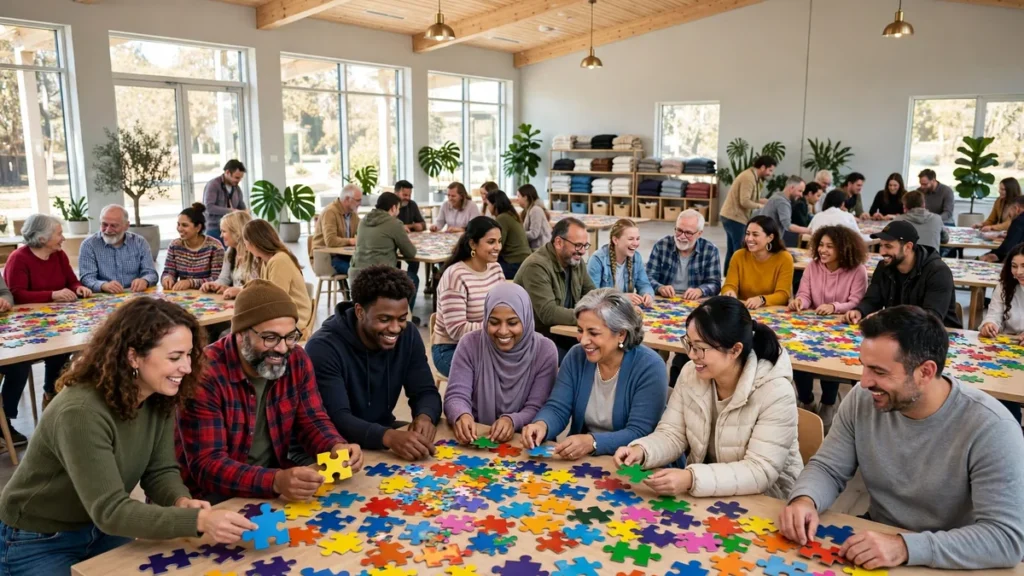
The giant jigsaw relay is the headline event for a reason. Each team receives the same 500 piece puzzle, and the first team to complete it wins the round. With 47 teams, you need 47 identical puzzles, which sounds expensive until you realise that bulk puzzle sets are widely available and the same sets can be reused at future events. Give each round a firm time limit of 45 minutes, and award partial points based on how much of the puzzle each team completes. That way, slower teams still earn points and stay in the competition. Sort the edge pieces first, assign one player to the border, and keep the picture visible so the whole team can check colours and shapes quickly.
2. Logic Grid Challenge
Logic grid puzzles work beautifully at scale because they need nothing more than a printed sheet and a pencil per player. Each team works through the same set of logic problems, such as matching five suspects to five clues, and earns points for every correct answer. Print the grids in bulk, hand them out at the same moment, and collect them after 20 minutes. Scoring is simple and objective, which matters when you have dozens of teams to judge. Include three difficulty levels in each set so that newer players can score early points while experienced solvers chase the harder grids.
3. Word Ladder Race
In a word ladder race, teams transform one word into another by changing one letter at a time, with every step forming a real word. The format is easy to explain, fast to play, and endlessly adjustable. Prepare a ladder of 12 to 15 steps, project the start and end words on the main screen, and let teams race to complete the chain. Award bonus points for the fastest correct ladder and for teams that find the shortest valid route. Word ladders reward vocabulary and quick thinking, and they make an excellent second or third round after a slower jigsaw session.
4. Pattern and Sequence Hunt
Pattern puzzles ask players to find the next item in a visual or number sequence, spot the odd one out, or complete a grid of shapes. They are ideal for a large group because they can be shown on a big screen and solved by the whole team at once. Prepare 20 pattern questions, display each one for 90 seconds, and have teams write their answers on a shared answer sheet. This round keeps the room quiet and focused, which is a welcome change of pace after the noise of a jigsaw relay. It also tests a different kind of thinking, so teams that struggled earlier often climb the leaderboard here.
5. Escape Room in a Box
Escape room in a box kits give every team a locked box, a set of clues, and a 30 minute countdown. Each box contains the same puzzles, so every team faces the same challenge and the fastest opening time wins. You will need one kit per team, which is the main cost, but many kits are reusable and some can be reset with fresh codes. Assign one helper per eight teams to check progress and hand out hint cards. Limit hints to two per team so that the challenge stays real, and make the final code a satisfying reveal that the whole room can celebrate.
6. Crossword Sprint
A crossword sprint works like a race against the clock. Each team gets the same crossword grid, built around a theme your group will enjoy, such as travel, food, music, or general knowledge. Teams have 25 minutes to fill in as many answers as they can, and points are awarded per correct word with a bonus for a fully completed grid. Crosswords are cheap to produce in bulk and easy to score with an answer key. They also suit mixed age groups well, since a team can divide the clues by topic and let each player tackle the ones they know best.
7. Digital Puzzle Tournament
A digital round uses phones, tablets, or laptops, with every team logging into the same puzzle platform at the same time. Choose a platform that supports team rooms, live leaderboards, and a fixed round length. Digital puzzles can include sliding tiles, memory matching, code breaking, and timed riddles, and the platform handles scoring automatically, which saves your helpers hours of marking. Test the wifi and the platform with a full room before the event, because a slow connection during a live round is the fastest way to lose a crowd of 237 players. Keep this round to 20 minutes so that screen fatigue never sets in.
Comparing the Top Games at a Glance
Use the table below to compare the leading options before you build your schedule. Setup time, cost, and player energy are the three factors that decide which games fit your event, so weigh them against your venue, your budget, and the mood you want to create.
| Game | Round length | Cost per team | Best for |
|---|---|---|---|
| Giant Jigsaw Relay | 45 minutes | Moderate | Teamwork and patience |
| Logic Grid Challenge | 20 minutes | Low | Quiet focus and fairness |
| Word Ladder Race | 15 minutes | Low | Fast energy and word skills |
| Pattern and Sequence Hunt | 30 minutes | Low | Visual thinkers |
| Escape Room in a Box | 30 minutes | High | Excitement and drama |
| Crossword Sprint | 25 minutes | Low | Mixed ages and knowledge |
| Digital Puzzle Tournament | 20 minutes | Moderate | Live scoring and speed |
Setting Up a 237 Player Puzzle Night
Good setup turns a chaotic crowd into a smooth event. Arrive at least three hours early, lay out the tables in rows with clear aisles, and place one puzzle set, one answer sheet, and one pencil pack on every table before anyone arrives. Put team numbers on the tables so players can find their seats without asking for help. Set up a central stage or raised area for the host, a large screen for clues and scores, and a sound system that can be heard clearly from every corner of the room.
Recruit helpers early and give each one a clear job. You need at least one helper for every eight teams, plus a host, a scorekeeper, and two people managing the door and registration. Helpers hand out materials, answer questions, watch the clock, and collect answer sheets. Brief them the day before, walk them through the venue, and give each helper a printed schedule so nobody has to guess what happens next. A team that has played at a similar scale before can be a useful model, and the format used for the best puzzle games for 234 players shows how the same helper ratios work with only a few less teams on the floor.
Registration deserves more attention than most organizers give it. With 237 players arriving at once, a single sign in desk will create a long queue and a slow start. Set up four registration points, one per section of the room, and hand each player a wristband or badge with their team number and table number. Keep the welcome short, explain the rules once from the stage, and start the first round within 20 minutes of the doors opening. A fast start sets the tone for the whole evening.
Your 237 Player Puzzle Night Checklist
Run through this checklist in the week before your event, and again on the morning of the day itself. Every item here prevents a problem that is small for ten players and serious for 237.
- Book a venue with seating and tables for at least 50 teams, plus space for a stage and a screen.
- Prepare one identical puzzle set per team, and keep five spare sets ready for damaged or missing pieces.
- Recruit one helper per eight teams, and brief every helper on the schedule and the rules.
- Test the sound system, the projector, the timers, and the wifi in the actual venue.
- Print answer sheets, scorecards, and team number cards in bulk, with spares for every table.
- Plan a clear scoring system, a tie breaker round, and a shared final puzzle for the whole room.
Common Mistakes to Avoid
The most common mistake is choosing puzzles that only work for one group at a time. A single puzzle on a stage with 237 people watching is a show, not a game, and most of the room will lose interest within minutes. Every round should give every team something to do at the same moment. If a game cannot be played in parallel, save it for a smaller gathering.
The second mistake is underestimating the time that logistics take. Handing out materials to 50 tables, collecting answer sheets, and updating a leaderboard all take longer than you expect. Build ten minutes of buffer between rounds, and keep the schedule visible on the main screen so teams always know what comes next. A relaxed host with a clear schedule beats a rushed host with an ambitious one.
The third mistake is making the scoring unclear or changing the rules halfway through. Publish the scoring system before the first round, display it on the screen, and stick to it. If a tie happens, have a tie breaker ready, such as a single fast puzzle that the tied teams solve head to head. Fairness is what keeps a large group happy, and the best puzzle games for 233 players follow the same rule, with the scoring fixed before play begins and never changed mid event.
Frequently Asked Questions
How many teams should 237 players be split into?
Teams of 4 to 6 work best, giving you roughly 40 to 59 teams. Teams of five are the most practical choice, producing about 47 teams. Smaller teams keep every player involved, while larger teams make discussion harder and leave quieter players out of the conversation.
How long does a 237 player puzzle event take?
Plan for three to four hours, including registration, five rounds of play, short breaks, and a final shared puzzle. Rounds of 15 to 45 minutes each, with ten minutes of buffer between them, give you a full evening without exhausting the players.
What is the cheapest way to run puzzle games for 237 players?
Printed puzzles are the cheapest option. Logic grids, crosswords, word ladders, and pattern hunts need only paper, pencils, and a printer. A full evening built from printed rounds can cost very little per player, and the materials can be reused or adapted for future events.
Do I need a special venue for 237 players?
You need a venue with tables for about 50 teams, clear walkways, a sound system, and a large screen. School halls, community centres, and conference floors are all good options. Visit the venue first, count the tables, and check the sound from the back row before you book.
How do I keep all 237 players engaged at once?
Use parallel play so every team works at the same time, mix puzzle types so different skills get their moment, and keep rounds short enough that no team sits idle. A live leaderboard on the main screen also helps, because teams can see their progress and stay motivated through every round.
Can children and adults play together in a 237 player event?
Yes, and mixed age teams often do very well. Children are often faster at visual patterns and word games, while adults bring wider general knowledge. Mix ages within each team rather than separating them, and choose puzzle types that reward different strengths so every player has a round where they shine.
The Bottom Line
The Best Puzzle Games for 237 Players are the ones that let every team play at the same time, reward different kinds of thinking, and build toward a shared finish that the whole room can celebrate. Split the crowd into teams of five, mix jigsaw, logic, word, pattern, and digital rounds, keep the scoring simple and public, and test everything in advance. Do that, and 237 players stops being a logistical problem and becomes the best part of the night.