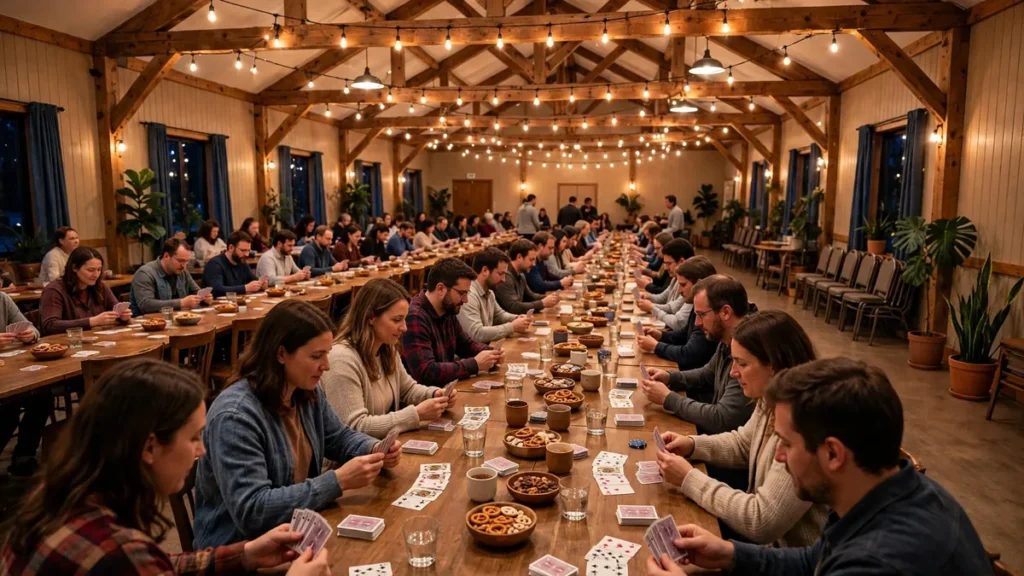
The best card games for 167 players are not the games with the largest player count printed on the box. No single card game seats 167 people around one table, deals everyone a hand at the same moment, and still finishes before the room loses interest. A standard card game works with two to eight players, a large one stretches to twelve, and after that the turn order alone becomes the problem. A group of 167 can still play card games together, but only when teams, tables, tournaments, and whole-room rounds do the work that one table cannot.
The trick is to stop thinking of 167 as one game and start thinking of it as one event. Twenty-eight tables of six, or forty-two teams of four, can all play the same game at the same time, and a shared scoreboard turns dozens of separate tables into a single competition. The best card games for 167 players are therefore the ones that scale cleanly: simple rules everyone learns in two minutes, short rounds, clear winners at each table, and scores that travel easily from table to table.
This guide explains the four formats that make a 167-player card night work, then walks through eight games with table counts, team sizes, timing, and deck counts for each one. Use the comparison table to pick your mix, then follow the setup plan and checklist to run the night without chaos.
Key takeaways
- No single card game seats 167 players, so plan for teams, multiple tables, tournaments, or whole-room play instead of one giant table.
- Split 167 players into 28 tables of six, or 42 teams of four, and keep every table playing the same game on the same clock.
- Uno is the strongest choice for 167 players because its rules are universal, rounds are short, and table winners feed neatly into a final.
- Use one deck per table plus spares, a shared scoreboard, and a host who calls round starts and ends for the whole room.
- Keep rounds to 15 minutes or less, rotate partners between rounds, and crown one overall winner from the table champions.
Why 167 Players Changes Everything
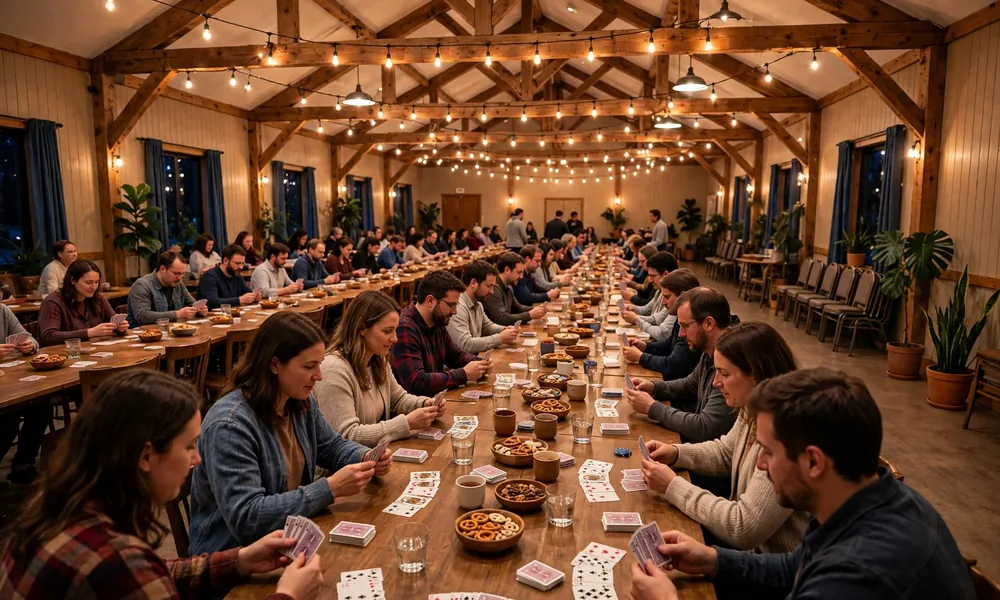
A card game is built around a table. The deck is shared, the discards are visible, and every player watches the same cards. That design breaks down long before 167 players. Even a game that claims to support twelve players becomes slow and confusing at that size, because each turn waits on eleven other people and a single hand can take an hour. With 167 players, the waiting alone would end the night.
The number itself adds a small wrinkle worth planning around. Because 167 is a prime number, it does not divide evenly into equal groups. Twenty-eight tables of six gives you 168 seats, which means one seat stays empty or one player becomes the roaming host. Forty-two teams of four gives you 168 places, so one team plays with three. Neither option is a problem once you name it in advance. Give the extra place a job: a floater who fills in where a table is short, a scorekeeper, or a substitute who joins the next round.
The honest answer, then, is that the best card games for 167 players are the best card games for six players, played twenty-eight times at once. The event is large, but each game stays small, which is what keeps the night fast, fair, and fun.
The Four Formats That Make 167 Work
Multiple tables, one game
This is the simplest format and the backbone of the whole night. Every table plays the same game, on the same clock, with the same rules. Twenty-eight tables of six cover 167 players with one spare seat. The host announces the start and end of each round, table winners report their scores, and the scoreboard does the rest. This format works with almost every game in this guide, and it needs nothing more than enough decks and enough tables.
Team play
Team play turns 167 individuals into 42 teams of four, with one team of three. Partners sit together, share a score, and cheer each other on, which makes the night feel social even in a huge room. Team play suits games with partnership scoring, such as Spades and Hearts, and it gives shy players a teammate to lean on. It also makes scoring simple: one score per team, forty-two scores to track, and a clear leaderboard after every round.
Tournaments and brackets
A tournament format adds stakes without adding complexity. Table winners advance, losers stay at their tables for a friendly consolation round, and the winners meet at fewer and fewer tables until one champion remains. A 167-player field narrows fast: twenty-eight table winners become five tables of five or six, and those winners meet at a single final table. Tournaments work best with short games such as Uno, Spoons, and War, where a table can crown a winner in fifteen minutes.
Whole-room games
Whole-room games let all 167 players take part in the same round at the same time, usually with the host calling the action from the front. Cheat works this way when tables compare claims, and a War bracket works when every table plays the same countdown together. Whole-room rounds are best used as openers and closers: one shared round to warm the room up, then tables for the main event, then one shared final to bring everyone back together. If you want ideas for the wider evening around the card tables, these party games for 166 players show how a similar-sized group can mix card play with whole-room energy.
The 8 Best Card Games for 167 Players
Each game below includes the format it suits best, the table layout for 167 players, the number of decks you need, and how long a round takes. Every game uses a standard deck or a widely available commercial deck, and none of them needs anyone to learn complicated rules before the night begins.
1. Uno
Uno is the strongest choice for a 167-player night, and it is the game to build the evening around. Almost everyone already knows the rules, a round at a table of six takes about fifteen minutes, and the winner is obvious the moment someone plays their last card. Uno also produces a clean tournament: twenty-eight table winners advance to five tables, and those five winners meet at a final table while the rest of the room watches and cheers.
For 167 players, set up twenty-eight tables of six and give each table one Uno deck, plus four spares for the finals. Keep the standard rules and skip house rules such as stacking Draw Two cards, because all twenty-eight tables must play the same way. Call each round from the front and record every table winner on the shared scoreboard.
2. Cheat
Cheat, also called I Doubt It, is the best bluffing game for a huge group because it needs no special deck and thrives on noise. Players discard cards face down while claiming a rank, and anyone can call out a bluff. At a table of six, a round takes about ten minutes, and the game rewards bold liars and sharp watchers in equal measure. It is also one of the few card games that works as a whole-room round, with the host calling the ranks for every table at once.
For 167 players, use twenty-eight tables of six with one standard deck per table. Because Cheat uses the full deck, keep one spare deck per four tables for cards that get bent or lost. The table winner is the first player to shed every card, and in a tournament the winners advance exactly as in Uno. Keep the calling rule strict: a challenge must be made before the next player discards, or it does not count.
3. Spoons
Spoons is the fastest game on this list and the best one for pure energy. Players pass cards around the table, racing to collect four of a kind, then grab a spoon from the middle. There is always one fewer spoon than players, so every round ends with a scramble and a laugh. A round takes five minutes at most, which makes Spoons perfect as a warm-up game or as a quick tiebreaker between longer rounds.
For 167 players, run Spoons as a relay rather than a single game. Set up twenty-eight tables of six, each with one deck and five spoons, and run three quick rounds per table. Table winners earn points for the scoreboard, and the fastest tables finish first, which gives the host a natural way to stagger the next round. Buy sturdy metal spoons rather than plastic ones, and keep spare decks handy, because Spoons is the game most likely to wear a deck out.
4. President
President, also called Asshole or Scum, is a climbing game where players shed cards in runs and sets, and the first player out becomes the President for the next round. The ranking system gives every round a story: the President gets the best cards, the lowest-ranked player gets the worst, and fortunes reverse fast. A round takes about fifteen minutes at a table of six, and the game needs nothing more than a standard deck.
For 167 players, use twenty-eight tables of six with one deck per table. President suits a league format, because the fun comes from holding a title across several rounds. Award points by finishing position at each table, play four rounds, and crown the player with the most points.
5. Rummy
Rummy is the best choice when your group includes experienced card players who want a game with real decisions. Players draw and discard to build sets and runs, and the scoring rewards careful hand management over several rounds. A full game at a table of six takes about twenty minutes, which makes Rummy the longest game on this list, so schedule it in the middle of the night when the room has settled into its rhythm.
For 167 players, set up twenty-eight tables of six, each with two standard decks shuffled together, because a single deck runs thin with six hands. Score each round on paper, with the lowest score winning the table, and carry scores forward across three rounds.
6. Spades
Spades is the best partnership game for 167 players, and the natural pick for the team format. Two partnerships of two bid on how many tricks they will win, then play to make their bid, with spades always trumps. The bidding gives every hand a small drama of its own, and partners learn to read each other quickly. A hand takes about twenty minutes with four players, so Spades suits a relaxed middle section of the evening.
For 167 players, form forty-one teams of four and one team of three, with the floater filling the rotating fourth seat for the smaller team. Use one standard deck per table and score to 250 points or across a fixed number of hands, whichever the host announces first. Keep the same partners together for the whole night rather than rotating them.
7. Hearts
Hearts is the best game for players who enjoy avoiding trouble rather than chasing it. The goal is to finish with the fewest points, and every heart taken is a penalty, which turns the usual card-game instincts upside down. Passing three cards before each hand adds a layer of strategy that experienced players love, and a full game at a table of six takes about twenty minutes.
For 167 players, use twenty-eight tables of six with one standard deck per table. Score each hand on paper and play four hands per table, with the lowest total winning. Hearts suits a quieter corner of the night, and the same table-and-scoreboard approach works in these card games for 166 players.
8. War
War is the simplest game on this list, and that simplicity is exactly why it belongs here. There are no decisions to make, no rules to argue about, and no experience needed: the higher card wins, ties go to war, and the player who collects every card wins the table. A game of War at a table of six takes about fifteen minutes, and it works beautifully as a bracket, because each table produces one winner with no disputes.
For 167 players, run War as a straight bracket. Twenty-eight tables of six produce twenty-eight winners, who meet at five tables, and those five winners play a final at one table while the room watches. Give each table one standard deck, and keep the rules identical everywhere: no shuffling mid-game, no peeking at the pile, and ties resolved with three face-down cards and one face-up card. War is the best closing game of the night, because the final is short, dramatic, and easy for the whole room to follow.
Best Card Games for 167 Players Compared
| Game | Best format | Round length | Decks for 167 | Best for |
|---|---|---|---|---|
| Uno | Tournament | 15 minutes | 28 Uno decks | The main event |
| Cheat | Whole-room | 10 minutes | 28 standard decks | Bluffing and noise |
| Spoons | Relay | 5 minutes | 28 standard decks | Warm-ups and energy |
| President | League | 15 minutes | 28 standard decks | Repeat rounds |
| Rummy | Tables | 20 minutes | 56 standard decks | Experienced players |
| Spades | Teams | 20 minutes | 42 standard decks | Partnership play |
| Hearts | Tables | 20 minutes | 28 standard decks | Quiet strategy |
| War | Bracket | 15 minutes | 28 standard decks | The closing final |
How to Set Up a 167-Player Card Night
Setup is where a 167-player night succeeds or fails, and most of the work happens before anyone sits down. Arrive early, lay the room out in rows of tables with clear aisles, and put the scoreboard where every table can see it. Number the tables, print a simple rules sheet for each game, and place one rules sheet and the right number of decks on every table before the doors open.
Timing matters more than anything else once play begins. Plan for four rounds of about fifteen minutes each, with five-minute breaks between rounds for scoring and moving. That gives you a main event of about ninety minutes, plus a fifteen-minute whole-room opener and a fifteen-minute final, for a two-hour evening. The host should call every round start and end from the front, with a timer everyone can see, because twenty-eight tables will never stay in sync on their own.
People matter as much as the plan. You need one host, one scorekeeper, and at least four floaters who can fill an empty seat, settle a rules question, or replace a worn deck. Brief them before the night begins, so no table waits for an answer. The layout advice in our guide to card games for 165 players transfers directly to a room this size.
Checklist for a 167-Player Card Night
- Book a hall with space for 28 tables of six, clear aisles, and a visible scoreboard wall.
- Buy or borrow 28 Uno decks and at least 60 standard decks, plus 10 spares for worn or lost cards.
- Number every table, print one rules sheet per game, and place decks and sheets before guests arrive.
- Appoint one host, one scorekeeper, and four floaters, and brief them on the rules and the round timer.
- Plan four 15-minute rounds with 5-minute scoring breaks, plus a whole-room opener and a closing final.
- Name the spare seat in advance: give the floater or the host the 168th place so no table is left short.
Frequently Asked Questions
Can one card game really seat 167 players?
No, and any guide that claims otherwise is not being honest. No card game is designed for 167 people at one table. The games in this guide work because 167 players are split into 28 tables of six, or 42 teams of four, all playing at the same time under one scoreboard.
How many tables do you need for 167 players?
You need 28 tables of six, which gives 168 seats, or 21 tables of eight, which also gives 168 seats. Tables of six are better, because turns move faster and every player stays involved. The one spare seat goes to the host or a floater.
How many decks do you need for 167 players?
Plan for about 60 standard decks plus 28 Uno decks if Uno is your main game. That is one deck per table for most games, two per table for Rummy, and a handful of spares. Decks are cheap, so buy more than you need rather than fewer.
What is the best card game for 167 players?
Uno is the best overall choice because everyone knows it, rounds take fifteen minutes, and table winners feed cleanly into a final. Spoons is the best warm-up, War is the best closer, and Spades is the best choice if your group prefers team play.
How long does a 167-player card night take?
Plan for about two hours: a fifteen-minute whole-room opener, four fifteen-minute rounds with five-minute breaks, and a fifteen-minute final. Add thirty minutes before the event for setup and fifteen minutes after for the prize and the scoreboard photo.
Do you need a prize for the winner?
A prize helps, but it does not need to be expensive. A small trophy, a deck of premium cards, or a gift card is enough, and a prize for the winning table as well as the overall champion keeps all 167 players invested until the final round.
The Bottom Line
The best card games for 167 players are the simplest ones, played at twenty-eight tables at once. Pick Uno as your main event, warm the room up with Spoons, close it with War, and let a shared scoreboard turn twenty-eight small games into one big night. Get the tables, the decks, and the timer right, and 167 players will feel like one room playing together rather than a crowd waiting for a turn.


