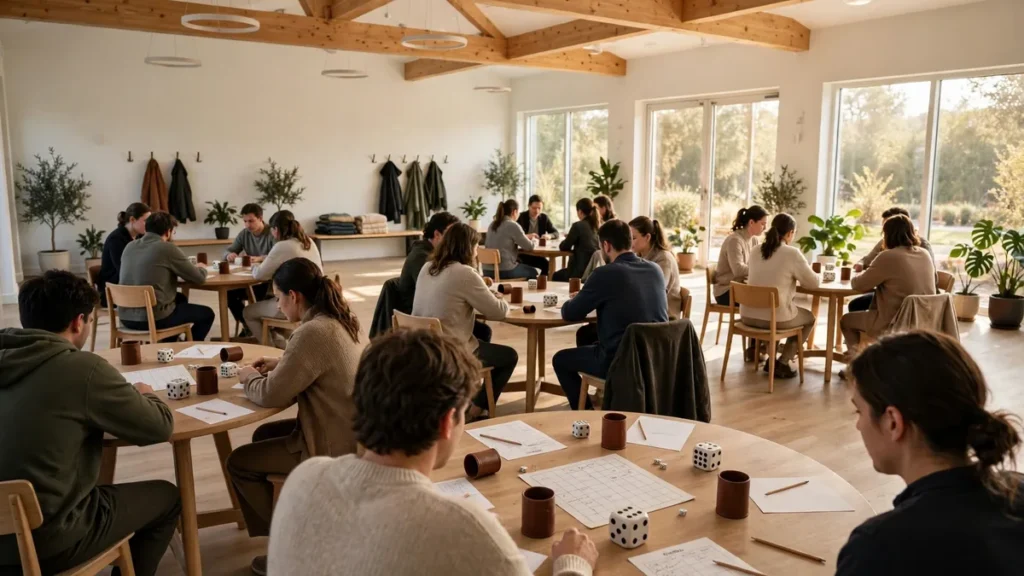
Seventy-one players is not a party. It is a small festival, a company away day, a wedding guest list, or a community hall filled to the brim. The best party games for 71 players work because they stop pretending that everyone can sit around one table and take turns. At this scale, the games that succeed are the ones built for teams, whole-room play, and fast rotations, where nobody waits twenty minutes for a single turn and nobody is left standing at the edge wondering what to do.
Planning for 71 people changes every decision you make. A game that is perfect for eight friends can fall flat with seventy-one, not because the game is bad, but because the format cannot stretch that far. The best party games for 71 players share a few qualities: they split the room into teams of six to ten, they let many people play at the same time, they are easy to explain in under two minutes, and they keep score in a way the whole room can follow. When those pieces are in place, a huge group stops feeling chaotic and starts feeling electric.
This guide covers the games that genuinely work at this size, how to organise them, and how to run the evening so the energy stays high from the first round to the last. Every game below has been chosen for a crowd of 71, with honest notes on space, equipment, timing, and the formats that make each one fair. Whether you are planning a milestone birthday, a work social, a school reunion, or a community celebration, you will find a plan here that fits your room, your budget, and your guests.
Key takeaways
- Split 71 players into seven or eight teams of eight or nine so everyone plays at the same time.
- Choose whole-room and team games, not turn-based games built for a single table.
- Run games in short rounds of ten to fifteen minutes and rotate teams between stations.
- Keep one visible scoreboard so all 71 players can follow the competition.
- Appoint a host and one captain per team before the first game begins.

Why 71 Players Changes the Game
Most party games are designed for a living room, not a hall. With 71 players, the maths of turn-taking breaks down quickly. If each person takes just thirty seconds, a single round lasts more than thirty-five minutes, and most of the room spends that time watching. That is why the best party games for 71 players are built around simultaneous play. Everyone should be doing something at the same time, even if that something is shouting an answer, drawing a picture, or cheering on a teammate.
Space matters just as much as format. Seventy-one adults need room to move, sit in teams, and gather for whole-room rounds. A hall with tables for eight works well, as does an open room with chairs arranged in team clusters. Outdoor spaces work too, provided there is a covered area for scorekeeping and a sound system that reaches the back of the group. Before you choose your games, walk the room and count the seats, the tables, and the power points. A game that needs every team at a table will fail if you only have seating for fifty.
Sound is the part most hosts forget. One person with a loud voice cannot reach 71 people in a noisy hall. A simple microphone and speaker, or even a portable public address system, makes the difference between a game everyone understands and a game half the room guesses at. If you are borrowing equipment, test it in the room before guests arrive. The same applies to music: a playlist and a speaker are enough for most of the games below, but the speaker needs to be loud enough for the farthest table.
How to Structure a 71-Player Party
The simplest structure that works is seven teams of ten and one team of eleven, or eight teams of eight or nine. Eight teams is often the easier number because it fits a knockout bracket and a rotation of eight stations. Give each team a name, a colour, and a captain. Colour-coded wristbands, badges, or table signs help guests find their team quickly and make the room look organised from the moment people arrive.
Captains are the secret to a smooth evening. Each captain collects answers, keeps their team together, and communicates with the host. Choose captains in advance where you can, and pick people who are organised and encouraging rather than simply the loudest. A good captain makes sure quieter players get a turn and keeps the team moving between rounds without the host having to chase anyone.
Team Sizes That Work
Teams of eight or nine hit the sweet spot for 71 players. Smaller teams mean more teams to manage, while larger teams mean some players go quiet. With eight teams of nine, every team can field a relay runner, a drawer, a guesser, and a scorekeeper without anyone doubling up too often. If your guest list includes children alongside adults, keep teams mixed so every team has a similar balance of ages and abilities.
Scoring That Everyone Can Follow
Use one scoreboard that the whole room can see. A whiteboard, a flip chart, or a projected slide all work, provided the writing is large enough to read from the back. Update scores after every round and read them aloud. Teams that cannot see the score lose interest, while teams that can see they are two points behind the leaders play harder in the next round.
The Best Party Games for 71 Players
The games below are ordered to build an evening: a warm-up that gets everyone talking, station games that run in parallel, and a whole-room finale that brings all 71 players together. You do not need to run all seven. Pick five or six that suit your space and your guests, and run them well.
1. Whole-Room Trivia Tournament
Trivia is the most reliable large-group game ever invented, and it scales beautifully to 71 players. Each team answers the same questions at the same time, writing answers on a sheet or holding up a card. The host reads the questions, teams discuss quietly, and answers are collected at the end of each round. Nobody waits for a turn, and every team is in the game from the first question to the last.
For a crowd this size, prepare the questions in advance and print an answer sheet for each team. The host reads each question twice, and teams have thirty seconds to agree on an answer. A team that finishes early can use the spare time to discuss the next question, which keeps the pace brisk. If you want more ideas for question sets and formats, the range of trivia games for adults is a useful starting point for building rounds that suit a mixed-age crowd.
2. Team Charades Relay
Charades works for 71 players when it becomes a relay rather than a single stage performance. Set up a stage area at the front of the room and send one player from each team up at a time. The host shows the same word or phrase to all eight performers, they act it out simultaneously, and their teams shout guesses. The first team to guess correctly scores, and the next player from each team steps up.
The relay format keeps the game fast because eight people are performing at once instead of one. Choose prompts that are visual and fun: film titles, animals, everyday actions, and famous characters all work well. Avoid obscure phrases that leave performers stuck and teams silent. A list of sixty prompts is enough for a twenty-minute round, with each performer getting about two minutes on stage.
3. Scavenger Hunt Relay
A scavenger hunt for 71 players works best as a relay inside the venue rather than a free-for-all across a neighbourhood. Prepare a list of twenty items or tasks that can be found or completed inside the hall: a red sock, a photo with someone wearing glasses, a team selfie with the host, a paper aeroplane that flies three metres. Teams send runners one at a time to complete each task and bring proof back to their table.
The relay structure keeps the hunt fair and safe. Only one runner per team is moving at a time, which avoids seventy-one people rushing around the room at once. Set a time limit of fifteen minutes and award points for each completed task, with bonus points for creativity on the photo tasks. A judge or the host checks each item as it arrives and marks it off the team list.
4. Pictionary Relay
Pictionary becomes a large-group game when it runs as a relay. Each team lines up, and the first player draws a word while their team guesses. When the team guesses correctly, the next player takes the pen and draws the next word. The relay continues for a set time, and the team with the most correct guesses wins. Running all eight teams at once, each with its own board or large pad, means all 71 players are involved.
Give each team a large pad of paper or a small whiteboard, plus thick markers that can be seen from a few steps away. Choose words that are easy to draw quickly: animals, objects, actions, and places. Avoid abstract words that stall the relay. A word list of forty items is enough for a fifteen-minute round, and the host can call time and count the completed words.
5. Minute-to-Win-It Stations
Minute-to-win-it games are short challenges that take sixty seconds each, and they are ideal for a station rotation with 71 players. Set up six stations around the room: stacking cups, balancing a biscuit on your forehead, moving an inflated balloon without using hands, sorting coloured sweets with chopsticks, bouncing a ball into a cup, and building the tallest tower from paper cups. Teams rotate through the stations, with one player attempting each challenge while teammates cheer.
Stations work because they let many people play at once without needing one big stage. Each station needs a small table, the equipment for its challenge, and a simple instruction card. A volunteer or a team captain runs each station, times the attempts, and records the result. Teams spend about five minutes at each station before rotating, which means a full rotation takes around thirty minutes.
6. Name That Tune, Team Buzzers
Name that tune is a natural fit for a large party because music fills the room and everyone can join in. Play a short clip of a song, and teams race to name the song or the artist. With 71 players, use a buzzer system: each team has a captain who raises a hand or rings a bell, and the first team to buzz gets to answer. If they are wrong, the next team gets a chance.
Build a playlist of thirty songs across the decades so every age group has a fair chance. Include a mix of pop, rock, film themes, and party classics, and keep each clip to about ten seconds. Announce the decade before each clip so teams know what to expect. A round of thirty songs takes about twenty minutes including scoring and the occasional singalong.
7. Giant Board Game Tournament
A board game tournament sounds impossible for 71 players until you split it into heats. Set up eight tables, each with a different quick board game, and let teams play short heats of fifteen minutes. After each heat, teams rotate to a new table and a new game. The team with the best combined result across all heats wins the tournament. Short, simple games work best: card games, dice games, and party board games that can be learned in two minutes.
Choose games that finish quickly and do not need long explanations. A game that takes an hour to play will stall the rotation, while a game that takes ten minutes keeps the tournament moving. Provide a one-page rules summary at each table so teams can start playing without waiting for the host. If you need inspiration for table games that suit a crowd, the selection of board games for large groups covers formats that work when many players share a small number of tables.
Best Party Games for 71 Players Compared
Choosing between games is easier when you can see them side by side. The table below compares the seven games in this guide by the space they need, the equipment involved, and the time each round takes. Use it to build a line-up that fits your venue and your schedule.
| Game | Players at once | Space needed | Equipment | Time per round |
|---|---|---|---|---|
| Whole-room trivia | All 71 | Seated hall | Question sheets, pens | 30 minutes |
| Team charades relay | All 71 | Stage and seating | Prompt cards | 20 minutes |
| Scavenger hunt relay | 8 runners at once | Hall and grounds | Task lists | 15 minutes |
| Pictionary relay | All 71 | Team tables | Pads, markers | 15 minutes |
| Minute-to-win-it stations | 48 at once | Hall with stations | Cups, balloons, balls | 30 minutes |
| Name that tune | All 71 | Seated hall | Speaker, playlist | 20 minutes |
| Board game tournament | All 71 | Eight tables | Board games | 40 minutes |
Planning Checklist for a 71-Player Party
A large party rewards preparation. Work through this checklist in the week before the event, and most problems will be solved before guests arrive.
- Confirm the venue, the seating for 71, and the table layout, with one table per team and a clear stage or front area.
- Split the guest list into eight teams, appoint a captain for each team, and prepare coloured wristbands or table signs.
- Test the microphone, speaker, and music playlist in the actual room, and pack spare batteries and cables.
- Print answer sheets, bingo cards, prompt lists, and score sheets, with at least ten spares of each.
- Prepare a visible scoreboard and assign one person to update it after every round.
- Buy small prizes for the winning team and a fun prize for the best team name or the best sportsmanship.
The checklist looks simple because it is. Large parties rarely fail for lack of ideas; they fail because the speaker was not tested, the teams were not formed before the first game, or nobody was keeping score. Spend an hour on the practical details and the games will take care of themselves.
Frequently Asked Questions
What is the best party game for 71 players?
The whole-room trivia tournament is the safest choice for 71 players because every team plays at the same time, it needs little equipment, and it works in any seated hall. Pair it with a lively game such as the charades relay or the minute-to-win-it stations so the evening mixes thinking and movement.
How do you split 71 players into teams?
Split 71 players into eight teams of eight or nine. Give each team a name, a colour, and a captain, and seat each team at its own table. Eight teams fit a rotation of eight stations and a simple points system, and teams of eight or nine are small enough that every player gets involved.
How long should games last for 71 players?
Plan for about two hours of games in total, made up of rounds lasting ten to thirty minutes each. Short rounds keep the energy high and let you adjust the schedule if a game runs long. Add breaks for food and drinks between blocks so guests can rest and socialise.
Do you need a host for 71 players?
Yes. A host with a microphone is essential for 71 players. The host explains the rules, keeps time, updates the scoreboard, and keeps the energy up between rounds. Without a host, instructions get lost across the room and games start late. Ask a confident friend to host, or hire a professional if the event is formal.
What equipment do you need for 71 players?
At minimum you need a microphone and speaker, printed answer sheets and pens, a visible scoreboard, and the equipment for your chosen games. Most of the games in this guide use cheap everyday items such as paper, cups, balloons, and markers. Test the sound system in the room before the party starts.
Can these games work outdoors for 71 players?
Yes, provided you have a covered area for scorekeeping and a sound system that reaches the whole group. Outdoor games such as the scavenger hunt relay and the minute-to-win-it stations work well on grass, but have an indoor backup plan for bad weather. Keep paper-based games under cover so the wind and rain do not spoil them.
The Bottom Line
The best party games for 71 players are the ones that treat a huge crowd as an advantage rather than a problem. Split the room into teams, choose games where everyone plays at the same time, keep the rounds short, and keep the score visible. A trivia tournament, a charades relay, and a set of minute-to-win-it stations will carry an evening on their own, and the rest of the games in this guide let you shape the night around your guests and your venue. Plan the practical details, appoint your captains, test your speaker, and then let the teams do the rest. For a smaller crowd, the classic party games for adults offer a simpler starting point, but with 71 players in the room, the team format is what turns a big gathering into a great party.