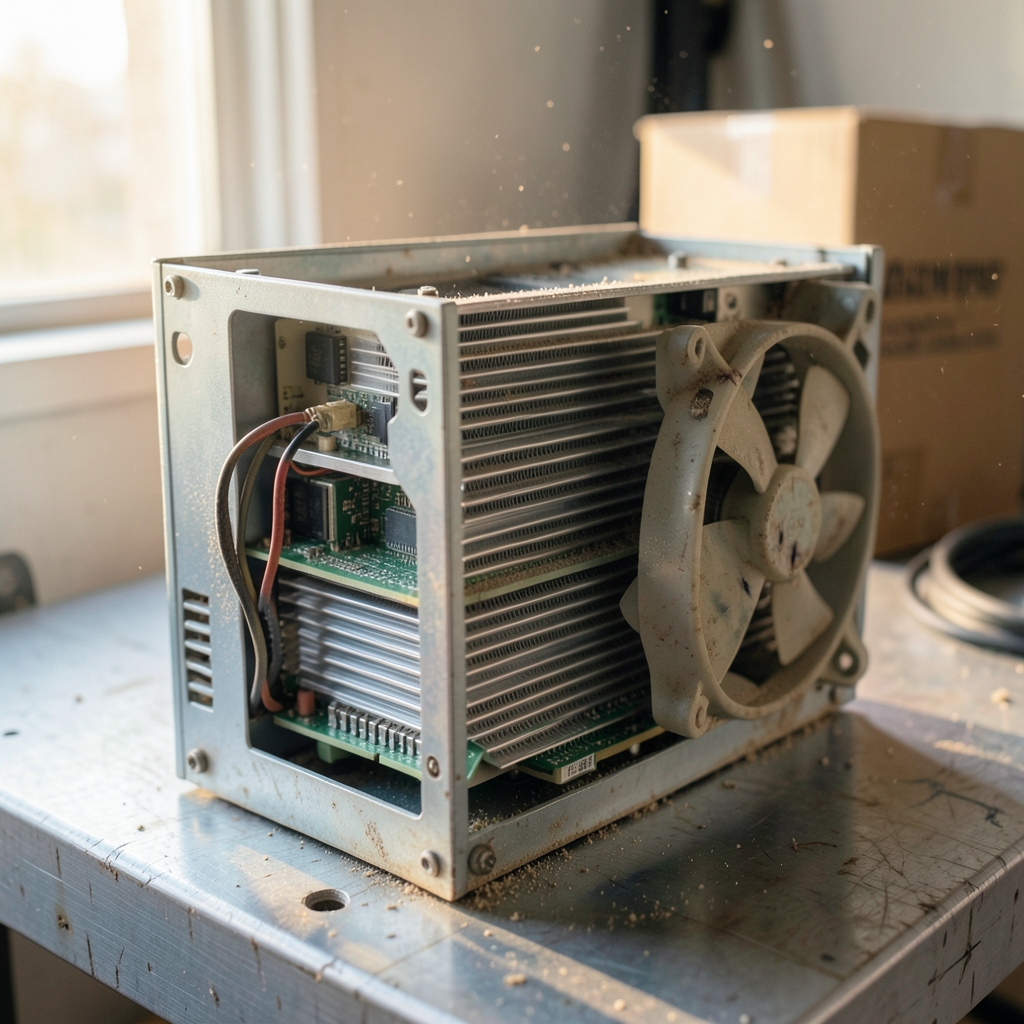
Quick Answer: What to check before using used ASIC miner marketplaces?
Before buying from a used ASIC miner marketplace, verify the seller’s reputation, the unit’s firmware and control board, PSU compatibility, and the platform’s escrow and dispute terms. Confirm the miner’s real hashboard history, inspect for burn marks or worn fans, and assume no warranty unless it is stated in writing.
Peer-to-peer forums, auction sites, and dedicated resale platforms all differ in how much protection they offer. Some hold funds in escrow and mediate condition claims, while others leave buyers to settle disputes directly with the seller.
Check seller feedback, firmware state, power supply specs, shipping and export rules, dispute windows, and the current network difficulty before paying, because each one changes what the rig is actually worth to you.
Why the Second-Hand Rig Market Rewards Careful Buyers

Ever noticed how a used miner always looks great in the listing photo? Clean fans, shiny heatsinks, a screenshot of a hashrate graph that could have come from any machine on earth. The gap between that photo and the box that lands on your doorstep is where money quietly disappears.
The used ASIC market exists for good reasons. Large farms rotate hardware constantly, hobbyists upgrade, and prices on older models fall fast once newer generations ship. That means real bargains are out there. It also means the market is full of units with stories the seller would rather not tell: a hashboard that drops offline under load, a control board flashed with unknown firmware, or a power supply rated for a voltage your wall socket does not deliver.
Buying well is mostly a process problem, not a luck problem. The checklist below is the one that separates a good deal from an expensive lesson.
Start With the Seller, Not the Miner
It is tempting to fixate on the model number and the price. Resist that. The seller is the first thing to check, because almost every other risk on this list gets easier or harder depending on who is on the other side of the transaction.
Feedback history and account age
Look for accounts with a long history and reviews that mention mining hardware specifically. A seller with two hundred transactions in phone cases may be perfectly honest, but they will not know how to pack a 15-kilogram miner or how to test a hashboard. Read the negative reviews first. How a seller responds to a complaint tells you more than a wall of five-star ratings.
Ask for a video, not a screenshot
A screenshot proves nothing. Ask for a short video showing the miner running, with the dashboard visible, the serial number legible, and the fans spinning. Better still, ask for a clip recorded at a stated time with a note or timestamp in frame. Sellers with nothing to hide rarely mind.
Private seller versus business
Consumer-protection law generally follows the seller’s status and location. Rules that protect buyers from traders often do not apply to private sales, and cross-border purchases can fall outside your local regime entirely. If you are buying from a business, ask in writing what guarantee applies. If you are buying from an individual, assume you have none.
Firmware and the Control Board: The Hidden Risk
Here is the part most buyers skip, and the part that bites hardest. ASIC firmware is often vendor-specific, and on popular models community builds add tuning options. A used unit can arrive with altered firmware, unknown admin credentials, or a swapped control board.
Plan to reflash the unit to a known-good image as soon as it arrives, before you point it at a pool. That means downloading the firmware from a source you trust, resetting credentials, and confirming the board is the model it claims to be. If the seller cannot tell you what firmware is installed, treat that as a yellow flag rather than a red one, but budget the time to fix it.
The same caution applies to any smart add-on hardware. If a seller bundles monitoring gadgets or dashboard tools, check what data those devices phone home with, in the same way you would compare features before committing to any connected tool, whether that is a set of AI music tools features compare before you commit or a miner telemetry dongle. The principle is identical: know what the box does before it joins your network.
Power, Voltage, and the Fire Risk Nobody Talks About
ASIC miners draw hundreds to thousands of watts continuously. A worn fan, degraded thermal paste, or a damaged connector on a used unit can push temperatures into dangerous territory. This is not a theoretical concern; high-draw equipment with compromised cooling is a genuine fire risk.
| Check | What good looks like | What to walk away from |
|---|---|---|
| PSU included | Matching model, correct wattage, clean cabling | No PSU, or a generic unit with no rating label |
| Input voltage | Matches your supply (110V or 220V) | Seller cannot confirm voltage |
| Connectors | No scorching, melting, or discoloration | Brown or blackened pins |
| Fans | Spin freely, no grinding, all present | Missing blades or seized bearings |
| Heatsinks | Clean, evenly seated | Bent fins, visible paste leakage |
Undersized or mismatched power supplies are a failure risk on their own. If the listing does not state the PSU model and voltage, ask before paying. Then inspect the unit under load for at least an hour before trusting it with a long run. (Ai avatar tools features compare before you commit)
The Economics: Hashrate Is a Lottery, Not a Salary
Sellers love to quote “expected daily earnings.” Treat those numbers with suspicion, because Bitcoin’s proof-of-work design means a miner’s expected earnings are proportional to its share of network hashrate, and individual block-finding times are wildly variable. A small rig can go weeks without a block and then find two in a day.
Two protocol parameters move the goalposts further. Network difficulty adjusts roughly every two weeks, and the block subsidy halves roughly every four years, with the last halving in April 2024 and the next expected around 2028. A used miner’s resale value depends heavily on those parameters; whether it powers on is only one factor.
Practical rule: run the numbers yourself at current difficulty, then stress-test them at twenty percent worse. If the rig only makes sense at today’s numbers, it does not make sense.
Escrow, Disputes, and the Paper Trail
Marketplace protections vary enormously. Some platforms hold funds until delivery is confirmed. Others release payment immediately and offer mediation only as a courtesy. Dispute windows are often short, sometimes measured in days from delivery rather than from the moment you finish testing.
Read the specific platform’s terms before you bid, not after something goes wrong. Then protect yourself with documentation: photographs of the packaging before opening, a video of the unboxing, screenshots of the listing, and a written record of every claim the seller made. If a unit arrives dead, that file is your case.
Shipping, Customs, and Export Rules
Mining hardware crosses borders constantly, and the rules are not static. Export-control and sanctions lists can affect whether certain equipment can be shipped to certain destinations, and those lists change. Buyers importing used units should check end-use and destination restrictions before committing, and should confirm who is responsible for duties and return shipping if the parcel is held.
Counterfeit and mislabeled components are also a documented problem in electronics resale, including mislabeled chips and refurbished parts sold as new. On a used miner, that can mean a hashboard rebuilt with salvaged ASICs. Ask for board-level photos and compare the chip markings against the model’s known specification.
Warranty Reality and the Cost of Being Wrong
Most ASIC manufacturers tie warranties to the original purchaser and void them on resale or firmware modification. Assume there is no warranty on a used unit, and price that assumption into your offer. If a seller claims a transferable warranty, ask for the terms in writing and confirm them with the manufacturer before you pay.
The same skepticism applies to any bundled software or subscription the seller throws in. A “free” monitoring plan that expires in three months is not a discount. Think about how you would weigh the fine print on AI coding tools features compare before you commit: the headline feature is rarely the thing that decides whether the purchase was smart.
A Practical Pre-Purchase Checklist
Work through this in order. If a seller balks at any step, that is information.
- Confirm the exact model, hashrate variant, and PSU specification in writing.
- Ask for a timestamped video of the unit running, with the serial number visible.
- Request board-level photos and check chip markings against the model spec.
- Read the platform’s escrow, dispute window, and returns policy in full.
- Check export-control and customs rules for your destination.
- Calculate profitability at current difficulty and at twenty percent worse.
- Budget for a replacement PSU and a reflash before the unit ever ships.
- Document the unboxing on video and test under load for at least an hour.
If you enjoy the puzzle-solving side of this hobby, the same instinct that makes a good riddle for rock collection satisfying applies here: the answer is usually hiding in plain sight, and the person who checks the details wins.
Common Mistakes That Cost Real Money
The most frequent error is buying on price alone. A rig that is thirty percent cheaper than every comparable listing is not a bargain; it is a question. The second most common is skipping the load test. A miner that idles quietly and dies under full draw will pass a five-minute check every time.
The third is ignoring the power bill. A used unit’s efficiency matters more than its sticker hashrate, and older models can burn far more electricity per unit of work. The fourth is trusting a screenshot. The fifth is failing to reflash firmware, which leaves unknown credentials on a device connected to your network.
Finally, many buyers forget that the marketplace is not the manufacturer. Platform support staff cannot diagnose a hashboard. They can only apply their own dispute rules. Knowing those rules in advance is the difference between a refund and a shrug.
Conclusion
Used ASIC miner marketplaces are neither a trap nor a shortcut to easy profit. They are a market like any other, with informed buyers on one side and hopeful ones on the other. The checks that matter are unglamorous: seller history, firmware state, PSU compatibility, escrow terms, export rules, and honest math at realistic difficulty.
Do that work before you pay, and a second-hand rig can be a genuinely sensible purchase. Skip it, and you will learn the same lessons the hard way, usually at three in the morning, usually with a fan screaming. The checklist is short. Use it.
FAQ
How much should I pay for a used ASIC miner?
There is no fixed number, because value depends on efficiency, current difficulty, and local electricity prices. A workable approach is to calculate expected earnings at today’s difficulty, then discount the offer for the risk of no warranty, a possible PSU replacement, and the chance of a failing hashboard. If the seller’s price only works at optimistic assumptions, walk away.
Can I trust a seller’s hashrate screenshot?
Not on its own. Screenshots are trivial to fake or reuse. Ask for a timestamped video showing the unit running with its serial number visible, and confirm the reported hashrate matches the model’s specification. Even then, plan to verify under load yourself once the unit arrives.
What firmware should a used miner arrive with?
Ideally the manufacturer’s stock firmware, or a well-known community build that the seller can name and date. Anything unidentified should be replaced. Reflash the unit to a known-good image from a trusted source before connecting it to your network or a mining pool, and reset all admin credentials in the process.
Do used miners come with a warranty?
Usually not. Most manufacturers tie warranties to the original purchaser and void them on resale or firmware modification. If a seller claims a transferable warranty, ask for the terms in writing and confirm them directly with the manufacturer before paying. Assume no coverage and price accordingly.
What voltage and power supply do I need?
It depends on the model and your region. Many miners run on 220V supplies, while some regions deliver 110V, and PSUs are rated for specific input voltages and wattages. Confirm the seller’s PSU model and voltage before buying, and never run a miner on an undersized supply, which is a failure and fire risk.
How long should I test a used miner after it arrives?
At least an hour under full load, ideally longer, with temperatures and fan speeds monitored throughout. Check for dropped hashboards, unusual noise, and any sign of scorching at the connectors. Document the unboxing and the test on video, because most platform dispute windows are short and start at delivery.




