What is the one garden purchase that most people make after the damage is already done? It is usually a soil test. By the time a tomato plant turns yellow or a lawn refuses to green up, the gardener has already spent money on fertilizer, lime, or a “miracle” amendment that never had a chance of working. A soil test is the cheap step that comes first, and the buying decision matters more than most people expect.
The market makes this harder than it should be. Walk into any garden center and you will find shelves of boxes promising to reveal everything about your soil for the price of a sandwich. Some of them are genuinely useful. Others are closer to a science fair project. This guide breaks down what different kits actually measure, where they fall short, how to sample correctly, and how to decide whether a kit or a laboratory test is the right tool for the job.
Start With the Question, Not the Kit

The single most common buying mistake is picking a kit before deciding what you need to know. Soil tests answer different questions, and the right tool depends entirely on which one is being asked.
| What you want to know | Best tool | Why |
|---|---|---|
| Is my soil too acidic or too alkaline? | Colorimetric pH kit or calibrated pH meter | pH is the most reliable do-it-yourself measurement and drives nutrient availability |
| Do I need lime or sulfur? | pH test, ideally lab-confirmed | Amendment rates depend on soil texture and buffer capacity, not pH alone |
| Is my vegetable bed short on nitrogen, phosphorus, or potassium? | Lab test preferred; colorimetric N-P-K kit as a rough check | Dye-based kits give ranges, not precise values |
| Is my urban soil safe for growing food? | Laboratory contaminant screening | Typical garden kits do not test for lead or arsenic |
| How much organic matter and cation exchange capacity does my soil have? | Laboratory test | Consumer kits rarely measure these at all |
A homeowner who just wants to know whether to lime the lawn needs a pH test and nothing more. Someone planning a raised-bed vegetable garden from scratch probably wants a fuller nutrient panel. Someone gardening next to an old painted house or a former industrial site should skip the garden-center boxes entirely and look for laboratory contaminant screening.
What Home Kits Actually Measure
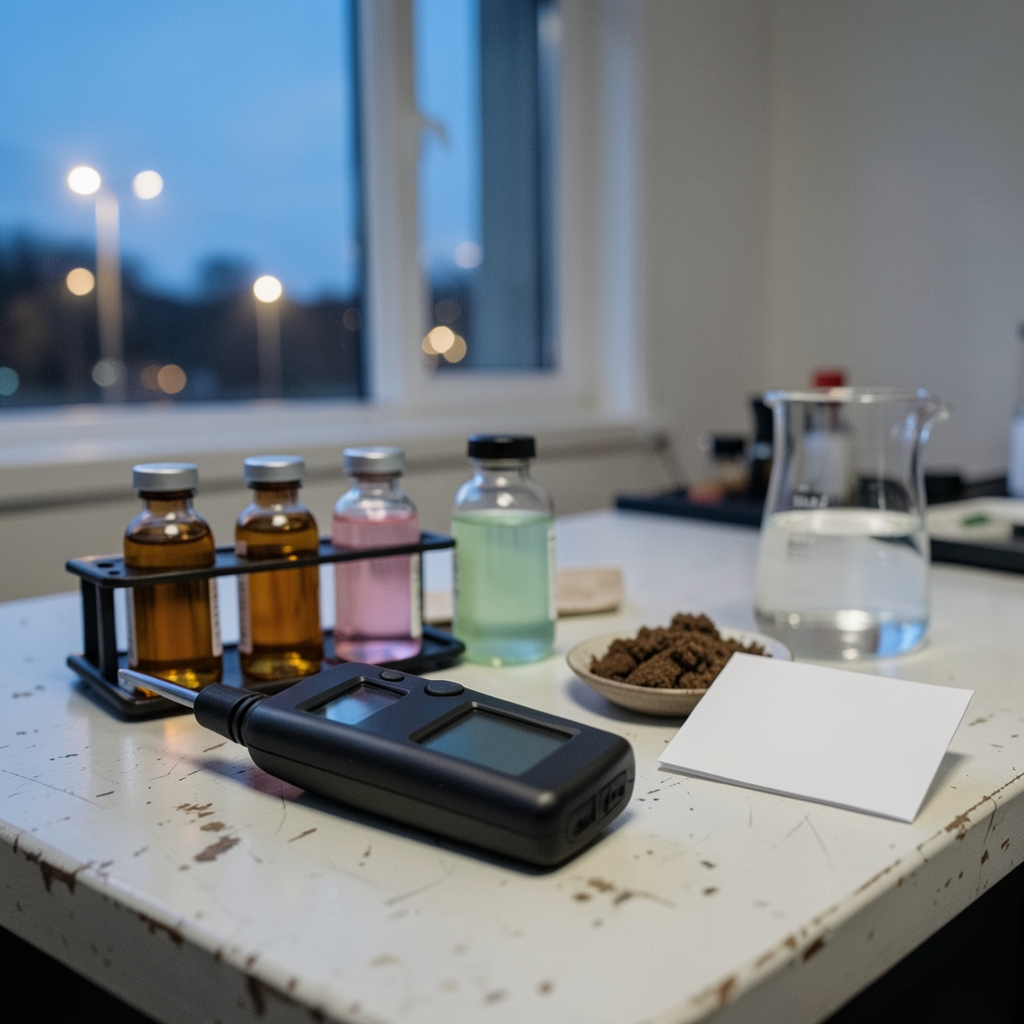
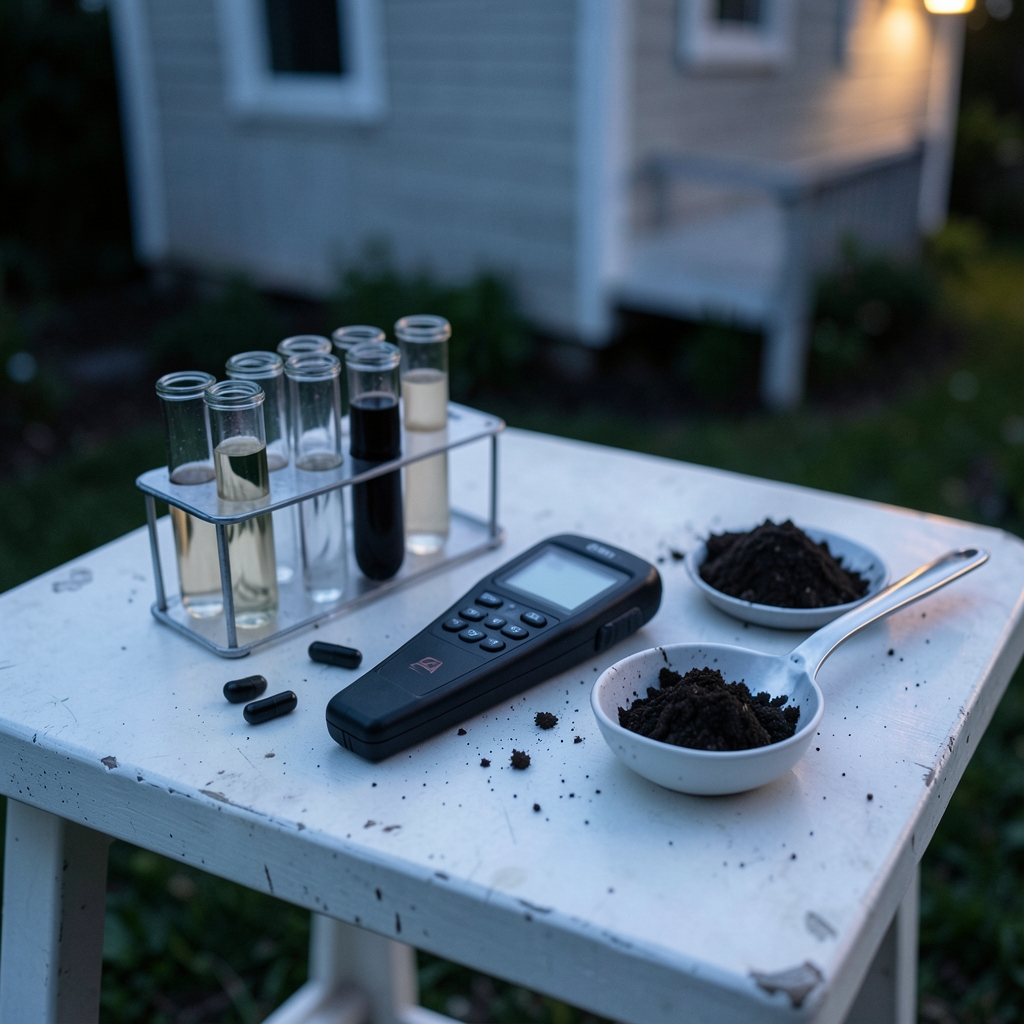
Most consumer kits fall into three families, and each has a distinct personality.
Colorimetric test kits use dye-filled capsules, tablets, or test tubes. You mix soil with a test liquid, the liquid changes color, and you match that color against a printed chart. These kits typically cover pH and sometimes nitrogen, phosphorus, and potassium. They are inexpensive, require no batteries, and give a useful snapshot. The catch is that color matching is subjective. Two people looking at the same tube can reasonably disagree about whether it is “medium” or “high,” and lighting changes everything.
Electronic pH and moisture meters are the probe-style devices sold for a few dollars to a few dozen dollars. They are fast and satisfying to use, but inexpensive units drift over time and need calibration against reference buffer solutions. Without calibration, a reading can be misleading in ways the display never reveals. A meter that has sat in a shed through two winters is a meter you should not trust.
Mail-in and digital kits sit in between. Some include sample tubes and a prepaid envelope so you send soil to a lab; others pair a small sensor with an app. These are often the best compromise for people who want more confidence than a color chart provides but do not want to research laboratories from scratch.
For anyone comparing options in detail, a breakdown of AI prompt testing tools features that actually matter when choosing evaluation software follows the same logic: identify the decision you need to make, then buy only the features that serve it. Soil kits reward the same discipline.
Where Kits Stop and Laboratories Begin
Laboratory tests add micronutrients, organic matter, cation exchange capacity, and contaminant screening. They also come with interpretation, usually in the form of recommended amendment rates tailored to the crop you named on the submission form. That interpretation is often worth more than the raw numbers.
Kits are cheaper and faster, but less precise. The trade-off is real and there is no clever way around it. A colorimetric N-P-K kit can tell you that phosphorus looks low. A laboratory can tell you how low, in parts per million, and how much phosphate to add per thousand square feet. For a lawn or a large garden, that difference translates directly into money spent on fertilizer you did or did not need.
There is also a standards gap. Soil testing methods are referenced in standards such as ISO 10390 for pH, but consumer kits rarely state which method they follow. That does not make them useless. It does mean their numbers should be treated as ranges rather than exact values, and that comparing a kit result to a lab result is not quite apples to apples.
Sampling Method Matters More Than the Kit
Here is the uncomfortable truth that experienced gardeners learn the hard way: a good kit with a bad sample gives bad results, and a mediocre kit with an excellent sample often gives usable ones. University extension services consistently emphasize representative sampling, and it is the step most home testers rush.
- Collect multiple cores, not one scoop. Aim for eight to twelve small subsamples from across the area, not a single trowel of soil from one spot.
- Sample at the right depth. For lawns and established beds, that usually means the top four to six inches; for deeper-rooted plantings, adjust accordingly.
- Avoid odd spots. Skip the area near the compost pile, the dog’s favorite corner, and the low spot where water pools. Those are not representative.
- Mix thoroughly before testing. Combine the cores in a clean bucket, break up clods, and take the test sample from the mixed soil.
- Use clean tools and clean containers. Residue from fertilizer, detergent, or a rusty trowel can skew results.
- Test at a consistent time. Sampling right after fertilizing tells you almost nothing useful.
The most frequent mistake is testing the worst-looking patch of soil instead of the whole area. That tells you why one corner looks bad, but it does not tell you what the bed needs overall. If a specific problem area is the concern, sample it separately and label it clearly.
Reading the Fine Print Before You Buy
A few details separate a kit worth owning from one that will sit in a drawer.
Number of tests. A kit advertising “ten tests” may mean ten pH tests and two nutrient tests. Check what is actually included, because replacement reagents often cost nearly as much as a fresh kit.
Expiration dates. Reagents degrade. A discounted kit from the clearance shelf may already be past its reliable window.
Units and reporting format. Look for results in recognizable units, such as parts per million or pounds per acre, rather than vague labels like “low, medium, high” with no scale behind them.
Instructions quality. Good instructions specify sample depth, soil-to-liquid ratios, and waiting times. Vague instructions are a warning sign about the whole product.
Interpretation support. Does the kit tell you what to do with the result, or just hand you a number? A pH of 5.8 means nothing to a first-time gardener without guidance on whether that is fine for blueberries and a problem for brassicas.
Budget-conscious buyers often do better with a simple, well-documented pH kit plus a laboratory test every few years than with an elaborate multi-test kit of uncertain precision. A comparison of best low cost ai prompt testing tools small teams budget makes the same point in a different market: cheap tools that answer the real question beat expensive tools that answer many questions badly.
Kits Versus Labs: A Practical Decision Framework
For most households, a hybrid approach works best.
Test pH at home, frequently, because it is the measurement consumer tools handle most reliably and because pH governs nutrient availability so strongly. Then send a sample to a laboratory every two to three years, or whenever starting a new bed, to get the fuller picture including organic matter and micronutrients. Use the lab’s recommendations to guide amendments and the home kit to monitor whether those amendments are working.
Skip home kits entirely if contamination is a concern. Typical garden kits do not screen for lead or arsenic, and no amount of careful color matching will change that. Soil contaminant screening generally requires laboratory analysis. Households growing food in urban yards, near older buildings, or on former industrial land should treat this as a hard requirement rather than a nice-to-have.
There is a mental discipline to all of this that puzzle solvers would recognize. Working through hard mind games that will test your logic trains you to separate what you know from what you assume. Soil testing demands the same separation. A color that looks “medium green” is an observation. The conclusion that your soil needs nitrogen is an inference, and it deserves a second check.
Common Mistakes That Waste Money
Buying a full N-P-K kit and never sampling properly is the classic error. So is buying a pH meter, never calibrating it, and trusting it for years. Another frequent one: testing soil that was just fertilized, then concluding the soil is rich when the reading reflects last week’s application.
Less obvious but equally costly is testing only once. Soil changes with cropping, amendment, and weather. A single test is a snapshot, not a permanent verdict. Gardeners who test pH annually and do a full lab panel every few years spend less on inputs overall because they stop guessing.
Finally, there is the temptation to over-buy. A hobbyist with four raised beds does not need a professional-grade multi-parameter kit. A smallholder with an acre of vegetables probably does. Matching the tool to the scale is the whole game, and it is the same principle covered in best ai prompt testing tools small businesses practical for teams evaluating software they will actually use.
Conclusion
The best soil testing kit is not the one with the most tests on the box. It is the one that answers the question you actually have, used on a sample you actually collected correctly. For most gardeners that means a reliable pH kit for routine monitoring, a laboratory test for the fuller picture every few years, and a laboratory contaminant screen whenever safety is in doubt. Buy for the decision, sample with care, and treat every result as a range rather than a verdict. Do that, and the humble soil test becomes one of the highest-return purchases in the whole garden shed.
Frequently Asked Questions
Are cheap soil testing kits accurate enough to trust?
For pH, inexpensive colorimetric kits are reasonably reliable when used carefully, which is why pH is the highest-value do-it-yourself measurement for most gardeners. For nitrogen, phosphorus, and potassium, dye-based kits are approximate and best treated as ranges rather than exact values. Inexpensive electronic meters can drift and need calibration against reference buffer solutions; without that, readings can mislead.
Do I need a laboratory test if I already have a home kit?
Not always, but often eventually. Laboratory tests add micronutrients, organic matter, cation exchange capacity, and interpretation with recommended amendment rates. A practical approach is to monitor pH at home and send a sample to a lab every two to three years, or whenever starting a new bed or making a major change.
Can a garden kit tell me if my soil is safe for growing vegetables?
Generally no. Typical garden kits measure pH and sometimes N-P-K, but they do not screen for contaminants such as lead or arsenic. Soil contaminant screening requires laboratory analysis. Anyone gardening in an urban yard, near older painted structures, or on former industrial land should arrange a lab test rather than rely on a home kit.
How many samples should I take from one garden bed?
Aim for eight to twelve small subsamples collected across the area, mixed together thoroughly in a clean bucket, with the actual test sample taken from that mixture. Sampling a single spot, or testing only the worst-looking patch, produces results that do not represent the bed as a whole.
Why did my kit and my lab report give different numbers?
Kits and laboratories use different methods and different levels of precision, and consumer kits rarely state which standard method they follow. Colorimetric results depend on visual matching, which is subjective and sensitive to lighting. Treat kit results as approximate ranges and lab results as the calibrated reference when the two disagree.
Is it worth testing soil more than once?
Yes. Soil changes with cropping, amendment, and weather, so a single test is a snapshot rather than a permanent verdict. Annual pH checks plus a periodic full lab panel help gardeners avoid over-fertilizing and catch problems before plants show symptoms.