
Quick Answer: What to check before using Scrypt ASIC miners?
Before using a Scrypt ASIC miner, verify that the hardware’s algorithm matches the coin and pool you plan to mine, then run the electricity math before you spend a cent on the machine. You can do this by pulling the model’s datasheet, checking your local power tariff, and confirming pool support for your coin’s current chain.
Scrypt is the proof-of-work function behind Litecoin and Dogecoin, and it differs from Bitcoin’s SHA-256, so a Scrypt miner cannot mine Bitcoin and vice versa. Some miners also ship with multi-algorithm firmware, which changes what you can point them at.
The key factors to check are algorithm compatibility, wall power draw versus your electricity rate, PSU headroom, firmware provenance, sustained hashrate history on used units, pool fees and payout schemes, noise and heat output, and local rules on mining and import duties.
Why Scrypt Hardware Deserves a Second Look
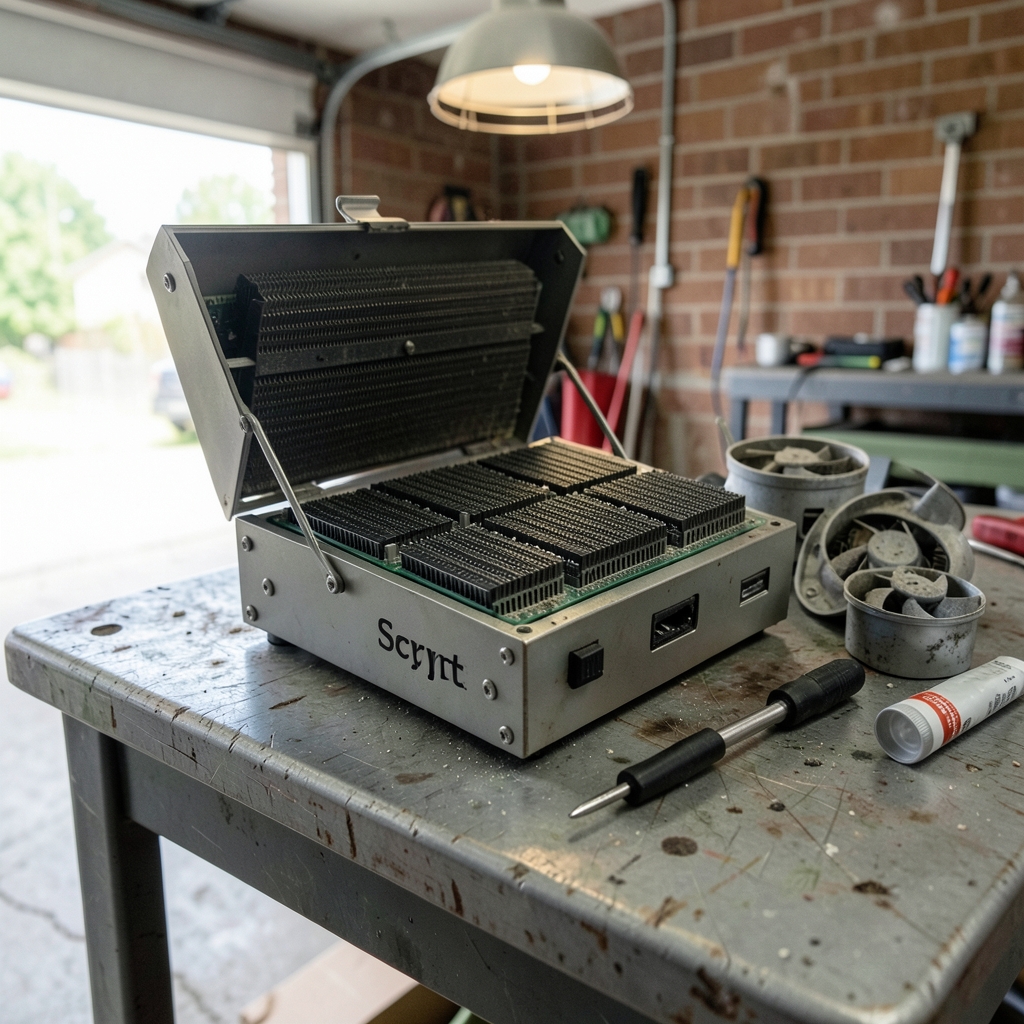
Can a machine that was built to be “ASIC-proof” end up being mined by ASICs anyway? That is exactly what happened with Scrypt, and it is the first thing to understand before buying anything.
Scrypt was designed as a memory-hard proof-of-work function. The idea was that requiring lots of memory would blunt the advantage of custom silicon and keep mining spread across ordinary hardware. Litecoin launched with Scrypt in October 2011 on that premise. In practice, the premise did not hold. Commercial Scrypt ASICs appeared from roughly 2014 onward, and the “ASIC-resistant” label became a historical footnote rather than a live promise.
That history matters for a practical reason. Scrypt ASICs are generally far less power-efficient than SHA-256 ASICs, so the electricity cost per unit of hash is high. A machine that looks cheap on a marketplace listing can be a money-loser the moment it is plugged into a wall socket in an expensive electricity market. The checklist below is built around catching that before the money leaves your account.
Match the Algorithm Before Anything Else
The single most common and most expensive mistake is buying a miner for the wrong algorithm. Scrypt ASICs are algorithm-specific in practice. A unit built for Litecoin’s Scrypt parameters will not mine SHA-256 coins like Bitcoin, and it will not mine Ethash coins either.
Worse, “Scrypt” is not always one thing. Variants exist, including Scrypt-N and Scrypt-Jane, and firmware expects an exact algorithm string. Before purchase, confirm three things line up:
- The algorithm string the miner’s firmware expects.
- The algorithm the pool actually serves.
- The coin you intend to mine, and whether that coin still uses the parameters your firmware assumes.
If you are comparing several machines side by side, it helps to approach it the same way you would any other hardware purchase. A structured feature comparison, like the kind used when people compare AI music tools features before committing, keeps you from being swayed by one flashy spec. The same discipline applies here: list the specs that matter, then score each candidate against them.
Run the Electricity Math First
This is where most hobby miners get burned, and it is entirely avoidable with a calculator and five minutes.
Scrypt ASICs draw real power, and their efficiency is poor relative to Bitcoin hardware. The formula is simple: wall watts multiplied by hours multiplied by your tariff gives you daily electricity cost. Compare that to expected coin yield at current network difficulty, then subtract pool fees. If the number is negative at your tariff, the miner is a space heater that occasionally produces crypto.
Three practical tips from people who have done this:
- Use wall watts, measured with a plug-in power meter, not the manufacturer’s “typical” figure. Real draw often runs higher.
- Check the PSU’s 12V rail rating specifically. Marketing wattage on the box is not the same as what the 12V rail can actually deliver.
- Model your tariff honestly, including tiered pricing, time-of-use rates, and any demand charges. A miner running 24/7 can push a household into a higher tier.
A quick comparison of the two cost pictures makes the point:
| Scenario | Power draw | Electricity cost per day | Verdict |
|---|---|---|---|
| Low tariff, small unit | 800 W | Low | Worth modeling in detail |
| High tariff, small unit | 800 W | High | Likely negative margin |
| Low tariff, large unit | 3,000 W | Moderate to high | Needs sustained-yield proof |
| High tariff, large unit | 3,000 W | Very high | Almost certainly a loss |
The exact numbers depend on your tariff and current network conditions, so treat the table as a shape, not a quote. The point is that the same machine can be viable in one home and hopeless in another.
Vet Used Units Like You Mean It
Second-hand Scrypt ASICs are everywhere, and the market is full of optimistic listings. Hashboards degrade with thermal cycling, and older ATX power supplies lose capacitance over time. A unit that hit its rated hashrate for ten minutes in 2021 may not sustain it today.
What actually works when buying used:
- Ask for a sustained hashrate log covering at least 24 hours, not a screenshot of a peak number. A single screenshot proves nothing about stability.
- Ask how the unit was cooled and whether it ran in a dusty environment. Dust-clogged heatsinks cause thermal throttling.
- Ask the age of the power supply, and budget for replacing it if the unit is more than a few years old.
- Check for physical signs of hashboard repair, reflowed solder, or swapped fans.
There is no industry standard for “acceptable degradation,” so treat seller claims skeptically and price the risk in. If a deal looks too good, the seller usually knows something the listing does not say.
Check Firmware Provenance and Security
Firmware is the quiet risk that rarely makes the headline list. Third-party or “unlocked” firmware is common on second-hand units, and it can do things you would not approve of, including redirecting mining rewards to a wallet you do not control or exposing the device’s web interface to the open internet.
Before connecting a miner to any network:
- Verify the firmware hash or signature against the vendor’s official release, where the vendor publishes one. Not all do, which is itself a data point.
- Change the default admin credentials immediately, before the network cable goes in.
- Put the miner on an isolated network segment or VLAN if your router supports it.
- Disable remote access features you do not need.
People apply the same security hygiene when they compare AI coding tools features before committing to a workflow: they check what the tool actually does under the hood rather than only what the sales page promises. A miner is a small networked computer with a wallet attached. Treat it that way.
Pool Terms Matter More Than Hashrate
A common trap is fixating on raw hashrate while ignoring where the coins actually go. Pool terms often decide whether a rig is profitable.
Check the pool fee, the payout threshold, and the payout scheme. PPS pays per share regardless of luck; PPLNS pays based on the last N shares and smooths out variance differently. For small miners, a high payout threshold can mean waiting a long time for a first payout, which matters if you want to test the setup before scaling.
Also confirm the pool supports your coin’s current chain state. Litecoin’s MWEB privacy upgrade, activated in May 2022, changed some wallet and pool behavior, and support varies by pool. Confirm with the specific pool before you commit hardware to it.
If you are also exploring adjacent hardware categories, the same due-diligence habit shows up elsewhere. People who compare AI avatar tools features before committing learn quickly that the headline feature is rarely the deciding one. With miners, the deciding factor is usually the fee schedule and payout terms, not the hashrate on the box.
Noise, Heat, and Where the Machine Lives
Scrypt ASICs are typically air-cooled and loud. Larger units can hit 70 dB or more at one meter, which is roughly the volume of a vacuum cleaner running continuously in your home. That is both a household problem and a technical one.
Before buying, confirm:
- Your space has enough ventilation to move the heat out. A miner is a resistive heater with extra steps.
- Your lease, homeowners association rules, or building management permit the noise and the electrical load.
- Your electrical circuit can handle the continuous draw. A dedicated circuit is often necessary for larger units.
Get the datasheet for your specific model rather than relying on general claims. Noise and heat figures vary widely between models and generations.
Rules, Taxes, and Import Duties
Mining income and hardware import duties are jurisdiction-specific and change over time. Some jurisdictions restrict crypto mining on grid power outright. Others tax mining rewards as income at the moment of receipt, which creates a recordkeeping obligation even if you never sell.
Check local rules before purchase, not after the unit arrives at customs. Import duties on mining hardware can add a meaningful percentage to the landed cost, and that changes the payback math. Because regulations shift, verify the current position for your jurisdiction at the time you buy rather than relying on an article written earlier.
Conclusion
Scrypt ASIC mining is not a plug-and-play hobby. The algorithm was designed to resist exactly this hardware, the resistance failed, and the machines that resulted are power-hungry, loud, and sensitive to electricity prices. None of that makes them useless. It makes them a purchase that rewards preparation.
The checklist is not long: confirm the algorithm matches your coin and pool, run the electricity math at your real tariff, check the PSU’s 12V rail, demand a 24-hour hashrate log on used units, verify firmware provenance, read the pool’s fee and payout terms, measure the noise and heat, and check your local rules. Do those eight things and you will avoid nearly every mistake that turns a miner into an expensive paperweight.
FAQ
Can a Scrypt ASIC mine Bitcoin?
No. Scrypt ASICs are built for the Scrypt proof-of-work function used by Litecoin, Dogecoin, and similar coins. Bitcoin uses SHA-256, which requires entirely different hardware. Some models ship with multi-algorithm firmware, but you should confirm per model rather than assuming.
Is Scrypt still ASIC-resistant?
No, and it has not been for over a decade. Scrypt was designed as a memory-hard function intended to blunt ASIC advantages, but commercial Scrypt ASICs appeared from roughly 2014 onward. The design goal was substantially defeated in practice, so plan around ASIC competition rather than against it.
How do I calculate whether a Scrypt miner is profitable?
Multiply wall watts by 24 hours by your electricity tariff to get daily power cost, then compare that to expected coin yield at current network difficulty minus pool fees. Use a plug-in power meter for real wall watts rather than the manufacturer’s typical figure, and include tiered or time-of-use rates in your tariff.
What should I ask a seller before buying a used Scrypt miner?
Ask for a sustained hashrate log covering at least 24 hours rather than a peak-hashrate screenshot. Ask about the unit’s cooling history, dust exposure, and the age of the power supply. Look for signs of hashboard repair. There is no standard for acceptable degradation, so price the risk into your offer.
Why does firmware matter on a mining rig?
Third-party firmware or firmware with vendor locks removed is common on second-hand units and can redirect mining rewards to an unknown wallet or expose the device’s web interface. Verify the firmware hash or signature against the vendor’s official release where one is published, change default admin credentials before connecting to a network, and isolate the miner on its own network segment.
Does pool choice really change my returns?
Yes, often more than hashrate does. Pool fee, payout threshold, and payout scheme (PPS versus PPLNS) all affect what you actually receive and when. Also confirm the pool supports your coin’s current chain state, since support for upgrades like Litecoin’s MWEB varies by pool.




