What if the biggest number on your mining profit dashboard is the one most likely to be wrong? That is the uncomfortable truth about electricity cost in crypto mining. The formula is simple. The inputs are not. And the calculators that promise to tell you whether your rig will sink or swim handle those inputs in very different ways.
This comparison looks at how the major mining electricity cost calculators actually work, where they quietly go off the rails, and how to sanity-check their output before you spend thousands on hardware.
Why Electricity Is the Hardest Number to Get Right
Mining profit calculators generally work from the same skeleton: hashrate multiplied by your share of the coin reward, minus electricity cost, minus pool fees, minus some allowance for hardware depreciation. Electricity is the input that varies most wildly from one miner to the next.
The arithmetic itself is not complicated. Take a 3,000-watt rig running 24 hours at $0.10 per kilowatt-hour. Divide 3,000 by 1,000 to get 3 kW. Multiply by 24 hours to get 72 kWh per day. Multiply by $0.10 and you get $7.20 per day. That part is settled math.
What is not settled is what number you should type into the $/kWh box. The U.S. residential average has hovered in the mid-teens of cents per kWh in recent years, but that national figure hides enormous state-by-state variation. Industrial rates typically run far below residential ones, often around half. A hobbyist in Hawaii and a commercial operator in Texas are not living in the same electricity universe, yet many calculators push both of them toward a single default.
The Four Calculator Types You Will Actually Encounter

Not all calculators are built for the same job. Broadly, they fall into four families.
| Calculator type | Typical strength | Typical weakness |
|---|---|---|
| Coin-specific profitability sites | Live network difficulty and coin price | Single flat $/kWh input, no demand charges |
| Multi-coin dashboard platforms | Hardware presets and fleet tracking | Preset wattage may not match your overclock |
| Marketplace-integrated calculators | Ties earnings to real payout data | Optimised for their own ecosystem |
| Spreadsheet and manual models | Full control over every assumption | No live difficulty, all maintenance on you |
The first three are convenient. The fourth is where serious operators often end up, because it is the only one that can model a real utility bill.
Where the Calculators Disagree: The Input Problem
Wattage: Wall or Component?
This is the single most common mistake. A calculator asks for your rig’s power draw, and you look up the GPU or ASIC spec sheet. That number describes the component, not the whole system. Add CPU, motherboard, fans, PSU inefficiency and any peripherals, and a “1,400-watt” rig can easily pull 1,600 watts at the wall.
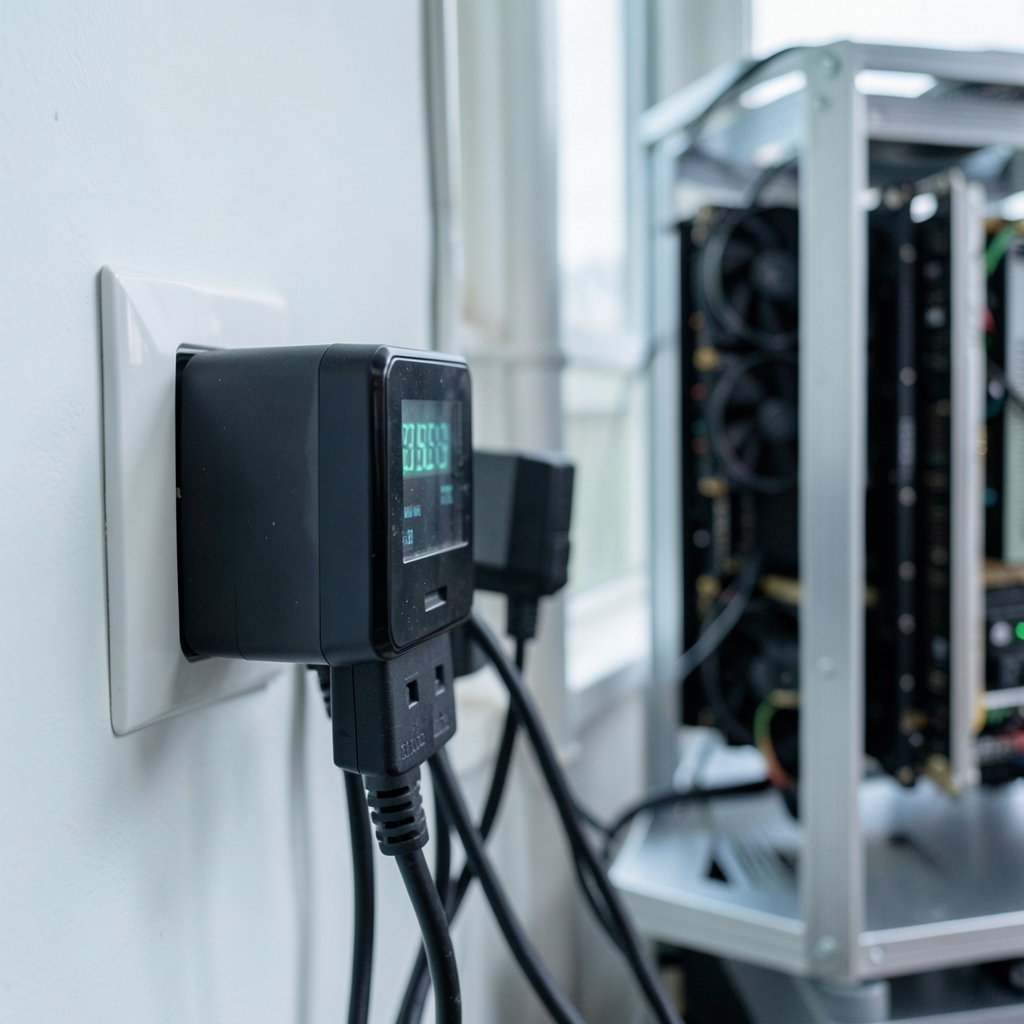
A power supply rated at 90 percent efficiency means every 900 watts delivered to the components costs you 1,000 watts at the meter. Over a month, that gap is real money. The fix is a cheap plug-in power meter. Measure the actual draw at the wall for 24 hours, then enter that figure. It is the highest-value ten dollars a miner can spend.
Tariff Structure: Flat Rate Is a Fiction
Most calculators assume one flat price per kWh. Real bills rarely work that way. Time-of-use pricing charges different rates depending on the hour, which means a rig running around the clock pays a blended rate that no single number captures. Tiered blocks push you into a higher price once you cross a monthly threshold, so the marginal cost of the last hundred kilowatt-hours is higher than the first.
Then there are demand charges, billed on your peak kilowatt draw rather than total consumption. A consumer calculator has no field for this. A commercial miner on a demand-charge tariff can see their effective cost per kWh swing dramatically based on when the rigs all spin up at once. Staggering start times is a practical workaround, but you cannot model it in a tool that only accepts one number.
Hardware Efficiency: Joules per Terahash
For ASIC miners, efficiency is quoted in joules per terahash. A modern machine at around 30 J/TH uses a fraction of the power per unit of hashrate compared with older gear at 100 J/TH. Calculators that let you enter wattage directly handle this fine. Calculators that lock you to a model preset can mislead if your unit is underclocked, overclocked, or simply a different revision than the one in their database.
Undervolting a GPU is the classic example. It cuts power draw and heat while sacrificing a little hashrate, and the efficiency gain is often worth more than the lost speed. A preset-based calculator will never see that tweak. A wattage-based one will.
What the Numbers Cannot Tell You
Even a perfectly calibrated calculator is a snapshot, not a forecast. Electricity is the stable input. Coin price and network difficulty are the volatile ones, and they move the result far more than a cent or two on your power rate.
This is the trap of staring at a daily profit figure. A calculator might show a healthy margin today and a loss next month with zero change to your hardware or your power bill, simply because more miners joined the network or the coin price dropped. Treat every output as a photograph of one moment, not a promise.
The same caution applies to the network side of the equation. Estimates of total network electricity consumption vary widely depending on methodology, which is why researchers publish their assumptions alongside their figures rather than a single headline number.
How to Vet a Calculator in Five Minutes
Before trusting any tool, run this quick audit.
- Check whether the electricity field accepts a decimal rate and whether it is clearly labelled per kWh.
- Look for a pool fee field. If it is missing, the profit figure is overstated.
- See whether you can enter wattage manually rather than picking a preset.
- Find the timestamp on the network difficulty and coin price data. Stale data produces stale answers.
- Test the tool with two wildly different power rates and confirm the output moves by the amount the arithmetic predicts.
If a calculator fails step five, close the tab. That is a basic math check, and failing it means something deeper is broken.
Practical Habits That Beat Any Calculator
The miners who get accurate numbers tend to share a few habits. They measure wall draw with a meter instead of trusting spec sheets. They pull their actual utility bill and calculate a true blended rate, including all fees and taxes, rather than using the advertised rate. They keep a simple log of daily earnings and actual power cost, so they can compare the calculator’s prediction against reality after thirty days.
That last habit is the most underrated. A calculator’s real value is not its prediction. It is how closely its prediction tracks your measured results over time. If the tool is consistently 15 percent optimistic, you now know to discount its output by 15 percent, and you have turned a flawed tool into a reliable one.
Budget-conscious operators also tend to build a small toolkit rather than relying on one site. The same instinct applies across the software stack: people hunting for free low cost technical seo tools alternatives that actually work tend to apply the same scrutiny to every subscription they keep. Miners comparing pipeline management tools alternatives compared across sales platforms for a side business often use the same side-by-side method to evaluate mining dashboards. And anyone weighing best low cost ai coding tools budget conscious developers rely on will recognise the pattern: the cheapest option is rarely the one with the lowest sticker price, it is the one whose hidden costs you have actually counted.
The Regulatory and Tax Layer Calculators Ignore
No profitability calculator accounts for tax. In the United States, mining income is generally treated as taxable, and the rules around digital assets have been clarified and updated over the years. Depending on where you live, there may be special tariffs, moratoriums, or licensing requirements aimed at crypto mining operations. None of that appears in a $/kWh field.
The practical consequence is that a rig showing a slim daily profit can be unprofitable after tax and compliance costs. Miners running at scale should model their after-tax position separately, ideally with professional advice, rather than trusting a dashboard that stops at gross electricity cost.
Which Calculator Should You Use?
There is no single winner, because the right tool depends on what you are trying to decide.
For a quick gut check on whether a coin is worth mining at all, a coin-specific profitability site is fine, provided you override the default power rate with your own measured figure. For tracking a fleet over time, a multi-coin dashboard with manual wattage entry earns its keep. For anything involving a commercial tariff with demand charges, a custom spreadsheet is not optional, because no consumer tool models it.
The honest answer is that the best setup combines two tools: a live calculator for network and price data, and a spreadsheet for your real cost structure. Use the first for the moving parts. Use the second for the parts only you can know.
Conclusion
Mining electricity cost calculators are useful, but they are not oracles. They share a simple formula and diverge mainly in how honestly they handle the inputs, especially power draw and tariff structure. The miners who get accurate answers are the ones who measure their wall draw, calculate a true blended rate from a real bill, and check the calculator’s predictions against thirty days of actual results.
Pick a tool that lets you enter wattage manually and shows a timestamp on its network data. Then do the part no calculator can do for you: verify the numbers against your own meter and your own bill. That combination will beat any default setting every time.
FAQ
What is the formula for mining electricity cost?
Multiply power draw in kilowatts by hours run, then by your price per kWh. A 3,000-watt rig running 24 hours at $0.10 per kWh costs 3 × 24 × 0.10, or $7.20 per day. The formula is simple; the difficulty is getting accurate wattage and tariff inputs.
Why do mining calculators overestimate or underestimate my costs?
Most take a single flat $/kWh figure. Real bills include tiered blocks, time-of-use rates and demand charges on peak kilowatts, none of which a single field captures. Calculators also often use component wattage rather than wall draw, which understates real consumption by the power supply’s inefficiency.
Should I use wall power draw or the spec sheet wattage?
Always use wall draw. A plug-in power meter costs very little and shows what the whole system pulls, including CPU, fans and power supply losses. Spec sheets describe components, not the meter reading your utility bills you on.
Do mining calculators account for taxes and regulations?
No. Tax treatment of mining income and any local rules or special tariffs sit entirely outside these tools. A rig showing a thin daily profit can be unprofitable once tax and compliance costs are included, so model those separately.
How often should I recheck calculator results?
Treat every output as a snapshot. Coin price and network difficulty move constantly, so recheck whenever you are making a hardware or power decision. Comparing predictions against thirty days of measured results tells you how much to trust a given tool.
What is joules per terahash and why does it matter?
It is a measure of how much energy a miner uses per unit of hashrate. Lower is better. A machine at around 30 J/TH uses far less power per unit of hashrate than older gear at 100 J/TH, which is why calculators that accept manual wattage entry beat preset-only tools.




