Have you ever faced a tricky problem that seemed completely impossible until you looked at it from a completely different angle? That is the exact magic behind lateral thinking puzzles, fun challenges designed to disrupt your standard thought patterns and force you to find unconventional answers. Unlike traditional math problems or straightforward trivia, these riddles cannot be solved by moving in a straight line.
At their core, these brain teasers train your mind to stop looking at the obvious path and start exploring hidden possibilities. If you want to sharpen your mind, test your friends, or simply enjoy a great mental workout, mastering these challenges is the perfect way to do it. This guide from Riddlespuzzle covers everything from classic examples to the science behind why they work so powerfully.
What Is Lateral Thinking?
The concept was originally coined by psychologist Edward de Bono back in 1967. He defined it as a clever method of solving problems through indirect and creative approaches — typically by viewing a situation in a new and unusual light. You can explore his original research methodology in Edward de Bono’s original lateral thinking framework, which remains as relevant to creative problem solving today as it was when first published.
While vertical thinking focuses on moving forward step by step with rigid logic, this creative style allows you to jump sideways to find entirely new starting points. Many people struggle with thinking outside the box riddles because our brains are naturally wired to look for patterns based on past experiences. When a riddle presents a scenario, your mind automatically fills in missing details with standard assumptions. The trick to finding the correct solution is identifying those hidden assumptions and questioning them systematically.
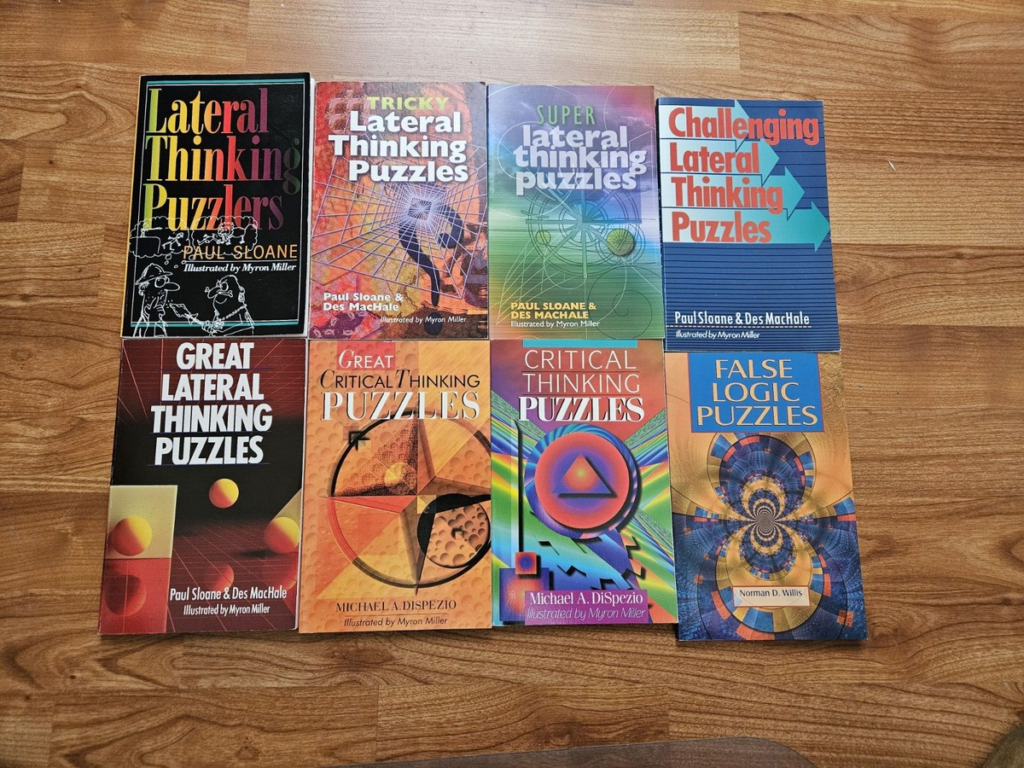
Classic Lateral Thinking Puzzles and Breakdowns
To truly understand how this creative process works, it helps to practice with some classic examples. Below are four famous scenarios that highlight how everyday logic can lead you down the wrong path when tackling lateral thinking puzzles.
The Elevator Dilemma
A man lives on the tenth floor of an apartment building. Every day, he takes the elevator down to the ground floor to go to work or go shopping. When he returns in the evening, he takes the elevator to the seventh floor and walks up the stairs the remaining three flights to his apartment. However, on rainy days, he takes the elevator all the way up to the tenth floor. Why does he do this?
-
The Assumption: Most people assume the man chooses to walk for exercise or that the elevator is broken on certain floors.
-
The Unexpected Reality: The man is a person of short stature. He can only reach the button for the seventh floor on normal days. On rainy days, he carries an umbrella, which he uses to poke the tenth floor button, making this one of the most classic thinking outside the box riddles.
The Two American Drivers
Two Americans were waiting in a long line to cross the border. One was the father of the other person’s son. How were the two people related to each other?
-
The Assumption: People often assume the two individuals must be a father and a son, or two men, which creates a confusing family tree loop.
-
The Unexpected Reality: The two people are the father and the mother of the child. They are husband and wife, offering a perfect example of how unexpected answer riddles trick our brains.
The Fatal Liquid
A man walks into a crowded bar and asks the bartender for a glass of water. The bartender reaches under the counter, pulls out a real gun, and points it directly at the man. The man looks shocked for a second, says thank you, and walks out of the bar completely satisfied. Why did this happen?
-
The Assumption: It seems like the bartender is committing an assault or threatening a customer for no reason.
-
The Unexpected Reality: The man had a severe case of the hiccups. The bartender realized this and used the gun to give the man a sudden scare. The fright cured the hiccups immediately, solving this creative logic puzzle instantly.
Comparing Different Styles of Brain Teasers
Not all mental challenges are created equal. To help you choose the best type of game for your next gathering, the comparison table below breaks down the four most popular puzzle styles by core mechanism, primary goal, and mental skill required.
| Puzzle Category | Core Mechanism | Primary Goal | Mental Skill Required |
| Lateral Thinking Puzzles | Breaking hidden assumptions | Finding a hidden narrative | Creative flexibility |
| Thinking Outside the Box Riddles | Double meanings of words | Solving a linguistic trick | Verbal wordplay |
| Creative Logic Puzzles | Deductive reasoning tracks | Sorting known facts systematically | Step by step analysis |
| Unexpected Answer Riddles | Misdirection within the text | Spotting the clever twist | High situational awareness |
How to Master Creative Logic Puzzles
If you want to become an expert at solving a creative logic puzzle, you need to train yourself to ask specific questions whenever you hear a new scenario. Based on available data regarding cognitive problem solving, experts suggest using a three step framework to break down tough lateral thinking puzzles.
1. Identify the Blind Spots
Write down every single detail given in the prompt, then separate the explicit facts from the details your brain filled in automatically. If a riddle mentions a doctor, did you assume the doctor was male? If it mentions a vehicle, did you assume it was a car on a road? These automatic assumptions are exactly where the solution is usually hiding.
2. Work Backward From the Twist
If the scenario seems physically impossible, try to imagine a specific environment where those exact rules would make perfect sense. Many unexpected answer riddles take place in unusual settings like airplanes, submarine decks, chessboards, or funeral homes rather than normal rooms.
3. Ask Closed Questions
When playing these games in a group, the solver is usually allowed to ask questions that the host can answer with yes, no, or irrelevant. To solve a creative logic puzzle efficiently, focus your questions on the physical properties of the items involved rather than guessing the plot right away. Ask about the weather, the time of day, the professions of the characters, and the physical space.
Why Solving Riddles Is Good for Cognitive Health
Engaging with brain teasers is not just a fun way to pass the time during a road trip or quiet evening. It provides genuine neurological benefits that accumulate over time.
- Regularly practicing with challenging scenarios strengthens synaptic connections in the brain and builds cognitive reserve against age-related decline
- Forcing your mind to reject the first obvious answer through lateral thinking puzzles builds better problem-solving habits that apply to real-world business decisions and creative challenges
- These games are deeply social, they encourage lively discussion, cooperative thinking, and genuine shared laughter when the ridiculous hidden truth is finally revealed
- The mental flexibility gained from consistent puzzle practice improves performance in engineering challenges, creative writing, negotiation, and strategic planning
- Children who regularly engage with age-appropriate puzzles develop stronger metacognitive skills — the ability to think about their own thinking — which supports academic performance
Conclusion
Training your mind to think differently is an ongoing journey that turns regular problem-solving into an exciting and rewarding game. By playing with lateral thinking puzzles, you learn to challenge standard assumptions, look past obvious answers, and discover hidden patterns in situations you would normally dismiss as straightforward.
The next time you face an impossible situation in real life, remember that the solution might just require a sideways jump in perspective, exactly like the best thinking outside the box riddles. For a massive collection of brain teasers, daily challenges, and classic creative logic puzzles to keep your mind sharp, check out riddlepuzzle.com.
Frequently Asked Questions
What is the main difference between a logic puzzle and a lateral thinking puzzle?
A standard logic puzzle gives you all the necessary pieces and requires you to use deductive reasoning to find the answer step by step. A lateral thinking puzzle purposefully hides major pieces of the background story, forcing you to use creative exploration to discover the missing context.
Can anyone learn how to solve thinking outside the box riddles easily?
Yes, anyone can improve their skills with practice. Solving thinking outside the box riddles is a learned behavior rather than an innate talent. The more setups you analyze, the faster your brain will learn to spot common patterns of misdirection and hidden assumptions.
Why are these types of riddles so popular in corporate job interviews?
Many modern companies use lateral thinking puzzles to see how candidates handle ambiguous problems under pressure. Interviewers do not always care if you get the exact answer immediately. They want to watch your thought process, see how you adapt to new hints, and evaluate your ability to solve a creative logic puzzle.
How do I host a fun lateral thinking game night for my friends?
To host a successful game night, choose a list of high quality lateral thinking puzzles where you know the full backstory well. Read the brief scenario to your guests and let them ask you yes or no questions. If the group gets completely stuck, offer a small clue to help them unlock these unexpected answer riddles.
Are unexpected answer riddles suitable for young children?
Many unexpected answer riddles are excellent for children because young minds are naturally creative and less bound by rigid adult assumptions. However, you should ensure the scenarios you choose do not rely on complex adult concepts like insurance fraud or corporate offices so they can enjoy the challenge.