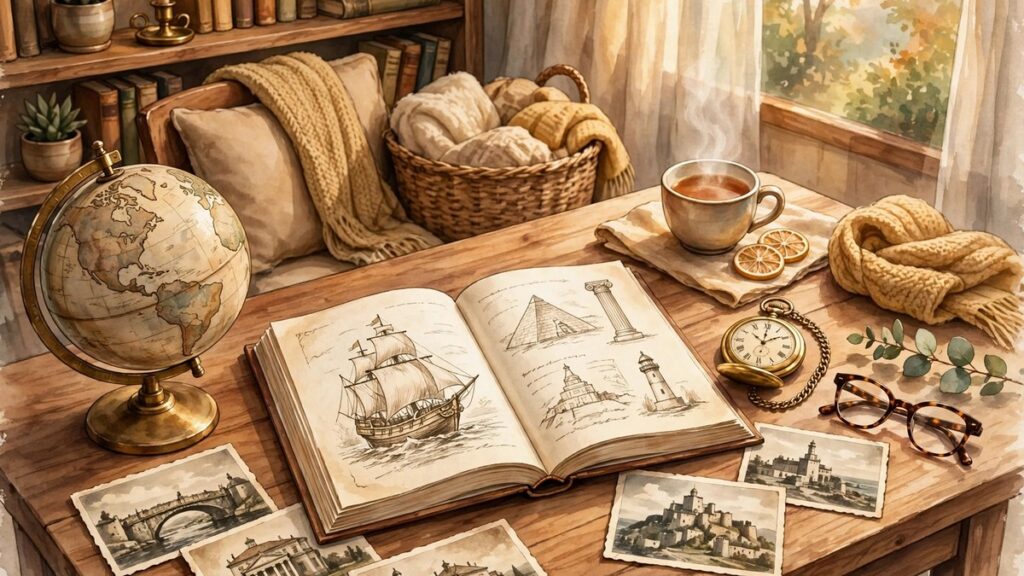
History is full of wonderful stories, and the best part is that many of them are easy to remember once you hear them told the right way. Whether you lived through some of these moments yourself, learned about them at school, or simply enjoy a good story from the past, easy history trivia is a lovely way to keep your mind active, spark a conversation, and share a laugh with friends and family. You do not need to be a historian to enjoy it — you just need curiosity and a love of a good question.
This collection of easy history trivia for seniors has been put together with gentle, friendly questions that most people will recognise. The answers are short, the facts are fascinating, and every question comes with a little extra detail so you can learn something new even when you already know the answer. It works beautifully as a quiet afternoon quiz on your own, a game at a family gathering, or a regular feature at a senior centre, church group, or coffee morning.
Take your time, enjoy each round, and do not worry about getting every answer right. The joy of trivia is in the remembering, the guessing, and the stories that follow each answer. Some questions will bring back happy memories of school days, favourite films, or events you watched unfold on the television. Others may surprise you — and those surprises are often the most fun of all.
Key takeaways
- This quiz includes 44 easy history questions with answers, grouped into five friendly rounds.
- Every question is gentle and suitable for seniors, with a short explanation after each answer.
- The rounds cover ancient history, American history, the twentieth century, famous leaders, and everyday inventions.
- Play alone, in pairs, or in teams — and use the checklist below to run a smooth, relaxed quiz night.
- Keep the answers handy, celebrate every correct guess, and enjoy the stories each question brings back.

How This Easy History Trivia Quiz Works
Each round below has its own theme, so you can play one round at a time or enjoy the whole quiz in a single sitting. Read each question aloud, give everyone a moment to think, and then share the answer together with the little fact that follows it. If you are playing in a group, one point per correct answer works perfectly, and a small prize for the winner — a box of chocolates, a bunch of flowers, or simply the honour of choosing the next quiz — adds to the fun.
| Round | Theme | Questions | Best For |
|---|---|---|---|
| Round 1 | The Ancient World | 1–8 | Warm-up |
| Round 2 | American History | 9–16 | Classic favourites |
| Round 3 | Wars and the Twentieth Century | 17–24 | Living memory |
| Round 4 | Presidents and Famous Leaders | 25–32 | People stories |
| Round 5 | Inventions, Culture, and Everyday Life | 33–44 | Fun surprises |
If you enjoy quizzes like this one, you will also love our easy history trivia questions for adults, which makes a wonderful follow-up round for a mixed-age family quiz night.
Round 1: The Ancient World
1. Which ancient civilisation built the pyramids of Giza?
Answer: The ancient Egyptians. The Great Pyramid of Giza was built around 4,500 years ago as a tomb for Pharaoh Khufu, and it was the tallest human-made structure in the world for more than 3,800 years.
2. What was the name of the famous ship that carried the Greek hero Odysseus home after the Trojan War?
Answer: Odysseus did not have one famous named ship in the way later stories suggest, but his journey home is told in Homer’s Odyssey. The poem is one of the oldest stories still read today, written nearly 3,000 years ago.
3. Which Roman emperor is said to have fiddled while Rome burned?
Answer: Nero. The story is probably a legend — the fiddle had not even been invented yet — but Nero remains one of the most famous, and most talked about, emperors of ancient Rome.
4. What material did the ancient Chinese invent paper from, long before it reached Europe?
Answer: Plant fibres, bark, and rags. Paper was invented in China around 2,000 years ago, and it slowly travelled west along trade routes, changing how people recorded stories, laws, and letters.
5. Which ancient Greek city is known as the birthplace of democracy?
Answer: Athens. Around 2,500 years ago, the citizens of Athens began to vote on their laws and leaders, an idea that still shapes governments around the world today.
6. What were the huge stone statues on Easter Island called?
Answer: Moai. Carved by the Rapa Nui people hundreds of years ago, these giant heads — which actually have bodies buried underground — still watch over the island in the Pacific Ocean.
7. Which wall, built to keep invaders out of China, can be seen from space?
Answer: The Great Wall of China. Built and rebuilt over many centuries, it stretches for more than 13,000 miles, and it is the longest wall in the world.
8. Who was the Queen of Egypt famous for her intelligence, her alliances with Rome, and her dramatic life?
Answer: Cleopatra. She spoke several languages, ruled Egypt for more than twenty years, and her story has inspired plays, films, and books for centuries.
Round 2: American History
9. In which year did the United States declare independence from Britain?
Answer: 1776. The Declaration of Independence was adopted on 4 July 1776, which is why Americans celebrate Independence Day every year on the Fourth of July.
10. Who was the first President of the United States?
Answer: George Washington. He served from 1789 to 1797, and he is often called the Father of His Country for leading the new nation through its earliest years.
11. Which ship brought the Pilgrims to America in 1620?
Answer: The Mayflower. After a difficult voyage of more than two months, the Pilgrims landed at Plymouth, in what is now Massachusetts, and their first harvest is remembered at Thanksgiving.
12. What was the name of the document that freed enslaved people in the Confederate states during the Civil War?
Answer: The Emancipation Proclamation. President Abraham Lincoln issued it in 1863, and it was a major step towards the end of slavery in America.
13. Which famous American bought Louisiana from France in 1803, doubling the size of the United States?
Answer: President Thomas Jefferson. The Louisiana Purchase added a vast stretch of land from the Mississippi River to the Rocky Mountains for about fifteen million dollars.
14. What was the name of the trail that many pioneers followed westward in the 1800s?
Answer: The Oregon Trail. Families travelled for months in covered wagons, covering about 2,000 miles to reach new homes in the West.
15. Which American state was the first to join the Union after the original thirteen?
Answer: Vermont. It became the fourteenth state in 1791, and it was the first state admitted after the original thirteen colonies.
16. What famous speech begins with the words “Four score and seven years ago”?
Answer: The Gettysburg Address. Abraham Lincoln gave this short, powerful speech in 1863, and it remains one of the most famous speeches in American history.
Round 3: Wars and the Twentieth Century
17. In which year did World War II end?
Answer: 1945. The war in Europe ended in May 1945, and the war in the Pacific ended later that year, bringing six long years of conflict to a close.
18. What was the name of the ship that sank on its first voyage in 1912 after hitting an iceberg?
Answer: The Titanic. It was the largest ship of its time, and its story has been told in books and films ever since, including the famous 1997 film.
19. Which country was the first to send a person into space?
Answer: The Soviet Union. Yuri Gagarin orbited the Earth in 1961, and his flight lasted just 108 minutes — but it changed history forever.
20. In which year did humans first walk on the Moon?
Answer: 1969. Neil Armstrong and Buzz Aldrin landed on 20 July 1969, and Armstrong’s words, “That’s one small step for man, one giant leap for mankind,” were heard around the world.
21. What was the Berlin Wall?
Answer: A wall that divided Berlin, and Germany, during the Cold War. It stood from 1961 until it fell in 1989, a moment of great joy that many people still remember watching on television.
22. Which war was fought between the North and the South in America from 1861 to 1865?
Answer: The American Civil War. It was the bloodiest war in American history, and it ended with the Union preserved and slavery abolished.
23. Who was the British Prime Minister for most of World War II?
Answer: Winston Churchill. Famous for his speeches and his determination, he led Britain through the darkest days of the war and is remembered as one of the great leaders of the twentieth century.
24. In which decade did the first television sets become common in American homes?
Answer: The 1950s. Television went from a novelty to a household staple, bringing news, sport, and entertainment into living rooms across the country.
Round 4: Presidents and Famous Leaders
25. Which President is on the American one-dollar bill?
Answer: George Washington. His portrait has appeared on the one-dollar bill since the 1860s, and his image is one of the most recognised in the world.
26. Which President wrote the Declaration of Independence?
Answer: Thomas Jefferson. He was only thirty-three years old when he wrote the draft, and he later served as the third President of the United States.
27. Who was the first woman to win a Nobel Prize?
Answer: Marie Curie. She won the Nobel Prize in Physics in 1903 and the Nobel Prize in Chemistry in 1911, and she remains the only woman to win Nobel Prizes in two different sciences.
28. Which civil rights leader gave the famous “I Have a Dream” speech in 1963?
Answer: Martin Luther King Jr. He gave the speech in Washington, D.C., in front of more than 200,000 people, and it became a defining moment of the civil rights movement.
29. Who was the longest-serving President of the United States?
Answer: Franklin D. Roosevelt. He served four terms, from 1933 until his death in 1945, leading the country through the Great Depression and most of World War II.
30. Which queen ruled Britain for more than seventy years, the longest reign in British history?
Answer: Queen Elizabeth II. She became queen in 1952 and reigned until 2022, guiding the country through decades of enormous change.
31. Who was the first President to live in the White House?
Answer: John Adams. He moved in during 1800, when the building was still unfinished, and his wife Abigail famously hung the washing in the East Room to dry.
32. Which famous leader helped end apartheid in South Africa and became its first Black president?
Answer: Nelson Mandela. After spending twenty-seven years in prison, he was released in 1990 and became president in 1994, winning the Nobel Peace Prize along the way.
Round 5: Inventions, Culture, and Everyday Life
33. Who invented the telephone?
Answer: Alexander Graham Bell. He patented the telephone in 1876, and his first famous words on it were, “Mr. Watson, come here, I want to see you.”
34. Who invented the light bulb that became practical for everyday homes?
Answer: Thomas Edison. His 1879 light bulb burned for more than thirteen hours, and his work soon lit up streets and homes across America.
35. In which year was the first car, the Benz Patent-Motorwagen, built?
Answer: 1885. Karl Benz built the first true automobile, with three wheels and a small petrol engine, and the modern car was born.
36. What was the first food to be sold in a tin can?
Answer: Oysters, fruit, and vegetables were among the earliest canned foods. Canning was developed in the early 1800s to feed soldiers, and it soon changed how families stored food at home.
37. Which famous playwright wrote Romeo and Juliet and Hamlet?
Answer: William Shakespeare. Writing more than 400 years ago, he gave the world some of its most loved plays and many phrases we still use today, such as “break the ice” and “wild-goose chase.”
38. What year did the first modern Olympic Games take place?
Answer: 1896. The games were held in Athens, Greece, with athletes from fourteen countries, and they revived a sporting tradition that began in ancient Greece.
39. Which brothers are credited with the first powered flight in 1903?
Answer: Orville and Wilbur Wright. Their first flight at Kitty Hawk lasted just twelve seconds, but it proved that heavier-than-air flight was possible.
40. Who painted the Mona Lisa?
Answer: Leonardo da Vinci. Painted in the early 1500s, it is now the most visited painting in the world, hanging in the Louvre in Paris.
41. What was the name of the first satellite launched into space in 1957?
Answer: Sputnik 1. Launched by the Soviet Union, its simple beeping signal amazed the world and began the Space Age.
42. Which sweet treat was invented by accident when a chemist tried to make a new soft drink flavour?
Answer: The popsicle — or, in a similar happy accident, the ice cream cone at the 1904 World’s Fair. Many favourite treats began as cheerful mistakes, which makes them all the sweeter.
43. In which year did the first Mickey Mouse cartoon, Steamboat Willie, appear?
Answer: 1928. It was one of the first cartoons with synchronised sound, and Mickey soon became one of the most famous characters in the world.
44. What did the ancient Romans use to build roads that are still standing today?
Answer: Layers of stone, gravel, and concrete. Roman roads were built so well that many are still in use, and the saying “all roads lead to Rome” comes from the great network they created.
For a lighter change of pace after all that history, try our music trivia for seniors — many of the songs will bring back happy memories of dances, radio shows, and family sing-alongs. And if you are playing with grandchildren, our history trivia questions for kids is a lovely way to share what you know with the next generation.
Your Easy History Trivia Checklist
- Choose one round to start with, so nobody feels rushed or overwhelmed.
- Read each question slowly and clearly, and repeat it if anyone asks.
- Keep the answers nearby, but let players guess before you reveal them.
- Give one point per correct answer and keep score on a simple piece of paper.
- Pause after each round for a chat — the stories behind the answers are half the fun.
- End with a small celebration for everyone, winner or not, because playing together is the real prize.
Frequently Asked Questions
Is this history trivia suitable for seniors with no history background?
Yes. Every question is easy, friendly, and based on well-known facts, famous people, and memorable events. The short explanations mean everyone learns something, even if they do not know the answer at first.
How many questions are in this quiz?
There are 44 questions in total, split into five rounds: the ancient world, American history, wars and the twentieth century, famous leaders, and inventions and everyday life.
Can I play this quiz at a senior centre or family gathering?
Absolutely. It works well read aloud to a group, played in teams, or enjoyed quietly on your own. One round at a time is perfect for a regular weekly quiz.
Are the answers included?
Yes, every question comes with its answer and a short, interesting fact, so the quizmaster does not need to look anything up.
Can children play too?
Yes, and they will love it. Older children and teenagers can join in, and the kids’ history trivia linked above is a great companion quiz for younger players.
How can I make the quiz harder or easier?
To make it easier, give a clue with each question or offer two choices. To make it harder, ask players to answer without choices, add a time limit, or ask for the year as well as the answer.
The Bottom Line
Easy history trivia for seniors is more than a quiz — it is a gentle way to revisit the stories that shaped our world, share memories with the people we love, and keep our minds bright and curious. With 44 friendly questions, five themed rounds, and a fact to enjoy after every answer, this collection is ready to play whenever you are. Pick a round, gather your friends or family, and enjoy the journey through history together.
Note: Answers are based on widely accepted historical facts, and a few dates and details can vary slightly between sources. If a question sparks a friendly debate, enjoy the discussion — that is often the best part of any trivia night.


