
Quick Answer: What to check before using home Bitcoin miners?
Before plugging in a home Bitcoin miner, check the noise level, the heat it dumps into the room, and whether your electrical circuit can carry a continuous 24/7 load. Those three physical realities decide whether the machine is workable in a house at all, long before profit enters the picture.
A miner is not like a gaming PC that idles between sessions. It runs flat out, day and night, converting nearly every watt it draws into heat and fan noise. That makes it closer to a space heater that also happens to earn money.
The key factors to compare are noise in decibels, heat output versus your room’s ventilation, circuit amperage and continuous-load limits, electricity cost per kWh, miner efficiency in J/TH, firmware and security, warranty and resale terms, and local rules on noise, zoning, and tax.
A home miner can make sense, but only when the boring checks come first. Most disappointed buyers skipped one of them and discovered the problem after the box was already humming in a spare bedroom. The sections below walk through each check in the order that saves the most money and the most household peace.
Why the Physical Checks Come Before the Profit Math
Plenty of people start with a profitability calculator. That is backwards. A calculator will happily tell you a miner earns a few dollars a day while saying nothing about the fact that it sounds like a vacuum cleaner that never switches off.
Physical constraints are fixed. Profit is not. Network difficulty adjusts roughly every 2,016 blocks, which works out to about two weeks, and hashprice swings constantly. Any break-even number is a snapshot of a moving target, so treat it as a rough sketch rather than a promise.
The practical order is simple: can your home physically host the machine, can your wiring safely power it, and only then, does the economics work at your electricity rate? Skipping ahead is the single most common mistake in this hobby.
Check the Noise Before Anything Else
Air-cooled ASIC miners are loud. Commonly cited figures land around 70 to 80 dB at close range, which is in vacuum-cleaner territory or louder. Exact numbers vary by model and fan setting, so check the manufacturer’s datasheet for the specific unit rather than trusting a general figure.
For context on what those numbers mean for hearing and daily comfort, public-health noise guidance is a useful reference point. A garage, basement, or detached shed absorbs far more sound than a bedroom closet. Solid-core doors, insulation board, and rubber mounting feet help at the margins, but they do not turn a loud miner into a silent one.
Here is the mistake almost everyone makes: they test the miner for ten minutes, decide it is tolerable, and then discover after a week that the constant whine has worn down everyone in the house. Run it for a full day before committing to a permanent location. If you share walls with neighbors, think about how far that sound carries at 2 a.m.
Heat Is Not a Side Effect, It Is the Whole Load
A miner drawing roughly 3,000 W behaves like a 3,000 W space heater in the room. That is not a quirk of the hardware; it is energy conservation. Almost every joule that goes in comes out as heat.
In winter, that can be genuinely useful, and some hobbyists deliberately heat a workshop or garage this way. In summer, it means your air conditioning fights the miner all season. A small room with a closed door will climb in temperature fast, and sustained heat shortens the life of the hardware itself.
Ventilation matters as much as raw airflow. Pulling cool air from one space and dumping hot air into another only moves the problem unless the hot air actually leaves the building. Before buying, ask where the exhaust goes, whether the room has any path for fresh air, and what happens on the hottest week of the year.
Electrical Load: The Check That Prevents Fires
A miner is a continuous-duty load, running 24/7 in a way that most household appliances never do. In the United States, the National Electrical Code generally limits continuous loads to 80% of a circuit’s rating. Code adoption varies by jurisdiction and editions update on a roughly three-year cycle, so confirm what applies where you live.
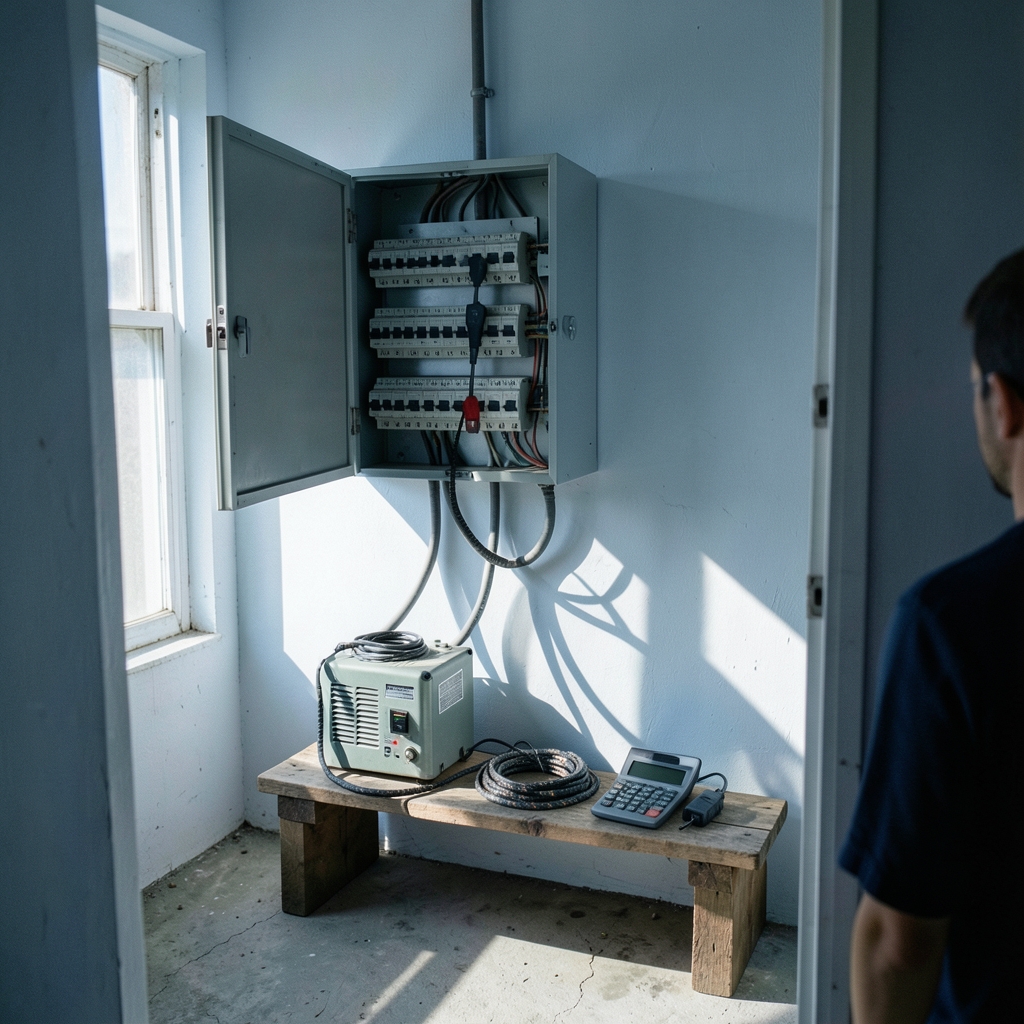
Do the arithmetic before you buy. A 3,000 W miner on a 120 V circuit draws about 25 amps, which is more than a standard 15 A or 20 A household circuit can carry continuously. That points toward a dedicated 240 V circuit installed by a licensed electrician, not a daisy-chained power strip.
| Check | What to Confirm | Why It Matters |
|---|---|---|
| Circuit rating | Dedicated circuit, correct amperage | Continuous loads are capped at 80% of rating |
| Voltage | 240 V where the miner supports it | Lower current for the same wattage |
| Breaker and wiring | Sized for the load, no shared outlets | Prevents overheating and nuisance trips |
| Plug and PSU | Correct connectors, quality power supply | Cheap adapters are a common failure point |
| HVAC capacity | Room can shed the heat | Heat buildup damages hardware |
A related trap: adding a second miner because the first one worked fine. Two units can push a circuit past its limit even when each one alone seemed acceptable. Leave headroom.
Efficiency Specs: Read J/TH Alongside Hash Rate
Hash rate gets the headlines, but efficiency in joules per terahash (J/TH) decides your power bill. Lower is better. A miner rated at 3,000 W and 100 TH/s runs at 30 J/TH; a newer unit with the same hash rate at a lower wattage beats it on running cost every hour of every day.
Nameplate efficiency is also optimistic. Real-world figures are worse because of power supply losses and high ambient temperatures. If a room runs hot, the miner draws more power for the same work, and the gap between the datasheet and reality widens.
This is the same discipline that pays off when comparing any hardware purchase on specs rather than marketing. If you enjoy that kind of side-by-side analysis, the approach in this breakdown of AI music tools features compare before you commit transfers neatly: list the numbers that actually affect cost of ownership, then compare like for like.
Electricity Cost Decides Whether It Earns Anything
Profitability comes down to your cost per kWh against the miner’s efficiency and the current network economics. Cheap hydro power and expensive urban retail rates produce completely different outcomes from the identical machine.
Check your utility’s rate structure before assuming a flat price. Time-of-use rates, demand charges, and rules about large residential loads are common, and a miner running around the clock may land in the most expensive tier. A tariff built for a normal household can behave badly when a constant multi-kilowatt load appears.
Then run the numbers honestly. Take your real rate, multiply by the miner’s actual wattage, and subtract that from a conservative revenue estimate. If the margin only works at today’s hashprice and today’s difficulty, it does not work. Both move.
Firmware, Security, and the Risk of Third-Party Code
Miners run firmware, and firmware can be outdated. Check for official updates from the manufacturer and apply them. Be cautious with third-party firmware: it can void warranties, and in documented cases modified firmware has redirected mining rewards away from the operator.
Basic hygiene goes a long way. Change default passwords, keep the miner on a separate network segment if you can, and check the payout address in your pool configuration regularly. A miner is a small computer with a wallet attached, and it deserves the same suspicion you would give any always-on device.
Warranty, Condition, and Resale Reality
Read the warranty terms closely. Does it cover the hash boards, or only the controller? Is the unit new, refurbished, or pulled from a farm? Refurbished units can be good value, but only when the seller is clear about condition and offers a real return window.
Expect resale value to fall. ASIC prices depreciate quickly as newer generations ship, which is a well-known market pattern rather than a fixed rule. Buy a miner as a tool with a working life, not as an asset that holds value.
Rules, Taxes, and Neighbors
Mining legality, noise ordinances, and zoning rules differ by country and locality. Some areas restrict home businesses or impose sound limits that a loud ASIC will breach. A quick call to local authorities costs nothing and prevents an expensive surprise.
Tax treatment varies too. In the United States, mined cryptocurrency is generally treated as income at fair market value when received, a position set out in IRS guidance from 2014. Confirm the current rules where you live, since guidance gets updated.
A Sensible Way to Start Small
If the checks above pass, start with one unit and one month of measurement. Track actual power draw with a meter, log the room temperature, and note how the household reacts to the noise. Then decide whether a second machine makes sense.
The same “test before you scale” mindset shows up in plenty of home projects, from building a puzzle room to crafting your own games. If you like the idea of a hands-on project that does not draw 3,000 watts, browsing creative DIY puzzle crafts you can make at home is a calmer way to spend a weekend, and the home craft ideas archive has more of the same.
Conclusion
Home Bitcoin mining is a physical hobby before it is a financial one. Noise, heat, and electrical capacity decide whether a machine belongs in your house at all. Efficiency, electricity rates, firmware hygiene, warranty terms, and local rules decide whether it is worth keeping.
Do the checks in that order. Measure the noise for a full day, map where the heat goes, confirm the circuit can carry a continuous load, and run the math at your real tariff with room for difficulty to move against you. If every answer holds up, a home miner can be a genuinely interesting project. If any one of them fails, the machine will find that weakness within a week, and it will not be subtle about it.
FAQ
How loud is a home Bitcoin miner in practice?
Air-cooled ASIC miners commonly land around 70 to 80 dB at close range, comparable to a vacuum cleaner or louder. The exact figure depends on the model and fan speed, so check the datasheet for the specific unit. In practice, most people find that a garage, basement, or shed is the only tolerable location inside a lived-in home.
Can a normal household outlet power a miner?
Usually not for full-size units. A miner drawing around 3,000 W pulls roughly 25 amps at 120 V, well beyond a standard 15 A or 20 A circuit, especially given the 80% continuous-load limit. Most installations need a dedicated 240 V circuit installed by a licensed electrician.
Does a Bitcoin miner really heat the room as much as a heater?
Yes. A miner drawing about 3,000 W behaves like a 3,000 W space heater, because nearly all the electrical energy becomes heat. That is useful in a cold workshop and a real burden in summer, when air conditioning has to remove every watt the miner produces.
What efficiency number should I look for?
Look at joules per terahash (J/TH), where lower is better. Compare the figure against your electricity rate rather than in isolation, and expect real-world efficiency to be worse than the nameplate because of power supply losses and hot ambient air.
Is third-party miner firmware worth the risk?
Often not. Third-party firmware can void the warranty, and in documented cases modified firmware has redirected mining rewards. Official manufacturer updates are the safer default, paired with changed default passwords and a payout address you check regularly.
How long before a home miner pays for itself?
There is no fixed answer. Payback depends on your cost per kWh, the miner’s efficiency, and network conditions that shift as difficulty adjusts roughly every two weeks and hashprice moves. Any payback figure is a snapshot, so treat short estimates with suspicion and plan for the hardware to lose resale value quickly.




