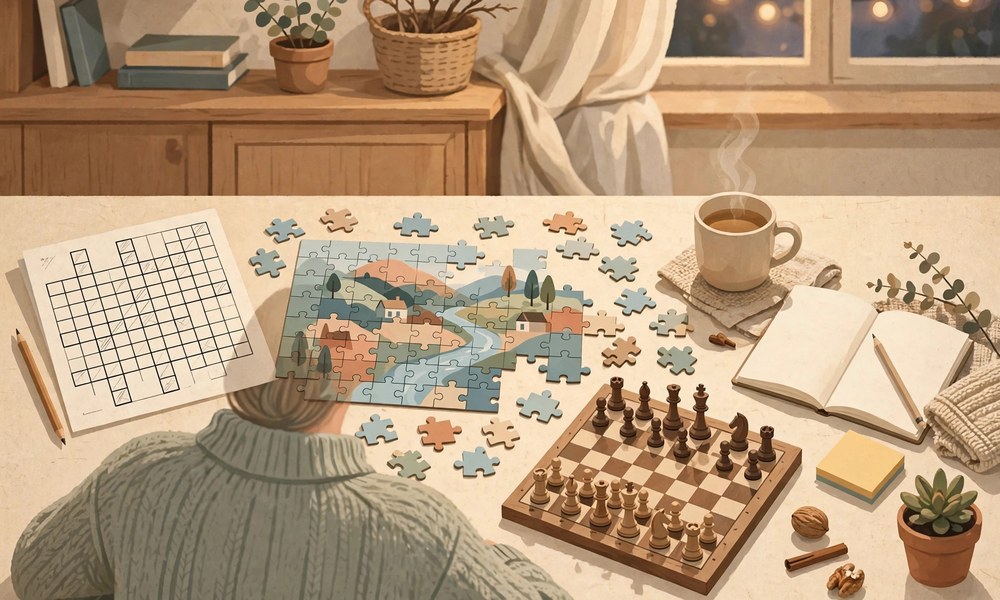
Your brain loves a good workout, and training it can be genuinely fun. Brain training games for adults are puzzles, word games, memory challenges and strategy battles that keep your mind sharp. Whether you have five minutes on your lunch break or a quiet hour in the evening, there is a game here for you.
Scientists have long known that the brain stays flexible throughout life, a quality called neuroplasticity. When you challenge yourself with a new puzzle, a tricky word game or a memory test, you build and strengthen connections between brain cells. The key is variety: mixing word, number, memory and strategy games works far more of your brain.
In this guide you will find 60 original brain training games for adults, each with a puzzle to try and an answer to check. Play alone, with a partner, or as a friendly competition. If you enjoy digital play, the best brain training apps are a great companion to the games below. For a bigger challenge, try our funny brain teasers for adults, and test your logic with hard logic puzzles for adults. Grab a notebook.
Key takeaways
- Sixty original games across six categories give memory, logic, language, spatial skills, strategy and attention a balanced workout.
- Just ten to fifteen minutes of brain games a day builds a lasting habit and sharper focus within weeks.
- Variety matters more than difficulty: mixing game types trains more of your brain than repeating one type.
- Every game includes an answer, so you can play solo and track which skills improve fastest.
- Pairing pen-and-paper puzzles with apps and board games keeps training fun and social.
Word and Language Games
Try these ten games, each with a puzzle to solve and an answer to check.
1. Anagram Sprint. Unscramble LISTEN into as many real words as you can in two minutes. How many can you find? Answer: Listen, silent, enlist, tinsel, inlets and lines all use the same seven letters.
2. Word Ladder Challenge. Turn COLD into WARM in four steps, changing one letter at a time to make a real word each step. Answer: COLD, CORD, WORD, WARD, WARM. Each step changes a single letter only.
3. Hidden Animal Hunt. Find the animal hiding in each phrase: the cat ate the rat, I saw a bear, the dog barked. Answer: Rat hides in cat ate the rat, bear hides in saw a bear, and dog is in plain sight.
4. Vowel Drop. Remove all vowels from BRAIN TRAINING. Now do the same with CHOCOLATE CAKE. Which is easier to guess? Answer: BRN TRNNG and CHCLT CK. Chocolate cake is easier because its consonants are more distinctive.
5. Alphabet Order. Sort these words alphabetically: zebra, apple, mango, banana, kiwi. Which comes first? Answer: Apple, banana, kiwi, mango, zebra. Sort by first letter, then second.
6. Rhyming Pairs. Name a word that rhymes with brain, puzzle, memory, focus and clever. No word twice. Answer: Train, muzzle, emery, hocus and ever. Rhyming searches your brain’s sound library.
7. Palindrome Hunt. What is the palindrome in: Was it a car or a cat I saw? Name three single-word palindromes. Answer: The whole sentence reads the same backwards. Madam, level and racecar are palindromes too.
8. Missing Letter. Fill in the missing letter: BR_N, PU_LE, ME_RY, FO_S, GA_S. What are the five words? Answer: Brain, puzzle, memory, focus and games. Filling gaps trains pattern completion.
9. Synonym Sprint. Give a synonym for happy, quick, smart, strong and calm in thirty seconds. Answer: Joyful, fast, clever, mighty and peaceful. Then try antonyms: sad, slow, dull, weak, tense.
10. Sentence Builder. Use the letters B, R, A, I, N to start five words that make a sensible sentence. Answer: Brave runners arrive in Norway. Big red apples inspire nutrition. Both follow the rule.
Number and Logic Games
Try these ten games, each with a puzzle to solve and an answer to check.
1. Sequence Detective. What comes next: 2, 6, 12, 20, 30? Look at the gaps between the numbers. Answer: 42. The gaps are 4, 6, 8, 10, so the next gap is 12, and 30 plus 12 is 42.
2. Odd One Out. Which number does not belong: 3, 7, 11, 15, 19, 23? Explain your reasoning. Answer: 15, the only number that is not prime. The rest, 3, 7, 11, 19 and 23, are all prime.
3. Magic Square. Arrange 1 to 9 in a three-by-three grid so every row, column and diagonal adds to 15. What sits in the centre? Answer: 5. One solution is 8, 1, 6 on top, 3, 5, 7 in the middle, and 4, 9, 2 below.
4. Missing Number. In the series 5, 10, 20, 40, what comes next? Now try 1, 1, 2, 3, 5, 8. Answer: 80, because each number doubles. The second series is Fibonacci, so 13 comes next.
5. Age Riddle. A father is three times as old as his son. In twelve years he will be twice as old. How old is the son? Answer: The son is 12 and the father is 36. In twelve years they will be 24 and 48.
6. Coin Logic. You have two coins totalling 30 cents, and one of them is not a nickel. What are they? Answer: A quarter and a nickel. The quarter is the coin that is not a nickel.
7. Clock Angles. When do the hands of a clock first overlap after 1 o’clock? Answer to the nearest minute. Answer: About 1:05. The hands overlap roughly every 65 minutes.
8. River Crossing. A farmer must carry a fox, a chicken and grain across a river, one item at a time. How? Answer: Chicken over, return alone, fox over, chicken back, grain over, return alone, chicken over.
9. Light Switch Logic. Three switches outside control three bulbs inside, and you may enter the room once. How do you match them? Answer: Turn one on for five minutes, then off, then turn a second on. The lit bulb is the second switch, the warm dark bulb the first, the cold dark bulb the third.
10. Number Pyramid. Each brick is the sum of the two below it. If the bottom row is 2, 3, 5, what is at the top? Answer: The middle row is 5 and 8, and the top is 13.
Memory Games
Try these ten games, each with a puzzle to solve and an answer to check.
1. Shopping List Recall. Read this list once, cover it, then write it down: milk, bread, eggs, apples, coffee, cheese, rice. Answer: Five or more is strong. Chunking into breakfast and pantry items helps.
2. Face Name Match. Memorise five people and jobs: Ana the baker, Ben the teacher, Cara the doctor, Dan the pilot, Eve the lawyer. Answer: Ana bakes, Ben teaches, Cara heals, Dan flies and Eve argues cases. Link each name to a vivid image.
3. Story Chain. Start a story with one sentence, then add a sentence beginning with the last word of the previous one. Keep going for ten sentences. Answer: Any chain following the rule works, for example: The dog ran. Ran to the park. Park was busy.
4. Digit Span. Read 7, 2, 9, 4, 1, 8, 3 once, then repeat them backwards without looking. Answer: Backwards they are 3, 8, 1, 4, 9, 2, 7. Grouping them as 729, 418, 3 makes it easier.
5. Room Scan. Look around your room for thirty seconds, close your eyes, and list ten objects you saw. Answer: Most people recall six to eight correctly. Naming objects aloud improves the score.
6. Word Pairs. Memorise these pairs: sun and moon, cat and dog, book and pen, rain and cloud, fire and ice. Answer: Sun pairs with moon, cat with dog, book with pen, rain with cloud, fire with ice.
7. Song Lyrics Recall. Recite the first verse of a song you have not heard in years, then check the real lyrics. Answer: Most people recall the chorus far better than the verse, because repetition strengthens memory.
8. Phone Number Challenge. Memorise a ten-digit phone number by splitting it into three chunks, then recall it after five minutes. Answer: Chunking into three groups, such as 555, 123, 4567, works far better than ten single digits.
9. Picture Memory. Study a photo for one minute, then list everything in it from memory: people, colours, objects and background. Answer: Twelve or more details is excellent. Background details separate good visual memory from average.
10. Yesterday Recall. Write down everything you did yesterday, hour by hour, without checking your phone or calendar. Answer: Most adults can fill in eight to ten hours. Gaps usually appear in the afternoon.
Visual and Spatial Puzzles
Try these ten games, each with a puzzle to solve and an answer to check.
1. Jigsaw Sprint. A 500-piece jigsaw has corner and edge pieces. Roughly how many edge pieces should it have? Answer: Roughly 72 to 76, depending on the cut. Sorting edges first gives you the frame.
2. Maze Runner. Draw a simple maze, then solve it with your non-dominant hand. Does it feel harder? Answer: Yes, because your non-dominant hand needs more conscious control. That extra effort is the workout.
3. Spot the Difference. Find five differences between two nearly identical pictures in under three minutes. What do you miss first? Answer: Small background details, like a missing button or a changed shadow, are missed first.
4. Tangram Challenge. Using seven tangram pieces, make a square, then a cat, then a house. Which is hardest? Answer: The cat is usually hardest because its ears need precise angles. Rotating pieces mentally helps.
5. Cube Counting. Imagine a cube made of 27 small cubes, three on each side. How many small cubes have paint on exactly two faces? Answer: 12. The edge cubes that are not corners each have two painted faces, and a cube has twelve edges.
6. Mirror Writing. Write your name backwards so it reads correctly in a mirror. Now write a whole sentence that way. Answer: Most people need ten to fifteen minutes of practice to write a short sentence fluently.
7. Shadow Match. Look at five objects and their shadows, then match each object to the correct shadow. Answer: Outlines and distinctive bumps help fastest. Matching shadows trains recognising shapes from partial information.
8. Map Memory. Study a simple map for one minute, then draw it from memory, including three landmarks and two roads. Answer: Most sketches get the landmarks right but distort distances. Drawing from memory strengthens spatial memory.
9. Pattern Blocks. Continue this pattern: circle, square, triangle, circle, square, triangle. What comes next? Answer: Triangle comes next, then circle. Repeating patterns are easy once spotted.
10. Origami Fold. Fold a square of paper into a crane, a boat and a hat from memory. Which folds do you forget first? Answer: The middle folds are forgotten first, because beginnings and endings stick best.
Strategy Board and Card Games
Try these ten games, each with a puzzle to solve and an answer to check.
1. Chess Puzzle. In chess, a knight on e4 attacks how many squares, and which piece is worth nine points? Answer: A knight on e4 attacks eight squares, and the queen is worth nine points.
2. Sudoku Sprint. Complete a medium Sudoku grid in under fifteen minutes. What strategy helps most? Answer: Scanning for the number that can only go in one place in a box works best.
3. Crossword Challenge. Solve a crossword without looking up any answers. Do across or down clues help you more? Answer: Across clues usually help first, because longer answers give more crossing letters.
4. Scrabble Strategy. In Scrabble, which two-letter words are worth learning first, and why is Q so tricky without a U? Answer: Learn AA, AB, AD, AE, AG, AH, AI, AL, AM, AN and AR first. QI and QAT are valuable exceptions.
5. Checkers Tactics. In checkers, how many pieces does each player start with, and what happens at the far side? Answer: Each player starts with twelve pieces. Reaching the far side crowns the piece as a king.
6. Card Memory Match. Lay out sixteen cards face down in pairs and match them. How many turns does it take? Answer: Most people need twelve to twenty turns. Remembering positions is the key skill.
7. Solitaire Logic. Play Klondike solitaire and count your moves. Which pile should you empty first? Answer: Emptying a column early matters because it frees a space for a king.
8. Domino Maths. Using dominoes, make a chain where touching ends always add to seven. How long can your chain get? Answer: A chain of ten or more dominoes is a strong result from a standard double-six set.
9. Backgammon Basics. In backgammon, how many checkers does each player have, and what is the goal? Answer: Each player has fifteen checkers, and the goal is to move them all off the board first.
10. Go for Beginners. In Go, what is the aim, and how does capturing stones work? Try a small nine-by-nine board. Answer: The aim is to surround more territory. Capturing works by surrounding enemy stones so they have no empty points left.
Speed and Attention Games
Try these ten games, each with a puzzle to solve and an answer to check.
1. Stroop Test. Read the word RED printed in blue ink, and say the ink colour, not the word. Try ten in a row. Answer: Saying blue when the word says red is hard, because reading is automatic. The Stroop test measures attention.
2. Reaction Timer. Test your reaction time by catching a dropped ruler. What is your average in milliseconds? Answer: Most adults average 200 to 250 milliseconds. Reaction time improves with practice and sleep.
3. Counting Backwards. Count backwards from 100 in sevens: 100, 93, 86, 79. How far can you get without an error? Answer: 100, 93, 86, 79, 72, 65, 58, 51, 44, 37, 30, 23, 16, 9, 2.
4. Dual Task Challenge. Walk around your home while counting backwards from 50 in threes. Does your walking slow down? Answer: Walking usually slows down, because attention is shared between two tasks.
5. Word Search Sprint. Find ten hidden words in a word search grid in under five minutes. What is the fastest way to scan? Answer: Hunting for unusual letters like Q, X and Z first is faster. Word searches train visual scanning.
6. Odd Word Out. In each group, find the word that does not belong: apple, banana, carrot, grape. Answer: Carrot, because it is a vegetable, not a fruit. Making your own groups trains categorisation.
7. Letter Counting. Count how many times the letter E appears in: Elephants eat enormous ears of corn every evening. Answer: Eleven times. Counting letters forces slow, careful reading, the opposite of skimming.
8. Focus Timer. Work on a puzzle for twenty-five minutes without checking your phone, then take a five-minute break. Answer: Most people finish about a third more in a focused block.
9. Name That Tune. Hum the first three notes of five favourite songs and see if a friend can name them. Answer: Songs with a distinctive opening are recognised fastest.
10. Rapid Recall. Name ten animals in ten seconds, then ten countries, then ten foods. Which list is hardest? Answer: Countries are usually hardest. Foods flow faster because the words are well practised.
How to Choose the Right Brain Game
Use this table to pick a game that matches the skill you want to sharpen today.
| Game type | Main skill trained | Best time to play | Difficulty |
|---|---|---|---|
| Word and language games | Vocabulary and verbal fluency | Morning coffee | Easy to medium |
| Number and logic games | Reasoning and problem solving | Lunch break | Medium to hard |
| Memory games | Short-term and working memory | Any quiet moment | Easy to hard |
| Visual and spatial puzzles | Spatial reasoning | Evening wind-down | Medium |
| Strategy board and card games | Planning and patience | Weekend with friends | Medium to hard |
| Speed and attention games | Focus and reaction time | Short breaks | Easy to medium |
Your Brain Training Checklist
Use this checklist to turn brain games into a habit that sticks.
- Pick one game category for each day of the week.
- Set a timer for ten to fifteen minutes and play without checking your phone.
- Write down your scores so you can see which games improve fastest.
- Try one game that feels hard every week.
- Play at least one game with a friend or family member.
- Review your answers honestly and celebrate small wins.
Frequently Asked Questions
Do brain training games really work for adults?
Yes, regular mental challenge supports memory, attention and problem solving when you vary the games and practise consistently. Games keep your mind active and engaged.
How long should I play brain games each day?
Ten to fifteen minutes a day is a great starting point. Short, focused sessions beat occasional marathons.
Are pen-and-paper games as good as brain training apps?
Both have value. Pen-and-paper games build patience and deep focus, while apps add variety and progress tracking.
Which brain games are best for memory?
Memory games in this guide, such as shopping list recall and digit span, target memory directly.
Can brain games help with focus and concentration?
Yes, games like the Stroop test and counting backwards train attention directly. Practising focus in short bursts builds concentration.
What if a game feels too hard for me?
Start with the easier games in each section. Every answer is included so you can learn the pattern and retry later.
The Bottom Line
Brain training games for adults work best when they are fun, varied and regular. These sixty games cover words, numbers, memory, visual puzzles, strategy and speed. Start with ten minutes a day and rotate through the six categories.
Note: These games are for entertainment and general mental exercise, not medical treatment. If you have concerns about memory or thinking, speak to a qualified health professional.