
Word games for 367 players sound impossible until you change the shape of the game. Nobody expects 367 people to crowd around one board, take turns one at a time, and stay interested for two hours. That is not a game night. That is a queue. The trick is to stop thinking of 367 as one giant group and start thinking of it as a range, from 3 players in a living room to 367 players in a hall, a school, a conference centre, or a whole community event. Once you frame it that way, word games become one of the easiest kinds of game to scale, because words need almost no equipment, almost no space per player, and no physical skill at all.
The number 367 is a useful test case because it is awkward. It is a prime number, so it does not split into neat equal teams, and that awkwardness forces good planning. Sixty-one teams of six gives you 366 players, plus one host, judge, or scorekeeper to make 367. Seventy-three teams of five gives you 365 players, plus two hosts. Six stations of 61 players gives you 366, plus one floater who covers breaks. Every one of those splits works, and every one of them keeps the game moving at the same time, in parallel, instead of in a single slow line. That is the whole secret of big-group word games: parallel play, shared puzzles, and a scoring system that lets hundreds of people compete without waiting for each other.
This guide covers the formats that actually work at that scale, the six word games best suited to a huge group, a sample schedule for a two-hour event, the equipment list, and the mistakes that turn a promising evening into a confused crowd. Whether you are planning a school event, a corporate social, a community fundraiser, or a tournament for a word-game club, the same principles apply. Keep the rules simple enough to explain in two minutes, keep every player busy at the same time, and keep the scoring visible so the room can feel the competition build.
Key takeaways
- Frame 367 as a range from 3 to 367 players, and scale with teams, stations, and tournaments rather than one giant game.
- 367 is prime, so use 61 teams of six plus one host, or 73 teams of five plus two hosts, to give every player a place.
- Run games in parallel so nobody waits: simultaneous boards, shared puzzles, and timed rounds beat turn-by-turn play.
- Pick games with simple rules, cheap equipment, and visible scoring, such as Scrabble-style boards, Bananagrams sprints, crossword relays, and word search races.
- One clear host, one visible clock, and one scoreboard matter more than fancy equipment at this size.
Why Word Games Scale Better Than Most Games
Most party games break down as numbers grow. Physical games need space and safety planning. Trivia games need a quiet room and a sound system that reaches the back row. Board games built for four players need dozens of copies and dozens of tables. Word games have a structural advantage: the core activity is thinking of words, and thinking scales. A crossword printed on a sheet of paper works for one person or for a team of six gathered around it. A word search works the same way. An anagram list can be handed to 367 people at once, and all 367 can start at the same moment.
Word games also need very little equipment per player. A pack of letter tiles, a printed puzzle sheet, a pencil, and a timer will run most of the formats in this guide. There is no need for expensive boards for every table, because many formats use paper puzzles instead of boards. Where boards are used, one board per team of four to six is enough, which means about 61 boards for a full 367-player event, and most clubs, schools, and libraries can borrow or hire that many. Compare that with a game that needs one set per player, and the cost difference is obvious.
The Maths of 367 Players
Sixty-one teams of six
Sixty-one teams of six is the cleanest split for a team event. Each team sits at its own table or station, plays the same puzzle at the same time, and submits one answer sheet per round. Six is a good team size for word games: large enough that everyone can contribute, small enough that nobody hides. With 61 teams, you need 61 tables or table spaces, 61 answer sheets per round, and a scoring team of at least three people to mark quickly between rounds. Team names help enormously at this scale, because calling out a team name is faster and friendlier than calling out a table number.
Seventy-three teams of five
Seventy-three teams of five works better when tables are small or when you want faster discussion inside each team. Five people can all see the same puzzle sheet without leaning across each other, and decisions come faster. The trade-off is more teams to manage: 73 answer sheets per round instead of 61, and a longer results list to read out. If you choose this split, keep the two spare places for hosts or scorers, and give each team a coloured wristband or table card so scorers can sort sheets fast.
Stations and divisions
Stations are the best option when the room is large and you want movement. Set up six stations with 61 players at each, and rotate teams through a different word game at every station. Each station runs for fifteen minutes, then a bell moves everyone on. Six stations times fifteen minutes is ninety minutes of play, plus a welcome and a final. Divisions work the other way: split the room into three divisions of about 122 players, run the same games in each division, and bring the division winners together for a final. Divisions are useful when you have three rooms or three halls, or when you want three separate winners and a grand final.
Word Games for 367 Players at a Glance
| Game | Best group size | Time per round | Equipment per team | Why it scales |
|---|---|---|---|---|
| Scrabble-style boards | 4 to 6 per board | 20 minutes | 1 board, tiles, score sheet | 61 boards run at once |
| Bananagrams sprint | 4 to 6 per table | 10 minutes | 1 tile pouch per table | Fast, noisy, simultaneous |
| Crossword relay | 5 to 6 per team | 15 minutes | 1 printed crossword, pencils | Same puzzle for all teams |
| Word search race | Any team size | 10 minutes | 1 printed sheet per player | Everyone starts together |
| Codenames-style clues | 5 to 6 per team | 20 minutes | 1 word grid per table | Team discussion, big drama |
| Anagram ladder | Any team size | 15 minutes | 1 answer sheet per team | Cheap, fast to score |
Six Word Games That Work for 367 Players
1. Scrabble-style tournament boards
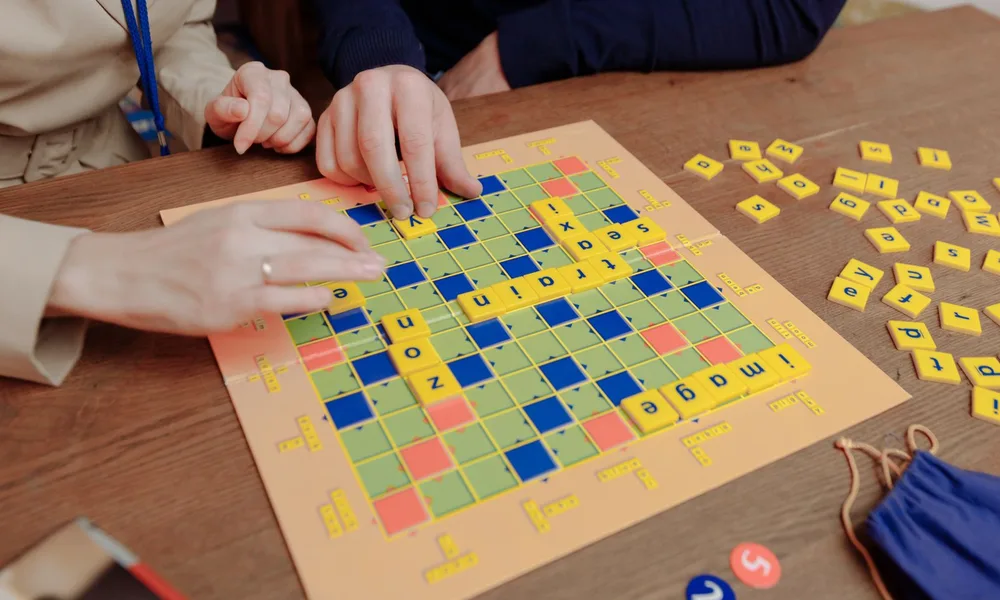
The practical details matter. Use a visible countdown clock so every table finishes together. Appoint one dictionary judge per ten tables, or one central judge with a printed word list, so disputes are settled fast. Keep a simple rule: if a word is challenged and found in the agreed dictionary, it stands, and play continues. Do not let one argument hold up sixty tables. If you are short of boards, run this format in two heats of about 30 tables each, with the top teams from each heat meeting in a final. Players who have tried the smaller version will recognise the format from earlier events, including the word games for 365 players guide, where the same tournament structure was used with 73 teams of five.
2. Bananagrams sprint
Bananagrams is a speed game: players race to build a crossword grid from letter tiles, shouting for more tiles as they go. In a big-group version, each table of four to six players works as one team, building a single shared grid against the clock. Give each table a pouch of tiles, start the timer, and let the room fill with the sound of tiles being flipped and rearranged. Ten minutes is enough for a sprint round, and three sprint rounds with different tile counts make a satisfying event.
3. Crossword relay
A crossword relay turns a quiet solo puzzle into a team race. Print the same crossword for every team, large enough to read from across a table, and give each team one copy plus pencils. Teams work together to fill the grid, and the first team to finish with all correct answers wins the round. Fifteen minutes is a fair time limit for a medium crossword. If no team finishes in time, the team with the most correct answers wins.
The relay part comes from the scoring: award points per correct answer, not just for finishing first, so teams that are slower still earn points and stay in the competition. Use crosswords with a theme that fits the event, such as travel, food, music, or the host organisation, and write clues that mix easy and hard answers so every team gets some early wins. A themed crossword also gives the host something to talk about between rounds, which keeps the room warm while scores are tallied. For teams that want to practise the format at home, the guide on how to make a word search puzzle shows the same print-and-play approach applied to a different puzzle type, and the same preparation habits apply here.
4. Word search race
A word search race is the simplest format in this guide and the easiest to run for 367 people. Print one word search per player, with the same hidden words for everyone, and start the whole room at the same moment. Players circle words as fast as they can, and the first finished sheet in each team earns team points. Ten minutes is plenty, and the format needs nothing more than paper and pencils.
5. Codenames-style team clues
Codenames-style play is the most social format in this guide. Each table gets a grid of 25 words, and one player per team gives one-word clues that link several words together. The team discusses, guesses, and either scores points or hits a word that ends the round. Twenty minutes per round is right for a big group, because discussion takes time and the best moments come from the debate, not the guessing.
6. Anagram ladder
An anagram ladder is a paper game with almost no equipment and very fast scoring, which makes it ideal for a big room. Give each team a sheet with a ladder of words: the first word is short, and each step adds or changes one letter to make a new word. Teams work down the ladder together, and the team that climbs furthest in fifteen minutes wins. The ladder format is satisfying because every step gives a small win, and teams can see their progress clearly.
Anagram ladders are also the cheapest game in this guide to prepare. One printed sheet per team, one answer key for the scorers, and a timer are all you need. They work well as a final round, because scoring takes under two minutes and the host can read out the answers while the room checks its own sheets. If you want a harder version, add a bonus step at the top of the ladder with a long word that only the strongest teams will reach. Players who enjoy this format often enjoy the wider series too, and the word games for 363 players guide uses a similar ladder as its closing round.
A Two-Hour Schedule That Actually Works
First thirty minutes: welcome and warm-up
Use the first ten minutes for welcome, team formation, and rules. Explain the scoring once, clearly, and put it on a slide or a poster where the whole room can see it. Then run a ten-minute word search race as a warm-up. It needs no explanation beyond the timer, and it settles the room. Use the last ten minutes of this block to collect sheets, announce the first scores, and explain the next game while the scoring team works.
Middle hour: the main games
Run two twenty-minute games back to back in the middle hour, with a five-minute scoring break between them. Scrabble-style boards and Codenames-style clues work well here, because both need concentration and both benefit from a settled room. Keep the host visible during this hour, with a microphone and a visible clock, and announce the time remaining at ten minutes, five minutes, and one minute. Those announcements stop teams from drifting and give the room a shared rhythm.
Final thirty minutes: sprint and results
Finish with a ten-minute Bananagrams sprint, which brings the energy back up after two thoughtful games. Then use fifteen minutes for final scoring, a short tie-break if needed, and the results. A good tie-break is a single anagram ladder step or a single crossword clue read aloud, with the first correct team answer winning. Read out the top ten teams, not just the winner, so more people hear their team name and leave feeling part of the event. Keep the final five minutes for thanks, photos, and the date of the next event.
Event Checklist
- Confirm the team split in advance: 61 teams of six plus one host, or 73 teams of five plus two hosts.
- Print all puzzle sheets, answer sheets, and answer keys, plus ten percent spares.
- Test the microphone, speakers, visible clock, and scoreboard before the first player arrives.
- Brief the scorers and judges on the rules, the answer key, and how disputes are settled.
- Place water, pencils, and team name cards on every table before doors open.
- Announce the schedule, the scoring, and the tie-break rule at the start, and stick to the clock.
Frequently Asked Questions
Can word games really work for 367 players?
Yes, when they run in parallel. The format matters more than the game itself. Simultaneous boards, shared printed puzzles, and timed rounds let 367 people play at once, while turn-by-turn games leave most of the room waiting. Choose games from the table in this guide, split players into teams of five or six, and keep the scoring visible.
What is the best team size for 367 players?
Teams of six are the cleanest split, giving 61 teams plus one host. Teams of five also work well, giving 73 teams plus two hosts, and they suit smaller tables and faster discussion. Avoid teams larger than six, because quieter players stop contributing, and avoid teams smaller than four, because you will need too many tables and too many boards.
How many boards do we need for a Scrabble-style tournament?
One board per team is enough, so 61 boards for 61 teams of six. If you cannot borrow or hire that many, run the format in two heats of about 30 tables each, with the top teams meeting in a final. Paper formats such as anagram ladders and word search races need no boards at all, so they are a good fallback when boards are scarce.
How long should a 367-player word game event last?
Two hours is the right length for most events: ten minutes of welcome, a ten-minute warm-up, two twenty-minute main games, a ten-minute sprint, and time for scoring and results. Longer events tire the room, and shorter events feel rushed. If you have the venue for three hours, add a social break with refreshments in the middle rather than adding another long game.
What if 367 players do not all arrive?
Plan for the number you have, not the number you invited. The team splits in this guide still work if a few teams are short a player, because a team of five can play every game a team of six can play. Keep spare puzzle sheets and a few flexible players who are happy to join whichever team needs them, and do not rework the whole plan for a small shortfall.
Do we need a professional host for an event this size?
You need a confident host, but not necessarily a professional one. The host must be comfortable with a microphone, firm about the clock, and fair about disputes. A teacher, a club organiser, or a confident team captain can do the job well. What matters is preparation: a printed schedule, a clear scoring system, and a rehearsed welcome that explains the rules in under two minutes.
Bottom Line
Word games for 367 players work when you treat 367 as a range, not a crowd. Split the room into teams of five or six, run games in parallel, keep the rules simple, and keep the clock visible. Scrabble-style boards, Bananagrams sprints, crossword relays, word search races, Codenames-style clues, and anagram ladders all scale, because they let everyone play at the same time with equipment that costs very little per player. Plan the numbers first, print ten percent extra of everything, brief your scorers, and stick to a two-hour schedule. Do that, and 367 players will leave having played, laughed, and argued about words together, which is exactly what a big-group word game event should feel like.


