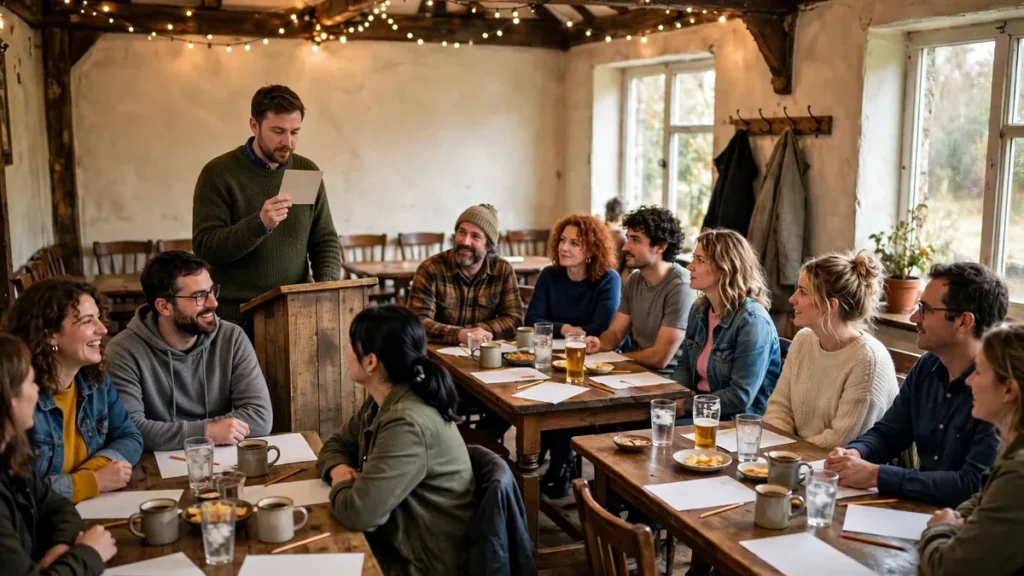
Five hundred and seventy-five players in one room sounds impossible until you picture it as many small tables working together. Nobody needs to shout across a hall, and nobody needs to wait for a turn that never comes. Each table becomes its own little team, and the host simply keeps the whole room moving at the same pace.
This article gives you nine fresh rounds built around Australian wildlife and Australian food. The animals are the stars here: bowerbirds that build decorated bowers, frogmouths that vanish against tree bark, pademelons and potoroos that most visitors never spot, wallaroos that thrive in dry country, barramundi that move between fresh water and salt water, and currawongs with their loud, rolling calls. Two food rounds finish the night with lamingtons and damper, two dishes almost everyone in the room will have an opinion about.
Every round below works the same way. The host reads one question at a time, teams write an answer on a blank sheet, and the host reads the correct answer before moving on. That steady rhythm is what makes a very large night feel calm. You do not need fancy equipment, and you do not need long explanations between rounds. You need clear questions, a fair way to add up points, and rounds that feel different from each other.
Key takeaways
- Nine rounds, each with one sample question, give a full evening without repeating a topic.
- Teams of five or six keep 575 players busy at about one hundred tables.
- One question at a time, with answers read aloud straight after, keeps a large hall in step.
- Mixing animals and food keeps the night friendly for players who know little about wildlife.
- Short rounds with a pause between them work better than one long stretch of questions.
The nine rounds at a glance
| Round | Topic | Best for | Sample question |
|---|---|---|---|
| Famous Bowerbirds | Australian birds | Bird lovers | Which colour objects does a male satin bowerbird collect? |
| Famous Frogmouths | Australian birds | Night wildlife fans | Is a tawny frogmouth an owl? |
| Famous Pademelons | Australian marsupials | Animal lovers | Where do most pademelons live? |
| Famous Wallaroos | Australian marsupials | Outback fans | What is another name for a common wallaroo? |
| Famous Potoroos | Australian marsupials | Quiet achievers | What fungi do potoroos love to dig up? |
| Famous Barramundi | Australian fish | Food and fishing fans | How large can barramundi grow? |
| Famous Currawongs | Australian birds | Back-garden birdwatchers | What colour is a pied currawong? |
| Famous Lamingtons | Australian food | Everyone | What coats the outside of a lamington? |
| Famous Damper | Australian food | Everyone | What two ingredients make a basic damper? |
The nine rounds
Famous Bowerbirds
Bowerbirds are famous for building structures that have nothing to do with nests. The male builds a bower on the ground, a neat avenue of twigs, and then decorates it with objects he has collected. The female visits, looks the bower over, and assesses the builder by the quality of his display. It is one of the most charming courtship habits in the bird world, and it makes for excellent quiz material.
The satin bowerbird is the best-known species in this round. Males collect blue objects: blue bottle tops, blue pegs, blue feathers, and blue flowers. They place each object with care, and they will steal a bright blue object from a rival if they get the chance. Other bowerbirds prefer different colours, so a good question can ask players to match a species with its favourite colour.
Sample question: Which colour objects does a male satin bowerbird collect? Answer: blue objects.
Famous Frogmouths
A tawny frogmouth looks like an owl, sounds a little like an owl, and hunts at night like an owl, but it is not an owl. It belongs to its own family, and its wide, frog-like mouth gives it its name. During the day it sits upright on a branch, feathers pressed tight, looking exactly like a broken branch. Many people walk past one without ever noticing it.
Frogmouths eat insects, small mammals, and other small prey, catching much of their food on the ground. They have soft, silent flight, and they rely on camouflage rather than speed. Their call is a low, steady drumming sound that carries through the bush at night. A host can use that call as a question, asking players what sound a frogmouth makes, or which time of day it hunts.
Sample question: Is a tawny frogmouth an owl? Answer: no, it belongs to its own family.
Famous Pademelons
Pademelons are small, shy marsupials that look like tiny hopping marsupials. They live in thick scrub and woodland edges, coming out at dusk to feed on leaves, grass, and fallen fruit. They are easy to miss, because they freeze when they sense danger and blend into the undergrowth. A quiz round about them rewards players who know the quieter corners of Australian wildlife.
The red-bellied pademelon lives in Tasmania, while the red-legged pademelon lives in rainforest along the east coast. Both are about the size of a small dog, with soft fur and a short tail. They move with quick, low hops, and they rarely venture far from cover. Their shyness is part of their charm, and part of what makes them good quiz subjects.
Sample question: Where do most pademelons live? Answer: in thick scrub and woodland edges, often in Tasmania and along the east coast.
Famous Wallaroos
Wallaroos are mid-sized macropods, and they are built for tough country. The common wallaroo, also known as the euro, lives in dry, rocky hills across much of Australia. It has a stocky body, a thick coat, and a calm manner that helps it cope with heat and scarce water. It is a survivor, and that makes it a strong quiz subject.
Wallaroos eat grasses and shrubs, and they can go for long periods without drinking, getting much of their moisture from food. They shelter in rocky outcrops during the heat of the day and feed in the cooler hours. Males can be much larger than females, and their coats range from reddish to grey, depending on where they live.
Sample question: What is another name for a common wallaroo? Answer: a euro.
Famous Potoroos
Potoroos are among the smallest members of the macropod family, and they are also among the least seen. They are small, with a pointed nose, a long tail, and a habit of hopping through dense undergrowth at night. They are not rats, and their quiet life makes them a lovely surprise in a quiz.
The long-nosed potoroo is the best-known species. It digs for fungi, especially truffles, using its strong front claws and its keen sense of smell. The fungi it eats help trees grow, because the spores pass through the potoroo and spread through the soil. In that way, a small animal that few people ever see does important work for the bush.
Sample question: What fungi do potoroos love to dig up? Answer: truffles.
Famous Barramundi
Barramundi is one of Australia’s most famous fish, and its name comes from an Aboriginal word for a large-scaled fish. It lives in northern waterways, estuaries, and coastal waters, and it can move between fresh water and salt water during its life. That journey makes it a fish of two worlds, and a fine quiz subject for anglers and food lovers alike.
Barramundi grow large, with some reaching more than a metre long. They are silver-grey, with a large mouth and a firm white flesh that holds up well in cooking. They are farmed as well as caught wild, and they appear on menus across the country, from simple grilled fillets to more elaborate dishes. A host can ask about their size, their habitat, and their flavour.
One of the most surprising facts about barramundi is that most start life as males and later change to females. That change is common in some fish, but it still surprises players who hear it for the first time. Ask about the name, the habitat, and the change, and the round will give every table something to talk about over supper.
Sample question: How large can barramundi grow? Answer: more than a metre long.
If your players enjoyed the animal rounds here, the trivia games for 573 players with Famous Sea Lions, Mongooses, Genets, Woodcocks, Carp, Tuna, Pheasants, Mangoes and Pecans offer another animal-led night with a different mix of wildlife and food.

Famous Currawongs
Currawongs are large, black-and-white birds with a loud, rolling call that many Australians know by sound before they know by sight. The pied currawong is the most common, with bold white patches on its wings and tail, and a yellow eye that stands out against its dark feathers. It is a confident bird, happy in gardens, parks, and bush alike.
Currawongs eat insects, small animals, and fruit, and they are known for taking food from other birds. Their call is often described as a ringing, musical sound, and it carries a long way on a still morning. They move in small family groups, and they are clever enough to learn where food is left out and when to return for it.
Sample question: What colour is a pied currawong? Answer: black and white, with a yellow eye.
Famous Lamingtons
The lamington is a square of sponge cake dipped in chocolate and rolled in coconut, and it is one of Australia’s best-loved cakes. It is named after Lord Lamington, a governor of Queensland, and the story goes that his cook dropped a piece of sponge into chocolate and then into coconut, creating a new cake by accident. Whether the story is exact or not, the cake itself is a national favourite.
Lamingtons are often filled with cream and jam, and they are sold in bakeries, school fetes, and fundraisers across the country. They are easy to make at home, and they keep well, which is why they became a favourite for lamington drives, where schools sell boxes of them to raise money. A host can ask about the coating, the filling, and the fundraiser tradition.
Sample question: What coats the outside of a lamington? Answer: chocolate and desiccated coconut.
Famous Damper
Damper is a traditional Australian soda bread, made from flour and water, with a little salt and baking soda, and baked in the coals of a campfire. It was the bread of stockmen and travellers, who carried flour in their packs and cooked a loaf each evening beside the fire. It is simple, filling, and best eaten warm, which is part of its appeal.
A good damper has a crisp crust and a soft, dense middle. It is often served with golden syrup, jam, or butter, and it goes well with a mug of tea. Some cooks add herbs, cheese, or dried fruit, but the classic version stays plain. A host can ask about the ingredients, the cooking method, and the traditional accompaniments.
Damper remains a favourite at campsites and outdoor gatherings, where a loaf cooked in a camp oven tastes better than any shop-bought bread. It is easy to make, hard to ruin, and full of history. Ask about those details, and every table will have an opinion, which is exactly what a good quiz round should do.
Sample question: What two ingredients make a basic damper? Answer: flour and water.
How to run the night for 575 players
Start by arranging teams of five or six players, which gives about one hundred tables. Give each team a blank answer sheet and a pencil, and ask each team to choose a name and write it across the head of the sheet. A clear team name helps the host call out points later, and it gives each table a small sense of identity.
Read each question twice, slowly, and wait for the room to settle before reading the answer. With 575 players, the host needs a microphone and a calm voice. A short pause after each answer lets teams add up their points and lets the host keep the room together. Do not rush, and do not let one loud table lead the room for everyone else.
Break the night into two halves, with a pause after the fifth round. That pause gives players a chance to stretch, buy a drink, and talk about the rounds so far. It also gives the host a chance to check the points and fix any mistakes before the second half begins.
Teams and tables
Keep teams small enough that everyone can hear each other, and large enough that no one feels alone with a hard question. Five or six players is the sweet spot. Mix ages and interests at each table, so that a bird lover sits beside a keen cook, and a fishing fan sits beside a keen reader. Mixed tables make for better answers and better conversation.
Points and fairness
Give one point for each correct answer, and give half a point only if you announce that rule before the night begins. Do not change the rules halfway through, and do not give extra points for funny answers, however tempting that may be. Fairness matters more than humour when 575 players are watching the same points board.
For another animal-led evening, the trivia games for 572 players with Famous Bobcats, Nightjars, Marmosets, Dotterels, Redstarts, Injera, Bannocks, Chiropodists and Osteopaths follow the same pattern with a different mix of animals, food and people.
Timing the evening
Allow about ten minutes for each round, including reading time and answers, and about fifteen minutes for the pause in the middle. That gives a full evening of about two hours, which is long enough to feel like an event and short enough to keep players fresh. If the room is restless, shorten the pause rather than the rounds, because the rounds are the reason everyone came.
Checklist for hosts
- Arrange about one hundred tables, with five or six chairs at each table.
- Print one blank answer sheet per team, plus extra sheets and pencils.
- Test the microphone and the speaker before the first team arrives.
- Prepare the nine rounds in order, with the answers on a separate sheet.
- Plan a pause after the fifth round, with drinks and snacks ready.
- Decide the points rule before the night begins, and announce it at the start.
Frequently asked questions
How many players can join one team?
Five or six players works best. Smaller teams struggle with hard questions, and larger teams leave quieter players out of the discussion. With 575 players, five or six per team gives about one hundred teams, which is easy to manage with a single points board.
How long does the night take?
About two hours, including a pause in the middle. Each round takes about ten minutes, and the pause takes about fifteen minutes. If you shorten the night, cut the pause first, and keep the rounds intact, because the rounds are the heart of the evening.
Do players need to know Australian wildlife?
No. The questions are written so that a player who has never seen a potoroo can still guess from the hints in the question. The food rounds help too, because most players know lamingtons and damper even if they know nothing about birds. Mixed knowledge is what makes the night fair.
What do we need besides questions?
Blank answer sheets, pencils, a microphone, and a points board are enough. A host who reads clearly and keeps a steady pace matters more than any extra equipment. Keep the room warm, keep the drinks flowing, and let the questions do the work.
How do you stop players looking up answers on their phones?
Ask teams to put phones away at the start, and remind them once at the pause. Most players will respect a clear request, especially when the host explains that the night is more fun when everyone guesses together. A friendly reminder works better than a strict rule.
Can we run the same nine rounds again next month?
You can, but the night works better with fresh rounds. Players remember answers, and the second night feels flat. If you want another evening in the same style, the trivia games for 571 players with Famous Shearwaters, Fulmars, Grebes, Oystercatchers, Mandrills, Bonobos, Nachos, Spring Rolls and Wontons give you nine new rounds to try.
The bottom line
Nine rounds, one hundred tables, and 575 players sound like a lot, but the night works because the format is simple. A host reads a question, teams write an answer, and the host reads the correct answer. Bowerbirds, frogmouths, pademelons, wallaroos, potoroos, barramundi, currawongs, lamingtons, and damper give the evening a clear Australian flavour, and the mix of animals and food keeps every table in the game. Arrange the teams, test the microphone, and let the questions carry the night.


