Finding the best trivia games for 147 players is a very different job from picking a quiz for a living room. At this scale, you are not choosing a single box off a shelf. You are designing an event for a crowd the size of a small wedding, and the game has to work for every person in the room at the same time, not just the loudest table at the front.
Trivia games for 147 players succeed when the format respects the size of the group. One hundred and forty-seven people cannot crowd around one board, share one buzzer, or take turns answering one question at a time. The evening needs teams, clear sound, visible questions, and a scoring system that nobody has to argue about. When those pieces are in place, a group this large becomes an advantage: the room buzzes, the rivalries feel real, and every correct answer earns a cheer.
This guide covers the formats that genuinely work for 147 players, the ones that only pretend to, and a step-by-step plan for running the night without chaos. Every recommendation below is built around team play, multiple tables, and whole-room formats, because those are the only structures that hold up when the player count reaches three figures.
Key takeaways
- No single trivia game seats 147 players at once, so team play across many tables is the only honest format.
- Divide 147 players into teams of six or seven, giving you about twenty-one to twenty-four teams to manage.
- Whole-room quiz nights with a host, a screen, and answer sheets scale better than any board or card game.
- Tournament and relay rounds keep energy high and stop the night from dragging after round three.
- Fair scoring needs one answer sheet per team, one scorekeeper per table cluster, and a visible leaderboard.

The Honest Truth About Trivia Games for 147 Players
Most trivia games are designed for a handful of people sitting close together. A typical box expects everyone to see the same cards, hear the same reader, and wait for the same turn. Multiply that by 147 and the design breaks. People at the back cannot see the cards. The reader cannot be heard. A single turn takes so long that half the room checks out before the second round begins.
That does not mean trivia is the wrong choice for a group of 147. It means the game itself is not the product you buy. The product is the event format. The questions still matter, the categories still matter, and the host still matters, but the structure around them decides whether the night works. The best trivia games for 147 players are really the best systems for running trivia at that scale.
Team Play Is the Only Format That Works
Teams of six or seven are the sweet spot for a crowd of 147. With teams of six, you get twenty-four teams and three players left over, which is easy to absorb by making three teams of seven. With teams of seven, you get exactly twenty-one teams. Either split keeps every team small enough that everyone at the table can talk, debate, and contribute.
Smaller teams sound fairer, but they create too many teams to manage. Teams of three would mean forty-nine teams, and no host can track, score, and entertain forty-nine separate groups in one evening. Larger teams sound simpler, but a table of twelve turns into an audience. The quiet players stop answering, the confident players take over, and the team stops feeling like a team. Six or seven players per team keeps the discussion lively and the logistics manageable.
Multiple Tables, One Shared Game
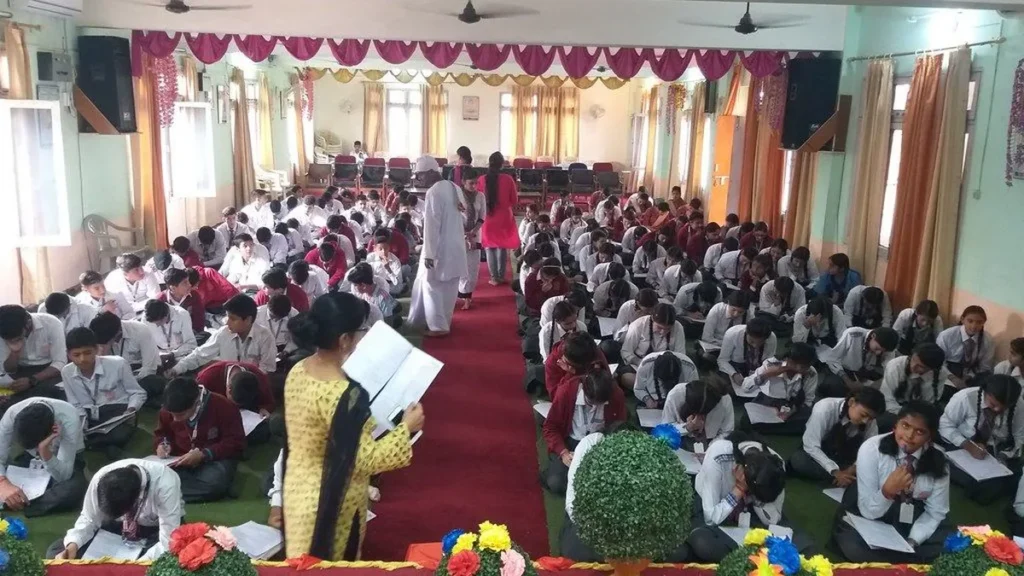
The room layout is the game board. Arrange round tables of six or seven across the hall, all facing a stage or a large screen. Every table gets the same answer sheet, the same pencil, and the same view of the questions. The host reads each question once, clearly, and the screen shows it at the same time so nobody at the back is guessing at words they half heard.
Timing is what keeps multiple tables in sync. Give teams a fixed window to answer, around thirty seconds for a standard question and a little longer for a picture round or a music round. A visible countdown on the screen does the work of a dozen shouted reminders. When time is up, answers are collected or held up, and the next question starts. The rhythm becomes part of the fun.
One practical detail makes a large difference: assign a table captain for each team. The captain writes the final answer, hands the sheet in, and settles any debate inside the team. Without a captain, teams argue about who writes, answers arrive late, and scoring turns into detective work. With one, the whole machine runs on time.
The Best Trivia Games for 147 Players
The formats below are ranked by how well they scale, how much energy they create, and how little equipment they demand. None of them requires a single game to seat 147 players, because no such game exists. Each one takes the strengths of trivia and rebuilds them for a whole room.
| Format | How It Works for 147 Players | Best For | Setup Effort |
|---|---|---|---|
| Whole-Room Quiz Night | Host and screen deliver the same questions to every table at once | Corporate events, school fundraisers, large parties | Medium |
| Tournament Bracket | Teams play head-to-head rounds until one champion remains | Competitive crowds, sports clubs, charity nights | Medium |
| Relay Trivia | Different team members answer different rounds in rotation | Mixed-age groups, family gatherings, team building | Low |
| Picture and Music Rounds | Visual and audio questions shown or played to the whole room | Breaking up long nights, keeping energy high | Medium |
| Table vs Table Challenge | Tables compete directly in short, fast rounds | Conference socials, pub quiz finals, community halls | Low |
| Progressive Jackpot Quiz | Points build across rounds with a big final question | Keeping late rounds tense, rewarding consistency | Low |
Whole-Room Quiz Nights
The whole-room quiz night is the backbone of large-group trivia. A host stands at the front with a microphone, questions appear on a large screen, and every team answers on paper at the same time. There is no waiting for turns, no board to pass around, and no moment when part of the room is idle. Everyone plays every question.
Structure the night in rounds of ten questions, with four to six rounds in total. Mix general knowledge with themed rounds so different teams get their moment. A geography round favours the travellers, a food round favours the cooks, and a music round favours the playlist makers. Variety keeps all twenty-one teams in the hunt, because no single team is best at everything.
For a similar scale of planning, the guide to trivia games for 145 players shows how the same whole-room approach adapts when the headcount shifts by just a couple of seats. The team sizes, the table plan, and the scoring system transfer almost exactly, which is useful if your guest list is still moving.
Tournament and Bracket Formats
A bracket format adds drama that a straight quiz cannot match. After two warm-up rounds, the top teams advance into head-to-head matches while the rest of the room watches, cheers, and plays along for fun. The final becomes a genuine event inside the event, with the whole hall watching two teams battle for the title.
Brackets work best when the early rounds are generous. Let every team play at least three full rounds before anyone is eliminated, so nobody travels to an event and goes home after ten minutes. The teams that drop out early should keep playing in a parallel fun league, with their own small prize, so the back half of the room stays engaged while the finalists fight it out.
Relay and Rotation Rounds
Relay trivia solves the biggest complaint about large teams: that only two or three people ever answer. In a relay round, each question must be answered by a different team member, rotating through the table. The history buff answers the history question, the film fan answers the film question, and the quiet colleague who knows everything about birds finally gets a turn.
Rotation rounds also keep the game honest. When one confident player cannot answer every question, the team has to listen to each other. The discussion gets better, the answers get more varied, and the players who usually stay silent discover they know more than they thought. It is the simplest way to make a team of seven feel like seven players instead of one player with six spectators.
How to Run a 147-Player Trivia Night
Running trivia for 147 players is mostly logistics. The questions are the easy part. The hard part is sound, sightlines, scoring, and timing, and every one of those can be solved before the first guest arrives. A host who prepares the room well can run the whole night with two helpers and a stack of answer sheets.
Start with the venue. You need a room where every table can see a screen and hear a speaker. A long narrow hall with tables in rows will leave the back tables guessing. A wide room with tables arranged in a gentle arc around the stage works far better. Walk the room before the event, sit at the worst table, and check that you can read the screen and hear a normal speaking voice through the speakers.
Sound deserves a real budget. A single small speaker will not carry a host’s voice across a hall of 147 people, especially once the teams start debating. Rent or borrow a proper PA system with at least two speakers placed halfway down the room, and test it with the room full of chatter. The host should never have to shout, and the teams should never have to strain.
Room Layout and Sound
Place the host and the screen at the front, the score table at the side, and the team tables in the middle. Keep aisles wide enough for helpers to collect answer sheets quickly between rounds. If the room has a bar or a food station, put it at the back so the queue does not block the view of the tables at the front.
Test everything an hour before guests arrive. Play a music round through the speakers, display a picture round on the screen, and have a helper sit at the farthest table and read the smallest text. Fixing a sound problem at six in the evening is easy. Fixing it in front of 147 waiting players is not.
Scoring That Stays Fair
Fair scoring is what separates a great trivia night from an argument. One answer sheet per team, collected after every round, is the cleanest system. Scorekeepers mark the sheets during the break, and the leaderboard goes up on the screen before the next round begins. Teams can see exactly where they stand, and nobody has to trust a score they cannot check.
Use a simple points system: one point per correct answer, with a bonus point for a perfect round. Avoid complicated multipliers in the main rounds, because they invite disputes and slow down the scoring. Save the drama for the final question, which can be worth double or triple points, and announce that rule before the night starts so every team plans around it.
Appoint one head scorekeeper and two helpers. The helpers collect sheets from their assigned table clusters, the head scorekeeper marks them against the answer key, and a second person spot-checks the top five teams. With twenty-one teams and ten questions per round, one round takes about ten minutes to mark. That fits neatly into a drinks break.
For broader large-group ideas beyond trivia, party games for 145 players covers formats that mix physical games, team challenges, and quick-fire rounds into the same kind of evening. Borrowing one or two of those ideas as an intermission game keeps the energy up between trivia rounds.
Choosing Questions for a Crowd This Big
Question choice decides whether 147 people feel clever or feel lost. A crowd this large contains every level of knowledge, from the person who reads quiz books for fun to the person who came because a friend dragged them along. The question set has to give both of them a reason to stay engaged.
Follow a simple difficulty mix in every round: four easy questions, four medium questions, and two hard questions. The easy questions keep every team on the scoreboard. The medium questions reward the teams that discuss properly. The hard questions separate the leaders from the pack. A round of ten questions that are all hard will silence the room by question five.
Write questions with one clear answer and no trick wording. In a room of 147, an ambiguous question does not produce one polite query. It produces twenty-one simultaneous arguments. Test every question on two people who are not trivia fans. If either of them can explain why two different answers might be right, rewrite the question.
Picture rounds are the best equaliser in a large room. A photo of a famous landmark, a close-up of a food, or a still from a film gives every table the same information at the same moment, and nobody is disadvantaged by a misheard word. Music rounds work the same way. Play ten seconds of a song, and every team either knows it or does not. Both formats also break up the rhythm of spoken questions, which keeps the night from feeling like a lecture.
Night-of Checklist
Use this checklist on the day of the event. Every item is small on its own, and together they are the difference between a smooth night and a stressful one.
- Confirm the team list and table plan, with 147 players split into teams of six or seven and a captain named for each team.
- Test the microphone, speakers, and screen from the farthest table at least one hour before guests arrive.
- Print one answer sheet per team per round, plus spares, with the team name written at the top of every sheet.
- Prepare the question pack and answer key, with one clear answer per question and the difficulty mixed in every round.
- Brief the scorekeepers on the points system, the collection route, and the plan for the leaderboard between rounds.
- Set out pens, a visible countdown timer, and the prizes for the winning team, the best team name, and the fun-league winners.
Frequently Asked Questions
Can one trivia game really work for 147 players?
No single boxed game seats 147 players, and any product that claims to is stretching the truth. What works is a whole-room format: one host, one screen, and teams of six or seven answering the same questions at the same time. The trivia is real, the competition is real, and the format is built for the size of the crowd.
How many teams should 147 players form?
Teams of seven divide 147 exactly into twenty-one teams, which is the neatest split. Teams of six give you twenty-four teams with three players to place, which is also easy to manage by making three teams of seven. Either way, keep teams between six and seven players so every table can talk and every team stays easy to score.
How long should a trivia night for 147 players last?
Plan for two to two and a half hours, including breaks. Four to six rounds of ten questions take about ninety minutes of play, and two short breaks for scoring, drinks, and conversation fill the rest. Longer nights tire the room, and shorter nights end before the competition has built any tension.
What equipment do I need for a group this large?
You need a microphone and PA system, a large screen or projector, printed answer sheets, pens, and a visible timer. A laptop with the questions loaded, a backup copy of the question pack on paper, and a small prize table complete the setup. You do not need buzzers, boards, or any specialist game equipment.
How do I stop one confident player from dominating a team?
Run at least one relay round where a different team member must answer each question. It forces the team to spread the answers around and gives quieter players a genuine turn. Naming a table captain who collects opinions before writing the final answer also helps, because the captain’s job is to listen, not to answer alone.
What prizes work best for a trivia night of this size?
Keep prizes simple and shared: a small trophy or hamper for the winning team, a fun prize for the best team name, and a prize for the winners of the fun league. Shared prizes suit team events far better than individual gifts, because the whole table celebrates together. Avoid prizes that single out one player, since trivia at this scale is a team achievement.
For groups that enjoy guessing games alongside trivia, word games for adults offers a strong set of options that work well as warm-up rounds before the main quiz begins. A quick word round loosens up the room and gets every table talking before the scoring starts.
Bottom Line
The best trivia games for 147 players are not found in a single box. They are built from team play, multiple tables, one shared set of questions, and a host who keeps the room moving. Split the crowd into teams of six or seven, run the night in rounds of ten with a visible leaderboard, and mix in a relay round and a picture round to keep every player involved. Do that, and 147 players stop being a logistics problem and start being the reason the night works.