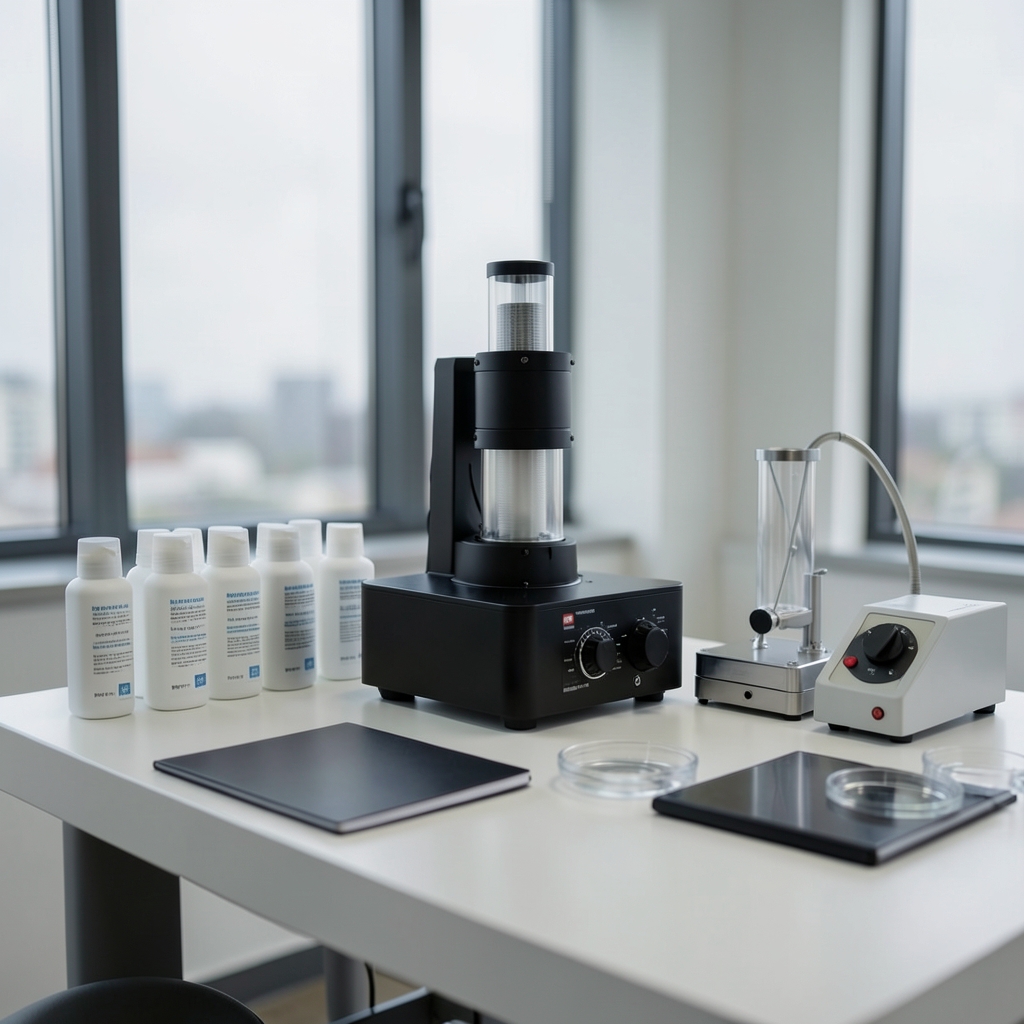
What does the number on a sunscreen bottle really mean, and how does anyone prove it is true? Every SPF claim depends on that question, and answering it takes more than a clever formulator with a good idea. It takes standardized methods, calibrated instruments, and human volunteers who are willing to sit under a solar simulator while a technician watches their skin for redness. The tools behind that process are the quiet gatekeepers of the entire sun care industry.
This guide sorts through the main categories of SPF testing tools, explains where each one fits, and flags the places where “best” depends entirely on which regulator you are trying to satisfy. No single instrument wins across every scenario, and anyone who claims otherwise is probably selling something.
Why SPF Testing Is Harder Than It Looks
Sun protection factor is a ratio. It compares how long protected skin takes to show erythema (sunburn redness) versus unprotected skin under the same UV dose. That sounds simple until you realize the measurement depends on skin type, application thickness, light source spectrum, and the subjective judgment of a trained observer reading a borderline red patch.
The dominant in-vivo standard is ISO 24444, first published in 2010 and revised in 2019. A single test typically uses 10 to 20 volunteers and costs on the order of thousands of dollars per product. That price tag is why in-vitro and computational approaches have become so attractive for early-stage screening.
In the United States, testing follows the FDA’s 2011 sunscreen testing and labeling rule under 21 CFR 352. The FDA’s 2019 proposed order would have raised the maximum labeled SPF from 50+ to 60+ and required UVA results on labels. Whether that proposal was finalized is something formulators must confirm directly with the agency, because the regulatory picture has moved slowly and unevenly. (Ai prompt testing tools alternatives use instead)
The Three Families of SPF Testing Tools
It helps to group tools by what they actually measure rather than by brand name.
| Family | What it measures | Typical use | Main limitation |
|---|---|---|---|
| In-vivo (human) | Erythema response under solar simulator | Regulatory claims, final validation | Slow, costly, ethics-reviewed |
| In-vitro (instrument) | UV transmission through a film | R&D screening, UVA ratings | Diverges from in-vivo at high SPF |
| Computational | Simulated film and radiative transfer | Early formulation, education | Limited peer-reviewed validation |
Each family has genuine strengths. The mistake people make is treating a cheap in-vitro number as if it were a label-ready claim.
In-Vivo Tools: Solar Simulators and Trained Eyes
The workhorse here is the solar simulator, usually a xenon arc lamp filtered to approximate the solar UV spectrum. It must match the reference spectrum closely, because a mismatch shifts the result. Alongside it sits the human element: trained assessors and, in some labs, colorimeters or reflectance instruments to support the visual read.
The in-vivo method remains the reference standard for a reason. It captures the messy reality of skin biology. But it is also the least forgiving of sloppy technique. Application rate, the amount of product per square centimeter, is a classic failure point. Get that wrong and the entire study is void.
In-Vitro Tools: Spectroradiometers and Integrating Spheres
For UVA protection, ISO 24443 covers in-vitro determination of the UVA protection factor. The core instrument is a UV spectrophotometer, often paired with an integrating sphere, measuring transmission through a thin, carefully spread film of product on a substrate.
The spreading step is where in-vitro testing lives or dies. Film thickness, substrate roughness, and how evenly the product sits on the plate all influence the reading. Practical tip: replicate the spreading step many times before trusting a single result. Variation between operators can exceed variation between formulations. (Best ai prompt testing tools small businesses practical)
A newer entrant is hybrid diffuse reflectance spectroscopy, standardized as ISO 23675 and published around 2022. It measures SPF non-invasively on skin and sits between the in-vitro and in-vivo worlds. The exact adoption status of this standard is worth verifying, since standards bodies revise quietly.
Computational and Simulation Tools
Radiative transfer codes, including open-source tools borrowed from atmospheric science, and commercial optical simulation packages are sometimes adapted to model how a sunscreen film scatters and absorbs UV. Monte Carlo approaches can explore how uneven application affects real-world protection.
These tools are genuinely useful for education and early screening. They are not a substitute for validated testing. Peer-reviewed validation against ISO 24444 remains limited, so treat simulation output as a hypothesis, not a claim. Teams comparing tool categories often find the same lesson that shows up when choosing software: the flashy feature rarely matters as much as whether the output survives contact with reality.
Matching Tools to Regulatory Markets
Here is where “best” gets slippery. A tool validated under one regime may be rejected under another.
| Market | Standard referenced | Label cap |
|---|---|---|
| International / EU | ISO 24444 (in vivo), ISO 24443 (UVA) | Generally 50+ |
| United States | FDA 21 CFR 352 | Historically 50+, with a 2019 proposal toward 60+ |
| Australia | AS/NZS 2604, administered via TGA | Per standard |
| Japan | Industry association standards | Per standard |
Australia’s Therapeutic Goods Administration requires SPF testing to AS/NZS 2604, and the current edition number should be confirmed before relying on it. The European Union sets labeling rules through the Cosmetics Regulation, with SPF details buried in the annexes rather than the main text.
The practical consequence: a contract lab that only runs FDA-style protocols may not produce data acceptable for an Australian or EU claim. Before booking any study, ask which standard the lab is accredited for. This is the single most common and most expensive mistake in the field.
How to Choose the Right Tool for Your Situation
Different users need genuinely different things. A startup with one hero product and a multinational with forty SKUs should not buy the same equipment.
- Define the claim first. A label claim needs in-vivo data under the right standard. An internal screening decision does not.
- Confirm the regulator’s accepted method. Check the current edition of the relevant standard rather than a summary from three years ago.
- Decide build versus outsource. In-vivo capability requires volunteers, medical oversight, and facility investment. Most smaller brands outsource.
- Invest in in-vitro capability for iteration. A spectrophotometer setup pays for itself when you are testing twenty prototype emulsions.
- Validate any computational tool against measured data. Never let simulation output reach a label.
For teams weighing budgets, the logic mirrors what shows up in any pricing comparison: the sticker price is rarely the real cost. Volunteer recruitment, medical supervision, and repeat studies dominate the in-vivo budget, while operator time dominates in-vitro work.
Small brands often assume they must choose between accuracy and affordability. In practice, the smart play is a tiered approach: cheap in-vitro screening to kill bad formulations early, then a single in-vivo study on the winner. That pattern echoes the reasoning behind any staged investment strategy, where incremental spending beats buying the biggest tool upfront.
Practical Tips, Common Mistakes, and What Actually Works
Experience across testing workflows surfaces a handful of recurring problems.
Mistake one: chasing a single “best” instrument. There is no universal winner. In-vitro SPF often diverges from in-vivo results, especially for high-SPF and UVA-heavy formulations. A tool that excels for a light daily moisturizer may mislead on a beach product.
Mistake two: ignoring the reference spectrum. Solar simulators and spectrophotometers must be calibrated against the correct reference. A drifted lamp produces confident, wrong numbers.
Mistake three: under-replicating the application step. Whether spreading product on a plate or dosing a volunteer’s back, consistency is everything. Write the protocol down and audit it.
Mistake four: treating standards as static. ISO 24444 was revised in 2019. AS/NZS 2604 has editions. The FDA proposal from 2019 may or may not have become final. Build a habit of checking primary sources each year.
What actually works: a documented, tiered testing program with named standards, accredited labs, and a clear separation between screening data and claim data. Teams that plan this way spend less and sleep better. The same discipline applies when evaluating any technical stack, where fit consistently beats features.
Where the Field Is Heading
Three forces are reshaping SPF testing. First, pressure to reduce animal and human testing is pushing investment into in-vitro and hybrid methods, with ISO 23675 representing a real step forward. Second, computational modeling is improving fast, though validation against in-vivo standards lags behind the marketing. Third, regulatory divergence persists, meaning global brands will keep maintaining multiple test dossiers for years.
For smaller players, the practical answer is to lean on accredited labs and buy in-vitro capability only when volume justifies it. For larger R&D groups, the answer is a portfolio approach with clear boundaries between screening, validation, and claims.
Readers exploring adjacent tooling decisions will find the same principle holds: fit beats features.
Conclusion
There is no single best SPF testing tool, and that is the honest answer. The best setup depends on the claim you need to make, the market you sell into, and how much iteration your formulation team requires. In-vivo solar simulation remains the gold standard for label claims. In-vitro spectrophotometry with integrating spheres is the workhorse for UVA and early screening. Hybrid diffuse reflectance and computational modeling are promising but demand careful validation. Choose by standard, not by brand. Confirm the current edition of every method you cite. Separate screening data from claim data. Do those three things and the number on your bottle will mean exactly what it says.
Frequently Asked Questions
What is the main standard for SPF testing?
The dominant in-vivo standard is ISO 24444, first published in 2010 and revised in 2019. It measures erythema response in human volunteers under a solar simulator. In the United States, the FDA’s 2011 rule under 21 CFR 352 governs testing and labeling instead.
Can in-vitro tools replace human SPF testing?
Not for label claims. In-vitro methods are excellent for screening and for UVA protection under ISO 24443, but they often diverge from in-vivo results, particularly for high-SPF and UVA-heavy formulations. Most regulators still require human testing for the SPF number on the bottle.
How much does an SPF test cost?
A single in-vivo test typically uses 10 to 20 volunteers and costs on the order of thousands of dollars per product, though figures vary widely by lab and region. In-vitro testing is far cheaper per sample, which is why tiered programs that screen in-vitro and validate in-vivo are so common.
What is ISO 23675?
It is a standard for hybrid diffuse reflectance spectroscopy, a non-invasive method for determining SPF on skin. It was published around 2022 and sits between purely in-vitro and fully in-vivo approaches. Its exact adoption status varies by market and should be verified.
Why do SPF labels cap at 50+ in some countries?
Labeling caps differ by market. The EU generally caps at 50+, while the US historically allowed 50+ with a 2019 proposal to move toward 60+. Australia follows AS/NZS 2604 as administered by the TGA. A formulation tested for one market may need retesting for another.
Do I need different tests for the US and EU?
Usually yes, or at least confirmation that your lab’s protocol satisfies both. The FDA rule and ISO 24444 are related but not identical, and UVA labeling requirements differ. Always ask a contract lab which specific standards it is accredited for before booking a study.




