
A good riddle book does something a phone screen rarely does: it slows you down, makes you think in a completely different direction, and then rewards you with that small, satisfying click when the answer finally lands. For adults, the best riddle books are not about simple wordplay for children. They are about logic, lateral thinking, maths puzzles, word puzzles, and clever twists that respect your intelligence while still catching you out.
In 2027, riddle books remain one of the easiest ways to keep your mind sharp. They need no battery and no screen. You can dip into one for five minutes on a train, work through a puzzle over coffee, or turn a chapter into a game night. The right book matches your taste, whether you love logic, visual puzzles, maths challenges, or short riddles to share.
This guide rounds up ten of the best riddle books for adults in 2027, from classic logic collections by Raymond Smullyan and Henry Ernest Dudeney to modern brain-game compilations and lateral-thinking favourites. Check current pricing before you buy, as editions and prices change often.
Key takeaways
- The best riddle books for adults mix logic, lateral thinking, wordplay, and maths, rather than relying on one puzzle type alone.
- Raymond Smullyan, Henry Ernest Dudeney, and Martin Gardner are the safest starting points if you want classic, clever, well-crafted puzzles.
- Choose a book by difficulty and format first: short riddles suit casual reading, while logic and maths collections suit focused solving.
- Lateral-thinking books are best for groups and game nights, while logic books are best for quiet, solo problem-solving.
- Check the edition before buying, because many classic titles are available in several printings with different puzzle selections.
Best riddle books for adults at a glance
| Book | Best for | Difficulty | Format |
|---|---|---|---|
| What Is the Name of This Book? | Logic puzzles | Medium to hard | Paperback and ebook |
| The Lady or the Tiger? | Logic and paradoxes | Medium to hard | Paperback and ebook |
| To Mock a Mockingbird | Logic and combinatory puzzles | Hard | Paperback |
| Amusements in Mathematics | Classic maths puzzles | Medium | Paperback and ebook |
| The Colossal Book of Mathematics | Maths and puzzle essays | Medium to hard | Paperback |
| Classic Lateral Thinking Puzzles | Group play and game nights | Easy to medium | Paperback |
| The Big Book of Brain Games | Visual and mixed puzzles | Easy to medium | Paperback |
| The Mammoth Book of Logical Brain Games | Everyday logic practice | Easy to medium | Paperback |
| Brain Games: Riddles | Short riddles on the go | Easy to medium | Paperback |
| The Ultimate Riddle Book for Adults | Quick riddles to share | Easy to medium | Paperback and ebook |
1. What Is the Name of This Book? by Raymond Smullyan
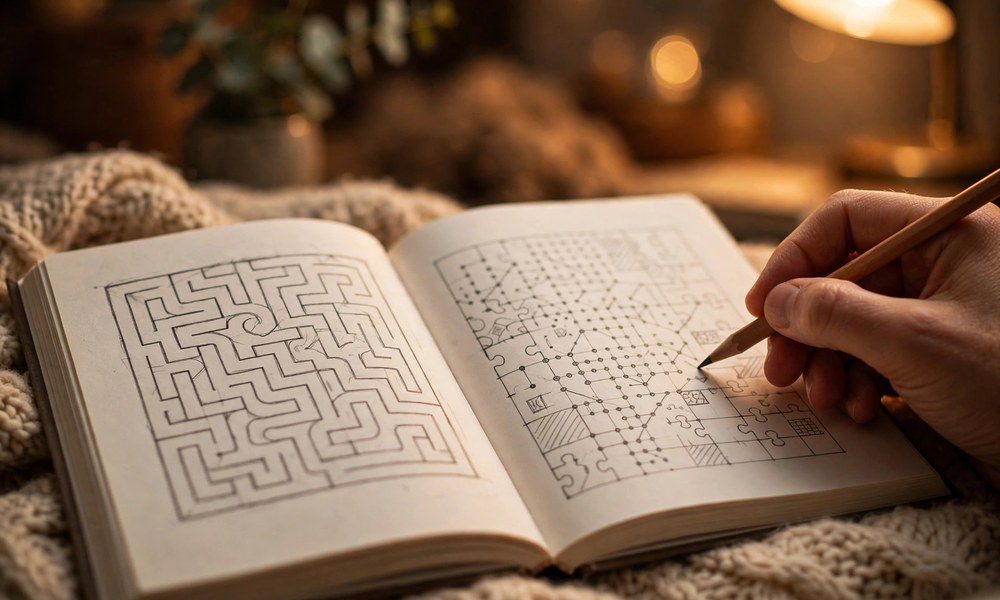
If you only buy one logic puzzle book, this is a strong place to start. Raymond Smullyan builds his puzzles around knights and knaves, truth-tellers and liars, and a series of wonderfully strange scenarios that look simple and turn out to be anything but. The puzzles are presented as short stories and conversations, so the book reads more like entertainment than a textbook, even when the reasoning gets demanding.
What makes it so good for adults is the progression. Early puzzles teach you the basic logic, then later chapters ask you to combine ideas, spot hidden assumptions, and think several steps ahead. It is a book you can work through in order, or open at random when you want a single satisfying challenge. It also pairs well with digital practice, and many readers who enjoy it go on to explore the best brain training apps for daily logic exercises between chapters.
Pros: Brilliantly written, genuinely clever puzzles, and a clear learning curve that rewards persistence. Cons: Some later puzzles are very demanding, and readers who dislike formal logic may find parts of it slow going.
2. The Lady or the Tiger? by Raymond Smullyan
This is Smullyan at his most playful, and arguably his most famous. The title puzzle, about a prisoner choosing between doors, is only the beginning. The book moves through logic puzzles, paradoxes, and puzzles about puzzles, including the famous Gödel-inspired material that explores what can and cannot be proved. It sounds heavy, but Smullyan keeps the tone light, funny, and conversational throughout.
Pros: Memorable puzzles, witty writing, and a mix of easy openers and genuinely mind-bending challenges. Cons: The Gödel sections can feel abstract for casual readers, and the book rewards careful reading rather than quick browsing.
3. To Mock a Mockingbird by Raymond Smullyan
This is the most challenging Smullyan book on this list, and the one most likely to delight serious puzzle lovers. It uses birds, forests, and playful stories to introduce combinatory logic, a subject that sounds intimidating but becomes surprisingly approachable in Smullyan’s hands. Each puzzle is a small logical riddle, and together they build into a deeper understanding of how reasoning itself works.
Pros: Deeply original, beautifully structured, and immensely satisfying for dedicated solvers. Cons: The hardest book on this list, and not suited to casual or group reading.
4. Amusements in Mathematics by Henry Ernest Dudeney
First published more than a century ago, this classic by Henry Ernest Dudeney still feels fresh because good maths puzzles do not age. The book contains hundreds of puzzles covering arithmetic, geometry, logic, wordplay, and clever tricks with numbers, coins, and shapes. Many of the puzzles are short enough to solve in a few minutes, which makes it perfect for dipping into.
Pros: A huge number of puzzles, timeless quality, and excellent value for money. Cons: The language is old-fashioned in places, and some puzzles assume familiarity with imperial measurements and older customs.
5. The Colossal Book of Mathematics by Martin Gardner
Martin Gardner was one of the great popularisers of recreational mathematics, and this large collection gathers some of his best puzzles, essays, and brain teasers. The puzzles range from simple riddles and card tricks to deeper problems in geometry, probability, and logic, all explained with Gardner’s trademark clarity and warmth.
Pros: Enormous variety, expert explanations, and puzzles that suit a wide range of abilities. Cons: It is a big, heavy book, and some sections are more mathematical than riddle-like.
6. Classic Lateral Thinking Puzzles by Paul Sloane and Des MacHale
Lateral thinking puzzles are the riddles that make you ask questions. A strange situation is described, and you have to work out what happened by asking yes-or-no questions. This collection by Paul Sloane and Des MacHale is one of the best introductions to the format, with puzzles that are short, surprising, and perfect for sharing.
Pros: Perfect for groups, quick to play, and full of memorable, shareable puzzles. Cons: Less satisfying for solo readers, since the fun depends on asking questions and guessing together.
7. The Big Book of Brain Games by Ivan Moscovich
Ivan Moscovich’s big, visual collection is a feast for the eyes as well as the brain. It contains more than a thousand puzzles, including visual riddles, mazes, optical illusions, number puzzles, and logic challenges, all presented with clear diagrams and illustrations. It is the kind of book you can browse for hours without realising how much time has passed.
For adults, the appeal is the mix. You can switch from a tricky visual puzzle to a word riddle to a maths challenge in the space of a few pages, which keeps the book fresh. It is also a strong choice for people who think visually and prefer puzzles they can see and sketch, rather than puzzles that are purely verbal. If you enjoy this style, you may also like the best puzzle apps for adults for a similar mix on your phone.
Pros: Huge variety, strong visual puzzles, and great for casual browsing. Cons: Some puzzles are quite easy for experienced solvers, and the book is large to carry around.
8. The Mammoth Book of Logical Brain Games by Dave Green
This is a practical, everyday puzzle book, and that is exactly its strength. Dave Green’s collection focuses on logic puzzles you can actually work through in a spare ten minutes: grids, sequences, deductions, and reasoning challenges that build steadily in difficulty. There is no pretence and no filler, just solid puzzles presented clearly.
Pros: Clear, well-paced puzzles, good for daily practice, and excellent length. Cons: Less variety than the bigger collections, and the presentation is functional rather than beautiful.
9. Brain Games: Riddles by Publications International
Sometimes you do not want a deep logic treatise; you want a book of short, fun riddles you can read in bed, share with friends, or work through on a lunch break. This volume in the popular Brain Games series delivers exactly that, with a large collection of riddles, word puzzles, and brain teasers arranged for quick, enjoyable solving.
The puzzles are accessible, the answers are included, and the format is friendly for beginners. It is a good first riddle book for adults who are new to puzzle books, and a good gift for someone who says they like riddles but has never owned a dedicated book. It also works well alongside a puzzle-themed present, and it pairs naturally with the best gift ideas for puzzle lovers if you are buying for someone else.
Pros: Friendly and accessible, lots of puzzles, and ideal for beginners and casual solvers. Cons: Experienced puzzlers may find many riddles too easy, and the variety is narrower than the classic collections.
10. The Ultimate Riddle Book for Adults
This popular riddle collection rounds out the list with exactly what its title promises: a large set of riddles aimed squarely at adult readers, covering wordplay, logic, lateral thinking, and trick questions. The puzzles are short, the answers are satisfying, and the book is designed to be picked up, enjoyed for a few minutes, and put down again.
Pros: Large riddle count, easy to dip into, and great for sharing out loud. Cons: Quality varies from riddle to riddle, and serious solvers may want a more challenging book alongside it.
How to choose the best riddle book for adults
Start with how you like to solve. If you enjoy careful reasoning and working alone, choose a logic book such as Smullyan or Dudeney. If you enjoy guessing, talking, and laughing with others, choose a lateral-thinking book. If you like variety, choose a big mixed collection such as Moscovich or Gardner. Difficulty matters too: a book that is too easy becomes boring, while a book that is too hard ends up unread on a shelf.
Paperback suits notes and sketches, while an ebook suits travel. Check that answers are included, and remember a gift should be a little easier and a lot more fun than a book you buy for yourself.
Checklist: before you buy a riddle book
- Match the puzzle type to your taste: logic, lateral thinking, maths, visual, or mixed.
- Check the difficulty level and read a sample puzzle if one is available.
- Confirm answers and solutions are included, and see how they are presented.
- Look at the edition and page count so you know how many puzzles you are getting.
- Decide between paperback for notes and sketches or ebook for portability.
- Check current pricing and format options before you buy, as editions change often.
Frequently asked questions
What is the best riddle book for adults to start with?
What Is the Name of This Book? by Raymond Smullyan is a great first choice, because it teaches logic through entertaining stories and builds in difficulty. If you prefer short, easy riddles, start with Brain Games: Riddles instead.
Are riddle books good for brain training?
Yes, in the sense that they encourage focused thinking, pattern-spotting, and creative problem-solving. They are not a medical treatment, but regular puzzle-solving is a enjoyable way to keep your mind active and engaged.
Which riddle book is best for game nights?
Classic Lateral Thinking Puzzles is the best pick for groups, because the puzzles are designed to be read aloud and solved together by asking questions. The Ultimate Riddle Book for Adults is another good group choice.
Do classic riddle books still hold up in 2027?
Yes. Books by Smullyan, Dudeney, and Gardner remain popular because their puzzles are based on logic and clever thinking, not on trends or technology. Good puzzles age very well.
Should I buy a paperback or an ebook riddle book?
Paperback is usually better for puzzle books, because you can write notes, draw diagrams, and flip back and forth easily. An ebook is better if you travel a lot or prefer reading on a tablet.
What makes a riddle book good for adults rather than children?
Adult riddle books use more complex logic, trickier wordplay, and harder maths, and they assume the reader can follow multi-step reasoning. They also tend to offer more variety and a higher difficulty ceiling.
The bottom line
The best riddle book for most adults in 2027 is What Is the Name of This Book? by Raymond Smullyan, because it combines brilliant logic puzzles with genuinely enjoyable writing. If you want something for groups, choose Classic Lateral Thinking Puzzles. If you want variety and visual puzzles, choose The Big Book of Brain Games. And if you want a classic maths puzzle collection to keep for years, choose Amusements in Mathematics. Whichever you pick, the real pleasure is slowing down, thinking differently, and enjoying the moment the answer clicks into place.
Note: Book availability, editions, and prices change often. Check current pricing and format options before you buy, and confirm the edition matches the puzzles described here.


