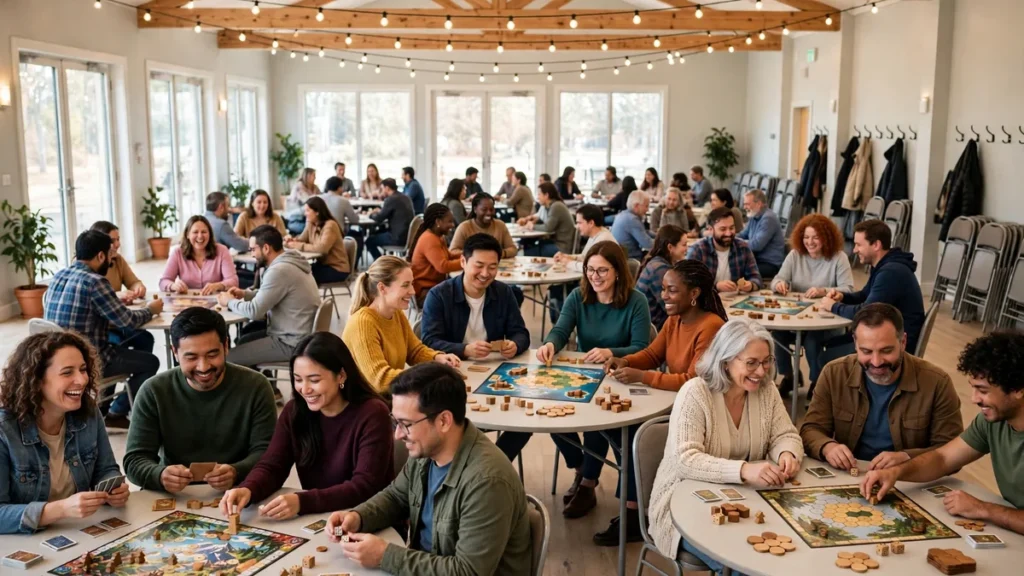
The best puzzle games for 87 players are not the games you would pick for a quiet evening with four friends. When 87 people gather in one room, a single jigsaw puzzle or a single board game cannot hold them all, and that is exactly what makes this kind of event so much fun. The best puzzle games for 87 players work because they turn a huge crowd into teams, tables, and stations, so everyone is solving something at the same time instead of watching a few people play.
Planning a puzzle night for 87 players sounds impossible until you break the number down. Nine teams of nine, with six extra players joining as floaters or judges, suddenly feels manageable. Twelve tables of seven or eight players each can run the same puzzle race in parallel. A whole-room puzzle hunt can send all 87 players moving at once, each person holding one clue that only makes sense when combined with the clues held by others.
This guide covers the puzzle games that genuinely work for 87 players, the formats that keep a crowd of that size engaged, and the practical setup that stops a big event from sliding into chaos. Every game here has been chosen because it scales through teams, multiple copies, tournament brackets, or relay play. No single game seats 87 players, so the honest answer is always a format, not a box.
Key takeaways
- No single puzzle game seats 87 players, so every option in this guide works through teams, multiple tables, tournaments, or relay formats.
- Split 87 players into teams of six to nine for the best balance of participation, noise control, and fair scoring.
- Run several puzzle stations at once so nobody waits more than a few minutes between turns.
- Mix puzzle types, because jigsaws, word puzzles, logic puzzles, and physical brain teasers use different skills and keep every kind of player involved.
- Keep rounds short, score simply, and announce standings often, because a large crowd loses energy fast when it cannot see how it is doing.

Why 87 Players Changes Everything About Puzzle Games
The first change is that the unit of play stops being the individual and becomes the team. A team of eight or nine players can work on a large jigsaw puzzle together, with some members sorting edge pieces, others hunting for colours, and one person keeping track of the picture on the box. A team of the same size can split a logic puzzle into parts, with each subgroup solving one section before combining the answers. Teams give every player a role, and roles are what stop large groups from drifting into spectators and passengers.
The second change is that scoring has to be simple enough to explain in one minute. Complicated point systems collapse when 87 people are trying to follow them, especially after the first round of drinks or the third puzzle of the evening. Points for finishing, bonus points for speed, and a small bonus for the most creative solution are enough. Anything more complex belongs in a tournament for twelve players, not a party for 87.
How to Run Puzzle Games for 87 Players
Team Play at Shared Tables
Team play needs enough table space for ten puzzles at once, and it needs identical puzzle sets so the contest is fair. Buy ten copies of the same jigsaw puzzle, or ten identical sets of wooden brain teasers, rather than ten different puzzles of different difficulty. If you want a broader mix of activities for the same crowd, best party games for 87 players use the same team structure with faster, louder rounds, and they pair well with a puzzle round earlier in the evening.
Multiple Tables and Puzzle Stations
Stations solve the waiting problem. Instead of every team doing the same puzzle at the same time, set up eight to ten stations around the room, each with a different puzzle, and rotate teams through them on a timer. Teams spend fifteen minutes at each station, earn points for what they complete, and move on when the bell rings.
Tournament and Relay Formats
Tournaments work well when you want a clear winner at the end of the night. Teams compete head to head in short puzzle duels, with winners advancing and losers moving to a consolation bracket so nobody is eliminated after one round. A relay format works on the same idea but inside a single team: one player solves the first part of a puzzle, tags the next player, and the chain continues until the puzzle is complete.
Whole-Room Puzzle Hunts
A whole-room puzzle hunt is the only format in which all 87 players are genuinely playing the same game at the same moment. Every player receives one clue, one piece of a code, or one fragment of a map, and the group has to combine them to solve a larger mystery. Escape-room style hunts work well here: hide puzzle stations around the venue, give each team a different starting point, and let the teams race to unlock the final box.
The Best Puzzle Games for 87 Players Compared
| Game | Best format | Players per unit | Round length | What it tests |
|---|---|---|---|---|
| Team jigsaw race | Team tables | 8 to 9 per team | 20 minutes | Pattern recognition, patience |
| Logic grid puzzles | Stations | 6 to 9 per team | 15 minutes | Deduction, teamwork |
| Word ladder relay | Relay | 8 to 9 per team | 10 minutes | Vocabulary, speed |
| Rubik’s cube relay | Relay | 8 to 9 per team | 10 minutes | Spatial thinking, speed |
| Escape-room hunt | Whole room | All 87 at once | 45 to 60 minutes | Observation, logic |
| Tangram challenge | Team tables | 8 to 9 per team | 15 minutes | Geometry, creativity |
| Sudoku sprint | Stations | 6 to 9 per team | 15 minutes | Numbers, logic |
| Puzzle scavenger hunt | Whole room | All 87 at once | 30 minutes | Searching, teamwork |
| Crossword race | Team tables | 8 to 9 per team | 20 minutes | Word knowledge, recall |
| Building block challenge | Stations | 6 to 9 per team | 15 minutes | Engineering, creativity |
The Best Puzzle Games for 87 Players
1. Team Jigsaw Race
The team jigsaw race is the most reliable puzzle game for a crowd of 87 players, and it should usually open the evening. Buy ten identical 500-piece jigsaw puzzles, one per team, and give every team the same picture so the race is fair. A 500-piece puzzle is the right size for a twenty-minute round with eight or nine players working together: a 1,000-piece puzzle is too slow for a timed round, and a 300-piece puzzle finishes too quickly for the slower teams to feel involved.
2. Logic Grid Puzzles
Logic grid puzzles, the kind where you work out who owns which house or which person arrived at what time, are perfect for station play. Print the same puzzle for every station, give each team a large grid sheet and a set of pens, and let the team divide the clues among its members. One subgroup works on the first set of clues, another on the second, and the team leader combines the partial answers into a full solution.
3. Word Ladder Relay
Word ladders are an excellent bridge between puzzle games and word games, because they use vocabulary and spelling in a way that feels like play rather than a test. If your crowd enjoys this round, best word games for 87 players offer more team-based word challenges in the same spirit. Keep each ladder to four or five rungs so that a full team relay takes about two minutes, and run three ladders per round so that every team gets several attempts. Award points for each completed ladder, with a bonus for the fastest team.
4. Rubik’s Cube Relay
A Rubik’s cube relay is the fastest, loudest game on this list, and it works even when most of the 87 players have never solved a cube. You do not need 87 expert cubers. You need one cube per team, a simple task per leg, and a format that lets beginners contribute. In the simplest version, each player in the relay has to complete one face of the cube, or to turn the cube until a single colour appears on top, before tagging the next player.
5. Escape-Room Puzzle Hunt
An escape-room puzzle hunt is the most ambitious option for 87 players, and it is the one that guests remember longest. The idea is simple: the room becomes the puzzle. Hide locked boxes, coded messages, and hidden keys around the venue, give each team a different starting clue, and let the teams race to solve a chain of puzzles that ends with a single final lock.
6. Tangram Challenge
Tangrams are seven flat geometric pieces that can be arranged into hundreds of shapes, from animals to letters to houses. For 87 players, the tangram challenge works as a team-table game: give each team a set of tangram pieces and a series of silhouette cards, and ask the team to recreate as many silhouettes as possible in fifteen minutes. The game is quiet, visual, and deeply satisfying, which makes it a good contrast to the noise of a relay or a race.
7. Sudoku Sprint
The sprint format solves the main problem with Sudoku as a group game, which is that it is usually a solitary activity. By splitting the grid and adding a clock, you turn a quiet puzzle into a team effort. Score by the number of correct cells when time runs out, rather than by completion alone, so that every team earns points for its work and nobody leaves a station with nothing.
8. Puzzle Scavenger Hunt
A puzzle scavenger hunt sends all 87 players searching the venue for hidden puzzle pieces. Before the night, hide 87 puzzle pieces around the room, one per player, each marked with a team colour and a number. When the hunt starts, players search for pieces in their team colour, bring them back to their team table, and work together to assemble the puzzle from the pieces they found. The team that completes its puzzle first wins.
9. Crossword Race
A crossword race is a classic word puzzle run as a team competition, and it is one of the easiest games on this list to prepare. Print ten copies of the same large-format crossword, one per team, and give each team twenty minutes to fill in as many answers as possible. The team structure matters here: one player reads the clues aloud, two or three players work on the across answers, two or three work on the down answers, and the team leader fills in the grid and checks the crossings.
10. Building Block Challenge
A building block challenge asks each team to build the tallest stable tower, the longest bridge, or the most creative structure from a limited set of blocks in fifteen minutes. The game tests planning, engineering, and teamwork. Give each team the same number and type of blocks, set a clear rule about what counts as stable, and let the teams plan for two minutes before they start building.
Setting Up Your 87-Player Puzzle Night
Prepare the materials. Count every puzzle, every set of pieces, and every printed sheet, and pack them by station or by team so that setup takes minutes rather than an hour. Bring spares of anything small and easy to lose, such as dice, pens, and individual puzzle pieces. If you want to round out the evening with board-based team play after the puzzle rounds, best board games for 87 players follow the same team-table layout used here, so the room setup carries over without rearranging the furniture.
Then plan the schedule. A good evening for 87 players runs for about two and a half hours, including a welcome, three or four puzzle rounds, a break, and a final. Open with the jigsaw race, because it is easy to explain and gets every team working together immediately. Follow with a station rotation or a relay, take a break for food and conversation, and finish with the escape-room hunt or the scavenger hunt, because the biggest, most exciting game should come last.
Scoring and Keeping 87 Players Engaged
Scoring for 87 players has to be visible, simple, and frequent. Put a large scoreboard where every team can see it, update it after every round, and read the top three teams aloud before the next round begins. Teams that cannot see their progress will stop trying, and teams that are far behind will stop caring, so keep the scoring close: award points for finishing, for speed, and for creativity. A close contest keeps all 87 players involved until the final round.
Remember that 87 players will have very different levels of puzzle experience. Mix the games so that every type of player has a round where they shine: a word round for the vocabulary experts, a building round for the hands-on players, a logic round for the quiet thinkers, and a relay for the competitive ones. When every player has a moment to contribute, the whole group leaves happy.
Checklist for Running Puzzle Games for 87 Players
- Divide 87 players into ten teams of eight or nine, and assign each team a table, a colour, and a team captain before the night begins.
- Buy or print identical puzzle sets for every team, and test each puzzle yourself to confirm it can be finished inside the round time.
- Set up ten team tables or eight to ten puzzle stations, with clear walkways, good lighting, and a microphone for the host.
- Prepare a simple scoring system, a visible scoreboard, and a countdown timer for every round, and update the standings after each round.
- Brief at least four volunteers on the rules, the rotation, and the hint system, so that no team is left waiting for help.
- Run a full test of the whole evening, including the final hunt or relay, with a small group, and fix any broken clues or unclear rules before the real night.
Frequently Asked Questions
Can one puzzle game really seat 87 players?
No single boxed game seats 87 players at once. Every option in this guide works by splitting the crowd into teams, running several tables or stations in parallel, or using a whole-room hunt where all 87 players share one puzzle. The number 87 describes the event, not the box, and the format is what makes the event work.
How many teams should 87 players form?
Ten teams work best, with eight or nine players on each team. Teams of that size are large enough to split a puzzle into parts and small enough that every player can see the work and take a turn. Teams of fewer than six players struggle with large puzzles, and teams of more than ten players leave some members with nothing to do.
What is the best puzzle game to start with?
Start with the team jigsaw race. It is easy to explain, it uses a familiar puzzle that everyone understands, and it gets all 87 players working together within minutes of the welcome. Save the escape-room hunt or the scavenger hunt for the end of the evening, when the crowd is warmed up and ready for something bigger.
How long should a puzzle night for 87 players last?
Plan for about two and a half hours, including a welcome, three or four puzzle rounds, a short break, and a final game with prize giving. Shorter evenings feel rushed for a crowd of this size, because setup and rotation take time, and longer evenings lose energy unless you add food and a proper break in the middle.
How much do puzzle games for 87 players cost?
The cost depends on how many copies you buy. Ten identical jigsaw puzzles and ten tangram sets can cost less than a single catered meal for 87 people, while a full escape-room hunt with locked boxes and printed clues costs more but can be reused for future events. Paper puzzles, such as logic grids, crosswords, and Sudoku sheets, cost almost nothing beyond printing.
What if some players have never done puzzles before?
Mix the games so that beginners always have a way to contribute. In a jigsaw race, a beginner can sort edge pieces. In a relay, a beginner can take a short, easy leg. In a scavenger hunt, a beginner can search for pieces. Keep the instructions simple, offer hints freely, and score by progress as well as by finishing, so that every team earns points for its effort.
The Bottom Line
The best puzzle games for 87 players are the ones that respect the size of the crowd instead of fighting it. Split the room into teams of eight or nine, run several puzzles at once through tables or stations, keep the rounds short and the scoring simple, and finish with a whole-room hunt that brings all 87 players together. Do that, and 87 players stop being a problem to solve and become the best part of the night.