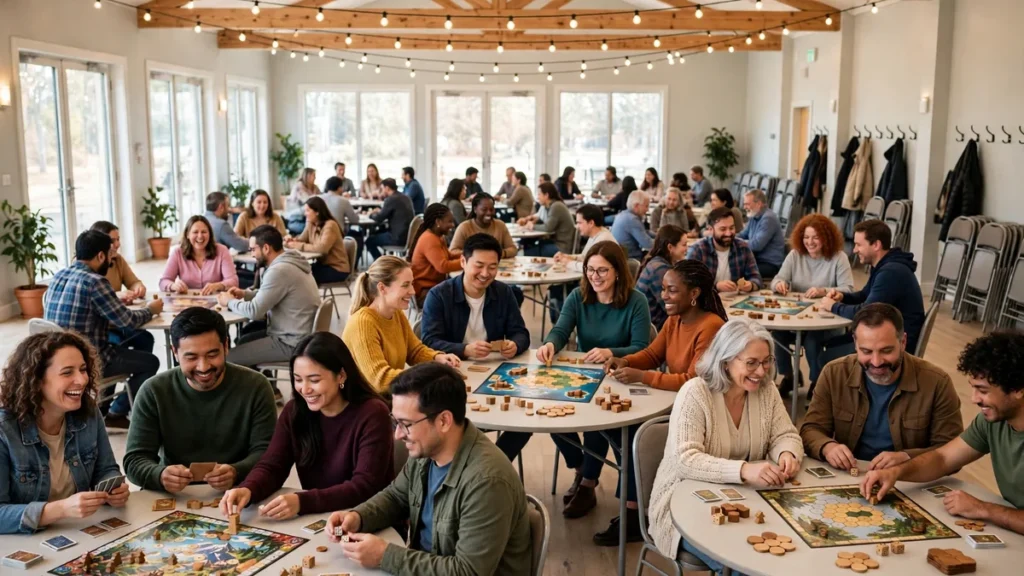
Finding the best puzzle games for 86 players starts with an honest fact: no single puzzle game seats 86 people at one table. No jigsaw is that large, no crossword grid fits 86 solvers at once, and no single puzzle box can keep that many minds busy at the same time. That does not mean a puzzle night for 86 players is impossible. It means the night has to be organised differently, with several tables running at once, teams sharing the solving, and a tournament or relay format that brings everyone together for one shared result.
The best puzzle games for 86 players are therefore not the games with the highest player count printed on the box. They are the puzzles that are easy to explain in two minutes, quick to play in short rounds, simple to run at ten or twelve tables at the same time, and fair when the results from every table are combined into one leaderboard. A good large-group puzzle keeps every player touching the pieces, not watching someone else solve.
This guide explains how to run a puzzle game event for 86 players, from table layouts and team sizes to scoring and rotation. It then reviews twelve puzzle games that work brilliantly in this large-group format, compares them side by side, and gives you a setup checklist and answers to the most common questions. Whether you are planning a company social, a school event, a community hall evening, a wedding reception activity, or a large family gathering, the plan below will help all 86 players enjoy the night instead of sitting on the sidelines.
Key takeaways
- No single puzzle game seats 86 players, so the best puzzle games for 86 players are played across multiple tables, in teams, or as a tournament.
- Split 86 players into teams of six to eight and run the same puzzle at ten to twelve tables at once for a fair race.
- Choose puzzles that are easy to explain in two minutes and finish in fifteen to thirty minutes per round.
- Score every table on the same scale, combine the results on one leaderboard, and rotate puzzle types between rounds.
- Prepare spare puzzles, printed answer sheets, timers, and a clear host script before the first round begins.

How to Run Puzzle Games for 86 Players
The format matters more than any single game when 86 people are involved. A puzzle that is wonderful for four friends can fall flat for a crowd if everyone is waiting for a turn. The structure below has been used at company socials, school events, and community evenings, and it works because every player is solving something at every moment.
Split Into Teams of Six to Eight
Divide the 86 players into teams of six to eight people. That gives you eleven to fourteen teams, which is a manageable number for one host to track. Teams of this size are large enough to feel social and small enough that every member can reach the puzzle. Give each team a name, a table, and a colour, and keep the same teams for the whole evening so rivalries can build.
Smaller teams of four would create more than twenty tables, which is hard to supervise and expensive to supply. Larger teams of twelve or more leave half the team watching. Six to eight is the sweet spot, and it also makes scoring simple: every team plays the same puzzle under the same conditions.
Run the Same Puzzle at Every Table
Set up ten to fourteen tables, one per team, and give every table the same puzzle. A jigsaw race, a crossword sprint, or a logic puzzle round all work well when every team starts at the same moment and the host calls time. Identical puzzles keep the competition fair, and the shared experience gives everyone something to talk about between rounds.
Buy or print multiple copies of each puzzle. For jigsaws, you need one identical puzzle per table, so a 500-piece puzzle bought in bulk is ideal. For crosswords and word puzzles, printing is cheap and easy. For logic puzzles and riddles, one printed sheet per team is all you need, plus pencils.
Use a Tournament or Relay Format
Run three or four rounds of different puzzle types and add up the points. A tournament format keeps the evening moving and lets a team that is weak at jigsaws catch up on crosswords. A relay format works well too: one player at a time works on the puzzle while teammates cheer them on, then the next player takes over. Relays add energy and make sure quieter players get a turn.
Finish with a whole-room final that everyone plays together. A giant crossword projected on a screen, a picture puzzle hunt around the hall, or a speed round of short riddles works well as a finale because all 86 players are involved at once. The final round should be worth enough points to matter, but not so many that earlier rounds feel pointless.
The 12 Best Puzzle Games for 86 Players
The twelve games below were chosen because they scale to a large group, need little explaining, and produce a clear winner in each round. Each one works at multiple tables, in teams, or as a whole-room game, and each one keeps every player involved.
1. Jigsaw Relay Race
The jigsaw relay is the classic large-group puzzle. Give every table the same 500-piece jigsaw and a timer. Teams race to finish first, or the host calls time after thirty minutes and the team with the most pieces placed wins. Jigsaws are visual, silent-friendly, and easy for mixed ages to enjoy. Sorting trays help, and a picture of the finished puzzle at each table stops arguments about where pieces belong.
2. Crossword Sprint
Print the same crossword for every team and set a fifteen-minute timer. Teams work together, shouting out answers and filling in the grid. Crosswords reward general knowledge and wordplay, and they are easy to score: one point per correct answer, with a bonus for the first finished grid. Choose a themed crossword that suits the occasion, such as a general knowledge grid, a holiday theme, or a puzzle about the company or school hosting the night.
3. Logic Puzzle Challenge
Logic puzzles, such as grid puzzles where teams work out who owns which pet or lives in which house, are perfect for team solving because different players spot different clues. Print one puzzle per team per round, with three difficulty levels across the evening. Logic puzzles are quiet, focused, and satisfying, and they suit players who prefer thinking to shouting.
4. Word Search Race
A word search race is fast, simple, and works for every age. Print large word searches with twenty to thirty hidden words and give each team highlighters. The first team to find every word wins, or award points per word found when time runs out. Word searches are a good warm-up round because nobody needs instructions and everyone can start immediately.
5. Sudoku Team Challenge
Sudoku scales surprisingly well to teams. Give each table the same Sudoku grid, printed large, and let the team solve it together. One player writes while the others call out numbers, or rotate the pen every two minutes so everyone gets a turn. Use medium-difficulty grids so the round lasts about fifteen minutes, and keep an answer key ready for instant scoring.
6. Picture Puzzle Hunt
Hide puzzle pieces, picture clues, or riddle cards around the hall and send teams out to find them. Each clue leads to the next, and the first team to complete the chain wins. A picture puzzle hunt gets people moving, which is welcome after sitting at tables, and it works brilliantly as a whole-room activity because all 86 players are searching at once.
7. Riddle Relay
In a riddle relay, the host reads a riddle and the first team to buzz in with the correct answer scores a point. Play ten or twelve riddles per round, with a mix of easy and hard ones so every team has a chance. Riddles are cheap to run, need no equipment beyond a buzzer or a raised hand, and they create the loudest, most energetic moments of the night. If you want more riddle ideas for future events, the best board games for 86 players guide shows how other table games scale to the same group size.
8. Tangram Team Build
Tangrams are seven flat shapes that teams arrange into pictures, animals, or letters. Give each table a tangram set and a set of silhouette cards, then race to complete as many silhouettes as possible in twenty minutes. Tangrams are hands-on, visual, and completely silent-friendly, which makes them a good change of pace after noisy rounds. They also suit mixed-age groups, since children and adults solve them at similar speeds.
9. Puzzle Card Games
Card-based puzzle games, such as set-matching games, memory games, and pattern-recognition card games, work well at multiple tables because the rules are simple and the rounds are short. Each table plays the same card game with the same deck, and the host compares scores across tables. These games add variety to the evening and suit players who enjoy a faster pace. For a deeper look at card formats that scale to this group size, see the best card games for 86 players guide, which covers the same multi-table approach in detail.
10. Escape Room Puzzle Stations
Set up five or six escape room stations around the hall, each with a different puzzle: a combination lock, a coded message, a hidden key, a pattern puzzle, and a logic grid. Teams rotate through the stations, solving each one to earn points. Escape room stations feel exciting and modern, and rotation keeps the energy high because teams are always moving to something new. Keep each station to ten minutes so the rotation stays on schedule.
11. Trivia Puzzle Mix
A trivia puzzle mix combines picture rounds, word puzzles, and quick-fire questions into one fast-moving game. The host projects or reads each puzzle, teams write their answers on a sheet, and the host marks them at the end of the round. Mixing puzzle types keeps everyone engaged, because a team that is weak at crosswords might be strong at picture puzzles. This format also works as a whole-room game, since all 86 players answer at the same time.
12. Giant Floor Puzzle
Finish the night with a giant floor puzzle that all 86 players build together. Lay a large-format puzzle, a giant crossword grid, or a huge picture puzzle on the floor in the middle of the hall and let everyone add pieces. A shared final puzzle creates a memorable ending and a good photo moment. It also reminds everyone that the night was about solving together, not just competing.
Puzzle Games for 86 Players Compared
Use the table below to choose the right mix for your event. The best evenings combine one quiet puzzle, one fast puzzle, and one whole-room puzzle, so every type of player has a round they enjoy.
| Game | Best For | Round Length | Equipment Needed | Noise Level |
|---|---|---|---|---|
| Jigsaw Relay Race | Visual solvers, all ages | 30 minutes | One puzzle per table | Low |
| Crossword Sprint | Word lovers | 15 minutes | Printed grids, pens | Medium |
| Logic Puzzle Challenge | Careful thinkers | 20 minutes | Printed sheets | Low |
| Word Search Race | Warm-up round | 10 minutes | Printed sheets, highlighters | Low |
| Sudoku Team Challenge | Number lovers | 15 minutes | Printed grids, pens | Low |
| Picture Puzzle Hunt | Getting people moving | 25 minutes | Hidden clues | High |
| Riddle Relay | Energy and laughter | 15 minutes | Buzzer or raised hands | High |
| Tangram Team Build | Hands-on solvers | 20 minutes | Tangram sets, cards | Low |
| Puzzle Card Games | Fast-paced rounds | 15 minutes | Card decks | Medium |
| Escape Room Stations | Excitement and variety | 10 minutes each | Locks, coded messages | Medium |
| Trivia Puzzle Mix | Whole-room finale | 20 minutes | Answer sheets | Medium |
| Giant Floor Puzzle | Shared ending | 20 minutes | Large-format puzzle | Medium |
Setting Up the Room for 86 Puzzle Players
A good room layout makes the difference between a smooth evening and a chaotic one. Plan the space before the players arrive, and test the setup with a small group if you can.
Tables, Chairs, and Space
Use round or rectangular tables that seat six to eight people each, with enough space between tables for the host and helpers to walk around. Eleven to fourteen tables will fill a community hall, so measure the room in advance and leave a clear area in the middle for the whole-room final. Place a table near the entrance for registration, name badges, and team assignments.
Supplies to Prepare in Advance
Prepare a supply box for each table: pencils, highlighters, a timer or stopwatch, answer sheets, and the puzzles for the first round. Keep spare puzzles, extra pens, and printed answer keys at the host table. Print the score sheet in advance, and assign one helper to update the leaderboard after every round so teams can see where they stand.
Timing the Evening
Plan for two to three hours in total. Allow fifteen minutes for arrival and team assignments, three or four rounds of fifteen to thirty minutes each, a ten-minute break in the middle, and twenty minutes for the whole-room final and prize giving. Announce the schedule at the start so teams know what to expect, and keep rounds on time even if a team is close to finishing. A clear schedule keeps the energy up and stops the evening from dragging.
Checklist for Your 86-Player Puzzle Night
Work through this checklist in the week before the event, and tick each item off as you complete it.
- Book a hall with space for eleven to fourteen tables of six to eight players each.
- Buy or print identical puzzles for every table, with spares for damaged or lost pieces.
- Divide the 86 players into teams of six to eight and prepare name badges and team lists.
- Prepare a host script, timers, answer keys, and a large visible leaderboard.
- Set up a whole-room final puzzle that all 86 players can join at the same time.
- Arrange prizes for the winning team and a small thank-you for every player.
Frequently Asked Questions
Can one puzzle game really work for 86 players?
Yes, but not as a single game at a single table. The best puzzle games for 86 players work because they are played at multiple tables, in teams, or as a whole-room activity. The game itself stays the same, and the format is what scales to 86 players.
How many tables do I need for 86 players?
Plan for eleven to fourteen tables, with six to eight players at each table. This keeps every player close to the puzzle and makes it easy for the host to supervise the room. Fewer tables mean crowded teams, and more tables mean extra cost and supervision.
How long should a puzzle night for 86 players last?
Two to three hours works well. That allows time for arrival, three or four rounds of different puzzles, a short break, and a whole-room final. Shorter evenings feel rushed, and longer ones tire players out, especially after several focused rounds.
What is the best first puzzle for a large group?
A word search race or a riddle relay makes the best opener. Both need almost no explanation, everyone can start immediately, and they warm the room up quickly. Save the longer jigsaw or logic rounds for the middle of the evening, when teams have settled in.
How do I score fairly across so many tables?
Give every table the same puzzle, the same time limit, and the same scoring rules, then combine the results on one leaderboard. Use a helper to check answers with a printed answer key, and announce scores after each round so teams can see the competition. For more ideas on scaling other game nights to a crowd this size, the best party games for 85 players guide uses the same multi-table format.
What if some players have never done puzzles before?
Mix puzzle types so every player finds a round they enjoy. A team that struggles with crosswords might shine at tangrams or the picture hunt. Keep the first round easy, explain the rules clearly, and remind teams that the goal is to enjoy the evening together, not just to win.
The Bottom Line
The best puzzle games for 86 players are not the games with the biggest box or the highest player count. They are the puzzles that are easy to explain, quick to play, and fair to run at many tables at once. Split the group into teams of six to eight, run the same puzzle at every table, score every round on one leaderboard, and finish with a whole-room puzzle that everyone solves together. With a good plan, a clear schedule, and the right mix of puzzle types, all 86 players will spend the evening solving, laughing, and competing, and the night will feel like one shared event rather than fourteen separate tables.