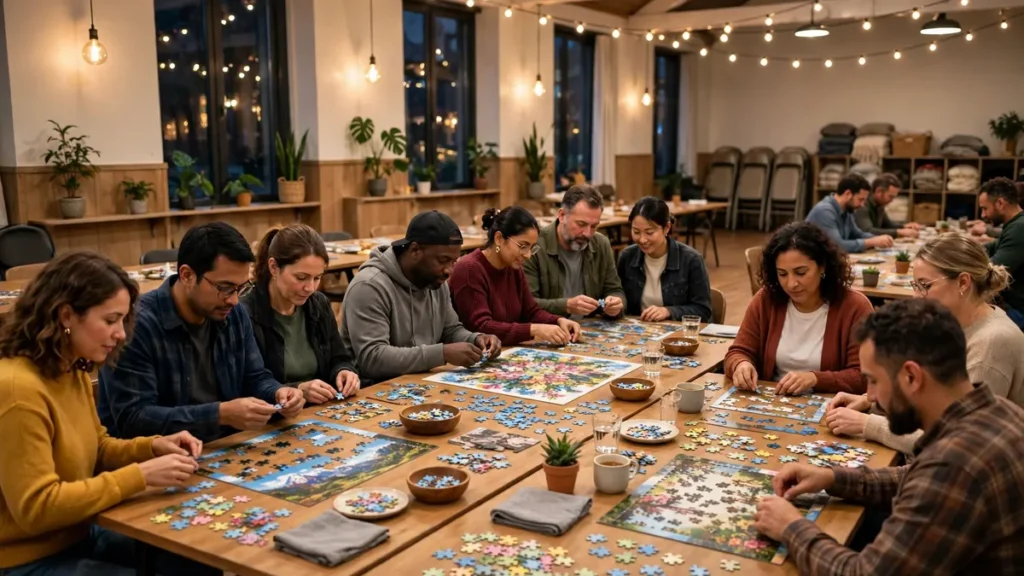
Finding the best puzzle games for 66 players is a very different challenge from choosing a puzzle game for a family evening or a small group of friends. Sixty-six players is not a table full of people. It is a hall full of teams, a school event, a company social, a fundraiser, or a community night where the room itself becomes part of the game. The puzzle games that work at this scale are the ones that let dozens of people play at the same time, keep every team busy, and still feel fair when the final scores are read out.
Most puzzle games are designed for two to six players, so running them for 66 people takes a plan rather than a single box. You need games that split cleanly into teams, rounds that move quickly, and scoring that a host can manage without losing the room. The good news is that puzzle games are unusually well suited to very large groups. They need no athletic ability, no special equipment beyond paper, cards, or a screen, and they give quieter players a real role alongside the loudest voices in the room.
This guide covers the formats that actually work for 66 players, from jigsaw races and escape-room style challenges to logic puzzles, word puzzles, and digital quiz rounds. Each recommendation has been chosen because it scales, it keeps the energy up, and it can be set up by one or two hosts. If you are planning a large game night, start with the format first, then pick the games that fit it.
Key takeaways
- Split 66 players into 11 teams of 6 for the best balance of teamwork and speed.
- Choose puzzle games that run in parallel rounds so nobody waits around between turns.
- Mix jigsaw, word, logic, and escape-room style puzzles to suit different strengths.
- Use a visible scoreboard and a strict timer to keep a large room focused and fair.
- Test every puzzle in advance and prepare a tiebreaker round before the night begins.

Why 66 Players Changes the Puzzle Game
A puzzle game for six people can be slow, thoughtful, and open-ended. A puzzle game for 66 people cannot. With eleven teams in the room, every minute of dead time is multiplied eleven times over, and a single confusing instruction can stall the whole evening. The best puzzle games for 66 players are therefore the ones with simple rules, clear goals, and a finish line everyone can see. If a game needs ten minutes of explanation, it is the wrong game for a crowd this size.
Team size matters more than most hosts expect. Teams of six work well because everyone can see the puzzle, reach the pieces, and contribute without talking over each other. Teams of eleven or twelve, by contrast, leave half the players watching instead of playing. Eleven teams of six also makes the maths easy: eleven identical puzzle sets, eleven score sheets, and a leaderboard with eleven rows. When you compare this with the setup used for puzzle games for 65 players, the difference is small but real, because 66 divides neatly into teams of six while 65 does not, and that neat division saves the host a surprising amount of fiddling on the night.
Space is the other factor that changes at this scale. Sixty-six players need roughly eleven tables, room to move between them, and a central spot where the host can be seen and heard. Before you choose any game, walk the room, count the tables, and check the sound. A puzzle night fails more often because of bad acoustics and cramped tables than because of bad puzzles.
How to Run Puzzle Games for 66 Players
Running puzzle games for 66 players is mostly a matter of structure. The puzzles themselves are the easy part. The hard part is keeping eleven teams moving in step, scoring fairly, and finishing on time. The structure below works for most venues and most groups, and it can be adjusted to fit a school hall, an office, a church hall, or a hired function room.
Form Teams of Six
Divide the 66 players into eleven teams of six before the night begins, and give each team a name, a table, and a colour. Pre-assigning teams avoids ten minutes of awkward shuffling at the start, and it stops friendship groups from clustering into one super-team while strangers sit alone. Mix ages, experience, and confidence levels across the teams if you can. A team with one strong word puzzler, one visual thinker, and one fast finisher will beat a team of six identical players almost every time.
Each team needs a captain who collects the answer sheets, keeps the time, and talks to the host. The captain is not the person who solves the most puzzles. The captain is the person who keeps the team organised, makes sure everyone has a job, and stops the team from arguing over a single clue while the clock runs down. Appoint captains in advance and tell them what the job involves, so they arrive ready rather than surprised.
Use Stations or Parallel Rounds
There are two reliable ways to run puzzle games for a crowd. The first is parallel rounds, where every team plays the same puzzle at the same time and the fastest correct finishers score the most points. The second is stations, where teams rotate between puzzle stations and collect points at each one. Parallel rounds are simpler to host and easier to score, while stations suit rooms with limited table space and groups that enjoy variety.
For a first large puzzle night, parallel rounds are the safer choice. Every team gets the same puzzle, the same time limit, and the same instructions, so there is nothing to argue about afterwards. Whichever format you choose, keep each round to fifteen minutes or less. Short rounds keep the energy high and let you fit five or six different puzzles into a two-hour evening.
Keep Score Visible and Simple
Score on a simple scale that everyone understands, such as ten points for a correct answer, five for a partial answer, and a bonus for the fastest team. Put the leaderboard where every team can see it, and update it between rounds rather than during them. A whiteboard, a projector, or even a large sheet of paper on the wall all work. What matters is that the scores are public, current, and correct.
Prepare a tiebreaker before the night begins, not when you discover two teams are level at the end. A single short logic puzzle or a quick word challenge makes a fair tiebreaker, and it gives the evening a proper climax instead of an awkward shared win. Announce the tiebreaker rule at the start so nobody feels it was invented to favour one team.
The Best Puzzle Games for 66 Players
The games below are the strongest choices for a group of 66, because each one scales to eleven teams, plays well in parallel rounds, and suits a mixed crowd. They cover jigsaw, word, logic, visual, and escape-room style play, so you can build a varied evening from this list alone. Mix at least three different types in one night, and the evening will feel like a proper puzzle event rather than a single game repeated.
1. Jigsaw Race
A jigsaw race is the simplest large-group puzzle game, and it is often the most popular. Give each team the same 500-piece jigsaw, start the timer, and award points to the teams that finish first or complete the most pieces in the time limit. Jigsaws work because everyone can help at once: one person sorts edges, another builds the sky, and another hunts for a single colour. Nobody is left waiting for a turn.
Choose puzzles with clear, colourful images and distinct regions, so teams can split the work sensibly. Avoid puzzles with large areas of plain sky or sea, which slow everyone down and frustrate beginners. A 500-piece puzzle is the right size for a twenty-minute round with teams of six.
2. Escape Room in a Box
Escape room games in a box bring the excitement of a real escape room into a hall full of teams. Each team gets an identical box or envelope containing a series of linked puzzles: a code to crack, a lock to open, a hidden message to find. The first team to escape wins the round. These games are ideal for 66 players because every team works independently and the host only needs to check the final answer.
Pick escape games designed for a single sitting of about forty-five minutes, and run them as one long round. Make sure each box contains exactly the same contents, and count the pieces before the night so no team is short a clue. If buying eleven identical boxes is too expensive, print your own escape-room style puzzle chain on paper.
3. Logic Puzzle Relay
A logic puzzle relay turns quiet solo puzzles into a team race. Each team receives a set of short logic puzzles, such as grid puzzles, sequence puzzles, or deduction challenges, and must solve them in order. A team cannot move to the next puzzle until the current one is correct, which keeps the race honest and stops teams from skipping the hard ones. The relay format also means a single strong logic thinker cannot carry a team alone, because the puzzles come thick and fast.
Keep each puzzle short enough to solve in two or three minutes, and print the answers on a separate sheet for the host. Ten puzzles per relay is a good number for a thirty-minute round. Vary the puzzle types so that different team members shine at different stages.
4. Word Puzzle Tournament
Word puzzles are a natural fit for large groups because they need nothing more than paper and pencils. Run a tournament of short rounds: anagrams, word ladders, cryptic clues, and word searches, each lasting five to ten minutes. Award points per round and keep a running total, so a team that is weak at anagrams can catch up in the word search. This format rewards breadth rather than a single skill, which keeps more teams in contention until the end.
Word puzzles also travel well between age groups, which matters when your 66 players include teenagers, parents, and grandparents. Choose clues that rely on general knowledge and wordplay rather than obscure vocabulary. A well-chosen word round is one where every team gets at least half the answers right, so the room stays noisy and confident rather than silent and stuck.
5. Picture Puzzle Challenge
Picture puzzles suit players who think visually rather than verbally, and they add welcome variety to a night of word and logic games. Show a series of images on a screen: spot the difference, find the hidden object, identify the close-up, or solve a rebus made of pictures. Teams write down their answers and hand them in before the next image appears. The whole room plays at once, which makes picture rounds feel like a shared event rather than eleven separate games.
Picture rounds are also the easiest to host, because the host controls the pace from the front of the room. Keep each image on screen for thirty to sixty seconds, and use large, high-contrast images that can be seen from the back tables. Test the screen from the furthest seat before the night.
6. Digital Puzzle Quiz
A digital puzzle quiz uses phones or tablets to run puzzle rounds on a big screen, with teams answering together from their tables. Platforms that support team play let all eleven teams answer the same puzzle at the same time, and the scores update automatically. This removes the need for paper answer sheets and makes scoring instant, which is a real advantage when you are hosting alone.
Digital rounds work best as a change of pace between physical puzzles, rather than as the whole evening. Two or three digital rounds mixed with jigsaw, word, and logic puzzles give the night variety without turning it into a screen-staring session. Check the venue Wi-Fi in advance, and have a paper backup ready. Many hosts pair a digital round with a traditional format, and the combination works well alongside trivia games for 66 players when the group wants a mix of puzzles and general knowledge.
Comparison Table: Puzzle Games for 66 Players
Use this table to compare the leading options at a glance. Setup time is for a host preparing eleven identical team sets, and the best round length is the time that keeps the game tense without letting it drag.
| Game | Best For | Setup Time | Round Length | Cost Level |
|---|---|---|---|---|
| Jigsaw Race | All ages, hands-on teams | Low | 20 minutes | Medium |
| Escape Room in a Box | Drama and teamwork | Medium | 45 minutes | High |
| Logic Puzzle Relay | Serious puzzlers | Low | 30 minutes | Low |
| Word Puzzle Tournament | Mixed ages and abilities | Low | 10 minutes per round | Low |
| Picture Puzzle Challenge | Visual thinkers | Medium | 15 minutes | Low |
| Digital Puzzle Quiz | Fast scoring | Medium | 15 minutes | Low |
Choosing the Right Format for Your Group
The right format depends on who your 66 players are. A school group with teenagers will love a digital quiz, while a corporate social with mixed ages will do better with a jigsaw race and a word tournament. A fundraiser audience that has paid for tickets will expect a polished evening with a visible leaderboard and a proper prize, while a casual community night can be looser and more playful. Match the format to the audience, not the other way round.
Budget matters too. Logic puzzles and word puzzles cost almost nothing beyond printing, while eleven identical jigsaws and eleven escape-room boxes cost real money. If the budget is tight, build the evening around the low-cost games and use one higher-cost game as the centrepiece.
Finally, consider the room. A hall with eleven tables and a projector suits parallel rounds and picture challenges. A building with corridors and side rooms suits a puzzle hunt. A small room with limited tables suits a digital quiz and a riddle relay, because teams can play from wherever they are sitting. Walk the space, count the tables, test the screen, and then choose the games that fit the space you actually have. The same thinking applies when you plan a mixed games night, and it is worth reading about board games for 65 players if you want to combine puzzle rounds with classic board games for a similar-sized crowd.
Checklist for a 66-Player Puzzle Night
- Split 66 players into 11 teams of 6, with a named captain and a table for each team.
- Prepare 11 identical sets of every puzzle, and count the pieces before the night.
- Test every puzzle yourself, and time how long it really takes to solve.
- Set up a visible scoreboard and agree the scoring rules before the first round.
- Prepare a tiebreaker puzzle and announce it as part of the rules at the start.
- Have a paper backup for any digital round, and check the venue Wi-Fi in advance.
Frequently Asked Questions
How long should a puzzle night for 66 players last?
Two to two and a half hours is the right length for most groups. That allows for five or six rounds, short breaks between rounds, and a prize ceremony at the end. Build in a ten-minute break halfway through, and keep the rounds tight so the evening finishes on time.
What is the best team size for 66 players?
Teams of six are the best size, giving eleven teams in total. Six is small enough that everyone can reach the puzzle and contribute, and large enough that a team has a mix of skills. Teams of four leave you with too many teams to manage, while teams of eleven leave half the players watching instead of playing.
Do I need eleven copies of every game?
For parallel rounds, yes. Every team needs the same puzzle at the same time, or the scoring is not fair. For station rounds, you need one copy per station rather than one per team, which can save money. For screen-based rounds such as picture puzzles, you need only one copy, because the whole room plays together.
How do I keep scoring fair with 66 players?
Use simple scoring, publish the rules before the first round, and keep the leaderboard visible. Award the same points for the same achievement in every round, and have a second person check the scores before you announce them. A tiebreaker decided in advance removes the hardest argument of the night before it happens.
Can children and adults play together in a 66-player puzzle night?
Yes, if you mix the teams and choose puzzles that suit a range of ages. Word puzzles, jigsaws, and picture rounds work well across generations, while very hard logic puzzles can leave younger players behind. Choose a mix of puzzle types so every age group has a round where they shine.
What prizes work best for a large puzzle night?
Small prizes for the winning team work better than one large prize, because a team of six cannot share a single item easily. Puzzle books, board games, or gift vouchers split well between six people. Announce the prizes at the start so teams have something concrete to play for.
The Bottom Line
The best puzzle games for 66 players are the ones that split cleanly into eleven teams of six, run in short parallel rounds, and mix jigsaw, word, logic, visual, and escape-room style play. Keep the rules simple, the scores visible, and the rounds short, and a crowd of 66 will play like a room full of small teams rather than a crowd waiting for something to happen. Plan the format first, test every puzzle in advance, and prepare a tiebreaker before the night begins, and your puzzle night will run smoothly from the first round to the final scores.


