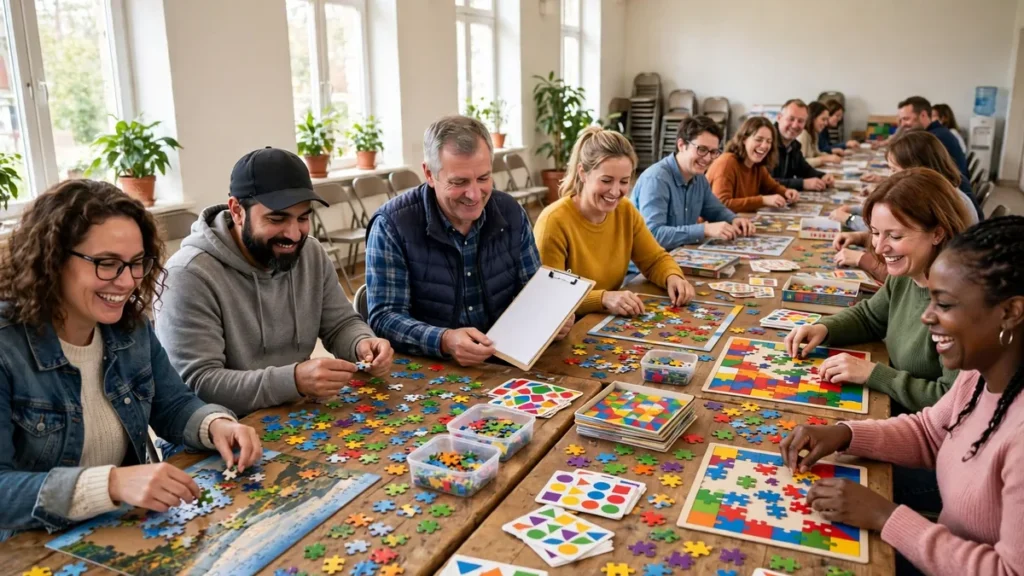
The best puzzle games for 345 players are the ones that let everyone play at the same time. A crowd of 345 is larger than most wedding receptions, school assemblies, and company parties, so a game built for six people around a kitchen table will not work here. What works instead is a format built on teams, simultaneous rounds, and simple scoring that a room full of people can follow without a long explanation.
Most organisers make the same mistake when they plan a very large puzzle event. They choose a clever game, then discover that only a small group can touch it while everyone else watches. The best puzzle games for 345 players avoid that problem completely. They use team tables, relay stations, shared scoreboards, and timed rounds, so every player has a piece, a card, or a clue in hand within the first five minutes.
This guide brings together ten formats that genuinely scale to 345 players, from giant jigsaw relays and logic races to escape-room stations and digital puzzle tournaments. You will find a comparison table, practical setup advice, a checklist, and answers to the questions organisers ask most, so you can run a smooth event whether it is a school fundraiser, a corporate away day, a community festival, or a family reunion.
Key takeaways
- Choose games where all 345 players act at the same time, so nobody waits for a turn.
- Split the crowd into teams of eight to twelve players, each with a captain, a table, and a score sheet.
- Keep every rule to one page and explain it in under two minutes before the first round starts.
- Use large pieces, large print, a loud scoreboard, and clear round timers that everyone can see.
- Mix jigsaw, logic, word, and escape-room rounds so different strengths all get a chance to shine.
How Puzzle Games Work for 345 Players
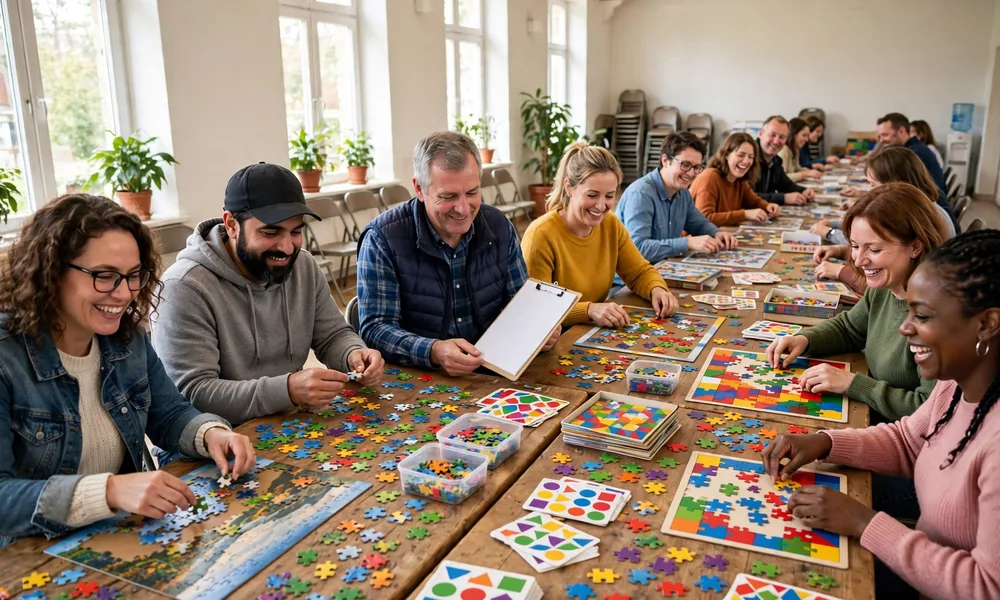
A puzzle game for 345 players is less about one board and more about a system. The room becomes a set of stations, each one running the same puzzle at the same time, with teams rotating or competing in parallel. A single host, a clear timer, and a visible scoreboard hold the whole event together, even when the crowd fills a hall, a gym, or a marquee.
The maths is simple. Divide 345 players into teams of ten and you have 34 or 35 teams, each needing only one table, one puzzle set, and one captain. Teams of twelve give you 29 teams. Either way, a host, a scorekeeper, and one helper per four or five tables can run the event.
Timing matters just as much as team size. Short rounds of ten to fifteen minutes keep energy high, and teams that finish early can move to a bonus puzzle, while teams that struggle still earn points for partial progress.
Comparison Table: The Best Puzzle Games for 345 Players
| Game format | Best for | Round length | Equipment needed | Difficulty |
|---|---|---|---|---|
| Giant jigsaw relay | All ages, mixed skill | 20 minutes | Large puzzles, tables | Easy |
| Logic puzzle race | Sharp thinkers | 15 minutes | Printed grids, pens | Medium |
| Escape-room stations | Teamwork, drama | 20 minutes | Lock boxes, clues | Medium |
| Word puzzle sprint | Word lovers | 10 minutes | Word grids, timers | Easy |
| Picture puzzle hunt | Families, casual players | 15 minutes | Printed images, clues | Easy |
| Digital puzzle tournament | Tech-friendly groups | 15 minutes | Phones, tablets, Wi-Fi | Medium |
| Riddle relay | Quick thinking | 10 minutes | Riddle cards, buzzers | Easy |
| Pattern and tile challenge | Visual thinkers | 15 minutes | Tile sets, pattern cards | Medium |
| Mystery box challenge | Curious teams | 20 minutes | Sealed boxes, clues | Hard |
| Team crossword championship | Word and trivia fans | 20 minutes | Large crosswords, pens | Medium |
The 10 Best Puzzle Games for 345 Players
1. Giant Jigsaw Relay
The giant jigsaw relay is the simplest large-scale puzzle game, and often the most popular. Each team gets the same large jigsaw, usually 500 pieces, and races to finish as much as possible in twenty minutes. Teams split the work naturally, with some players sorting edges, others sorting colours, and one player placing pieces in the centre. The relay element comes from a simple twist: every five minutes, each team sends two players to help a neighbouring team, then returns with a fresh idea.
This format works because jigsaw puzzles need no explanation and no special skill. A five-year-old and a seventy-year-old can both contribute, which matters in a mixed crowd of 345. Choose puzzles with clear, colourful images and large pieces, and avoid dark or repetitive scenes that slow everyone down. Score teams by pieces placed, not just by finishing, so every team earns points for honest progress.
2. Logic Puzzle Race
A logic puzzle race gives every team the same set of grid puzzles, Sudoku-style challenges, and deduction problems, printed in large type on separate sheets. Teams work through them in order, earning points for each correct answer, and the host calls time after fifteen minutes. The format suits players who enjoy quiet concentration, and it balances the noisier, faster games in the programme.
Keep the puzzles varied in difficulty so that every team can solve the first few and feel successful. Include one easy warm-up, two medium puzzles, and one hard puzzle per round, and let teams choose the order after the warm-up. Print answer sheets separately and collect them at the end of each round, so scoring stays fast and fair. A logic race also works well as a calm round between two high-energy games.
3. Escape-Room Stations
Escape-room stations bring drama and teamwork to a large puzzle event. Set up six to eight identical stations around the room, each with a lock box, a set of clues, and a short story, such as escaping a library or opening a treasure chest. Teams rotate through the stations in turn, with twenty minutes to solve each one, and helpers reset the clues between groups.
The key is to make each station self-contained and resettable in under two minutes. Use combination locks with codes that can change quickly, and keep clues in labelled envelopes so a helper can check them at a glance. If you want inspiration for the kinds of puzzles that work well in this format, look at escape room board games, which use the same mix of codes, hidden clues, and teamwork on a smaller scale. For 345 players, the station model is what makes that same excitement possible for everyone.
4. Word Puzzle Sprint
A word puzzle sprint is a ten-minute burst of anagrams, word searches, and crossword clues, and it is ideal for warming up a large crowd. Each team gets the same printed pack, and players divide the pages among themselves, calling out answers as they find them. The short time limit keeps the pace fast, and the shared pack means that a strong speller and a quick pattern-spotter can both contribute.
Choose words that most adults will know, and avoid obscure vocabulary that frustrates casual players. Mix easy anagrams with a few tricky ones, and add a bonus round where teams must make the longest word they can from a set of letters. Score by correct answers, with a small bonus for the longest word, and announce the leaders after each sprint so the room stays engaged.
5. Picture Puzzle Hunt
A picture puzzle hunt turns the whole venue into a puzzle. Teams receive a set of cropped or close-up photographs and must match each one to a location, object, or poster in the room. Each correct match earns points, and teams can also earn bonus points by solving a short riddle that leads to the next picture. The hunt works well for families and casual players who prefer moving around to sitting at a table.
Plan the hunt carefully so that teams do not crowd the same spot. Stagger the starting pictures, so each team begins at a different point, and use clear boundaries so nobody wanders into another event. Keep the pictures large and clear, and test the route yourself before the event starts. A picture hunt is also a good way to use outdoor space on a fine day, with pictures hidden around a garden or courtyard.
6. Digital Puzzle Tournament
A digital puzzle tournament uses phones or tablets, with every team playing the same puzzle app or web game at the same time. The host starts a timer, teams solve as many levels as they can, and scores are submitted through a simple form or shown on screen. This format is clean, fast to set up, and easy to score, as long as the Wi-Fi holds up under the load of 345 devices.
Test the connection in advance, and choose games that work offline or with low data use if the venue Wi-Fi is weak. For ideas on which apps suit adult players, the guide to puzzle apps for adults is a useful starting point, because it focuses on games with clear levels, fair difficulty, and no long tutorial. Ask teams to bring at least one charged device per team, and keep a few spare tablets ready for teams that have none.
7. Riddle Relay
A riddle relay is fast, funny, and perfect for a large room. The host reads a riddle aloud, teams write down their answer, and the first teams to answer correctly earn points. After each riddle, the host moves on quickly, so the room never waits long. Ten riddles in ten minutes is a good pace, with a mix of easy, medium, and hard riddles to keep every team in the game.
Choose riddles with clear, single answers, and avoid riddles that depend on a trick of wording that only some players will know. Read each riddle twice, and display it on a screen as well as reading it aloud, so players at the back can follow. A riddle relay works well as an opening round, because it needs no equipment and it gets the whole room laughing and thinking together.
8. Pattern and Tile Challenge
A pattern and tile challenge suits visual thinkers. Each team gets a set of coloured tiles and a series of pattern cards, and must copy or complete each pattern as quickly as possible. The first patterns are simple, with later ones adding rotation, symmetry, and missing pieces. Teams earn points for each correct pattern, and the host checks them with a quick glance at the finished tile layout.
Use large, sturdy tiles that are easy to handle and hard to lose, and keep spare sets ready in case a tile goes missing. Print pattern cards in large, high-contrast colours, and laminate them so they survive a long event. This game is quieter than a riddle relay, so it works well as a middle round when the room needs a calmer pace before the final.
9. Mystery Box Challenge
A mystery box challenge is the most theatrical format on this list. Each team receives a sealed box containing a puzzle, a set of clues, and a small locked compartment. Teams must solve the clues in order to open the compartment and find the final answer. The box format creates a real sense of discovery, and teams often remember it as the highlight of the event.
Keep the boxes identical, so every team faces the same challenge, and test each box yourself before the event. Use simple locks and clear clues, and give helpers a master list of answers so they can offer a hint if a team gets stuck. A mystery box round takes about twenty minutes, so schedule it near the end of the programme, when teams are warmed up and ready for a harder challenge.
10. Team Crossword Championship
A team crossword championship brings the programme to a satisfying close. Each team gets the same large crossword, printed on a big sheet so several players can work on it at once. Teams fill in as many answers as they can in twenty minutes, with points for each correct word and a bonus for completing a full row or column. The shared sheet encourages discussion, and even players who rarely do crosswords can help with a single clue.
Choose a crossword with a mix of general knowledge, wordplay, and themed clues, and avoid clues that only a specialist would know. Provide a word list or a few starter letters for teams that need a boost, and collect the sheets promptly when time ends. Announce the final scores, celebrate the winners, and give every team a small prize or certificate, so the event ends on a warm note.
How to Run a Puzzle Event for 345 Players
Start planning at least four weeks before the event, and confirm the venue, tables, and helpers first. Visit the venue, check the lighting and power points, and test the Wi-Fi if you plan a digital round.
Recruit helpers early and give each one a clear role: a host, a scorekeeper, a timekeeper, and one helper for every four or five tables. Brief them the day before, walk them through each game, and give them a printed schedule.
On the day, arrive early and set up each table with its first puzzle, pens, and a score sheet. Welcome teams, give each captain a schedule, and explain the first game in under two minutes. Keep rounds short, announce scores regularly, and leave a ten-minute break in the middle.
Scoring should be simple, visible, and fair. Use a large scoreboard and update it after every round. Award points for partial progress, not just for finishing, and use a short tie-breaker riddle if the final scores are close.
Choosing the Right Mix for Your Crowd
A good programme for 345 players usually includes six to eight rounds in a three-hour session, mixing quiet and noisy games, sitting and moving games, and easy and hard challenges. Start fast, follow with a calm round, and finish with a dramatic final such as the mystery box or the crossword championship. School groups enjoy the riddle relay and picture hunt, corporate groups prefer logic races and escape-room stations, and family reunions suit jigsaw relays and word sprints. The ideas in board games for large groups can also help with table layout, team size, and pacing, because the same scaling principles apply to both.
Event Checklist for 345 Players
- Confirm the venue, tables, chairs, lighting, and Wi-Fi at least four weeks before the event.
- Divide 345 players into teams of eight to twelve, and name a captain for each team.
- Prepare one puzzle set per team, plus spare sets, pens, score sheets, and timers.
- Brief helpers, the host, the scorekeeper, and the timekeeper the day before the event.
- Set up a visible scoreboard, a clear schedule, and a loud timer that every table can see and hear.
- Test every puzzle, lock, app, and clue yourself, and pack spares for anything that could break or go missing.
Frequently Asked Questions
Can 345 players really play puzzle games together?
Yes, as long as the games use teams and simultaneous rounds. No single puzzle can hold 345 people, but 29 to 35 teams can each play the same puzzle at the same time, with a host, a timer, and a scoreboard holding the event together. The team model is what makes a very large puzzle event possible.
How many teams should 345 players form?
Teams of eight to twelve players work best. That gives you 29 teams at twelve players each, or 35 teams at ten players each, with a few spare places. Teams of this size are large enough to split the work, yet small enough for every player to contribute and be heard.
How long should a puzzle event for 345 players last?
Plan for about three hours, including a break. Six to eight rounds of ten to twenty minutes each, plus welcome time, a break, and a short awards ceremony, fits comfortably into three hours. Shorter events feel rushed, while longer events tire players out.
What equipment do I need for 345 players?
You need one puzzle set per team, plus spares, pens, score sheets, timers, and a visible scoreboard. Long tables, good lighting, and clear aisles are essential. For a digital round, ask each team to bring at least one charged phone or tablet, and test the venue Wi-Fi in advance.
Are puzzle games suitable for mixed ages and abilities?
Yes, if you mix the formats. Jigsaw relays, word sprints, and picture hunts suit all ages, while logic races and mystery boxes challenge stronger players. A mixed programme means that every player, whatever their age or skill, can contribute to their team.
How do I keep scoring fair for 345 players?
Use simple scoring, award points for partial progress, and update a visible scoreboard after every round. Collect answer sheets promptly, use helpers to check answers, and use a short tie-breaker riddle if the final scores are close. Clear rules, announced before the first round, prevent most disputes.
Bottom Line
The best puzzle games for 345 players are not the cleverest games, but the ones that scale. Pick formats where everyone plays at the same time, split the crowd into teams of eight to twelve, keep the rules short, and mix jigsaw, logic, word, and escape-room rounds so every strength gets a turn. With a good venue, a clear schedule, briefed helpers, and a visible scoreboard, 345 players can solve, laugh, and compete together in a single memorable event.