
Finding the best puzzle games for 333 players sounds almost impossible at first. Three hundred and thirty-three people is not a living-room game night; it is a school assembly, a company conference, a festival crowd, or a whole community gathered in one place. Most puzzle games are designed for two to six players, so scaling one up to hundreds of people takes a different kind of planning. The good news is that it can be done, and when it works, it is one of the most memorable group activities you will ever run.
The best puzzle games for 333 players share a few qualities. They use simple rules that anyone can learn in under two minutes, they split the crowd into small teams that work at the same time, and they give every team the same puzzle so the result is fair. They also keep everyone busy at once, because nothing kills a giant group game faster than three hundred people standing around watching ten people play. The games in this guide were chosen because they meet all of those tests.
In this guide you will find jigsaw races, logic puzzles, word puzzles, escape-room style challenges, and digital puzzle rounds that all scale to a crowd of 333. You will also find a step-by-step plan for running the event, a comparison table to help you choose, and a checklist that covers the materials, the room, and the scoring. Whether you are planning a school event, a corporate day, a church gathering, or a community festival, you can use these games exactly as described.
Key takeaways
- Split 333 players into small teams of 5 to 9 people so everyone gets a real role and nobody is left watching.
- Choose puzzles with rules that take less than two minutes to explain, because long explanations lose a crowd of this size.
- Give every team the same puzzle at the same time so the competition is fair and the finish is easy to judge.
- Run several short rounds instead of one long game so energy stays high and late arrivals can still join in.
- Prepare spare puzzles, extra answer sheets, and a clear scoring board before the event starts.
Why Puzzle Games Work for 333 Players
Puzzle games work for huge groups because they do not need everyone to be in the same place doing the same small thing. A puzzle can be copied, printed, projected, or handed out in identical sets, so three hundred people can all start at the same moment. Unlike a ball game, where only a few players touch the ball, a puzzle gives every single person a piece of the problem to solve. That shared starting line is what makes a puzzle event feel fair.
They also work because puzzles welcome every age and ability level. A ten-year-old and a seventy-year-old can both spot a pattern, find a word, or place a jigsaw piece. You do not need speed, strength, or special knowledge to take part, and that matters when your group includes children, older adults, and people who have never met each other. A good puzzle lets quiet people shine just as much as loud ones.
How to Organise 333 Players
The single most important decision is team size. With 333 players, teams of six give you about fifty-five teams, which is easy to manage if you number the tables and hand each team a colour. Teams of nine give you thirty-seven teams, which means fewer tables but more talking inside each team. Either size works, but teams larger than ten start to leave people out, because only a few voices get heard. Keep teams small enough that everyone can see the puzzle.
Use a central scoreboard that everyone can see. A large whiteboard, a projected spreadsheet, or a simple chart on the wall all work well. Update it after every round so teams can see where they stand. Visible scores create excitement without any extra effort from the host, and they stop arguments about who is winning. Announce the top five teams after each round and give a small cheer for the team in last place too, so nobody feels left out.
Setting Up the Room
Arrange tables in rows with clear walkways between them so the host and helpers can reach every team quickly. Each table needs enough space for the puzzle, the answer sheets, and a pencil for every player. If you are using jigsaws, give each team a tray or a large sheet of card so pieces do not slide off the table. Put a number card on every table that matches the team list, and tape the team list to the door so people can find their place without asking.
Timing Each Round
Keep rounds short. Ten to fifteen minutes is the sweet spot for most puzzle rounds with a crowd this size. Short rounds keep energy up, let you run five or six different games in an afternoon, and mean that a team that struggles in one round can recover in the next. If a round runs longer than twenty minutes, attention drops and people start chatting about other things. Set a visible timer on the screen so every team can see how long is left.
The Best Puzzle Games for 333 Players
The games below are ordered from the easiest to set up to the most ambitious. Every one of them has been chosen because it scales cleanly to 333 players, needs little or no special equipment, and keeps every team active at the same time. Mix and match them to build an afternoon that suits your group, your room, and your budget.
1. Giant Jigsaw Race
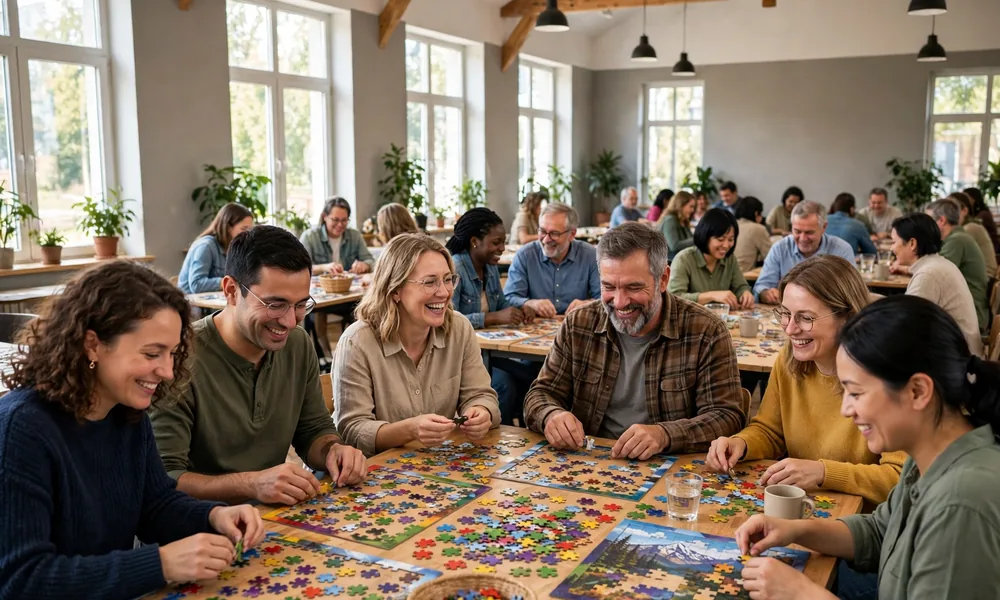
The giant jigsaw race is the simplest big-group puzzle and often the most popular. Buy or borrow one identical jigsaw puzzle for every team, with the same picture and the same number of pieces. A 100-piece puzzle suits mixed ages, while a 300-piece puzzle suits adults who want a real challenge. Every team opens its box at the same signal and races to finish first. The first team to complete the picture and raise a hand wins the round.
To keep the race fair, check that every box is sealed before the event and that no team opens theirs early. Give each team a flat board or a sheet of card to build on, and remind teams that pieces on the floor do not count. If you have fewer puzzles than teams, pair two small teams together or run the race in two heats. A jigsaw race works beautifully as the opening game because it gets everyone talking within seconds.
2. Team Logic Puzzle Challenge
Logic puzzles are perfect for large groups because they cost almost nothing to run. Print the same logic grid puzzle for every team, such as a puzzle where teams must work out who owns which pet, lives in which house, and likes which colour. Give each team one printed copy and a pencil, and set a fifteen-minute limit. Teams that solve the puzzle correctly score points, with bonus points for the fastest correct answers.
The best logic puzzles for a crowd have a single clear answer and clues that can be split up. One team member can work on the first three clues while another works on the next three, so the whole team stays busy. Avoid puzzles that need specialist knowledge, such as advanced maths or science facts, because they favour a few experts and leave the rest of the team out. Choose puzzles that reward careful reading and teamwork instead.
3. Word Search Relay
A word search relay turns a quiet solo puzzle into a noisy team race. Print a large word search grid for every team, with the same twenty hidden words. Teams must find all twenty words and circle them, then bring the finished sheet to the scoring table. The first team to hand in a fully correct sheet wins, and every other team keeps working until the time runs out. Partial credit goes to teams that find the most words.
To make the relay more exciting, hide the word list until the round starts, and theme the words to your event. A school event might use science words, a company day might use words from the company values, and a community festival might use local place names. Themed words make the game feel personal and give teams something to talk about afterwards. Print the grids large enough to read from across a table, with at least fourteen-point type.
4. Escape Room in a Box
An escape-room style challenge sounds too complex for 333 people, but it works if you turn it into a paper-based puzzle hunt. Give every team the same sealed envelope containing five small puzzles: a code to crack, a riddle to solve, a pattern to complete, a word lock combination, and a final question. Teams must solve the puzzles in order, because each answer unlocks the next clue. The first team to open the final envelope and read the winning message takes the round.
Prepare the envelopes the day before, and number them so you know which team has which set. Keep the puzzles short: each one should take two or three minutes for a team working together. Use simple codes, such as a number code where each letter is shifted by one, or a puzzle where teams count objects in a picture. Test the whole chain yourself before the event, because one broken clue stops every team at the same point.
5. Puzzle Quiz Showdown
A puzzle quiz showdown uses a projector and a microphone to turn puzzle solving into a show. The host shows a puzzle on the big screen, such as a rebus, a visual brain teaser, a sequence to complete, or a spot-the-difference picture. Teams write their answer on a small whiteboard or a sheet of paper and hold it up when the time is up. Correct answers score a point, and the scoreboard is updated after every question.
This format is ideal for a crowd of 333 because everyone looks at the same screen at the same time, and nobody needs any materials except an answer sheet. It also lets the host add humour, music, and commentary between questions, which keeps the energy high. Prepare at least twenty questions so you can drop any that fall flat, and mix easy questions with hard ones so every team scores at least a few points.
6. Digital Puzzle Rounds
If your venue has good Wi-Fi and most players have a phone, digital puzzle rounds can add variety to the day. Teams join the same quiz or puzzle app using a team code, and the host runs rounds of picture puzzles, anagrams, and quick logic questions from a laptop. Scores appear on the screen automatically, which saves the host a lot of counting. Digital rounds are fast, colourful, and easy to run once the technology is set up.
Test the Wi-Fi before the event with as many devices as you can, because a hall full of phones can overload a weak network. Always have a paper backup ready, so that if the connection fails you can switch to printed puzzles without losing the afternoon. Keep digital rounds short, around ten minutes each, and mix them with hands-on games so players are not staring at screens all day.
Choosing the Right Mix for Your Group
Not every group needs the same games. A school group with children aged eight to twelve will enjoy jigsaws, word searches, and picture quizzes, while a corporate group of adults may prefer logic puzzles, escape-room challenges, and digital rounds. A mixed community group needs a blend, with at least one game that suits children and one that suits adults. Think about who is coming before you choose your games, and pick at least one game that every age can enjoy.
For a similar scale of event, the puzzle games for 331 players guide uses the same team structure and round format, so it is a useful companion if you are planning a series of large puzzle events. The format scales up or down by simply adding or removing teams, which is why it works for crowds of any size.
Comparison Table
| Game | Setup time | Cost per team | Best for | Round length |
|---|---|---|---|---|
| Giant jigsaw race | 15 minutes | Medium | Opening game, all ages | 20 minutes |
| Team logic puzzle challenge | 5 minutes | Low | Quiet thinking, mixed ages | 15 minutes |
| Word search relay | 5 minutes | Low | Calm round, themed events | 10 minutes |
| Escape room in a box | 60 minutes | Low | Mid-event challenge | 25 minutes |
| Puzzle quiz showdown | 20 minutes | Low | Closing game, whole hall | 20 minutes |
| Digital puzzle rounds | 30 minutes | Low | Teens, corporate groups | 10 minutes |
Scoring That Keeps Everyone Happy
Fair scoring is what turns a good puzzle day into a great one. Use the same points for every round, or scale the points so later rounds are worth more, which keeps the competition open until the end. A simple system is ten points for first place, eight for second, six for third, and one point for every team that finishes. That way every team scores something, and the winner is not decided after the first round.
Always check answers carefully before announcing results. Have two helpers mark the sheets independently, or use an answer key that is clear enough for a quick check. Mistakes in scoring cause more arguments than any other part of a puzzle event, so take an extra minute to get it right. If two teams tie, use a quick tie-breaker question rather than sharing the points, because a single winner makes a better finish.
Checklist for Your 333-Player Puzzle Event
- Book a hall with enough tables and chairs for 333 players, plus clear walkways for helpers.
- Print team lists, number cards for every table, and ten percent extra puzzle sheets and answer sheets.
- Test the microphone, speaker, projector, and timer the day before the event.
- Prepare one identical puzzle set per team and label every box and envelope with its team number.
- Brief your helpers on scoring, timing, and how to answer team questions through the microphone.
- Set up a visible scoreboard and a small prize for the top three teams and the best team name.
Frequently Asked Questions
How many teams should 333 players be split into?
Teams of six give you about fifty-five teams, and teams of nine give you thirty-seven teams. Both sizes work well. Choose six if you want more teams and a livelier competition, or nine if you have fewer tables. Avoid teams larger than ten, because quieter players start to get left out and the puzzle becomes the work of only two or three people.
What is the best first puzzle game for a crowd of 333?
The giant jigsaw race is the best opening game for most groups. It needs no explanation beyond the starting signal, it gets every team talking within seconds, and it creates a clear, exciting finish. If jigsaws are too expensive for your budget, start with a word search relay instead, which needs only printed sheets and still gives every team a fair race.
How long should a puzzle event for 333 players last?
Plan for two to three hours, including breaks. That gives you time for four to six rounds of ten to twenty-five minutes each, plus time for introductions, scoring, and prizes. Shorter events feel rushed with a crowd this size, while events longer than three hours lose energy. If you have a full day, run puzzle games in the morning and a different activity in the afternoon.
Do puzzle games work outdoors for 333 players?
Yes, but choose your games carefully. Laminated word searches, logic puzzles on clipboards, and quiz rounds with a loudspeaker all work outdoors. Avoid loose jigsaw pieces and small paper puzzles on a windy day, because pieces blow away and teams lose time searching the grass. Bring weights or clips to hold sheets down, and have an indoor backup plan if the weather changes.
What ages can play puzzle games for 333 players?
All ages can play, as long as you choose the right puzzles. Children aged eight and over enjoy jigsaws, word searches, and picture quizzes, while teenagers and adults enjoy logic puzzles and escape-room challenges. For a mixed-age event, put a mix of ages in every team so younger players and older players can help each other. That mix is often what makes the day special.
How much does it cost to run puzzle games for 333 players?
Most events cost very little. Paper-based games such as logic puzzles and word searches cost only printing, which is a few pounds or dollars for the whole group. The main cost is jigsaw puzzles if you run a giant jigsaw race, but you can borrow those from a library or community group. The puzzle games for 330 players guide breaks down similar costs for a crowd of almost the same size, and the puzzle games for 329 players guide shows how the same format works with slightly fewer teams.
The Bottom Line
The best puzzle games for 333 players are the ones that give every person a job, use rules anyone can learn in two minutes, and let all teams start and finish together. Split the crowd into small teams, run short rounds, keep the scoring visible, and mix hands-on games such as the giant jigsaw race with paper puzzles and a closing quiz showdown. Plan the room, test the sound, print spare sheets, and brief your helpers the day before. Do that, and 333 strangers will leave feeling like one team that solved something together.


