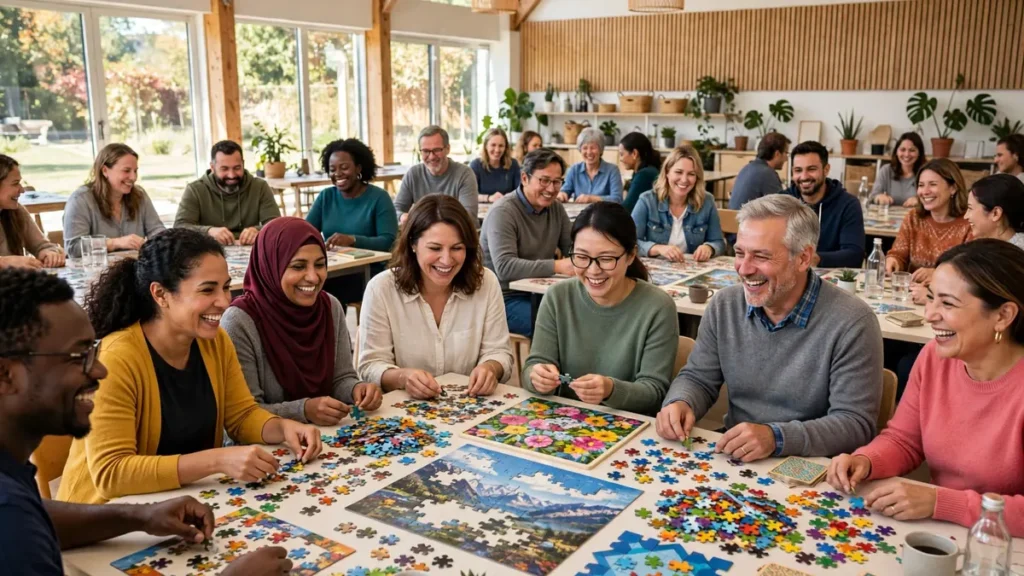
The best puzzle games for 302 players turn an enormous crowd into one shared challenge instead of 302 people waiting for something to do. When a group this large gathers for a school event, a company day, a community festival, or a family reunion, a puzzle gives everyone a clear job, a visible goal, and a reason to talk to the people beside them. Nobody needs to be the fastest, the loudest, or the most confident person in the room. A good puzzle rewards patience, careful observation, and teamwork, which is exactly why it works so well at this scale.
Planning for 302 players is different from planning for a table of six. You need games that split cleanly into teams, rounds that run at the same time, and scoring that stays simple enough for volunteers to manage without a spreadsheet. The games in this guide do all three. They use printed sheets, shared screens, puzzle boards, or simple props, and every one of them can be scaled up by adding teams, stations, or rounds. If you have organised puzzle games for 301 players before, you will recognise the same structure here, with one extra team, one extra table, and one extra round of cheering at the end.
This guide covers ten games that suit mixed ages and mixed abilities, from fast word puzzles to slow, careful jigsaws. Each entry explains how the game works, how to set it up for 302 players, and what makes it fun rather than frustrating. You will also find a comparison table, a step-by-step plan for running the event, a short checklist, and answers to the questions organisers ask most often. Read the whole guide before you choose, because the best game for your group depends on your space, your time, and how competitive your players want to be.
Key takeaways
- Split 302 players into teams of six to ten so every person gets a real role and nobody is left watching.
- Choose puzzles with clear rules and a visible finish line, such as a completed picture, a solved code, or a finished word grid.
- Run several rounds or stations at the same time so large groups stay busy instead of queuing for one activity.
- Keep scoring simple: points per solved puzzle, bonus points for speed, and a small prize for the best team spirit.
- Mix fast puzzles with slower ones so quick thinkers and careful solvers both have a moment to shine.

What Makes a Puzzle Game Work for 302 Players
A puzzle game works for 302 players when it can be played by many teams at once without losing its shape. The rules should fit on one page, the goal should be obvious from the first minute, and the result should be easy to check. If a game needs a single host to watch every move, it will slow down as soon as the crowd grows. The best large-group puzzles let each team work on its own copy while the host keeps time, answers questions, and announces scores. That balance keeps the energy high and the waiting low.
Best Puzzle Games for 302 Players at a Glance
| Game | Best for | Time per round | Setup |
|---|---|---|---|
| Giant Jigsaw Relay | Teamwork and patience | 30 minutes | Puzzle boards and tables |
| Team Crossword Race | Word lovers | 20 minutes | Printed grids |
| Escape Room Stations | Problem solving | 25 minutes | Lock boxes and clues |
| Picture Puzzle Hunt | Visual thinkers | 20 minutes | Printed images |
| Code Breaker Challenge | Logic and codes | 15 minutes | Code sheets |
| Trivia Puzzle Mix | Mixed ages | 20 minutes | Question cards |
| Word Search Sprint | Quick rounds | 10 minutes | Printed sheets |
| Memory Match Tournament | Focus and recall | 15 minutes | Card sets |
| Logic Grid League | Careful solvers | 25 minutes | Grid sheets |
| Build and Solve Challenge | Hands-on teams | 30 minutes | Blocks and models |
The 10 Best Puzzle Games for 302 Players
These ten games were chosen because they scale cleanly, suit mixed ages, and stay fun when dozens of teams play at once. You can run one as a single event or combine several into a puzzle tournament with a leaderboard. Each game below includes the setup, the rules, and a practical tip for managing a crowd of 302 players.
1. Giant Jigsaw Relay
The giant jigsaw relay is the most visual game on this list, and it gives every team a puzzle they can see growing. Give each team the same 500-piece jigsaw, or a 1,000-piece puzzle for confident groups, and set a 30-minute timer. Teams work together to sort edge pieces, build sections, and fit the picture together. The first team to finish wins, but teams that finish close behind earn points for the number of pieces placed. This keeps slower teams motivated right up to the final minute.
2. Team Crossword Race
A team crossword race turns a quiet solo puzzle into a lively group contest. Each team receives the same crossword grid and clue sheet, and the first team to complete the grid correctly wins the round. The best crosswords for large groups mix general knowledge, wordplay, and themed clues, so different team members can contribute in different ways. One person may be strong on history, another on wordplay, and a third on quick spelling, and the team needs all three.
3. Escape Room Stations
Escape room stations bring the excitement of a locked-room game to a hall full of players. Set up six to eight stations around the room, each with a small puzzle: a combination lock, a hidden message, a number code, or a matching task. Teams rotate through the stations, solving each one to collect a clue or a stamp. The team that solves the most stations in the time limit wins, and a final puzzle ties all the clues together for a bonus round.
4. Picture Puzzle Hunt
A picture puzzle hunt asks teams to find details, spot differences, or solve visual riddles hidden in printed images. Each team gets a set of pictures and a list of things to find, such as a hidden number, a misplaced object, or a pattern that appears twice. The puzzles look simple at first, but the details reward careful looking, and teams often laugh when they realise the answer was in front of them all along. It is a calm, focused game that suits players who prefer looking to shouting.
5. Code Breaker Challenge
The code breaker challenge gives teams a series of coded messages to crack, using simple ciphers such as letter shifts, number codes, and symbol swaps. Each solved message reveals a word, and the words together form a final phrase or answer. The game suits logical thinkers, but it works for everyone because teams can split the work: one person decodes, one checks the alphabet key, and one writes down the answers. The moment a team cracks a code feels like a small victory, and those small victories add up fast.
Prepare three levels of codes, from easy to hard, and let teams choose their starting level. Easy codes earn fewer points, while hard codes earn more, so teams must decide whether to play safe or take a risk. For 302 players, print code sheets for every team and display a large cipher key on a screen or poster. This format is closely related to the puzzle games for 300 players many organisers already know, and it scales in the same way: more teams simply means more printed sheets and a louder cheer when the final phrase is solved. Keep the final phrase short and satisfying, such as a team motto or the name of the event.
6. Trivia Puzzle Mix
The trivia puzzle mix blends quiz questions with puzzle tasks, so teams need both knowledge and problem-solving skills. Each round includes a set of questions, a word puzzle, and a picture round, and teams earn points across all three. A team that is weak on general knowledge can still win points on the word puzzle, while a team that is slow at puzzles can catch up on the questions. That balance makes it one of the fairest games for a mixed crowd of 302 players.
7. Word Search Sprint
A word search sprint is the fastest game on this list, and it makes a perfect warm-up or a quick break between longer rounds. Each team gets the same word search grid and a list of hidden words to find. The first team to find every word wins, but teams also score points for each word they find, so nobody leaves empty-handed. The game is simple to explain, quick to play, and easy to repeat with a fresh grid, which makes it ideal for large groups with limited time.
8. Memory Match Tournament
A memory match tournament tests focus and recall in a format that anyone can play. Each team gets a set of face-down cards, and players take turns flipping two cards to find matching pairs. A match earns a point and another turn, while a miss passes play to the next person. The game is simple, but it becomes tense as the board fills up and players try to remember where each card sits. It rewards attention rather than speed, which suits players who prefer a calmer challenge.
For a large event, run the tournament in heats: teams play a short match against the clock, and the highest scores advance to a final round. Use large, sturdy cards with clear pictures or words, and keep each set to 24 cards so a match fits comfortably in fifteen minutes. For 302 players, you will need many card sets, so choose a theme that is easy to print in bulk, such as animals, shapes, or famous places. A volunteer at each table can watch for mistakes and keep the game moving, and the final round makes a lively finish to the day.
9. Logic Grid League
A logic grid league is the quietest game on this list, and it often produces the closest finishes. Each team receives a logic puzzle, such as a grid that matches people to hobbies, places, or times, and must use the clues to fill in every box correctly. The puzzles reward careful reading and steady thinking, and teams that rush often make small errors that cost them points. It is a satisfying game for players who enjoy working through a problem step by step.
Choose puzzles with a clear difficulty level, and give teams a worked example before the real round starts so everyone understands the grid. For 302 players, run two rounds of 25 minutes each, with a different puzzle each time, and award points for each correct row as well as for a full solution. Provide pencils and erasers, because logic puzzles often need a second attempt, and print the grids large enough to write in comfortably. This game suits older children, teenagers, and adults, and it pairs well with a faster game afterwards to lift the energy again.
10. Build and Solve Challenge
The build and solve challenge is the most hands-on game in this guide. Teams receive building blocks, a model picture, or a set of pieces, and must build the model and then solve a puzzle based on what they built. For example, teams might build a tower, then use the colours or heights of the blocks to crack a code. The game combines physical building with mental puzzle solving, and it gets teams talking, pointing, and laughing as they work. It is especially popular with younger players and with teams that enjoy practical tasks.
For 302 players, keep the models simple and the pieces large, so teams can build quickly and safely. Use identical sets for every team, and check that no pieces are missing before the event starts. Set a 30-minute limit, and award points for the build, the puzzle answer, and teamwork. A judge can walk around the room, checking builds and offering hints, which keeps the game fair and friendly. This challenge makes a strong final game, because the finished models look impressive on display and give everyone something to photograph at the end of the day.
How to Run a 302-Player Puzzle Event
Start by deciding your format: a single game, a tournament of three or four games, or a station rotation where teams move between puzzles. A tournament works well for a half-day event, while a station rotation suits a full day with more space. Once you know the format, choose your teams. Groups of six to ten work best, giving you roughly 30 to 50 teams. Assign each team a name, a colour, and a table, and print a simple schedule so everyone knows where to be and when.
On the day, welcome players with a short explanation of the rules and a practice puzzle so nobody starts confused. Keep rounds to 30 minutes or less, with short breaks for scoring and moving. Use a visible leaderboard, updated after each round, so teams can see their progress and stay motivated. If you want ideas for mixing puzzle rounds with lighter games, the party games for 300 players format is a useful model: it shows how large groups can switch between focused play and relaxed fun without losing momentum. End with a final round, a prize ceremony, and a group photo, so the event finishes on a high note.
Your 302-Player Puzzle Checklist
- Split 302 players into teams of six to ten, with a named captain for each team.
- Print enough puzzle sheets, grids, and answer sheets for every team, plus spares.
- Test every puzzle, lock, code, and prop before the event starts.
- Set up tables, lighting, and a visible leaderboard before players arrive.
- Brief your volunteers on the rules, the scoring, and the rotation plan.
- Keep rounds short, breaks regular, and the final ceremony simple and celebratory.
Frequently Asked Questions
How many teams should 302 players form?
Teams of six to ten work best, which gives you roughly 30 to 50 teams. Smaller teams mean everyone gets more turns, while larger teams are easier to manage but can leave quieter players out. If your group includes many children, use teams of six so each child stays involved. For adult groups, teams of eight to ten work well and keep the number of tables manageable.
How long does a 302-player puzzle event take?
A single game takes 30 to 60 minutes, while a tournament of three or four games takes two to three hours with breaks. A full station rotation can fill a half day. Plan for 15 minutes of welcome and practice, 20 to 30 minutes per round, and five minutes between rounds for scoring and moving. Add extra time for the prize ceremony at the end.
What age groups suit these puzzle games?
Most of these games suit ages eight and up, with simple versions for younger children and harder versions for adults. Word searches, memory matches, and jigsaws work for the widest age range, while logic grids and code breakers suit teenagers and adults best. For mixed-age groups, form teams with a mix of ages so younger and older players can help each other.
Do we need special equipment for 302 players?
You need tables, chairs, printed puzzle sheets, pens, and a timer, plus the specific props for each game, such as jigsaws, card sets, or lock boxes. A projector or whiteboard helps for scores and instructions, but it is not essential. The most important equipment is enough printed copies: count your teams, add spares, and print a few extra answer sheets for the host.
How do we keep scoring fair with so many teams?
Use simple scoring, such as one point per solved puzzle and a small bonus for speed, and keep a single master score sheet with the host. Check finished puzzles against an answer key before awarding points, and update the leaderboard after every round so teams can see their standing. Having two volunteers check scores together reduces mistakes and keeps the results trusted.
Can these games work outdoors?
Yes, many of them work outdoors if you protect the materials from wind and rain. Jigsaws, code breakers, and logic grids need flat tables and shelter, while picture hunts and trivia mixes work well in open spaces. Use clipboards, weighted card, and sealed sheets for outdoor rounds, and keep spare copies indoors in case the weather changes. A garden or park setting can make a puzzle event feel relaxed and festive.
The Bottom Line
The best puzzle games for 302 players are the ones that give every person a job, every team a fair chance, and every round a clear finish. Start with teams of six to ten, choose a mix of fast and slow puzzles, and keep the rules and scoring simple enough for volunteers to run. Test your puzzles, print plenty of spares, and leave room in the schedule for breaks and celebration. Do that, and 302 players will leave with a shared memory, a favourite puzzle, and a reason to come back for the next event.


