
Finding puzzle games for 284 players sounds impossible at first. Most puzzle games are built for one person at a kitchen table or a small group around a board, so a crowd of nearly three hundred seems far beyond what a puzzle can handle. The truth is that puzzles scale beautifully once you stop thinking of one game for everyone and start thinking of one event made of many small games running at the same time.
The secret is to break the crowd into teams and give every team the same puzzle at the same moment. A jigsaw race, a logic challenge or a puzzle hunt becomes a fair contest when seventy-one teams of four all start together, and the energy in the room builds as teams finish within seconds of each other. Nobody sits on the sidelines, nobody waits for a turn that never comes, and the whole event feels like one giant game.
This guide covers the best puzzle games for 284 players: twelve games that work at this scale, a plan for splitting 284 people into teams, a comparison table, and a scoring system that keeps the competition honest. Whether you are planning a school event, a company day, a festival or a family reunion, you will find a format here that fits your space and budget.
Key takeaways
- Split 284 players into 71 teams of four so every team tackles the same puzzle at the same time.
- Choose puzzles with identical copies for every team, so the contest stays fair and easy to judge.
- Mix fast puzzles, slow puzzles and physical puzzles to keep every kind of player engaged.
- Run several short rounds instead of one long game, so a slow start never ruins the day.
- Score with simple points per round and a clear tie-breaker decided before the first puzzle begins.
Why Puzzle Games Work for 284 Players
Puzzles have a rare advantage over most party games: they reward thinking, not shouting, speed of body, or luck. A quiet teenager can out-solve a confident adult, a grandparent can spot the pattern everyone else missed, and a team that talks well can beat a team of quicker individuals. That levelling effect matters when your crowd spans ages, abilities and backgrounds.
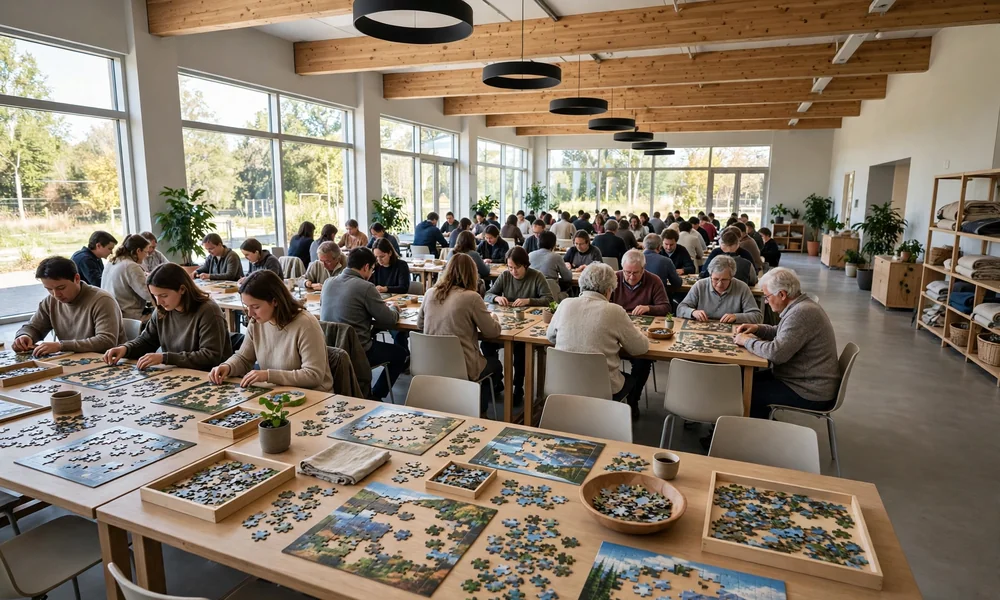
Puzzles also keep a huge room calm and focused. A sports game with 284 players turns chaotic, but a puzzle hall turns quiet in the best way, with the hum of seventy teams working, the murmur of discussion, and then the rising cheer as the first teams finish. One announcement starts every table at once, one whistle ends the round, and the results are visible on the table in front of you.
How to Organise 284 Players into Puzzle Teams
The Team-of-Four Model
Divide your 284 players into 71 teams of four. Teams of four are the sweet spot for puzzles: small enough that everyone has a job, large enough that four brains see more than one, and easy to seat around a single table. Give every team a number, a table and a colour, and print the team list in advance so nobody queues to find out where they belong. If your crowd includes children and adults, mix the ages within each team rather than grouping all the children together, because mixed teams solve better and enjoy the day more.
Each team needs a captain, chosen by the team itself in the first two minutes. The captain collects the puzzle, hands in the finished answer, and speaks for the team if there is a dispute, so every question and answer comes through a single named person.
Rotation Stations That Keep Everyone Moving
For puzzle formats that need special equipment, set up rotation stations. Create six stations around the room, each with a different puzzle type, and send twelve teams to each station at a time. Teams spend fifteen minutes at a station, then rotate together when the whistle blows. After six rotations every team has tried every puzzle, and nobody has waited idly for their turn.
Rotation also solves the problem of different puzzle lengths. A fast team that finishes early can attempt a bonus puzzle at the same station while they wait, so quick solvers stay busy and slower teams never feel rushed. Prepare one bonus puzzle per station, worth a small number of points.
The 12 Best Puzzle Games for 284 Players
The games below are ordered from the easiest to organise to the most ambitious. Every one of them has been chosen because it genuinely works with seventy-one teams playing at once. Start with the first few if this is your first large event, and add the more complex formats once your team is confident.
1. Giant Jigsaw Relay
The giant jigsaw relay is the simplest large-group puzzle game and the one most organisers start with. Buy seventy-one identical 500-piece jigsaw puzzles, one per team, and give every team the same picture. The first team to complete the puzzle wins the round. Choose a bright, detailed image with clear regions of colour, because a puzzle that is mostly sky or sea will frustrate even good teams. A 500-piece puzzle takes a team of four around forty-five minutes, a good length for a headline round.
2. Escape Room in a Box
Escape room kits in a box are ideal for large groups because each box is a complete self-contained puzzle. Buy or hire enough identical kits for one per team, and every team races to crack the same series of locks, codes and hidden clues. Choose kits designed for forty-five to sixty minutes of play, and test one kit yourself before the event so you know the solutions and can help stuck teams with hints. Allow each team three hints, each costing a small points penalty, so no team is ever completely stuck.
3. Puzzle Hunt Around the Venue
A puzzle hunt sends teams around your venue solving clues that lead from one location to the next. Each clue is a puzzle in itself: a riddle, a code, a rebus or a logic problem, and the answer tells the team where to go next. With 284 players, stagger the start times so teams leave at two-minute intervals, which prevents a crush at the first clue and spreads teams evenly around the course. Design ten clues for a ninety-minute hunt, place a marshal at the trickiest spots, and bring every team back to a central point for a final puzzle.
4. Crossword Relay Race
The crossword relay turns a quiet solo puzzle into a noisy team race. Print the same large crossword for every team and give each team one pen, which forces teammates to agree on every answer before it is written down. Use a themed crossword that suits your crowd, such as general knowledge, animals, food, or the history of your school or company. A grid of twenty to thirty clues is about right for a thirty-minute round. Score it by counting correct answers rather than by finishing first, so a careful team can beat a fast team with five wrong answers. Teams who enjoy this format also enjoy the best trivia games for 284 players, which use the same team structure in a question-and-answer format.
5. Sudoku Tournament
Sudoku is a perfect large-group puzzle because it needs nothing but paper and a pencil, and every player can be solving at the same time. Run it as a team tournament: each team receives the same set of five Sudoku grids, graded from easy to fiendish, and teams work through them in order. The team that completes the most grids correctly in thirty minutes takes the round. Start with a gentle grid so every team gets an early success, then raise the challenge so the strongest teams are separated from the rest.
6. Logic Grid Challenge
Logic grid puzzles, the kind where you work out who owns which pet or lives in which house from a set of clues, are made for team discussion. One person reads the clues aloud, another tracks them on the grid, and the rest test ideas against each other. Give all seventy-one teams the same logic puzzle and the same thirty minutes, and the winning team is the one that fills the grid correctly first. Choose a puzzle with a single clear answer and twelve to fifteen clues, so it is neither too easy for a team of four nor too long to finish.
7. Tangram Team Build
Tangrams are seven flat shapes that can be arranged to form hundreds of pictures, and they make a wonderful hands-on puzzle for large groups. Give each team a tangram set and a series of silhouette cards, and challenge teams to complete as many silhouettes as they can in twenty minutes. The shapes are cheap to buy in bulk or cut from card, and the game suits players of every age because it is visual rather than word-based. Score one point per completed silhouette, with bonus points for the hardest cards.
8. Rubik’s Cube Relay
A Rubik’s Cube relay is a crowd-pleaser even when most players cannot solve a cube. Set it up as a team relay: each team member solves one face of the cube, then passes it to the next person, and the team finishes when all six faces are complete. Teams that include a confident cuber can race ahead, but teams without one can still compete by learning a simple method for a single face during a ten-minute practice session before the round begins. You will need seventy-one cubes, which is the main cost, but cubes are inexpensive in bulk and can be reused for years.
9. Word Ladder Sprint
A word ladder asks players to change one word into another by changing a single letter at a time, with each step forming a real word. Turning CAT into DOG takes three steps, and longer ladders are surprisingly tricky. Print a set of ten ladders for each team, ranging from three steps to eight, and give teams twenty minutes to climb as many as they can. The game needs no equipment beyond printed sheets, and it is easy to check because every ladder has one shortest solution.
10. Nonogram Picture Puzzle Race
Nonograms, also called picture logic puzzles, reveal a hidden image as players fill in squares on a grid according to number clues. They are absorbing, silent and deeply satisfying when the picture finally appears. Give every team the same set of three nonograms, small, medium and large, and challenge them to reveal all three pictures inside forty minutes. Nonograms need concentration more than speed, so they make a good contrast round after the fast, noisy games.
11. Mystery Puzzle Boxes
Mystery puzzle boxes are small wooden or plastic boxes that open only when the solver finds the hidden catch, slides the right panel or turns the pieces in the correct order. They are excellent for a station rotation because one box per station serves a whole group of teams in turn. Place a box at each station with a small prize or the next clue inside, and teams earn their reward by opening it. Buy boxes of mixed difficulty and label them clearly, so teams know whether they are attempting a two-minute box or a ten-minute challenge.
12. Collaborative Mural Puzzle
The collaborative mural puzzle turns the whole event into a piece of art. Give each team a blank section of a giant picture, divided into seventy-one squares, and ask each team to complete its square as a small jigsaw or a colour-by-numbers puzzle. As teams finish, their squares are added to a display wall, and by the end of the day the full mural is revealed. It is the only game on this list where every team, even the slowest, contributes to a shared result.
Comparison Table: Puzzle Games for 284 Players
| Game | Players per Team | Time Needed | Equipment | Best For |
|---|---|---|---|---|
| Giant Jigsaw Relay | 4 | 45 minutes | 71 identical puzzles | All ages, headline round |
| Escape Room in a Box | 4 | 60 minutes | 71 identical kits | Teenagers and adults |
| Puzzle Hunt | 4 | 90 minutes | Printed clues, marshals | Outdoor venues |
| Crossword Relay Race | 4 | 30 minutes | Printed grids, pens | Word lovers |
| Sudoku Tournament | 4 | 30 minutes | Printed grids, pencils | Quiet, focused round |
| Logic Grid Challenge | 4 | 30 minutes | Printed puzzles, grids | Team discussion |
| Tangram Team Build | 4 | 20 minutes | Tangram sets, cards | Warm-up, all ages |
| Rubik’s Cube Relay | 4 | 25 minutes | 71 cubes | Fast, visual excitement |
| Word Ladder Sprint | 4 | 20 minutes | Printed ladders | Mixed-age teams |
| Nonogram Picture Race | 4 | 40 minutes | Printed grids, pens | Calm, focused play |
| Mystery Puzzle Boxes | 4 | 15 minutes | Puzzle boxes | Station rotation |
| Collaborative Mural Puzzle | 4 | 60 minutes | Pre-cut mural sections | Whole-event finale |
Scoring and Prizes That Keep 284 Players Honest
Keep the scoring simple enough to explain in one minute. Award ten points for first place in a round, eight for second, six for third, and one point for every other team that finishes the puzzle, plus a bonus point for the fastest correct answer. Every team that finishes earns something, so the leaderboard stays close and the last round stays exciting.
Decide your tie-breaker before the event starts and announce it at the opening. A good tie-breaker is a single five-minute puzzle, played only by the tied teams, with the fastest correct answer taking the higher place. Never decide a tie by a coin toss or a judge’s opinion, because both feel unfair after hours of play. Print a large leaderboard and update it after every round, so teams can see their position and the gap to the teams above them.
Choose prizes that celebrate thinking rather than spending. Medals for the top three teams, a puzzle book for every team member, and a certificate for every player cost very little and mean a great deal. Teams that enjoyed the puzzle rounds often enjoy the best board games for 284 players as a follow-up event, where the same seventy-one teams can meet again over a different kind of game.
Checklist: Running a Puzzle Event for 284 Players
- Book a hall with at least seventy-one tables and enough space between them for teams to move comfortably.
- Print seventy-one identical copies of every paper puzzle, plus ten spare copies for mistakes and late arrivals.
- Test every puzzle yourself before the event, and write the answers on a sealed sheet for the judges.
- Assign team numbers, tables and colours in advance, and print the list at the entrance.
- Prepare a scoring sheet, a leaderboard and a tie-breaker puzzle before the first round begins.
- Brief your helpers on the rules, the hint system and the rotation plan so every station runs the same way.
Frequently Asked Questions
Can puzzle games really work for 284 players at once?
Yes, provided you split the crowd into teams and give every team the same puzzle at the same time. Seventy-one teams of four playing identical puzzles is a fair contest, and it is far easier to manage than one game for 284 individuals. The key is identical materials, a shared start time and a clear finish rule.
How much does a puzzle event for 284 players cost?
A paper-based event using crosswords, Sudoku, word ladders and logic grids costs very little beyond printing. Jigsaw puzzles and escape room kits cost more, but the materials can be reused for future events.
What if some teams finish much faster than others?
Prepare a bonus puzzle for every round, worth a small number of points, so fast teams stay busy while slower teams finish. Fast finishers can also help as assistant judges. Never start the next round until at least half the teams have finished.
Are these puzzle games suitable for children?
Most of them are, especially tangrams, jigsaws, word ladders and the mural puzzle. For mixed-age events, put children and adults in the same teams rather than separating them, and choose puzzle difficulties that suit your youngest players. Escape room kits and hard logic grids suit teenagers and adults better than younger children.
How long should a puzzle event for 284 players last?
A half-day event of three to four hours works well, with four or five rounds and breaks between them. A full day allows eight to ten rounds including the mural finale, but schedule a lunch break and at least one outdoor break so players stay fresh.
What should I do if two teams tie on points?
Use the tie-breaker you announced at the start: a single short puzzle played only by the tied teams, with the fastest correct answer deciding the higher place. Decide this before the event, write it on the leaderboard, and never change it mid-event. If the tie-breaker also ends in a draw, award both teams the same place and share the prize.
Bottom Line
Puzzle games for 284 players work when you treat the crowd as seventy-one teams playing the same game at the same time, not as 284 individuals hoping for a turn. Start with the jigsaw relay or the tangram build, add a puzzle hunt or an escape room kit once your helpers are confident, and finish with the collaborative mural so every player leaves with a shared memory. Plan the teams, print the spares, keep the scoring simple, and the puzzles will do the rest. If you enjoy organising large-group game nights, the best card games for 284 players use the same team-of-four structure and make a natural second event for the same crowd.


