
Finding the best puzzle games for 212 players takes more planning than picking a game for a family night, because almost no puzzle game is designed for 212 people to play at the same moment. The number itself tells you what kind of event this is: a school assembly, a company gathering, a church social, a camp reunion, or a community night where the whole room needs something to do at once. The games that work at this scale are not single-table games stretched thin. They are games that split naturally into teams, run in parallel rounds, or let every table solve the same puzzle at the same time and compare results.
The best puzzle games for 212 players share three qualities. First, they are easy to explain in under two minutes, so nobody is left waiting while a host reads a long rulebook. Second, they scale by adding teams rather than by adding waiting time, which means a group of 212 can be split into 26 teams of eight, 53 teams of four, or any combination that fits the room. Third, they give every player something to do, not just the fastest person at each table. A good large-group puzzle lets the quiet pattern-spotter matter as much as the quick talker, and that balance is what keeps a room of 212 people engaged for a full hour.
This guide covers the formats that actually work at this size, from jigsaw relays and team logic puzzles to word hunts, picture rounds, and timed puzzle races. You will find a comparison table to help you choose, a setup plan for running the event, a checklist for game day, and answers to the questions organisers ask most often. Every game here can be prepared with ordinary supplies, printed sheets, or a projector, and every one of them has been chosen because it survives contact with a very large, very mixed group of players.
Key takeaways
- Split 212 players into teams of four to eight so everyone gets a real job to do and no team waits long for a turn.
- Choose puzzles that run in parallel across all teams, such as jigsaw relays, word hunts, and logic grids, rather than games that need one player at a time.
- Keep every round short, between ten and twenty minutes, and score teams after each round so the energy stays high.
- Use the same puzzle for every team in a round, with a clear answer sheet, so scoring is fast and fair.
- Mix puzzle types across the event, combining visual, word, number, and logic puzzles, so different strengths get their moment.
What Makes a Puzzle Game Work for 212 Players
A puzzle game works for 212 players when the puzzle itself does the heavy lifting. The host should not need to manage 212 separate turns, and no player should need to wait more than a minute or two before contributing. Parallel play is the simplest test: if all 26 teams can be solving at the same time, the game fits. If only one team can play while the rest watch, it does not fit, no matter how clever the puzzle is. This is why team jigsaws, printed logic puzzles, and projected picture rounds dominate large-group events, while single-player puzzle apps and one-board games do not.
Clarity matters just as much as scale. With 212 players, the rules have to survive being heard once, in a noisy room, by people of very different ages. The strongest formats use a single clear goal, such as finish the puzzle first, find the most hidden words, or solve the grid with the fewest clues. A worked example on the screen or on a sample table helps far more than a long verbal explanation, and a one-page printed instruction sheet at each table settles most questions before they reach the host. When the goal is obvious, teams start solving within a minute, and the room settles into the focused, cheerful noise that marks a good puzzle event.
Fairness is the third test, and it is the one organisers most often overlook. Every team should face the same puzzle, the same time limit, and the same scoring rules. That means identical jigsaw sets, identical printed sheets, and a visible timer that everyone can see. It also means planning for ties, because with 26 teams, two teams will often finish within seconds of each other. Decide in advance whether a tie is broken by a speed bonus, a bonus question, or a shared win, and announce it before the first round begins. Teams accept almost any rule when they hear it up front, and they argue about almost any rule when they hear it after the fact.
The Best Puzzle Games for 212 Players
The games below are grouped by type so you can build a balanced event rather than running the same kind of puzzle five times in a row. A strong programme usually includes one visual game, one word game, one logic game, and one fast team race, with short breaks between rounds. Each group includes the format, the team size that works best, and the practical details that decide whether it runs smoothly on the day. If you are planning a smaller version of the same event, the ideas in our guide to the best puzzle games for 211 players use the same team structure with one fewer player to place.
Jigsaw Relays and Team Jigsaw Races
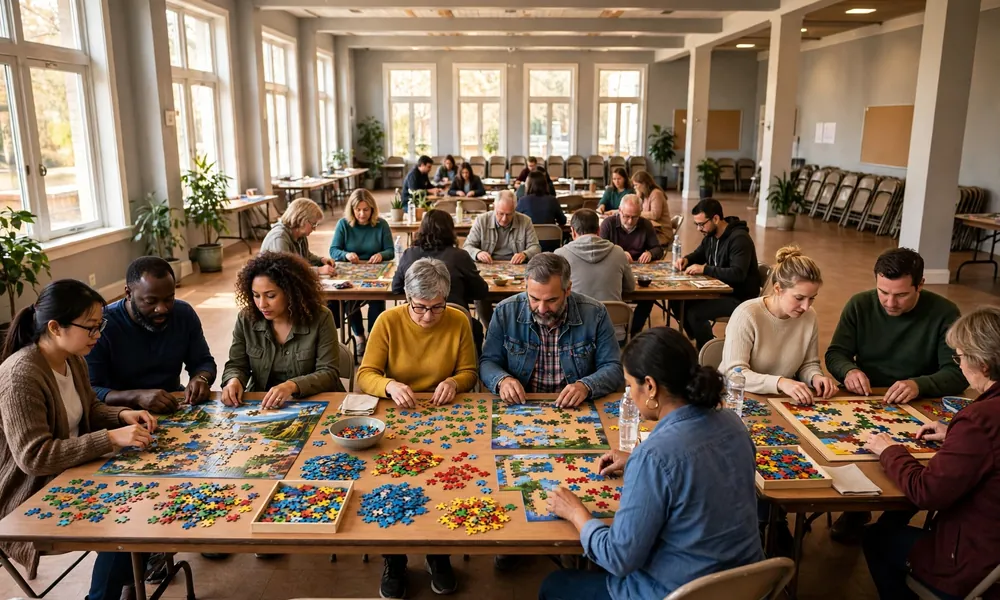
The jigsaw race is the most reliable large-group puzzle game, and it is the one to choose if you can only run a single game. Give every team the same 500-piece jigsaw, set a 30-minute timer, and score teams on how much of the puzzle they complete, with a bonus for the first finished picture. Teams of six to eight work best, because that size lets two people sort edge pieces, two people work on the sky or background, and the rest hunt for specific colours and shapes. A 500-piece puzzle is the right difficulty for a mixed group: a 300-piece puzzle finishes too fast for experienced teams, while a 1,000-piece puzzle leaves most teams staring at an unfinished frame when the timer ends.
Buy or borrow identical puzzles rather than a mixed set, and open one box in advance to check the piece count and the picture quality. A puzzle with a clear, colourful image and strong contrasts between regions is far easier for teams to solve than a puzzle of a misty landscape in similar shades. If the budget does not stretch to 26 identical puzzles, run the jigsaw in heats instead: six teams play at a time while the rest take part in a paper puzzle round, then swap. Heats take longer overall, but they keep the cost down and they give the host a natural break between rounds.
Word Hunts, Anagrams, and Vocabulary Puzzles
Word puzzles are the cheapest large-group games to prepare, because they need only printed sheets and pens, and they are the easiest to score fairly. A word hunt gives every team the same grid of letters and the same list of hidden words, with points for each word found and a bonus for the full set. Teams of four work well here, because four people can scan different corners of the same grid without crowding each other. Set a 15-minute limit, and choose words that fit the event theme, such as the name of the school, the company, or the season, so the puzzle feels made for the occasion rather than pulled from a generic book.
Crossword races work in the same way, with one difference: they reward general knowledge as well as word skill, so they suit mixed-age groups where younger players know the pop-culture clues and older players know the history clues. Use a crossword designed for a general audience rather than a cryptic one, and avoid clues that depend on one narrow interest. If you want a ready-made word game to pair with these rounds, the best puzzle games for 210 players guide includes word-hunt formats that use the same four-person team size and the same 15-minute round length.
Logic Grids, Code Breakers, and Puzzle Races
Logic grids are the quiet stars of large-group puzzle events. Each team gets the same grid puzzle, such as matching five people to five hobbies and five towns from a set of clues, and the first team to complete the grid correctly wins the round. These puzzles reward careful reading and teamwork, because one person can read the clues aloud while another fills in the grid and a third checks the logic. Choose a grid with around twelve to fifteen clues, so that a good team can finish in 15 to 20 minutes. A grid with too few clues is guesswork, and a grid with too many clues turns into a long slog that loses the room.
Code breaker rounds add a sense of mystery that logic grids sometimes lack. Give every team the same coded message, plus a short key that explains part of the code, and let them decode the rest. A simple substitution code works well for a first round, while a code that combines a word clue with a number pattern suits a second, harder round. Keep the decoded message short, a single sentence of ten to fifteen words, and choose a message that fits the event, such as a welcome line or a joke about the group. Teams that finish early can be given a bonus code to crack for extra points, which keeps them busy while slower teams finish the main puzzle.
Comparison Table: Best Puzzle Games for 212 Players
| Game | Team size | Time per round | Supplies needed | Best for |
|---|---|---|---|---|
| Jigsaw race | 6 to 8 | 30 minutes | Identical 500-piece puzzles | Main event, large halls |
| Jigsaw relay | 6 to 8 | 30 minutes | Puzzles, piece trays | Active groups, big rooms |
| Word hunt | 4 | 15 minutes | Printed grids, pens | Low budget, any room |
| Anagram race | 4 | 10 minutes | Printed word lists | Quick rounds, mixed ages |
| Crossword race | 4 to 6 | 20 minutes | Printed crosswords | General knowledge teams |
| Spot the difference | Any size | 5 minutes | Projector, image slides | Fast rounds, tie-breakers |
| Pattern round | Any size | 10 minutes | Projector, shape slides | Visual thinkers, all ages |
| Picture puzzle hunt | 4 to 6 | 20 minutes | Printed colour pictures | Rooms without a projector |
| Logic grid | 4 to 6 | 20 minutes | Printed grids, pencils | Careful, methodical teams |
| Code breaker | 4 to 6 | 15 minutes | Printed codes, answer sheets | Adding mystery to the day |
| Puzzle race circuit | 4 to 6 | 40 minutes | Five station puzzles | Finale, memorable finish |
| Team trivia puzzle | 6 to 8 | 20 minutes | Projector, question slides | Closing round, whole room |
How to Set Up a 212-Player Puzzle Event
Start by fixing the team count, because every other decision follows from it. With 212 players, teams of eight give you 26 teams plus four players to place, while teams of six give you 35 teams plus two players to place. Teams of eight are easier to manage, because 26 tables fit in most halls and 26 answer sheets are quick to mark. Place the extra players as floating helpers, one per table on a rota, or add them to the teams that have a younger or less confident player who would benefit from an extra pair of eyes. Announce the teams in advance if you can, by email or on a noticeboard, so that nobody spends the first twenty minutes of the event finding their table.
Next, prepare the materials in team packs, one pack per team, each containing the printed puzzles, pens, answer sheets, and a team number card. Packing by team rather than by puzzle saves a surprising amount of time on the day, because helpers can hand out one pack per table instead of sorting loose sheets in a busy room. Label every pack clearly, count the packs twice, and keep two spare packs ready for the teams that lose a sheet or spill a drink. For the jigsaw rounds, stack the puzzle boxes by team number in the order the tables are laid out, so helpers can walk down the row and place one box on each table without checking a list.
Scoring needs to be visible and fast. Use a large scoreboard, either a whiteboard or a projected sheet, and update it after every round while the next round is being explained. Teams that can see their position play harder in the next round, while teams that cannot see any scores assume the event is not really a competition and slow down. Award points on a simple scale, such as ten points for a finished puzzle, five for a half-finished one, and a two-point bonus for the fastest correct finish, and apply the same scale to every round. If you are also planning party games for a group this large, the best party games for 210 players guide shows how to run high-energy team rounds with the same scoring board and the same team sizes.
Checklist Before Game Day
- Count the players and confirm the team sizes, so you know exactly how many teams, tables, and puzzle packs you need.
- Test every puzzle with a small trial group, and time how long it takes, so the round lengths in your plan match real solving times.
- Print two spare copies of every puzzle and answer sheet, and pack them separately from the main team packs.
- Check the room, the tables, the lighting, the projector, the microphone, and the visible timer the day before, not on the morning of the event.
- Brief every helper on their job, their station, and the scoring rules, and give each helper a printed copy of the schedule.
- Prepare the scoreboard, the tie-breaker puzzle, and the prizes in advance, so the ending runs smoothly even if an earlier round overruns.
Frequently Asked Questions
How many teams should 212 players be split into?
Teams of eight give you 26 teams with four players left to place, which is the simplest arrangement for most halls. Teams of six give you 35 teams with two players left over, which suits a room with many small tables. Either size works, but avoid teams larger than eight, because the quieter players at a big table stop contributing, and avoid teams smaller than four, because the marking and the material costs rise sharply with the number of teams.
What is the best puzzle game for 212 players if we only have one hour?
Run a jigsaw race for 30 minutes, followed by a 15-minute word hunt and a five-minute picture puzzle tie-breaker, with short breaks for scoring in between. This mix gives teams a visual game, a word game, and a fast finish, and it fits inside an hour with time to announce the winners. Skip the puzzle race circuit for a one-hour event, because it needs at least 40 minutes on its own and at least five helpers to run well.
Do we need identical puzzles for every team?
Yes, for any round that is scored on speed or completion. Identical puzzles keep the round fair, and they make scoring simple, because every team is judged against the same picture and the same piece count. If identical puzzles are too expensive, run the game in heats with fewer puzzles, or choose a printed puzzle instead, where identical copies cost almost nothing to produce.
How do we keep 212 players engaged between rounds?
Keep the gaps short, update the scoreboard during the gap, and play a short bonus puzzle on the screen while helpers mark the answer sheets. A two-minute gap feels like a breather, while a ten-minute gap feels like the event has stalled. If marking takes longer than two minutes, add more markers, or switch to puzzles with a single clear answer that can be marked at a glance.
Can children and adults play the same puzzle games together?
Yes, if you mix the teams and mix the puzzle types. Put at least one adult and one child on each team, and include word puzzles that favour adults, picture puzzles that favour children, and logic puzzles where both can contribute. Avoid puzzles that depend on one age group alone, such as a crossword full of clues from a single decade, and avoid team sizes that let one strong player solve everything while the rest watch.
What supplies should we buy first if the budget is small?
Buy pens, printed answer sheets, and a visible timer first, because those three items are needed for almost every game in this guide. Then add printed word and logic puzzles, which cost very little per team. Buy jigsaw puzzles last, because they are the most expensive item, and consider borrowing them from a library, a school, or a puzzle club before buying 26 identical boxes.
The Bottom Line
The best puzzle games for 212 players are the ones that let every team solve the same puzzle at the same time, with clear rules, a visible timer, and fair scoring. A jigsaw race anchors the event, word hunts and logic grids fill the middle rounds, and a picture puzzle or code breaker gives the day a memorable finish. Keep the teams between four and eight players, keep the rounds short, and keep the scoreboard visible, and a group of 212 will stay engaged from the first puzzle to the last.


