
Finding the best puzzle games for 128 players is a very different challenge from picking a game for a family evening. With 128 people in the room, you are not choosing a box to open at the kitchen table. You are designing an event, and the puzzle games for 128 players that work best are the ones that turn a huge crowd into small, focused teams with a shared goal and a clear finish line.
The first thing to understand is that no single puzzle game seats 128 players around one table. No jigsaw puzzle, escape room, crossword, or board game is built for a group that large, and any product that claims otherwise is stretching the truth. The good news is that this does not matter at all. With the right format, 128 players can enjoy puzzle games together,
This guide covers the formats that genuinely work for 128 players, the specific puzzle games that suit each format, and a practical plan for running the night from the first welcome to the final score. Every recommendation here has been chosen for a crowd of exactly 128 players, using team play, multiple tables, tournament brackets, and whole-room games, so you can plan with confidence instead of guessing.
Key takeaways
- No single puzzle game seats 128 players, so the best events split the crowd into teams of 4 to 8 and run several games at once.
- Jigsaw relays, escape room tournaments, puzzle hunts, and whole-room riddle races are the most reliable formats for a group of 128.
- Plan for at least 16 tables, one host per zone, and a scoring system everyone can see from across the room.
- Keep rounds short, between 15 and 30 minutes, so no team waits long and energy stays high.
- Test every puzzle in advance with a small group, because a puzzle that is too hard or too easy will stall a whole room of 128 players.
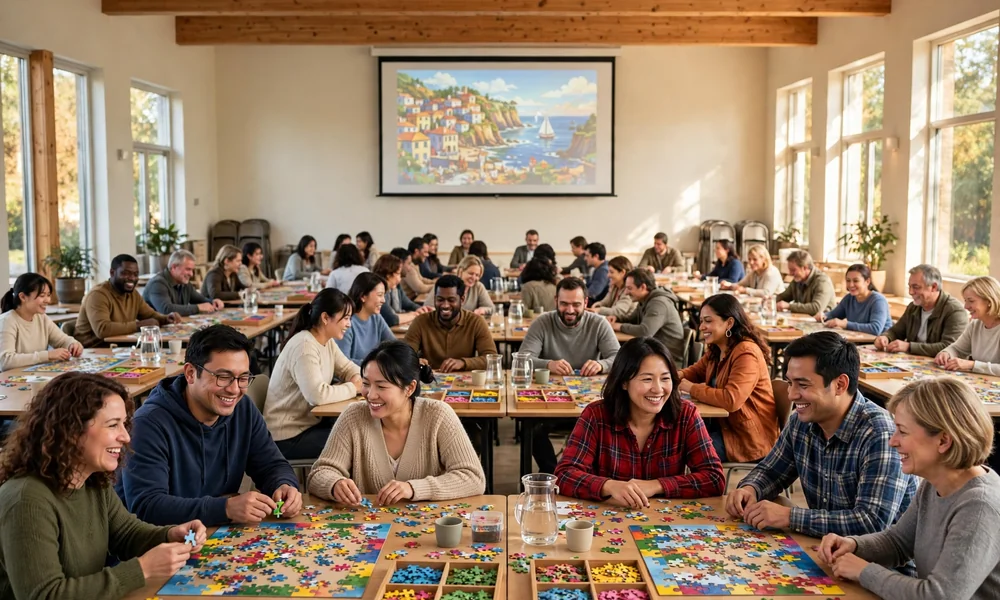
The Honest Truth: No Single Puzzle Game Seats 128 Players
It is worth saying plainly before you spend any money: there is no puzzle game on the market designed for 128 people to play at the same time in the same game. Jigsaw puzzles top out at a handful of builders around one board. Escape rooms usually hold 4 to 10 players. Even the largest party puzzle games assume a dozen people at most. A group of 128 players needs a different approach, and pretending otherwise is how large game nights fail.
The solution is structure, not a bigger box. Divide 128 players into 16 teams of 8, or 32 teams of 4, and suddenly every proven puzzle game becomes usable again. Each team plays the same puzzle at its own table, and the competition happens between teams rather than inside one oversized game. The room still feels like one event, because everyone is solving the same challenge at the same time, and the shared countdown creates the atmosphere that a single game never could.
This team-based approach also solves the two problems that sink most large events: waiting and confusion. When 128 people share one puzzle, most of them stand around watching. When they are split into teams, everyone has pieces in their hands within a minute of the start.
The Four Formats That Actually Work for 128 Players
Every successful large-group puzzle night uses one of four formats, and most use a mix of two or three across the evening. Choose your format first, then pick the games that fit it, rather than buying games and hoping a format appears. The four formats below cover every kind of venue, from a school hall to a company conference floor.
Team Tables
Team tables are the simplest and most reliable format for 128 players. Set up 16 tables with 8 chairs each, give every table the same puzzle, and start the clock. Teams race to finish first, or earn points for each section completed before time runs out. This format works beautifully for jigsaw puzzles, crosswords, Sudoku grids, and tangram challenges, because every team has identical materials and the result is easy to judge.
Tournament Brackets
A tournament bracket turns puzzle solving into a spectator event, which suits 128 players very well. Teams face each other in head-to-head rounds, winners advance, and the final is played on a stage or a central table while the rest of the room watches. This format suits escape room style challenges, logic puzzles, and riddle rounds, where each match has a clear winner.
Relay Races
In a relay, each team member solves one small puzzle before tagging the next player, so the whole team must contribute before the team can finish. A 128-player relay might have 16 teams of 8, with each player tackling a different puzzle type: one does a word search, the next a Sudoku, the next a riddle, and so on. Relays are ideal when you want every single player involved, because no one can hide while a faster teammate does all the work.
Whole-Room Games
Whole-room games put all 128 players in one shared challenge, usually with a host on stage and answers submitted by team captains. A giant crossword projected on a screen, a riddle race with buzzers, or a puzzle hunt with clues hidden around the venue all count as whole-room games. This format is the best choice for the opening or closing round of the night, because it brings the entire room together and gives everyone a shared memory.
Best Puzzle Games for 128 Players: The Shortlist
The games below are the strongest choices for a crowd of 128 players, chosen because they scale cleanly into teams, need little specialist equipment, and stay fun when played under time pressure. Each one names its best format, so you can match games to the evening you are planning. For a closer look at how similar large groups are handled, the guide to puzzle games for 126 players shows the same team-based thinking applied to a nearly identical crowd size.
Jigsaw Puzzle Relay
A jigsaw relay is the classic large-group puzzle game, and for good reason. Give each of your 16 teams the same 500-piece puzzle, start the timer, and award points for the first finished puzzle, the most pieces placed, and the best teamwork. A 500-piece puzzle takes a team of 8 about 45 minutes, which is a comfortable length for one round.
Escape Room Tournament
An escape room tournament adapts the escape room idea for a crowd by running the same puzzle chain at many tables at once. Each team gets a box of locks, codes, and clue cards, and must solve a chain of 6 to 8 puzzles to open the final box. Teams that finish early move to a bonus puzzle while slower teams keep working, so nobody sits idle.
Giant Crossword Race
A giant crossword race projects one large crossword on a screen while teams work on printed copies at their tables. The host reads clues one at a time, teams race to fill the matching answer, and points go to the first team to call out each correct word. This game suits 128 players because the shared screen keeps everyone focused on the same clue, while the team tables keep the solving social.
Puzzle Hunt
A puzzle hunt sends teams around a venue following a trail of clues, with each clue solved to reveal the next location. For 128 players, run 16 identical trails in different orders so teams do not bunch up at the same clue station. Each station holds a different puzzle type: a riddle, a code, a pattern, or a word puzzle.
Sudoku Relay
A Sudoku relay gives each team a set of Sudoku grids at increasing difficulty, and players take turns completing one grid before passing the set to the next player. Because Sudoku has one correct answer, scoring is simple and disputes are rare, which matters when 128 players are competing. This is the calmest game on the list, and it works well as a quieter round between louder ones.
Riddle Relay
A riddle relay is the fastest game to set up and one of the most entertaining for a big crowd. The host reads riddles to the whole room, teams discuss for 30 seconds, and team captains submit answers on cards or through a simple scoring app. With 128 players, use 20 to 30 riddles across the round, mixing easy, medium, and hard ones so every team scores something.
Tangram and Pattern Challenge
A tangram challenge gives each team a set of seven geometric pieces and a series of silhouette cards to recreate against the clock. It is visual, silent-friendly, and easy to judge from across the room, since a finished silhouette is obvious at a glance. For 128 players, run it as a team tables round with 10 silhouette cards per team, awarding points for each correct shape and bonus points for the fastest team.
Logic Puzzle Tournament
A logic puzzle tournament hands each team a set of grid logic puzzles, such as who owns which house or who arrived in which order, and teams race to solve them correctly. These puzzles reward careful thinking over speed, which balances an evening that also includes fast games. This game suits adult groups and older students best, since younger players may find pure logic puzzles frustrating under time pressure.
Best Puzzle Games for 128 Players Compared
Use this table to pick the games that fit your venue, your audience, and the time you have. Setup time is the time needed before the event starts, and the best format column tells you how each game should be run with 128 players.
| Game | Best Format | Round Length | Setup Time | Best For |
|---|---|---|---|---|
| Jigsaw Puzzle Relay | Team tables | 45 minutes | 30 minutes | All ages, relaxed evenings |
| Escape Room Tournament | Tournament bracket | 30 minutes | 2 hours | Adults, team building |
| Giant Crossword Race | Whole-room game | 30 minutes | 1 hour | Mixed ages, opening round |
| Puzzle Hunt | Relay race | 60 minutes | 3 hours | Outdoor venues, active groups |
| Sudoku Relay | Relay race | 25 minutes | 20 minutes | Quiet rounds, older players |
| Riddle Relay | Whole-room game | 30 minutes | 30 minutes | Closing round, all ages |
| Tangram Challenge | Team tables | 20 minutes | 15 minutes | Families, younger players |
| Logic Puzzle Tournament | Tournament bracket | 30 minutes | 45 minutes | Adults, serious puzzlers |
How to Set Up a 128-Player Puzzle Night
Good setup is what separates a smooth puzzle night from a chaotic one. With 128 players, small problems become big ones quickly: a missing puzzle set stalls a whole table, and unclear instructions confuse 16 teams at once. Work through the steps below in order, and run a short rehearsal with a few helpers before the doors open.
Choose the Venue and Layout
You need a hall that fits 16 tables of 8 with space to walk between them, plus a stage or front area for the host. Arrange tables in rows facing the front, leave a wide central aisle for the host and helpers, and put the scoreboard where every table can see it without turning around.
Form the Teams
Teams of 8 work best for 128 players, giving you 16 teams and a clean bracket. Mix ages and abilities within each team rather than grouping all the strongest players together, because mixed teams stay closer in score and keep the night competitive. If you are running a company or school event, the ideas in the guide to party games for 127 players offer useful extra thinking on team sizes and mixing groups for very large crowds.
Plan the Schedule
A three-hour evening with four rounds of 30 minutes, plus breaks, works well for 128 players. Start with a whole-room game to bring everyone together, follow with two team table or relay rounds, and finish with a riddle relay or a final bracket match. Build in a 15-minute break halfway through for drinks and a chance to stretch.
Prepare Materials and Helpers
Count every item twice: 16 copies of each puzzle, 16 sets of pencils, 16 answer sheets, and spares for anything that can be lost or damaged. Recruit at least 8 helpers, one per two tables, plus a host and a scorekeeper, and brief them all before the event so everyone knows their job and the answers to the most likely questions.
Run the Scoring Fairly
Scoring must be simple, visible, and consistent, or 128 competitive players will argue about it. Use one scoring rule for the whole night, such as 10 points for a finished puzzle, 5 for the fastest team, and 1 point per correct answer in quiz-style rounds. Update a large scoreboard after every round, and have the scorekeeper double-check any close result before announcing it.
Scoring Systems That Keep 128 Players Engaged
The best scoring system for 128 players rewards effort as well as winning, so teams at the bottom of the table still have a reason to try in the final round. A simple approach is to award points for every puzzle completed, not only for finishing first, with bonus points for speed and accuracy. Avoid elimination formats for the whole night, because a team knocked out in round one will spend two hours watching, and that is a poor experience for anyone who came to play.
Common Mistakes to Avoid
The most common mistake is choosing puzzles that are too hard. A puzzle that takes one person an hour will take a team of 8 about 20 minutes, but a puzzle designed for experts will still stall a room of casual players, so test every puzzle with a small group first and time them. The third mistake is running out of time for the final round, which is usually the most exciting part of the night, so protect the last 30 minutes and cut an earlier round short rather than the finale. Finally, remember that variety matters: a night of only jigsaws or only word puzzles will bore half the room, so mix visual, word, logic, and physical puzzles across the evening, and borrow ideas from the guide to board games for 127 players if you want to add a board game round to the schedule.
Checklist: Your 128-Player Puzzle Night
Run through this checklist the week before the event, and again on the day itself, so nothing important is left to chance.
- Venue booked with space for 16 tables of 8, a stage area, and a visible scoreboard.
- 128 players split into 16 teams of 8, with captains chosen and table assignments printed.
- All puzzles tested in advance, with 16 identical sets packed into labelled table boxes.
- Host, scorekeeper, and at least 8 helpers briefed on the schedule and the rules.
- Sound system, projector, timer, and scoreboard tested in the venue before guests arrive.
- Prizes, certificates, and a clear plan for the final round and the winner announcement.
Frequently Asked Questions
Can 128 players really play puzzle games together?
Yes, but not in a single game. Split the 128 players into teams of 4 to 8, give every team the same puzzle, and run the event as a competition between teams.
What is the best puzzle game for 128 players?
The jigsaw puzzle relay is the safest all-round choice, because it is easy to set up, suits all ages, and keeps every team busy for a full round. If your group enjoys competition, add an escape room tournament or a riddle relay as well, since those create the most excitement and the best stories afterwards.
How many teams should 128 players form?
Teams of 8 give you 16 teams, which is the cleanest number for scheduling, brackets, and scoring. Teams of 4 give you 32 teams, which works if you have the tables and helpers for it, but 16 teams of 8 is easier to manage and still gives every player a real role in each puzzle.
How long does a 128-player puzzle night take?
Plan for about three hours, including a welcome, four rounds of 20 to 45 minutes, a break, and a prize announcement.
What equipment do I need for 128 players?
You need 16 tables and 128 chairs, 16 identical sets of each puzzle, pencils, answer sheets, a timer, a projector or large screen, a sound system, and a scoreboard everyone can see. Pack one labelled box per table with that table’s materials, and bring spares of anything small that can be lost.
Are puzzle games for 128 players suitable for children?
Yes, if you choose the right games and mix the teams so children play alongside adults. Jigsaw relays, tangram challenges, and riddle relays suit younger players best, while logic puzzle tournaments and hard Sudoku rounds suit older children and adults.
The Bottom Line
The best puzzle games for 128 players are not the biggest boxes on the shelf. They are the games that work in teams, run on a clear format, and give every one of the 128 players something to solve. Split the crowd into 16 teams of 8, mix jigsaw relays, escape room tournaments, puzzle hunts, and riddle races across the evening, and keep the rounds short, the scoring visible, and the puzzles tested in advance. Do that, and 128 players will not feel like a problem to manage. They will feel like the reason the night was worth running.


