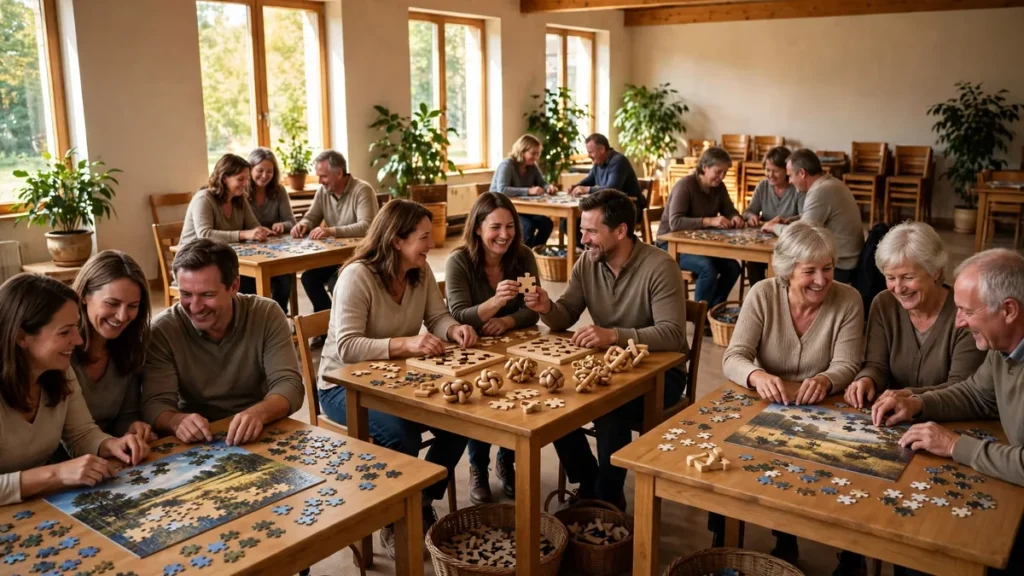
Finding the best puzzle games for 103 players starts with an honest fact: no single puzzle game seats 103 people around one table. A jigsaw puzzle, a crossword, a Sudoku grid, or a wooden brain teaser is built for one person or a small group, not a crowd of more than a hundred. That does not mean a puzzle night for 103 players is impossible; it means the format has to change, and once it does, puzzle games become one of the best large-group activities you can run.
The trick is to stop thinking of 103 players as one giant game and start thinking of them as many small teams playing at the same time. Split the room into teams of four to six, give every team the same puzzle, and suddenly you have a race. Add stations, relays, and a shared scoreboard, and the whole room is playing together even though nobody is crowded around a single table.
This guide covers the puzzle games that work best at that scale, the formats that keep 103 people engaged, and a practical plan for running the event without chaos. Every game below scales well, needs little equipment, and works in a hall, a school gym, or a big family reunion.
Key takeaways
- No single puzzle game seats 103 players, so the winning format is teams of four to six competing at the same time.
- Jigsaw races, crossword relays, and Sudoku tournaments are the easiest large-group puzzle formats to run.
- Every team needs an identical puzzle and a clear finish line, or the competition will feel unfair.
- A shared scoreboard and a host with a microphone keep a room of 103 players focused and excited.
- Plan for about 90 minutes, with short rounds, breaks between rounds, and a simple prize for the winning team.

Why Puzzle Games Work for 103 Players
Puzzle games have an advantage that most large-group games do not: they are quiet, focused, and easy to run in parallel. A room of 103 people playing a shouting game turns into noise within minutes, while a room solving puzzles hums with concentration. That energy is much easier for a host to manage, and it works for mixed ages in a way that physical games often do not.
Puzzles also level the playing field. Speed, strength, and loud confidence matter very little when the task is finishing a crossword or spotting the missing piece of a jigsaw. A ten-year-old can beat a grown adult at Sudoku, and a quiet team member can be the one who cracks the logic puzzle everyone else missed. Every team has a real chance to win.
The Team Format Is the Whole Secret
With 103 players, the maths of the room decides everything. Divide 103 by five and you get about twenty teams, with a few teams of six to cover the remainder. Twenty teams fit comfortably in a hall with twenty tables, and the host only needs to manage twenty teams, not 103 individuals, which makes scoring, timing, and announcements far simpler.
Teams of four to six are the sweet spot. Smaller teams leave people feeling exposed, while larger teams leave quieter players with nothing to do. Five is ideal: enough hands for a jigsaw, enough brains for a crossword, and small enough that everyone can see the puzzle.
What Makes a Puzzle Scale to 103 Players
Not every puzzle survives the jump to a huge group. A good large-group puzzle is cheap to duplicate, quick to explain, and easy to score. A 500-piece jigsaw costs a few dollars per copy, takes a team about thirty minutes, and has an obvious finish: the last piece.
The puzzles that fail at scale are the ones that need expensive equipment, long explanations, or subjective judging. A single giant puzzle that the whole room shares sounds fun but creates a bottleneck, with most people standing and watching. Keep the rules short enough to explain in one minute, and the scoring simple enough to do on a whiteboard.
The Best Puzzle Games for 103 Players
The games below are ranked by how well they work for a crowd of 103 players, not by how fun they are for two people on a sofa. Each one includes the format that makes it work at scale and how long a round takes. Mix three or four of them into a single event for the best results.
1. Jigsaw Puzzle Race
The jigsaw race is the simplest large-group puzzle game and the one most hosts start with. Buy twenty identical 500-piece jigsaw puzzles, one per team, and start the timer. The first team to finish wins the round, and because every team has the same puzzle, the race is fair.
Choose a puzzle with a clear, colourful image and distinct regions, such as a landscape with a sky, a building, and a garden. Avoid puzzles that are mostly one colour, since they frustrate teams and slow the race to a crawl. A 500-piece puzzle takes a team of five about twenty-five to thirty-five minutes; for a shorter event, use 300-piece puzzles. Keep a few spare puzzles on hand in case a piece goes missing.
2. Crossword Relay
A crossword relay turns a quiet solo activity into a team sprint. Print the same crossword for every team, and let teams work through it together for ten minutes. Score one point per correct answer, with a bonus for the first team to finish the whole grid. After five minutes, each team passes its crossword to the next table, so teams inherit a half-finished grid.
The pass keeps the energy high and stops any single team from running away with the round, and it forces teams to communicate instead of dividing the clues and working silently. Use a themed crossword that matches your event, such as general knowledge or movies, and print the grids large enough to read from across a table.
3. Sudoku Tournament
Sudoku is one of the best puzzle games for a large group because it is completely silent, perfectly fair, and easy to score. Print the same Sudoku grid for every team, and give teams fifteen minutes to solve it. Score by correct numbers, with a time bonus for the fastest complete grid.
Run the tournament in two rounds: an easy grid first, then a medium grid for the teams that qualify. Let teams split the grid into sections, with each player owning a row or a three-by-three box. For a mixed-age room, use grids with more starting numbers so younger players can contribute from the first minute.
4. Logic Puzzle Challenge
Logic puzzles, such as grid puzzles where teams work out who owns which pet or who sits in which seat, are ideal for team play because they reward discussion. One person reads clues aloud while others track possibilities on a grid. Print one logic puzzle per team and give fifteen minutes, with points for each correct row of the solution.
Choose puzzles with a clear story and about ten to twelve clues: too few and the puzzle is guesswork, too many and teams run out of time. Award partial points for each correct deduction so teams that do not finish still score, and read the solution aloud at the end.
5. Word Search Sprint
A word search sprint is the fastest round you can run, and it works brilliantly as an opener while latecomers are still arriving. Hand every team the same word search grid with twenty hidden words, and give them five minutes. One point per word found, with a bonus for the first team to find them all.
Word searches are also the most accessible puzzle on this list. Young children, older players, and anyone who struggles with numbers can all contribute, which makes the sprint a great equaliser at the start of the night. Use a large grid with a word list printed underneath, and pick a theme that fits your event.
6. Riddle Relay Race
A riddle relay adds movement and noise to a puzzle night, which is useful after two quiet rounds. Place a riddle card face down at the far end of the hall for each team. One player from each team runs to the card, reads the riddle, runs back, and the team solves it together. When the team has the answer, the next player runs for the next card.
The relay format keeps the whole room involved because the runner changes every round, and the team discussion between runs gives everyone a role. Choose riddles that take thirty seconds to two minutes to solve, and mix easy and hard ones so the lead changes hands. Keep the running distance short and the floor clear, and remind players to walk quickly rather than sprint. If your group enjoys this kind of challenge, the same relay structure works well with the board games that work for 103 players, where teams take turns at shared tables between puzzle rounds.
7. Puzzle Station Rotation
Station rotation is the format to use when you want variety without running every game for the whole room at once. Set up five or six stations around the hall: a jigsaw table, a crossword table, a Sudoku table, a wooden brain teaser table, and a tangram table. Each team spends ten minutes at a station, then rotates, earning points at every station.
Rotation solves the biggest problem of a 103-player event, which is that not everyone likes the same puzzle. A team that struggles with Sudoku may shine at tangrams, and a team that finds jigsaws slow may love the brain teasers. You need one volunteer per station to explain the puzzle and record scores, so this format works best when you have five or six helpers.
8. Giant Picture Puzzle Hunt
A picture puzzle hunt turns the whole venue into the game. Before the event, hide numbered puzzle pieces, clue cards, or picture fragments around the hall, the garden, or the building. Each team gets a list of locations to search and a puzzle to assemble from what they find.
This format works well outdoors or in a large venue with many rooms, and it is the best choice when your group includes children who need to move. Keep the search area safe and clearly bounded, and give every team a map so nobody gets lost. The puzzle itself can be a printed picture cut into pieces or a series of riddles that lead from one location to the next. Limit the hunt to twenty minutes so the evening stays on schedule.
Puzzle Games for 103 Players Compared
Use this table to pick the right mix for your event. Times assume teams of four to six players, and costs cover twenty teams, which is roughly what 103 players need.
| Game | Time per round | Cost for 20 teams | Best for | Energy level |
|---|---|---|---|---|
| Jigsaw puzzle race | 25 to 35 minutes | Moderate | The headline round | Calm and focused |
| Crossword relay | 10 minutes | Very low | Word lovers | Busy and chatty |
| Sudoku tournament | 15 minutes | Very low | Fair, silent scoring | Quiet and intense |
| Logic puzzle challenge | 15 minutes | Very low | Team discussion | Focused and social |
| Word search sprint | 5 minutes | Very low | Opening round | Fast and light |
| Riddle relay race | 15 minutes | Very low | Energy and movement | High and noisy |
| Puzzle station rotation | 60 minutes total | Moderate | Variety and choice | Steady and moving |
| Giant picture puzzle hunt | 20 minutes | Low | Outdoor venues | High and active |
How to Run a 103-Player Puzzle Event
A great puzzle night is mostly planning. The games themselves are simple; the work is in the room layout, the timing, and the scoring. Get those three right and the evening runs itself.
Setting Up the Room
Arrange twenty tables in rows with clear aisles between them, so the host can walk the room and teams can reach the scoreboard easily. Put a number card on every table so players can find their seats quickly. Place the puzzle for the first round face down on each table before anyone arrives, with pens and a scorecard beside it.
Sound matters more than decoration. A host with a microphone and a speaker can run a room of 103 people; a host without one will be shouting by the second round. Test the microphone before the doors open, and put the scoreboard where everyone can see it, with a countdown timer during each round.
Running the Tournament
Open with the word search sprint: it needs no explanation and gives latecomers a low-pressure way to join in. Follow it with the crossword relay, then the Sudoku tournament, and save the jigsaw race for the middle of the evening. Put the riddle relay after the jigsaw, when people need to stretch their legs, and finish with the logic puzzle challenge as a calm final round.
Keep rounds short and breaks shorter: ten minutes of puzzle, two minutes of scoring, and a one-minute break is a good rhythm. Announce the top five teams after every round, and read out one interesting moment, such as the fastest finish or the closest score.
Scoring That Feels Fair
Simple scoring beats clever scoring at this scale. Award points per correct answer, per finished puzzle, or per station completed, and add a small time bonus for the fastest team in each round. Write the running totals on the scoreboard after every round. Ties are common with 103 players, so decide your tiebreaker before the event and announce it in advance.
Have one scorekeeper who does nothing but collect scorecards and update the board, since the host cannot run the room and score twenty teams at the same time. Collect scorecards at the end of each round, check them quickly, and return them before the next round starts. If a team disputes a score, check the answer sheet together and move on. The same straightforward approach to fairness applies to other large gatherings, and it is worth reading how party games for 103 players handle scoring and team sizes, since the room logistics are almost identical.
Checklist for a 103-Player Puzzle Night
Work through this checklist the week before your event, and again on the day itself.
- Count your players and divide them into teams of four to six, with numbered table cards ready for each team.
- Buy or print identical puzzles for every team, plus two spare sets in case pieces go missing.
- Test the microphone, speaker, projector, and countdown timer before the doors open.
- Print a scorecard for each team and brief one scorekeeper who will update the board after every round.
- Prepare a tiebreaker question and announce it at the start so every team knows the rule.
- Bring a simple prize for the winning team, such as a small trophy, a box of puzzles, or a gift card.
Frequently Asked Questions
Can one puzzle game really seat 103 players?
No. No jigsaw, crossword, Sudoku, or board puzzle is designed for 103 people at a single table. The format that works is twenty teams of about five players each, all solving the same puzzle at the same time. The competition is real, the room is shared, and every player is involved, but the puzzle itself is always played at a normal table size.
How many teams should 103 players form?
Aim for twenty teams: seventeen teams of five and three teams of six. That gives you twenty teams with sizes of five or six, which is close enough that no team feels disadvantaged. If a few players drop out on the day, rebalance the teams before the first round rather than letting one team play short.
How long does a puzzle night for 103 players take?
Plan for about ninety minutes of play plus thirty minutes for arrival, team formation, and prizes, so two hours in total. Four rounds of ten to thirty minutes each, with short breaks between them, fill the time well. Do not stretch a single puzzle format beyond forty minutes or the room will lose energy.
What is the cheapest puzzle game for a huge group?
Printed puzzles are the cheapest by far. A crossword, a Sudoku grid, a word search, and a logic puzzle cost almost nothing per team once you have the files. A full evening of printed rounds for twenty teams costs less than a single round of store-bought jigsaws, which is why most large-group hosts start with paper puzzles and save the jigsaw race for one special round. Printed card games can fill the same low-cost role, and the card games for 103 players use the same team structure with decks that cost very little per table.
Do puzzle games work for mixed ages?
Yes, puzzles are one of the best mixed-age activities because they reward different skills. Younger players are often faster at word searches and spotting jigsaw pieces, while older players tend to be stronger at crosswords and logic puzzles. Mixed-age teams usually beat single-age teams because the skills balance out.
What equipment do I need for 103 players?
You need twenty tables, enough chairs for 103 people, a microphone and speaker, a whiteboard or projector for the scoreboard, and one identical puzzle set per team for each round. Add pens, printed scorecards, table number cards, and a timer. That is the whole list. You do not need special software or apps, and the event works just as well in a hall with no Wi-Fi as it does in a modern conference centre.
The Bottom Line
The best puzzle games for 103 players are not the biggest puzzles you can buy. They are the simplest puzzles, played by small teams, at the same time, in the same room, with a clear scoreboard and a host who keeps the rounds moving. A jigsaw race, a crossword relay, a Sudoku tournament, and a riddle relay will fill two hours, keep 103 people engaged, and cost very little. Set up twenty tables, print identical puzzles, and keep the rounds short.


